TL;DR: This daily Radar summarizes source-checked AI launch candidates for Kingy AI readers, with pricing notes, use cases, and human-review caveats where details are still emerging.
Launch Snapshot
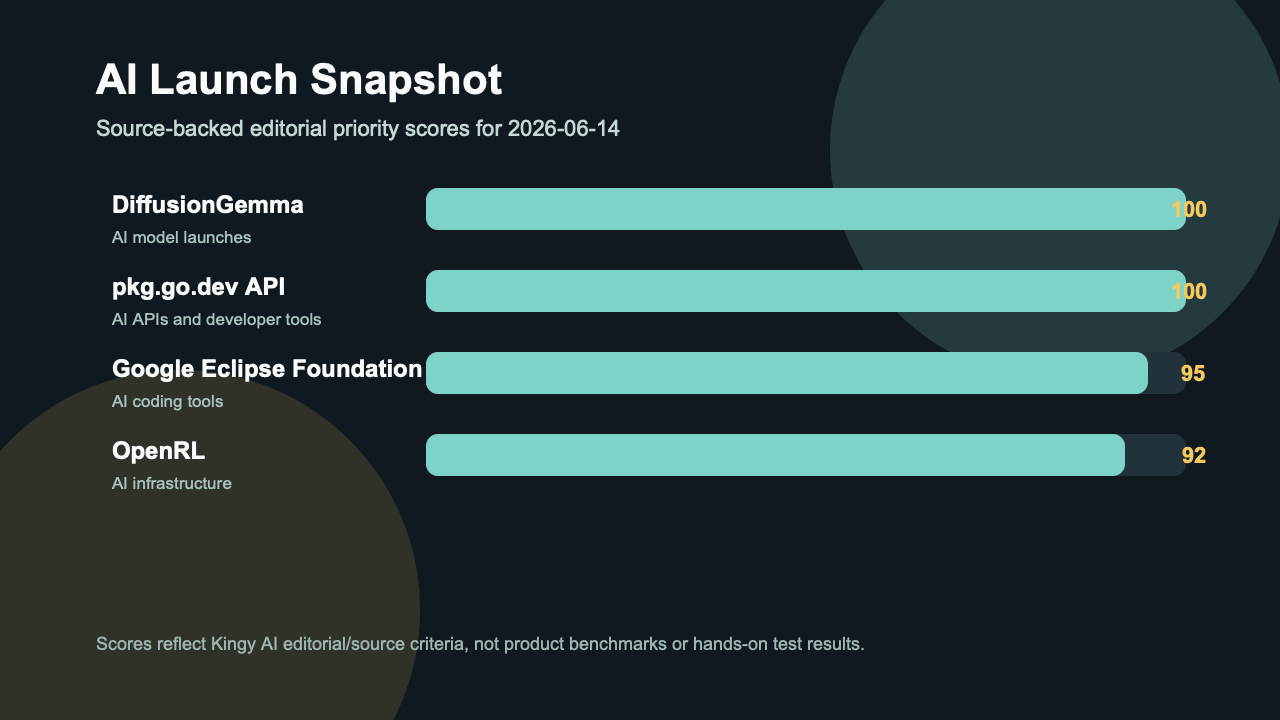
The snapshot below compares the strongest source-checked launches by Kingy AI score. It is a research-priority visual, not a benchmark chart or hands-on test result.
Strongest Launches
DiffusionGemma
DiffusionGemma is an experimental open-weight Gemma 4 model that generates text with discrete diffusion and parallel denoising instead of standard token-by-token autoregression.
Checked launch source, docs, GitHub repo, Hugging Face page for the current Radar entry.
Why it matters: Most language models still generate one token at a time, which makes serving memory-bandwidth-heavy and hard to accelerate locally. DiffusionGemma matters because it gives developers a practical way to test a non-autoregressive generation architecture inside a familiar open-weight model ecosystem.
Who should care: AI Platform Teams, AI Engineers, Developers, Researchers
For broader Kingy AI context, compare DiffusionGemma with other AI launch radar coverage and recent AI News before treating this as a standalone buying decision.
Pricing: The model weights are available on Hugging Face under an Apache 2.0 license. Google did not publish a separate model price for local use; hosted usage through Google Cloud, NVIDIA NIM, or other inference providers may carry infrastructure or provider costs. Confirm current pricing on the official pricing/source page.
What launched: Google published the DiffusionGemma developer guide on June 10, 2026 after its launch announcement, positioning the model as an experimental Gemma 4-based open-weight model for faster parallel text generation, bidirectional context handling, and local or self-hosted deployment. See the official launch source.
What feels promising: Most language models still generate one token at a time, which makes serving memory-bandwidth-heavy and hard to accelerate locally. DiffusionGemma matters because it gives developers a practical way to test a non-autoregressive generation architecture inside a familiar open-weight model ecosystem.
What feels unproven: [‘The architecture is experimental and may not fit ordinary chat or production use without careful evaluation’, “Google’s speed and quality claims are source-provided and should be benchmarked on the reader’s own hardware”, ‘Provider pricing varies when the model is served through hosted infrastructure’, ‘The best use cases for diffusion-based text generation are still emerging’]
pkg.go.dev API
The new pkg.go.dev API gives Go developers, IDEs, automated workflows, LLMs, and coding agents structured JSON access to Go package metadata.
Checked launch source, docs, GitHub repo for the current Radar entry.
Why it matters: AI coding agents are only as good as the code and dependency context they can retrieve. The pkg.go.dev API matters because it gives Go-based AI coding tools a more reliable official substrate for package search, dependency understanding, symbol inspection, and vulnerability-aware assistance.
Who should care: AI Platform Teams, AI App Builders, AI Engineers, Developers
For broader Kingy AI context, compare pkg.go.dev API with other AI launch radar coverage and recent AI News before treating this as a standalone buying decision.
Pricing: No paid pricing was announced. The public v1beta API is documented on pkg.go.dev and appears to be part of the public Go package discovery service; teams should still review usage, caching, and stability expectations before production dependence. Confirm current pricing on the official pricing/source page.
What launched: Google Open Source announced the pkg.go.dev API on June 12, 2026, adding v1beta GET endpoints for Go package, module, symbol, search, version, imported-by, and vulnerability metadata plus an OpenAPI contract and reference CLI. See the official launch source.
What feels promising: AI coding agents are only as good as the code and dependency context they can retrieve. The pkg.go.dev API matters because it gives Go-based AI coding tools a more reliable official substrate for package search, dependency understanding, symbol inspection, and vulnerability-aware assistance.
What feels unproven: [‘The API is currently v1beta and may evolve before v1’, ‘The release is AI-enabling developer infrastructure rather than a standalone AI model or app’, ‘Production users should design for caching, endpoint changes, and service limits’, ‘Its value for AI agents depends on how well tools integrate the metadata into retrieval and planning flows’]
Google Eclipse Foundation Strategic Membership
Google joined the Eclipse Foundation as a Strategic Member to support open infrastructure for AI-integrated developer platforms, including Open VSX and tools such as Google Antigravity.
Checked launch source, docs for the current Radar entry.
Why it matters: AI coding tools increasingly rely on open extension registries, compliance infrastructure, and shared developer tooling standards. This matters as a market signal, but it is better suited to tracker coverage than a standalone product article.
Who should care: AI Platform Teams, AI Engineers, Developers
For broader Kingy AI context, compare Google Eclipse Foundation Strategic Membership with other AI launch radar coverage and recent AI News before treating this as a standalone buying decision.
Pricing: No product pricing was announced because this is a foundation membership and sponsorship announcement, not a paid AI tool launch. Confirm current pricing on the official pricing/source page.
What launched: Google Open Source announced on June 10, 2026 that Google had joined the Eclipse Foundation as a Strategic Member and would sponsor Open VSX while supporting open infrastructure used by AI-integrated developer tools. See the official launch source.
What feels promising: AI coding tools increasingly rely on open extension registries, compliance infrastructure, and shared developer tooling standards. This matters as a market signal, but it is better suited to tracker coverage than a standalone product article.
What feels unproven: [‘This is not a direct product launch’, ‘Impact on developers depends on future Eclipse Foundation and Open VSX work’, ‘It should not be treated as a buyer-ready AI tool’]
OpenRL
OpenRL is a research-preview open-source API for running LLM fine-tuning and reinforcement-learning post-training on self-hosted Kubernetes or local infrastructure.
Checked launch source, docs, GitHub repo for the current Radar entry.
Why it matters: Agentic reinforcement learning and post-training are becoming infrastructure-heavy. OpenRL matters because it gives teams a self-hosted path for experimenting with post-training APIs instead of coupling every research loop directly to a managed platform or hand-rolled GPU orchestration stack.
Who should care: AI Platform Teams, AI Engineers, Developers, Researchers
For broader Kingy AI context, compare OpenRL with other AI launch radar coverage and recent AI News before treating this as a standalone buying decision.
Pricing: OpenRL is an open-source Apache 2.0 project. No managed-service price was published; users should expect their own compute, Kubernetes, GPU, cloud, and engineering costs when running it. Confirm current pricing on the official pricing/source page.
What launched: Google Open Source announced OpenRL on June 11, 2026 as a GKE Labs research preview for a self-hosted training API that lets teams fine-tune LLMs on their own Kubernetes clusters or machines. See the official launch source.
What feels promising: Agentic reinforcement learning and post-training are becoming infrastructure-heavy. OpenRL matters because it gives teams a self-hosted path for experimenting with post-training APIs instead of coupling every research loop directly to a managed platform or hand-rolled GPU orchestration stack.
What feels unproven: [‘OpenRL is a research preview and not an officially supported Google product’, ‘The project currently focuses on LoRA fine-tuning and plans broader functionality later’, ‘Teams still need Kubernetes, GPU, and ML operations expertise’, ‘No managed service, SLA, or production support commitment was verified’]
Related Kingy AI Links
For more launch tracking and founder resources, see AI Launches, AI Tools, and the AI News archive. Founders can also use the AI Sponsored Video ROI Calculator.
Sponsor path
Sponsor Kingy AI launch coverage
Launching an AI product that needs clear demos, creator education, and buyer trust? Sponsor a Kingy AI video or launch feature.
The Kingy Brief
Get the next Kingy Brief.
Source-checked AI changes, original tests and one practical thing to try.
Free · Choose your subjects · Double opt-in · Unsubscribe anytime