Kingy Video Test
I Let Dreamina Octo World Build My Creative Vision | Vibe Creation
Disclosure: Dreamina paid Kingy for this sponsored video and provided non-public account access. The campaign link could not earn commission. Dreamina did not provide generation credits or review or approve the video before release. The differentiator is not another image generator. It is whether one canvas can preserve creative direction while the character, world, storyboard, and shots evolve together.
Disclosure: this video was sponsored.
Video published June 9, 2026. The snapshot records below are tied to that publication date; their latest verification date is July 28, 2026. Live data is labeled separately and updates from current KALI records.
Watch it. Try it. · Dreamina shot planner
Plan the story. Leave with the shots.
Describe the premise and continuity anchors. Generate five editable shots, then export the plan for Dreamina or another image-to-video workflow.
Watch the workflow on this pageRuns in this browser. Your inputs are not sent or saved.
Video
Full evidence
Useful next step
Download the Dreamina production pack
Want the exact prompts, shots, and asset lineage behind Octo World? Download the verified production pack, then use the dated evidence on this page to separate the demonstrated connected-canvas workflow from current product claims.
Verified Dreamina prompt, shot, and asset-lineage production-pack ZIP.
Dreamina Octo’s real advantage is not the word “agent.” It is the connected canvas: the character, voice, locations, props, storyboard and shots stay visible and reusable while the story changes.
Verdict: try it for connected previsualization; do not standardize on it yet
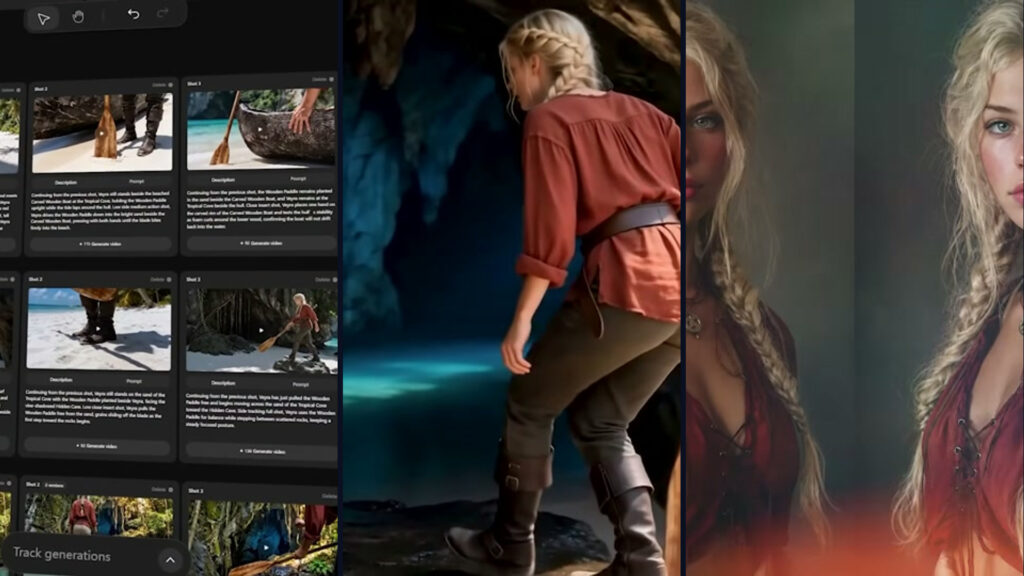
Dreamina Octo is worth trying when an AI-video process keeps losing continuity between a character, environment, storyboard and final shots. Curtis’s test shows why the canvas matters: one pirate portrait becomes a voice, full-body references, environment plates, named objects, a five-scene storyboard and a short cinematic sequence.
The result does not establish the same quality for every project, account or model version. Octo remains a gradually rolled-out closed beta with no stable public rate card. That makes it suitable for exploration and previsualization—not yet a safe production dependency for teams needing guaranteed access, predictable cost, versioned approvals, an API or settled enterprise controls.
Best for: solo filmmakers, AI-video creators, concept artists and small teams developing character-led stories across connected scenes. Skip it for now: if procurement-ready pricing, repeatable batch output, client-grade provenance or guaranteed access is non-negotiable.
Useful chapters
- 00:00 — The connected-canvas premise
- 00:43 — Open Dreamina Octo
- 00:58 — Upload the source character
- 01:38 — Refine the voice and personality with the agent
- 02:07 — Generate consistent full-body references
- 02:57 — Add 16:9 environment plates and choose a story direction
- 03:37 — Build the five-scene storyboard
- 04:24 — Generate clips for each scene
- 06:02 — Final sequence and workflow verdict
What Curtis tested versus what Dreamina says
Demonstrated in the recorded workflow
- Curtis opened Octo from Dreamina and uploaded a portrait of a pirate character.
- He added an audio node, selected text-to-speech, chose Eleven v2 and used the first voice option shown. The voice name was not visible.
- He entered a short commander line, listened, then asked Octo for a stronger pirate-era voice and a longer line.
- He requested several full-body images while asking for character consistency.
- He generated 16:9 environment-only images based on the established locations.
- He selected a bright tropical cove and asked Octo to lead the character, Veyra, toward treasure in a hidden cave.
- Octo produced a project called “Cove Gold,” a four-act structure, reusable references and five scene cards.
- Curtis used “Create storyboard,” expanded scenes by clips, selected favourite shots and assembled a connected short.
The visible graph named @Veyra, @Treasure Chest, @Wooden Paddle, @Carved Wooden Boat, @Tropical Cove and @Hidden Cave. Reusing those named references across shot prompts is the strongest evidence in the video.
Officially sourced, not independently retested
- Dreamina currently describes Octo as a collaborative agent, multimodal canvas and connected character/object/environment/scene workflow.
- Dreamina’s current material names Seedream 5.0 Lite and GPT Image 2 for image work and Seedance 2.0 in the connected Octo scene workflow.
- Dreamina says access remains a gradual closed-beta rollout and the beta is free before official pricing begins.
Not established by the video
The recording does not establish total generations, rejected shots, elapsed time, export resolution, frame rate, watermark state, cost per usable shot, repeatability, enterprise controls, API access or the editing tool used for the final stitch. It also does not establish the provenance, consent or commercial-use status of the source portrait, voices or outputs. Those remain release-gate questions.
Exact workflow and settings
1. Start with a rights-cleared character
Upload one source image and record its owner, origin, consent status and permitted use before generating. The filmed portrait is not included in the download because its licence was not established in the reviewed evidence.
2. Create one simple voice reference
- Node: Audio
- Mode: Text to speech
- Model visible on screen: Eleven v2
- Voice: first option shown; name not visible
- Starter line: “I’m the commander of this ship…”
- Seed, stability, similarity and style: not shown
Confirm the agent can see both the portrait and audio node before expanding the brief. One small reference makes continuity failures easier to diagnose than a twenty-shot opening request.
3. Build reusable character and location references
Create four full-body reference images of @Veyra while preserving her face, hair, age, red-and-beige wardrobe language and overall silhouette. Vary pose and camera angle, not identity. Do not add new characters, logos or text.Using the locations already established on this canvas, create clean 16:9 environment plates for @Tropical Cove and @Hidden Cave. Exclude @Veyra and all other people. Preserve geography, light direction and colour continuity so these can be reused as scene references.4. Choose one narrow story path
Curtis chose the bright cove and hidden-cave direction before spending credits across unrelated settings. He asked Octo to lead Veyra from arrival toward the treasure, which became a four-act, five-scene board.
5. Create scenes, then clips
Each scene card carried a key visual, interior/exterior and day/night label, environment description, character action and a “Create storyboard” control. The by-clips route expanded each scene into individual shots. The visible per-shot credits are account-state evidence, not a public dollar price.
Continue from the approved previous shot. Use @Veyra, @Tropical Cove, @Carved Wooden Boat and @Wooden Paddle. Wide 16:9 establishing view, consistent late-afternoon light, same wardrobe and facial identity. Veyra beaches the boat, steps onto the sand and plants the paddle. Do not redesign props or geography.6. Review lineage before assembly
For every generated shot, record the input references, prompt version, model label, credit cost, output ID, approval state and scene position. The download supplies this ledger. It turns continuity from a vague visual hope into an auditable production decision.
What changed after filming
The June video identifies Seedance 2.0, and the visible voice selector says Eleven v2. By July 28, Dreamina’s public Octo page also promoted Seedance 2.5 and linked to claims about up to 30-second continuous scenes, richer multimodal references and more precise editing.
That does not prove Curtis’s project was recreated on 2.5 or that every Octo account can use it. Dreamina’s current connected-workflow description still names Seedance 2.0. The defensible update is that Dreamina’s model surface expanded after filming while the demonstrated project remains a Seedance 2.0 test.
The access story did not graduate: Octo is still described as a closed beta with gradual rollout and no official paid rate card.
Current pricing and access — checked July 28, 2026
- Access: closed beta with gradual account rollout through the Dreamina homepage or Canvas workspace.
- Octo beta price: officially described as free before paid pricing is introduced.
- General Dreamina access: free daily credits are advertised.
- Stable paid Octo rate card: not published in the official sources reviewed.
The 36.8K–39K balance and per-shot credit values visible in Curtis’s account are not public plan pricing. They should not be converted into dollars or promised to another user.
Download the Dreamina Octo prompt, shot and asset-lineage pack
The pack contains a rights-first brief, staged prompt sequence, five-scene shot list, asset-lineage ledger, claims/evidence log and continuity/export QA checklist. It includes no proprietary output or unverified reference image.
Download the free Dreamina Octo production pack
Official sources and method
- Curtis Pyke’s Dreamina Octo video — visible workflow, settings, outputs and paid-promotion label.
- Dreamina Octo overview — current workflow, model references and Seedance 2.5 update.
- Dreamina Octo official review — closed-beta and gradual-access status.
- Dreamina AI-native creative system — beta price statement and connected asset workflow.
- Dreamina homepage — current model menu and free daily credits.
YouTube labels the video as including paid promotion. The page uses Curtis’s public footage for hands-on evidence and official Dreamina sources for current product, price and access claims. The original project and account were not available for an independent rerun.
Try it and keep the page current
- Try Dreamina Octo
- Kingy’s earlier Dreamina review
- Kingy’s Seedance 2.0 reporting
- Current Kingy AI video-generator guide
The Kingy Brief
Follow The Kingy Brief.
One consequential launch, one pricing, limit, or shutdown change, one hands-on test, one exact prompt or Test Pack, and one try / watch / skip verdict.
Free · Choose your subjects · Double opt-in · Unsubscribe anytime
Keep checking the evidence
Current Product Facts
These links resolve only to approved public Product Facts records. Unresolved records are omitted.
As of publication
These values come only from the verified, write-once snapshot stored for this video. Current tool values are never substituted here.
Dreamina: Octo workflow, closed-beta access and evaluation guide
- Pricing at publication
- Historical Status: Not established by the filmed evidence; no June 9 public Octo rate card was verified; Account Evidence: Visible account credits were not treated as plan pricing.
- Features at publication
- Filmed Workflow: Portrait reference to Eleven v2 voice, full-body references, 16:9 environments, a four-act/five-scene storyboard, then short generation using Seedance 2.0; Evidence Limit: One paid-promotion demo; repeatability, API access and production rights were not established.
Historical record date: June 9, 2026. Snapshot verification date: July 28, 2026.
Live now
These modules read the current KALI tool records. Their verification dates are current-record dates, not historical evidence.
Dreamina: Octo workflow, closed-beta access and evaluation guide
Current pricing
- Pricing
- Dreamina invites users to try its creative tools free and says no credit card is required, but Octo remains in closed beta with gradual account rollout. Kingy found no stable public Octo rate card. Treat access, credits, model costs and export limits as account-specific until Dreamina publishes durable commercial terms.
- Free plan
- Yes
Current record verification date: July 29, 2026. This identifies the current record only; it is not historical evidence.
Current feature summary
- What it does
- Dreamina combines AI image and video creation in a browser workspace. Its Octo closed beta is documented as connecting conversational planning, contextual canvas state, image operations, video generation, timeline editing and export.
- Best for
- Creators, filmmakers, designers and AI artists evaluating short-form reference-driven visual workflows with human continuity, rights and export review.
- API
- No
- Open source/open weight
- No
Current record verification date: July 29, 2026. This identifies the current record only; it is not historical evidence.
Verification & Sources
- Evidence state
- Recheck due
- Sources
- 4 sources
- Freshness
- Needs recheck: checked July 29, 2026
- Last verified
- July 29, 2026
- Last updated
- July 29, 2026
What this evidence state means
- Definition
- The claim was previously checked, but its review window expired or a material change may have invalidated it.
- Required provenance
- The prior evidence and check date are retained, together with the expiry or change signal that triggered recheck.
- Owner
- Kingy freshness queue owner and assigned editorial reviewer
- Freshness rule
- This is already outside its freshness rule. It must not be presented as current until reviewed against current evidence.
- Disputes and corrections
- Use “Suggest a correction” on the record. Kingy editorial reviews the cited evidence, records material corrections, and changes or removes the state when it is not supported.
Key source checks
Suggest a correction
What's changed since this video
Compare the verified publication snapshot with the current KALI record. This side-by-side view does not claim changes that the evidence cannot verify.
Dreamina: Octo workflow, closed-beta access and evaluation guide
At publication
Dreamina: Octo workflow, closed-beta access and evaluation guide
- Pricing at publication
- Historical Status: Not established by the filmed evidence; no June 9 public Octo rate card was verified; Account Evidence: Visible account credits were not treated as plan pricing.
- Features at publication
- Filmed Workflow: Portrait reference to Eleven v2 voice, full-body references, 16:9 environments, a four-act/five-scene storyboard, then short generation using Seedance 2.0; Evidence Limit: One paid-promotion demo; repeatability, API access and production rights were not established.
Historical record date: June 9, 2026. Snapshot verification date: July 28, 2026.
Current record
Current pricing
- Pricing
- Dreamina invites users to try its creative tools free and says no credit card is required, but Octo remains in closed beta with gradual account rollout. Kingy found no stable public Octo rate card. Treat access, credits, model costs and export limits as account-specific until Dreamina publishes durable commercial terms.
- Free plan
- Yes
Current record verification date: July 29, 2026. This identifies the current record only; it is not historical evidence.
Current feature summary
- What it does
- Dreamina combines AI image and video creation in a browser workspace. Its Octo closed beta is documented as connecting conversational planning, contextual canvas state, image operations, video generation, timeline editing and export.
- Best for
- Creators, filmmakers, designers and AI artists evaluating short-form reference-driven visual workflows with human continuity, rights and export review.
- API
- No
- Open source/open weight
- No
Current record verification date: July 29, 2026. This identifies the current record only; it is not historical evidence.
Canonical tool guides
Use the canonical tool, pricing, and comparison pages for the latest entity-level guidance.