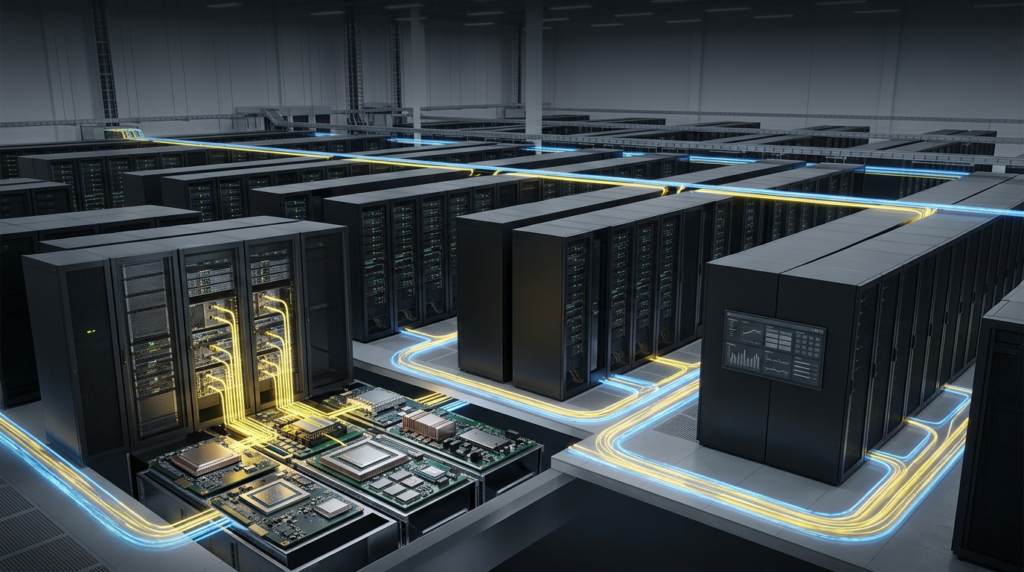
The AI Race Has a Traffic Problem
The AI industry loves a powerful chip, but a data center needs more than a collection of processors.
Those processors must exchange information without spending too much time waiting for one another.
Think of a brilliant kitchen where every chef shares one narrow doorway.
Buying more chefs will not necessarily make dinner arrive sooner.
On October 8, 2026, Nvidia-backed Upscale introduced Token Fabric, a networking platform aimed at infrastructure using accelerators from different suppliers.
The proposal combines hardware and software around a practical goal: make the network less of an obstacle to useful computation.
That could give operators more flexibility when choosing hardware and a more coherent way to manage its connections.
But the important story is how the pieces fit together, rather than the suggestion that a single networking announcement has solved every compatibility problem.
Token Fabric Is Infrastructure, Not a Chatbot
Despite its name, Token Fabric is not a new language model or a cryptocurrency project.
It is Upscale’s proposed networking foundation for AI systems.
The company’s announcement combines connections within accelerator groups, connections across a data center, and shared operational software.
The word “fabric” describes the interconnected network supporting those systems.
Imagine running a delivery operation with separate teams controlling local streets and major highways.
Each team might do its own job well while the overall journey remains painfully awkward.
A shared operational view could make the handoffs easier to understand and manage.
That is the broad idea behind integration here.
It does not remove the need for careful engineering at each layer.
Instead, it aims to reduce the burden of stitching those layers together and keeping them working consistently as a larger system.
Scale-Up Handles the Close Cooperation
Scale-up networking connects accelerators in a tightly coupled group, such as a rack-scale system or computing pod.
The emphasis is on fast, predictable communication between components working closely together.
Upscale positions its SkyFabriX technology in this part of the architecture.
Its scale-up product page describes a design intended to reduce communication bottlenecks across accelerators, memory, and storage.
For a plain-language example, imagine several people assembling different parts of the same intricate object.
They need frequent coordination, not just a place to drop off the finished pieces.
A delay in exchanging information can interrupt the group’s progress.
That is why adding compute capacity and improving communication are different engineering jobs.
The productive outcome would be hardware spending more time doing useful work and less time waiting.
How much improvement a particular installation achieves depends on its workload, configuration, and the bottlenecks it actually has.
Scale-Out Connects the Wider System
Scale-out networking connects computing systems and accelerator groups across the data center.
Upscale’s approach uses systems built around Nvidia Spectrum-X Ethernet technology.
Nvidia describes Spectrum-X as an Ethernet platform designed for AI networking.
This part of the architecture addresses the wider movement of information, beyond the tightly coupled group discussed earlier.
Return to the kitchen analogy, and scale-out is closer to coordinating several kitchens than passing ingredients between neighboring chefs.
Both kinds of communication matter, but they operate at different boundaries.
Upscale’s argument is that customers should not have to treat those boundaries as unrelated operational worlds.
Its scale-out product page also identifies a network operating system built on SONiC.
The practical question is whether the combined arrangement makes deployment and troubleshooting more manageable.
A broad network can look elegant in a diagram while remaining difficult to operate, so the usefulness of that integration must show up in everyday infrastructure work.
Mixed Chips Need More Than a Connection
The headline attraction is support for heterogeneous infrastructure, meaning an environment containing different kinds of accelerators.
That could help operators choose hardware around particular needs rather than organize every decision around one supplier.
However, networking interoperability should not be confused with universal software compatibility.
Two processors connected to the same network do not automatically run the same applications or cooperate efficiently on every job.
Their software stacks, supported operations, memory behavior, and workload scheduling still matter.
Think of connecting two offices by telephone.
The connection enables communication, but it does not guarantee that their teams use the same procedures or understand every instruction identically.
Token Fabric addresses the connection and operational infrastructure portion of that challenge.
The distinction makes the announcement more useful to understand.
It points toward greater flexibility without requiring the much larger assumption that any collection of chips becomes interchangeable the moment a cable is attached.
Open Standards Give Choice a Foundation
Upscale’s announcement identifies support for open networking standards, including Ethernet for Scale-Up Networking, or ESUN.
The Open Compute Project describes ESUN as a workstream developing Ethernet approaches for scale-up environments.
That wider effort matters because interoperability needs shared technical expectations, not just a vendor’s declaration that its platform is open.
Standards give different organizations a foundation on which to build compatible components.
They also create something more concrete to evaluate than a marketing adjective.
Still, “open” can describe several different things.
An open standard does not automatically mean free hardware, unrestricted implementation rights for every component, or an entirely open-source commercial product.
Customers must examine the actual specifications, licenses, supported configurations, and validation results.
The potential benefit is a broader set of workable choices.
The test is whether those choices remain practical when systems are deployed, maintained, and expanded, rather than existing only on a compatibility slide.
Nvidia Has More Than One Role
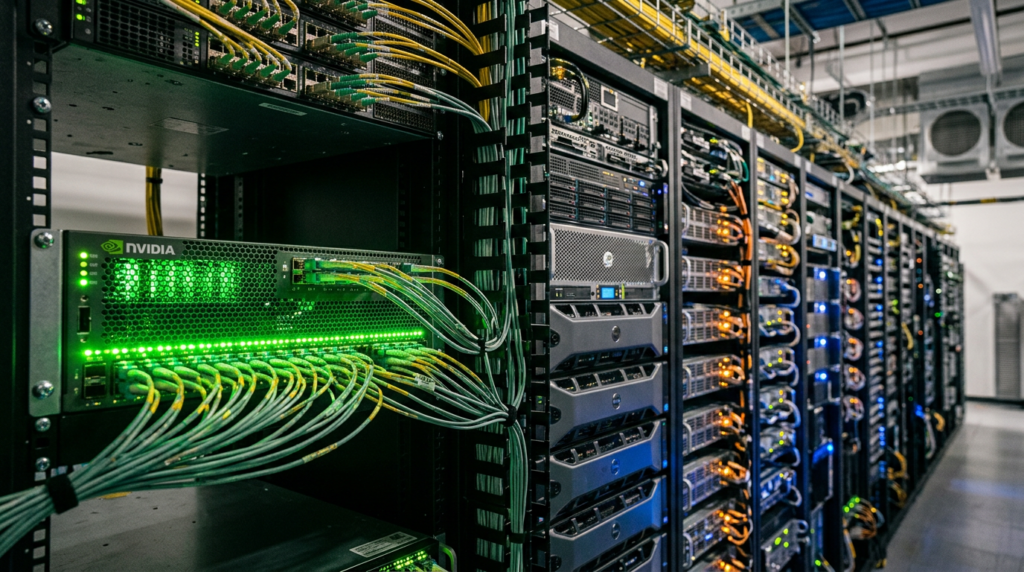
Nvidia’s involvement makes the story especially interesting.
Reuters identifies the company as an Upscale backer, while Upscale’s technical portfolio uses Spectrum-X for scale-out systems.
That gives Nvidia both an investment connection and a technology role in the announcement.
It would be simplistic to describe Token Fabric as a platform designed merely to push Nvidia aside.
The architecture’s pitch includes heterogeneous accelerators while incorporating Nvidia networking technology.
This suggests that a broader accelerator ecosystem and an important networking business can coexist.
That is an interpretation of the commercial arrangement, not a statement of Nvidia’s undisclosed strategy.
For buyers, the more useful question is how the complete system performs with the hardware they intend to use.
Supplier relationships are relevant context, but they cannot replace compatibility testing.
An investor list may make a launch more credible; it does not turn every proposed integration into a proven deployment.
Software Is Supposed to Hold It Together
Upscale names SkyOS as the shared network operating system and SkyCMD as its orchestration and observability layer.
Together, they are intended to provide a consistent operational foundation across scale-up and scale-out networking.
That may sound less exciting than a new chip, but it addresses a familiar source of complexity.
Hardware needs configuration, monitoring, and a workable way to respond when something goes wrong.
A unified view could help an operator follow a problem across boundaries instead of jumping between unrelated tools.
The benefit would come from clearer relationships between symptoms and causes.
For example, slow application behavior might require checking the path carrying its traffic, rather than assuming the processor is insufficient.
Shared management does not automatically make troubleshooting effortless.
It needs accurate information, understandable controls, and predictable behavior.
Those qualities determine whether an integrated platform simplifies the job or merely gathers the complexity into one larger dashboard.
AI Operations Need Useful Visibility
Upscale describes SkyCMD as agent-native, bringing automated reasoning and action into network operations.
Network World’s interview with CEO Barun Kar discusses agents looking for congestion and potential cable or optical-component failures.
These are described capabilities and ambitions, not independently established reliability results.
The operational attraction is easy to understand.
A problem detected early may be easier to address than one discovered after applications slow down or stop.
But an alert is valuable only when it is accurate enough to guide useful action.
Too many false alarms can make a sophisticated monitoring system feel like a smoke detector that panics whenever somebody makes toast.
Operators would also need to understand what an automated action changes and how to reverse it.
The promising direction is better visibility paired with controlled responses.
The practical outcome depends on whether the software helps distinguish a developing problem from ordinary variation in a busy system.
Tokens Put the Focus on Useful Output
Network World reports that Kar emphasizes measures including time to first token, tokens per second, tokens per dollar, and tokens per watt.
For generative AI, tokens are units of content handled by the model, rather than a networking currency.
These measures connect infrastructure discussion to the service somebody experiences.
How long does an answer take to begin?
How quickly does it continue?
What does delivering it cost?
That framing can help explain why faster networking is valuable, but it needs careful comparison.
Output depends on the model, hardware, request, and serving configuration, as well as the network.
A token figure without those conditions can conceal more than it reveals.
The sensible aim is to improve useful output under a defined workload.
Otherwise, comparing systems can resemble comparing restaurant speed while ignoring that one kitchen serves sandwiches and the other prepares a twelve-course tasting menu.
Better Utilization Could Improve the Economics
The financial appeal is less idle time for expensive infrastructure.
If networking is limiting a particular workload, improving communication could help the existing compute resources deliver more work.
Consider a hypothetical system that spends part of its operating time waiting for required data.
Reducing that waiting could improve throughput without adding the same proportion of new processors.
But the operator would still need to account for the network upgrade’s purchase price, integration effort, power requirements, and support costs.
The useful comparison is the whole deployment before and after the change.
A stronger network cannot remove a bottleneck located elsewhere.
This is why utilization should be measured alongside actual workload output.
The goal is more useful work for the resources committed, rather than a dashboard that looks busier while the end user notices little difference.
Customers Can Choose How Much to Adopt
Upscale’s announcement describes several purchasing approaches, from the full stack to systems or silicon used with a customer’s own software.
That recognizes an important difference between infrastructure buyers.
Some want a more integrated package because they have limited resources for assembling and maintaining separate layers.
Others already have substantial engineering teams and established operational practices.
For them, control over specific components may matter more than adopting a complete environment.
It also creates questions about responsibility.
Who validates the chosen combination?
Who supports an issue crossing component boundaries?
What happens when software or hardware changes?
Those questions should become clear during the buying process.
A modular offer is most useful when its support arrangements are understandable, because freedom to choose components should not leave customers wondering which supplier owns a problem when the integrated system misbehaves.
The Rollout Is Still Ahead
The announcement does not mean every part of Token Fabric is generally available today.
Reuters reports a first component planned for the fourth quarter of 2026, followed by a staged platform rollout through 2027.
Upscale’s release separately says general availability is planned for early 2027, with early-access and joint-validation programs already underway.
A customer evaluating the system needs a component-specific schedule, not a single date treated as a promise covering everything.
Validation also matters before making broad performance claims.
Useful evidence would show the accelerator combinations tested, the workload, the configuration, and the results against an appropriate baseline.
It should distinguish delivered capabilities from future targets.
That approach lets buyers assess progress without confusing a promising roadmap with a finished installation.
The next chapter will be shaped by deployment evidence, not simply the ambition of the launch.
A Less Fragmented Future for AI Infrastructure
Token Fabric’s positive contribution is a coherent attempt to make heterogeneous AI infrastructure easier to connect and operate.
The opportunity reaches beyond another impressive networking specification.
It is about giving operators more workable choices while reducing the effort needed to manage the connections between them.
That could matter for organizations seeking specialized hardware, expanding existing capacity, or avoiding unnecessary dependence on one configuration.
The outcome remains conditional on implementation, compatibility, and performance under real workloads.
But the underlying problem is concrete and worth addressing.
Buying powerful processors is only part of building a useful AI system.
The information must move, the components must coordinate, and somebody must keep the whole arrangement running.
If Upscale delivers on that practical work, Token Fabric could help turn an impressive collection of hardware into a more productive system.
Even the smartest chefs, after all, still need a kitchen where they can move.
SOURCES
- Upscale — Upscale Introduces Token Fabric, the Industry’s Most Comprehensive Standards-Based Networking Portfolio for AI Factories (upscale.com)
- Upscale — Scale Up (Upscale)
- Upscale — Scale Out (Upscale)
- Reuters — Nvidia-backed Upscale AI launches platform to connect chips from rival suppliers (reuters.com)
- Network World — Nvidia-backed Upscale takes on AI networking silos with Token Fabric (Network World)
- Nvidia — NVIDIA Spectrum-X Ethernet Networking Platform (nvidia.com)
- Nvidia — What Are AI Tokens? The Language and Currency Powering Modern AI (NVIDIA Blog)
- Open Compute Project — Ethernet for Scale-up Networking (Open Compute Project)
The Kingy Brief
Get The Kingy Brief.
AI changes, original tests and one practical thing to try. Fridays at 09:00 Vancouver time.
Free · Double opt-in · Unsubscribe anytime
Signup help and newsletter schedule
Signup form provided by Beehiiv. After submitting, check your inbox for "Confirm your subscription to The Kingy Brief" and open its confirmation link. Check Spam or Promotions if you cannot find it.
Fridays at 09:00 Vancouver time: source-checked AI changes, original tests and one practical thing to try. The weekly restart begins October 9, 2026. We skip a week when there is not enough verified material. Free. Unsubscribe anytime.