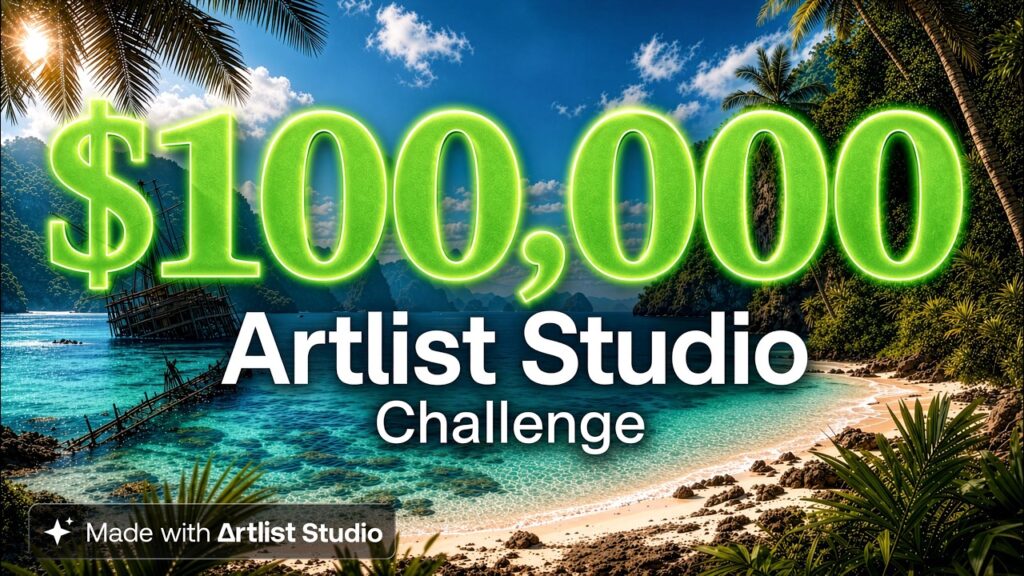
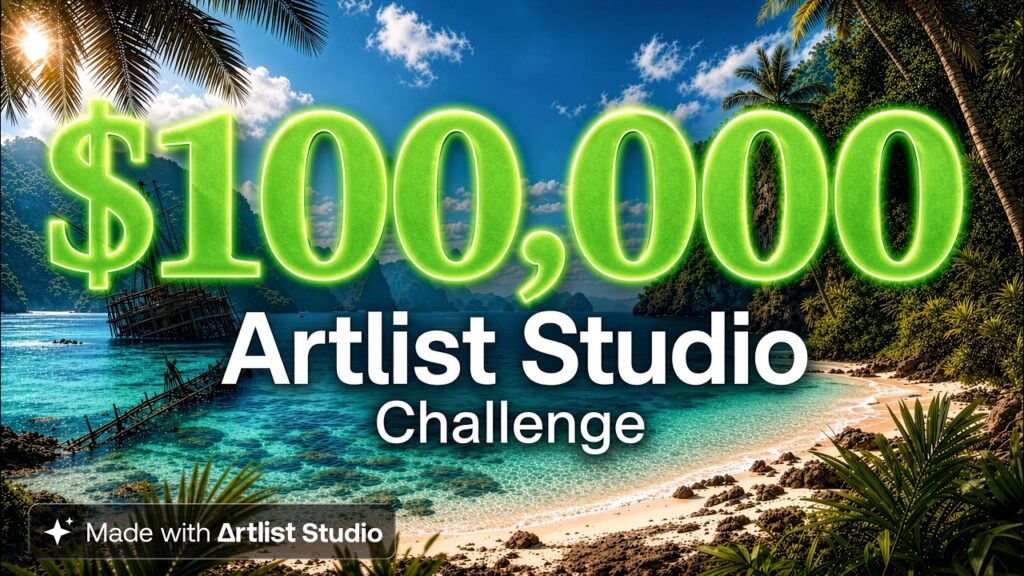
The creative landscape has never been more competitive — or more rewarding — for filmmakers, AI artists, and independent storytellers. In a bold move that underscores how rapidly AI-powered production tools are reshaping the industry, Artlist announced in May 2026 the Artlist Studio Challenge 2026, a global contest advertising $100,000 USD in production funding for one winner and AI credits for up to ten finalists.
Highlighted in a recent breakdown by Kingy AI — an official Artlist brand ambassador — the challenge represents not just another flashy marketing campaign, but a genuine attempt to fund the next generation of cinematic talent. Entries are now closed. The official contest pages say submissions are closed. The rules below describe the original round, not an invitation to submit a new entry.
A Big-Money Contest from a Brand That Knows the Game
Artlist is no stranger to high-stakes creative competitions. The platform has built its reputation over the past decade as one of the go-to destinations for royalty-free music, sound effects, stock footage, and creator tools. But with the launch of Artlist Studio, the company has expanded well beyond licensing — pivoting into a full-fledged AI-powered production suite that lets creators generate characters, environments, scenes, and entire trailers from within a single integrated platform. As Kingy AI explored in its recent deep-dive on Artlist’s pivot, this represents a fundamental shift from Artlist’s older identity as primarily a stock music company into something much closer to an end-to-end studio for the AI era.
The original challenge invited creators to make a cinematic trailer of at least 30 seconds for an original film or series using Artlist Studio. One selected winner could receive $100,000 USD in production funding. A trailer was an application to a judged competition, not a promise of funding.
The premise was to demonstrate a creative concept in a trailer and compete for support. The first submission round has ended.
How the Challenge Works: Three Simple Steps
The structure of the contest, outlined on the official Artlist blog, is refreshingly straightforward and broken down into three clearly defined steps.
Step 1: Dream and Create. The original round required a cinematic trailer of at least 30 seconds for an original film or series using Artlist Studio, with the official watermark. The landing page says applicants had to be over 18, use an Artlist subscription, and submit only one application per person, team, or company. Multiple applications could be disqualified.
Step 2: Submit and Share — historical rules. Entries were due through the official submission landing page by May 25, 2026, 11:59pm EDT. The rules required posting the trailer to Instagram, TikTok, or YouTube, tagging @Artlist.io and using #ArtlistStudioChallenge. Both official pages now say submissions are closed; the landing page says late applications are ineligible.
Step 3: Judging and Support. Artlist’s contest announcement video is retained as historical background. The official written rules describe up to ten finalists receiving 5 million AI credits per month for a year, which the landing page valued at approximately $28,000 per finalist. The blog requires a finalist pilot of at least two minutes. One winner is to receive $100,000 USD in production funding; the landing page says this is paid in installments according to project progress and needs and may be subject to tax deductions.
At Artlist’s approximate valuation, ten credit awards would total about $280,000 in credit value. Together with the advertised $100,000 production award, that is about $380,000 in mixed advertised value if all ten finalist awards are made. It is not more than $380,000 in cash or proof that those awards have been paid.
The Cinematic Showcase: “The Uncontacted”
To demonstrate what’s actually possible within Artlist Studio, the Kingy AI video walks viewers through a complete sample entry titled “The Uncontacted.” The trailer opens with sweeping cinematic shots of a biplane soaring over tropical islands, transitions into the haunting imagery of a shipwreck, and introduces a stranded woman named Moon as she navigates an increasingly mysterious and dangerous jungle. The piece carries the polished feel of a Hollywood streaming-service trailer, complete with a stylized title card and a “Coming Summer 2026” release date.
What makes the demonstration so compelling is the confirmation that every visual element was created entirely within Artlist Studio — from the framing of individual shots, to AI video generation, to special effects and music. There were no external cameras, no traditional VFX pipelines, and no third-party music licensing. The entire production existed within one ecosystem — exactly the kind of consolidated workflow Kingy AI demonstrated in its earlier guide to building a complete cinematic marketing video using only Artlist.
For aspiring filmmakers who have historically been gated out of high-end production by budget constraints, this is a fundamental shift in what’s achievable from a laptop.
Behind the Scenes: How the Trailer Was Built
The linked video is retained as historical background for the challenge. For more detail on the production workflow, see Kingy AI’s Artlist Studio Review and Buyer’s Guide.
The workflow within Artlist Studio is organized into a clean project-based interface. The creator begins by establishing the central character — in this case, Moon — directly within the platform. As outlined on the official Studio page, Studio allows for detailed character customization, including outfit editing and identity-preserving adjustments, which means the same character can appear consistently across multiple scenes without the visual drift that often plagues AI-generated content.
Next comes environment generation. Three primary settings were built for the trailer: “The Island,” “The Plane,” and “Deep Jungle.” Each environment was generated and refined within Studio to match the narrative tone, with the platform offering fine-tuned control over visual style, lighting, and atmosphere.
From there, the production enters what the video describes as the Framing stage — essentially the storyboarding phase, where start frames are created for each scene. These start frames serve as anchors for the Directing stage, where AI video generation transforms each still into a motion sequence. The video specifically calls out the use of Seedance 2.0 for video generation, rendered at 1080p in a 16:9 aspect ratio, with auto camera settings handling cinematography decisions.
It’s a workflow that mirrors traditional filmmaking — concept, character, location, framing, direction — but compresses what would normally take weeks of pre-production into a single sitting. Kingy AI’s hands-on Artlist Studio walkthrough on YouTube covers the same pipeline in more granular detail as background on the production workflow.
Post-Production: Where Everything Comes to Life
Once all scenes are generated within Artlist Studio, the workflow transitions into traditional video editing software for final assembly. The video emphasizes that this post-production phase — adding sound design, special effects, and pacing — is where the project truly “comes to life.” Artlist’s own music, SFX, and AI generation libraries integrate naturally at this stage, eliminating licensing headaches and keeping everything within one creative ecosystem.
A particularly valuable pro tip shared in the video: generate each scene in bite-sized portions of approximately five seconds. This approach not only produces more accurate AI generations — since shorter clips give the model less opportunity to drift — but also saves significant credits over the course of a project. For creators working with a fixed credit budget, this kind of efficiency advice could be the difference between completing a polished trailer and running out of resources halfway through.
A Promotional Boost: Five Times the Generation Power
The original coverage described a promotion promising up to five times more generation with models including Seedance 2.0, Nano Banana Pro, and Kling 3.0. This review has not verified that promotion as current. Do not assume it applies to a new subscription or use it as a guaranteed credit budget.
The contest and any launch-period promotion should be treated as dated offers. Check current product terms separately before paying for production credits.
Why This Challenge Matters
The Artlist Studio Challenge 2026 lands at a pivotal moment for the creator economy. AI-powered production tools have advanced to the point where individual creators can produce visuals that rival mid-budget studio output. What’s been missing is the funding mechanism to turn those proof-of-concept trailers into full projects.
By offering $100,000 to a single winner — and meaningful year-long support to up to ten finalists — Artlist is positioning itself not just as a tool provider, but as a genuine patron of independent cinema. It’s a model that other platforms in the AI creative space would do well to study.
The advertised production fund was conditional on selection, not a return a creator could expect from making a 30-second trailer. The first round is closed.
Final Thoughts
The Artlist Studio Challenge 2026 provides a historical example of AI production support tied to a judged creative competition. Its original deadline was May 25, 2026. Both official pages now state that submissions are closed and finalists will be revealed; this review does not establish that a winner has been announced or funding disbursed.
Creators can still study the linked workflow and the original challenge structure. They should not treat this article as an open application window or assume the old prize and promotion terms apply to a future contest.
Keep the creative example; verify any new opportunity against its own current official rules.
The Kingy Brief
Get The Kingy Brief.
AI changes, original tests and one practical thing to try. Fridays at 09:00 Vancouver time.
Free · Double opt-in · Unsubscribe anytime
Sign up for The Kingy Brief on Beehiiv.
Signup help and newsletter schedule
Signup form provided by Beehiiv. After submitting, check your inbox for "Confirm your subscription to The Kingy Brief" and open its confirmation link. Check Spam or Promotions if you cannot find it.
Fridays at 09:00 Vancouver time: source-checked AI changes, original tests and one practical thing to try. We skip a week when there is not enough verified material. Free. Unsubscribe anytime.