Tencent gives 3D artists a head start
A concept sketch can sell a character in seconds.
Turning that same sketch into something a team can rotate, light, and edit takes considerably longer.
Tencent Hunyuan released Hy3D 3.6 on November 27, aiming to shorten that stretch of work with a 3D generation model built for professional creators.
The update focuses on the shape of the object and the way its surfaces react to light, two features artists can inspect as soon as they open a file.
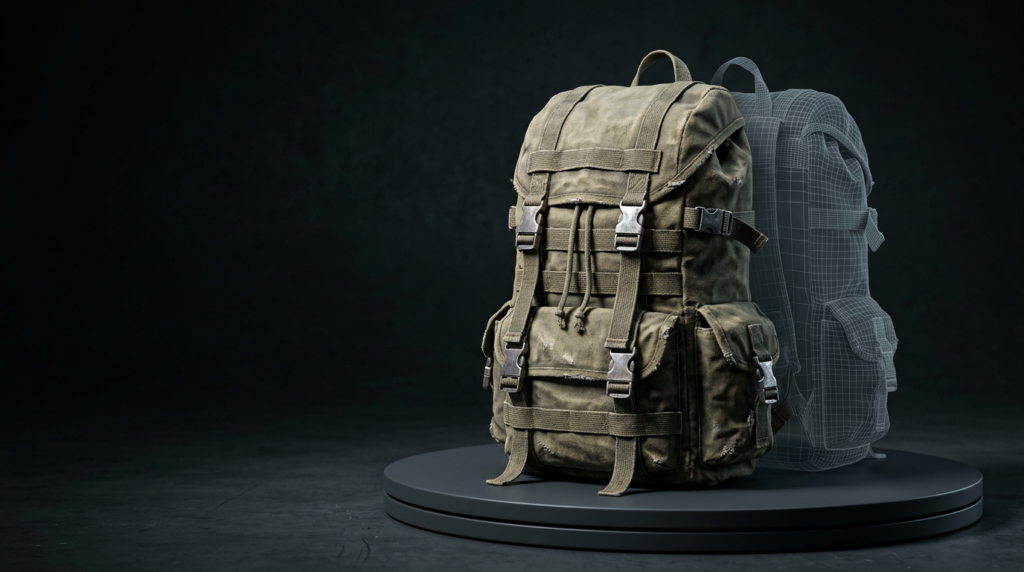
Think of a battered explorer’s backpack with layered straps, creased fabric, and dull metal buckles.
The first draft can give the team something to discuss while the brief is still evolving.
A strap can move, a buckle can shrink, and everyone can see what those choices do to the silhouette.
What actually changed
Tencent Cloud lists a maximum of two million mesh faces for Hy3D 3.6, up from 1.5 million, and texture resolution up to 8K, up from 4K.
The documented texture options are 2K, 4K, and 8K.
Mesh faces describe the surface itself, including how finely it can curve around a finger or fold over a shoulder.
A texture gives the surface visual detail, like a faded stripe on that shoulder.
Both limits matter most when the asset will spend time close to the camera.
On a shelf in the back of a scene, the same asset can often get by with much less.
The higher ceilings give artists room to decide where a file should carry detail and where a lighter version will do.
What native 3D means here
Tencent describes Hy3D 3.6 as a native 3D model that learns from the geometry, textures, and materials of three-dimensional assets.
The distinction becomes easier to see once a prop moves beyond its reference image.
An illustration might show the front of a fantasy helmet with the back completely hidden.
A generated helmet still needs something at the rear, where the shape might taper, flare, or leave room for a hinge.
That decision can be valuable for exploring ideas, especially when the artist has yet to draw the missing view.
It also creates a design choice for the team to review.
A plausible hinge may look convincing on screen and still clash with a sketch that the art director approved two weeks earlier.
A silhouette tells you plenty
Put a character under flat lighting and squint.
You can usually tell whether the pose reads, whether the shoulders feel too broad, and whether that enormous collar is about to swallow the face.
Tencent highlights more defined outlines, clearer boundaries between parts, and more natural-looking curves in its launch examples.
Those are features an artist can judge early, before debating the exact shade of the collar.
The same check helps with props.
If two chunky tools hang from a belt, each should read as its own object when the character turns.
At this stage, a clean silhouette can make it easier to decide which pieces of a draft deserve further work.
A great surface finish can wait until everybody agrees what shape they are polishing.
Why materials matter when the lights move
PBR stands for physically based rendering, a way to describe how surfaces should respond under different lighting.
Tencent Cloud lists metalness, roughness, and normal maps among the material outputs.
Roughness changes how sharp a reflection looks, while a normal map can make shallow details appear to catch the light without adding a ridge to the mesh.
Picture a hiking boot under an overcast sky.
Its rubber sole should react differently from the metal eyelets or the worn leather above them.
Move that boot under a bright studio lamp and the differences should still read.
An artist can judge those materials by rotating the light, checking the surfaces from several angles, and seeing whether the boot still looks like the same object throughout.
The useful part of a dense model
A high-poly model gives artists enough geometry to work on small features such as sculpted seams, carved ornament, and wrinkles.
In a game pipeline, that detail can then be baked into maps for a lighter mesh.
The lighter asset carries the visible impression of a seam, while the original sculpt retains its full shape for further edits.
That division makes a dense first pass interesting to a team that already has a way to simplify and bake its assets.
It also gives art leads a clear question during review.
Which details will survive at the distance where players actually see them?
The answer might save an afternoon spent perfecting a tiny buckle that appears on screen for less time than the loading icon.
The texture has to go somewhere
A UV layout tells a renderer how to wrap a flat image around a three-dimensional object.
Imagine peeling the label from a bottle and laying it out on a desk.
The label is flat, while the placement instructions tell you where it sits when wrapped around the cylinder.
Tencent Cloud documents an editable automatic UV layout and texture transfer from a reference image.
The next step is seeing how that layout holds up on an asset with awkward corners, like a backpack with overlapping straps.
Watch for stretching where the straps bend, seams that interrupt a printed pattern, and tiny areas of texture covering large parts of the model.
Those flaws can become easier to spot once the object starts turning under light.
The game asset has to move
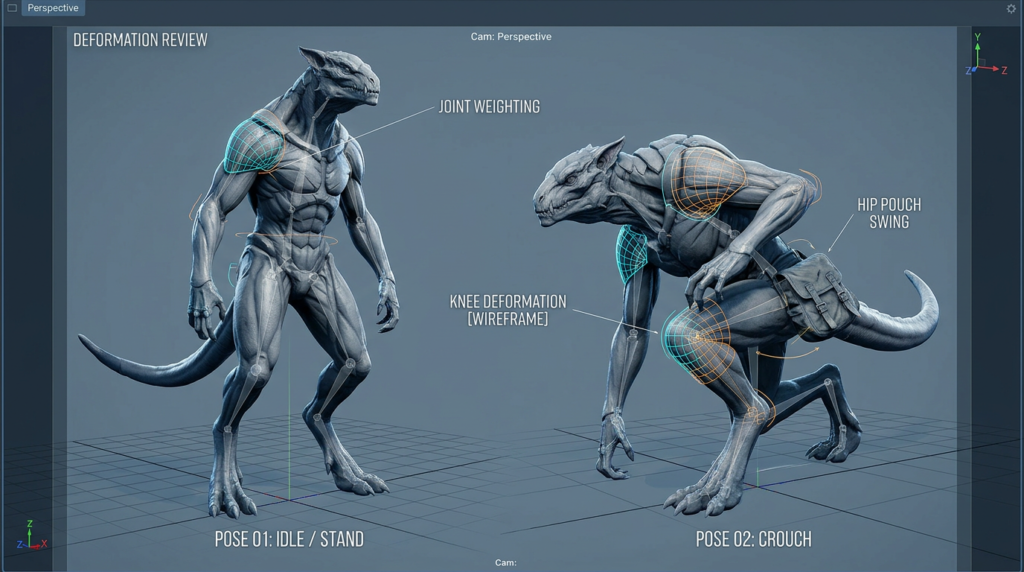
A creature can look terrific in a turntable preview and get into trouble as soon as an animator asks it to sit.
The shape and placement of polygons around a shoulder or knee affect how the skin bends at that joint.
A belt pouch presents a different challenge because it may need to swing without merging into the leg.
Tencent Cloud lists separate tools for part separation, retopology, and rigging alongside its generation features.
For a game team, the working file has to survive those handoffs.
One practical test would be to import a generated creature, put it through a few of its expected poses, and count how many fixes are needed before it can leave the animator’s desk and enter the game.
Film puts the camera closer
A film prop can hold up across a room and then reveal every dent when the camera pushes in.
That is where a dense mesh and a larger texture can earn their place.
Imagine a close-up of a weathered brass instrument as a character lifts it toward a window.
The window light will show how the engraved markings, rubbed edges, and patches of discoloration sit together across the surface.
Tencent integrated Hy3D 3.6 into WorkRally, its filmmaking platform.
There is a practical case for getting a prop into a shot early, even when the final asset is still on the schedule.
A rough version can help the crew choose the lens and decide which side the actor should turn toward the light.
Product mockups have rules of their own
A product team can use a generated model to explore how a design looks from different angles before commissioning a polished render.
A pair of headphones, for instance, might be easier to discuss once a group can turn the earcups and see how the headband curves around them.
The same demo raises a question about fidelity.
Do the hinge, controls, charging port, and branding match the actual product?
A plausible extra button can survive a quick internal review and become a problem once it appears in a retail image.
The more closely a visual will be tied to a real item, the more important it becomes to bring in product references and have someone who knows the design check the asset side by side.
Printing brings the mesh into the real world
Tencent Cloud lists watertight mesh generation and STL export, both relevant to creators who want to send a model to a slicer.
A watertight mesh encloses a volume, giving the slicer a clearer boundary between the inside and outside.
A small figurine still has to cope with gravity.
A long staff might be thin enough to snap during cleanup, and a wide cape might need supports that leave marks across its surface.
Those are physical considerations that become clear once the figure has a target size, material, and print orientation.
A prototype can help reveal which details survive at that scale.
The intricate clasp on the front of a coat may come out beautifully in the render and read as a bump in the hand.
Where creators can get access
Hy3D 3.6 is available through Tencent Cloud’s Token Hub API.
National Business Daily and TechNode also reported integrations with Tencent’s Miora creative agent, the LAP game asset platform, and WorkRally.
Those entry points give the release a few different audiences.
A developer can look at the API as a way to add generation to an existing pipeline.
Someone already assembling shots or working with game assets inside one of Tencent’s platforms can encounter the tool in the context of a project.
IT Home also points to Tencent’s browser-based Hunyuan 3D Creation Engine as a place to try the model.
For a team evaluating access, the difference comes down to how the generated file gets from the first experiment into the software where artists will edit it.
A file format gets you through the door
Tencent Cloud lists OBJ, GLB, STL, USDZ, and FBX across the product’s export options.
Each has somewhere familiar to go.
GLB is commonly used for sharing a textured asset in a viewer, for example, while an animation team may work with FBX.
A good handoff starts by opening the result in the receiving tool and checking what arrived.
Did the materials come through as expected, and does the model sit at the right scale and orientation?
For a batch of props, even a small mismatch can be tedious if somebody has to correct it by hand every time.
One clean round trip with a representative file can answer more about everyday use than a gallery full of objects that were already set up to look their best.
What Tencent’s blind test can tell us
Tencent says it organized a blind evaluation involving hundreds of professional 3D artists and modelers.
The company reported that Hy3D 3.6 outperformed the models it compared against on overall geometry quality, texture quality, and usability.
Those results give teams a reason to look at the model, while broader independent testing would help establish how it performs across different kinds of assets and references.
A studio that mostly builds stylized creatures will want a different sample from a retailer that needs dozens of similar shoes.
They may also disagree on which flaw matters most.
A retailer may care about whether a logo wraps correctly around a heel, while a character artist may care far more about what happens to the mesh when the creature bends.
Count the edits after generation
Generation time is easy to put on a dashboard.
The hours people spend repairing meshes, moving seams, and revising materials tell you whether a model saves time on a particular job.
A fair trial could give two artists the same approved brief and stop the clock once their assets pass the same review.
Along the way, the team could tally rejected generations, minutes spent editing each version, and whether the final file opens cleanly in the program that needs it.
It could also record how often a good result shows up from one prompt or reference.
A standout prop is welcome on any deadline.
A way to get twenty props to the same standard matters when the rest of the scene depends on them.
A better draft changes the first review
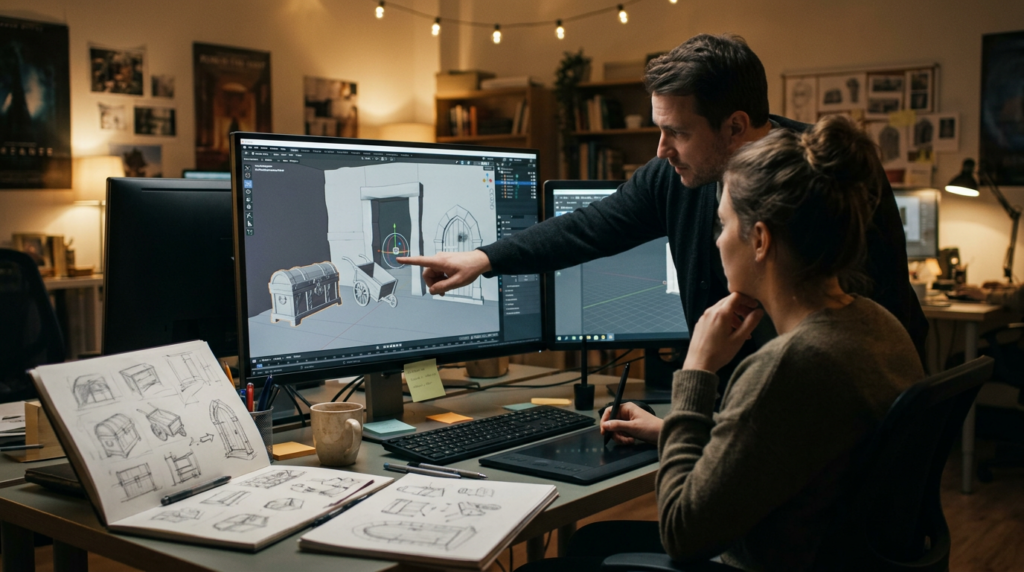
The most immediate opportunity for Hy3D 3.6 is to give artists something substantial to react to while a project still has room to change.
An art director can discuss the weight of a coat with a modeler who can turn it around.
A game team can drop three candidate props into a room and see which one reads from the doorway.
A filmmaker can spot the awkward edge that lands right in the middle of a close-up.
Those are useful decisions to make before anyone spends hours polishing the wrong shape.
The draft makes disagreements easier to resolve when everyone can clearly see the same shape on screen.
If the generated geometry and materials hold up during editing, the first review can happen sooner.
That buys the artist time for the part of the job where taste matters most.
Sources
- Tencent Cloud — Hy3D 3.6 specifications, material maps, and export formats
- Tencent Cloud — Token Hub API documentation
- Tencent Hunyuan via IT时代网 — Launch announcement and geometry examples
- National Business Daily — Release and Tencent platform integrations
- IT Home — Native 3D generation and browser access
- TechNode — English-language launch coverage
- CNMO — Tencent’s blind evaluation and reported results