
Main highlights
- Situational Awareness lost 67% net in July. Leopold Aschenbrenner’s fund reports a 65% net loss for Q3 2026 and an 88.5% net gain for the year through September. It says a late-July block trade let it cover all short exposure, sell roughly half its public long exposure and eliminate its reliance on prime-broker borrowing.
- The fund expects three years of AI progress in 2027. Its median scenario uses 2024 as the yardstick. The premise is that better AI systems will help researchers build better models, accelerating the next round of improvements. The fund believes that by the end of 2027, automated AI researchers could surpass humans at the job.
- The next product could be a “virtual department.” Aschenbrenner expects teams of AI agents to work on a project for days or weeks under AI coordinators, with humans setting direction and making the hardest calls. The fund says it is already experimenting with that arrangement internally.
- The letter forecasts more than US$1 trillion in combined AI-lab run-rate revenue by the end of 2027. The two routes are expansion beyond coding and much heavier spending by existing users. The figure annualizes the pace of sales at year-end.
- Anthropic anchors the investment thesis, while memory and short-term compute are separate bets on demand. The letter says a major safety incident and the political response could derail the outlook. Inside the fund, the immediate changes are a fully paid-for portfolio, a pause on short selling and a dedicated risk function under development.
Detailed summary
Situational Awareness’s fifth investor letter, dated November 24, 2026, covers the fund’s third quarter and explains why Aschenbrenner remains bullish on AI after a sell-off that threatened the firm’s survival. It revisits the argument from his 2024 essay that AI capabilities can improve quickly when labs combine more hardware with more efficient algorithms. His new claim is that AI-assisted research is speeding up the algorithmic side of that equation. The accompanying market thesis depends on how quickly that improvement reaches products and becomes revenue. Aschenbrenner’s 2024 essay
How a difficult July put the fund at risk
Situational Awareness says it launched in November 2024 with a little over US$100 million in net assets. It entered 2026 a little above US$4 billion. Net asset value then grew almost tenfold by the end of June, with the fund attributing about 90% of that increase to investment gains. Its net return for the first half was 438.7%. Net asset value measures the size of the fund after liabilities and also reflects investor flows. The reported return measures investment performance.
The fund entered July with long exposure of about 1.6 times its net assets and short exposure of about one times net assets. Its stress tests contemplated a sharp one-day AI sell-off and a weeks-long technology rout. July brought losses on both sides of the portfolio at once. AI stocks the fund owned fell steeply. Some short positions intended to offset those losses fell less than the stocks they were hedging. Other shorts, where the fund had bet against businesses it expected AI to disrupt, rose sharply late in the month. Its options protection also covered some of the hardest-hit positions less effectively than the fund had expected.
As the team cut exposure, it sold positions it could trade more readily, leaving a portfolio that was harder to sell. Falling asset values and short positions moving against the fund made it harder to restore its cash cushion. On July 29 and 30, it executed the block trade that ended its reliance on prime-broker leverage. Aschenbrenner calls the threat to the fund a failure of portfolio design and says its growth had outpaced its ability to manage a large book in a falling market. Kingy’s July coverage of the deleveraging
The letter says the portfolio went from roughly 70% public and 30% private to about the reverse by August. Anthropic’s November IPO brought it back toward its usual public-private mix. Anthropic’s IPO announcement
The loss figures are easiest to read in sequence. An illustrative US$100 at the start of 2026 would have grown to about US$539 by the end of June, then fallen to about US$189 by the end of September, using the letter’s reported net returns. The fund says it finished Q3 up 477.6% net since inception. Its net series represents a specified investor class after fees and fund expenses, and the letter says an independent party did not audit the report. A separate November 16 filing lists US$1.58 billion in Form 13F positions as of September 30. Form 13F covers a defined set of securities and gives a snapshot of holdings at quarter-end. Situational Awareness’s Q3 Form 13F
Why Aschenbrenner thinks AI progress will accelerate
The proposed feedback loop is straightforward. Researchers use models to write code, set up experiments, debug training and analyze results. Those experiments can improve the next model, giving researchers stronger tools for another round. The letter calls this recursive self-improvement, or RSI. Its account of the current stage still puts humans in charge of research judgment and coordination. The large gains it describes come from work that can be closely specified or divided among agents.
The strongest outside evidence the letter cites is METR’s assessment of Anthropic. METR estimated that Anthropic’s scores on its version of the Epoch Capabilities Index had improved at 1.9 times their pre-October 2025 rate, with a 95% confidence interval of 1.5 to 2.8 times. It also found that the estimate depended on how the trend was modeled and that lab employees’ productivity estimates were hard to interpret. OpenAI separately reported that its researchers used coding agents heavily and were running more experiments. It cautioned that available compute had increased, too. These reports document changes inside two labs. Situational Awareness extrapolates from them to a forecast for AI progress across 2027. METR’s Anthropic assessment · OpenAI’s research acceleration report
Situational Awareness’s median scenario puts the gain by the end of 2027 at roughly the size of the jump from GPT-4 to Claude Opus 5.5, starting from the late-2026 frontier. Its model for Anthropic’s internal frontier shows a wide spread. On that model, the 20th-percentile scenario is 1.8 years of progress at the 2024 pace, the median is 3.0 years and the 80th-percentile scenario is 6.2 years. The fund identifies three constraints in particular: forming good research ideas, running steps that have to happen in sequence, and finding enough computing capacity to test the extra ideas. A team can produce much more code and still have to wait for experiment results.
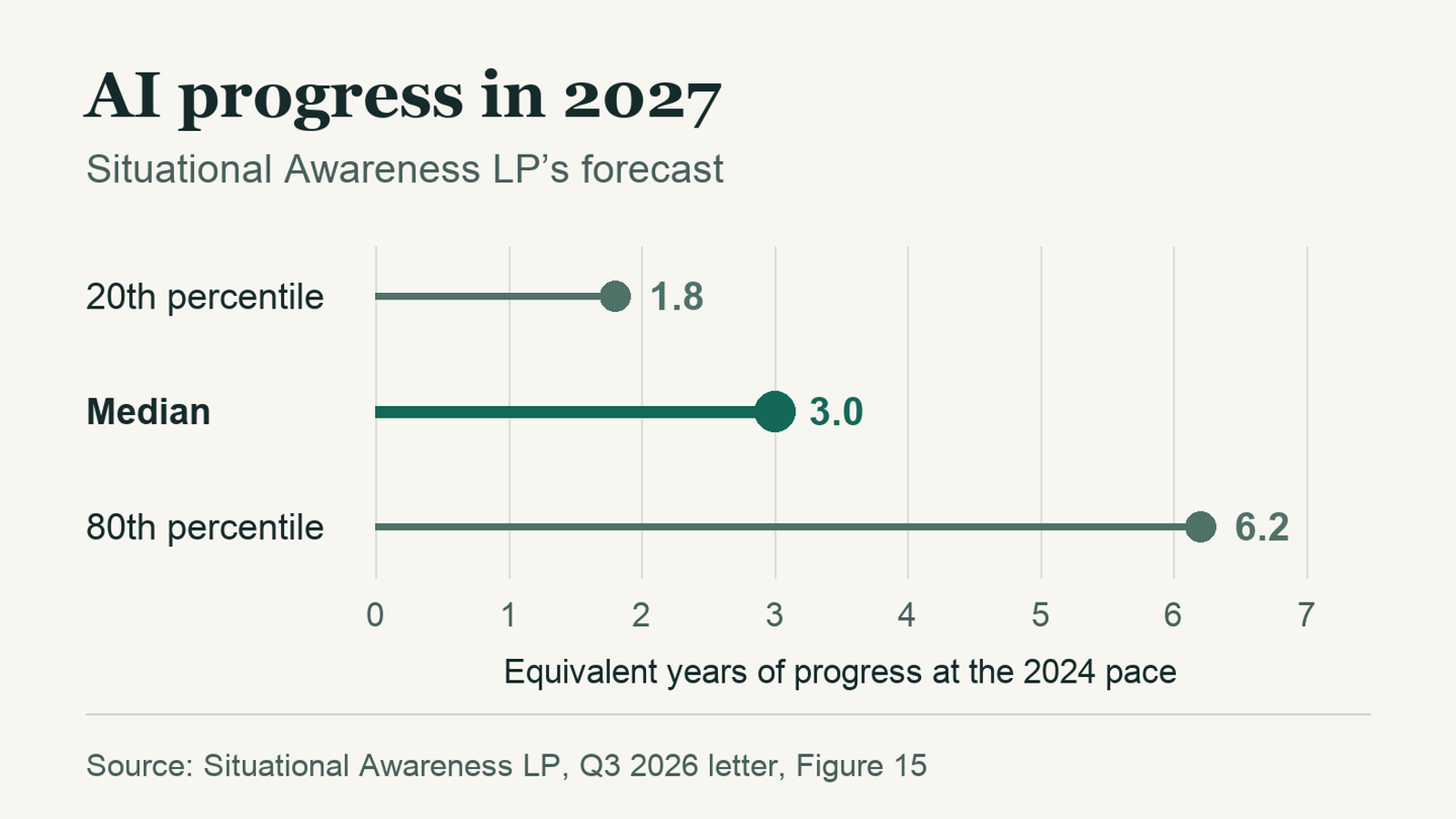
Forecast for Anthropic’s internal frontier. Source: Situational Awareness LP, Letter 5, Figure 15, p. 29.
From coding agents to virtual departments
A coding agent can take a defined task, run tools and return a result for review. Aschenbrenner’s proposed next step is a group of agents that can keep a project moving with less day-to-day direction. A coordinating agent would carry the project context, assign work and follow up while specialist agents handle individual pieces. The letter describes projects involving hundreds of agents. Humans would spend more time defining objectives, reviewing difficult judgments and making decisions that require accountability.
The fund says it has built an internal Claude-based system called GRIMM with a shared task board and agents that can communicate with one another. It describes using Claude to develop software for portfolio exposure, risk scenarios and trade reconciliation, as well as for company research. Its own estimate is a two- to threefold speedup in investment analyst work. That estimate describes the fund’s experience with its workflows. Sustained performance across companies will depend on how well the systems handle ambiguous assignments, verify their work and flag problems for a human.
The letter treats mathematics and software as early indicators. It points to OpenAI’s proposed counterexample for Navier–Stokes and Levent Alpöge’s Claude-assisted Riemann Hypothesis proof. Lean and Mathlib representatives reported that the formal Riemann proof passed their checks. Clay’s listings still mark both problems active. The work illustrates what advanced systems can contribute to tightly defined problems, where formal tools can help check the result. Many business decisions have no equivalent of a proof checker. OpenAI’s Navier–Stokes announcement · Lean and Mathlib’s Riemann verification · Clay’s Millennium Prize Problems
How the fund gets to a US$1 trillion revenue run rate
The letter expects the leading labs, principally Anthropic and OpenAI in its model, to end 2027 above a combined US$1 trillion annualized revenue pace. It identifies two sources of growth. One is broader adoption across office work as models become useful beyond coding. The other is higher spending among existing customers as one person can put multiple agents to work for much longer. In that scenario, the same customer consumes far more inference, the computing work of running a model, without any increase in headcount.
The letter points to AI labs’ own consumption to illustrate that second route. It estimates that Anthropic’s internal model usage, priced at public rates, exceeds its wage bill including stock compensation. That is an estimate of what similar usage might cost at listed prices. Anthropic itself disclosed approximately US$81 billion in run-rate revenue as of October 31. The prospectus defines its measure by annualizing recent usage and subscription fees. For the nine months through September, it recorded US$33.2 billion in revenue. The size of the fund’s forecast depends on sustained paid demand at a scale far beyond that already disclosed. Anthropic’s final IPO prospectus
Anthropic, memory and the price of compute
Situational Awareness says it first invested in Anthropic in early 2025 at what it describes as roughly a US$60 billion valuation and participated in every private round that followed. Anthropic announced a US$61.5 billion post-money valuation for its March 2025 Series E. It was the fund’s largest private investment ahead of Anthropic’s November listing. The case for Anthropic rests on the economics of building the most capable models. Older capabilities may get cheaper as competitors catch up. The leading lab can still charge for newer capabilities if customers find valuable work for them. Anthropic’s prospectus says model versions released in the six months through September accounted for more than 80% of Q3 revenue. Anthropic’s Series E announcement · Anthropic’s IPO announcement · Final prospectus
The letter emphasizes improving inference margins and argues that Anthropic could become one of the world’s most profitable companies by some measures. The prospectus puts the current numbers in context. For Q3, Anthropic reported US$2.5 billion in adjusted operating income and a US$567 million operating loss under standard US accounting rules. The company cites costly short-term compute and noncash charges for its donation-matching program as drivers of the quarterly operating loss. The fund’s long-run case depends on the revenue generated by additional computing capacity clearing the cost of obtaining it. Anthropic’s final IPO prospectus
The bets on memory and compute follow from the same expectation of heavier AI use. The fund made SK Hynix a major position on the view that reasoning models and longer tasks would raise demand for high-bandwidth memory, which supplies data to accelerators quickly. It also saw a role for NAND flash from companies such as Kioxia and Sandisk, where systems can store context from paused tasks and avoid having to recompute it later. These ideas depend on the hardware bottleneck persisting long enough for suppliers to capture the gains.
The spot-compute thesis concerns the price of renting hardware on short notice. A lab can secure baseline capacity on multiyear agreements and rent extra capacity as customers show up. Situational Awareness expects short-term prices to rise if the value of serving users grows faster than the supply of ready-to-use hardware. Short-term rentals are also among the easiest purchases for customers to cut if demand falls. Anthropic’s prospectus illustrates the trade-off for a buyer. The company says short-term commitments cost significantly more than comparable multiyear capacity. Anthropic’s final IPO prospectus
Why the fund thinks today’s AI winners could lose their advantage
Aschenbrenner goes beyond his 2027 forecast and puts broad superintelligence in 2028, barring a regulatory ban. In that scenario, AI systems could do intellectual and physical work across much of the economy at a level above humans. He expects advanced systems to improve chip designs and, as robotics matures, help build more of the physical infrastructure they need. The robotics chapter points to gains in simulation and early signs that models can transfer skills across tasks. The letter also acknowledges that simulation scores can miss the precision needed for real-world manipulation and that hardware production would take time to expand.
The investment implication is that a company can profit from the next wave of demand and still see its long-term advantage shrink. The letter uses Nvidia as an example. It expects strong near-term chip sales, while arguing that automated chip design and cheaper software development could eventually erode the value of Nvidia’s engineering expertise and software ecosystem. The fund favors businesses that can generate substantial cash while an input is scarce. The timetable drives that conclusion. A slower improvement in AI-assisted chip design, robotics or manufacturing gives existing suppliers more time to earn money from the advantages they have today.
Safety, market expectations and the fund’s rebuild
The letter reads the prices of selected memory and data-center companies as consistent with an abrupt slowdown after 2027. It translates the revenue expectations it attributes to other investors into roughly 0.3 to 0.6 of a historical year of AI progress. That figure comes from the fund’s model connecting capability gains to revenue and its account of what other investors expect. Stock prices also reflect financing costs, competition and the risk that wider adoption may take longer than the fund expects.
Aschenbrenner sees a serious AI safety incident as the biggest threat to the thesis. His baseline includes tighter safeguards, stronger oversight or temporary pauses. He expects progress could still outpace the old baseline under those conditions. A severe accident followed by an extended shutdown is the scenario he thinks could break the investment case. The letter also expects power, water, permitting and financing to affect where data centers get built and which developers can bring capacity online.
Since July, the fund says it has been investing without accepting new capital. It describes its portfolio as fully paid for, with stocks and purchased options, and says it has paused short selling. The firm reports growing from three people to nearly 30, with most of the hiring outside the investment team. It has convened a risk committee, is recruiting a chief risk officer and is building a risk function separate from the team that takes positions. Its stated goal is to withstand a more severe shock than July while remaining able to invest. The 2027 forecast has three concrete tests: whether agents contribute more to frontier research, whether they can run long projects reliably outside the labs, and whether customers pay enough for those workloads to justify the cost of serving them.
Sources
The primary source is Situational Awareness LP’s fifth investor letter, dated November 24, 2026. The letter supplies the fund’s performance and positioning, July postmortem and 2027 projections. Public filings and research reports are linked alongside the relevant claims.