
Entertainment’s Biggest Players Enter the Room
Stability AI has raised $76 million, but the most interesting part of the deal is not the size of the cheque. It is the guest list.
Universal Music Group, Warner Music Group, Sony Music Group and video-game publisher Electronic Arts participated in the Series B round. AMD Ventures and Pacific Alliance Ventures also joined as new investors. Returning backers included Coatue, Greycroft, Kadmos Capital, Sean Parker and former Google chief executive Eric Schmidt.
That is not your standard collection of venture capital firms hunting for the next dazzling demo. These companies control valuable music catalogues, game franchises, production pipelines and distribution networks. Now, they also own equity in one of the most recognizable names in generative AI.
According to Stability AI, the latest investment brings the total amount raised under chief executive Prem Akkaraju to $232 million. That figure includes two equity rounds and convertible notes since Akkaraju took charge in June 2024. The company did not disclose its latest valuation.
Stability AI plans to use the new capital to expand its creative-production products, strengthen its applied research and grow its professional-services business. In plain English: it wants to build practical AI tools that studios, musicians, designers and developers will actually use.
The company is no longer pitching itself as merely the home of a famous image generator. It wants a permanent desk inside the entertainment industry’s creative workshop—and several of the workshop’s owners have just handed it a key. (Stability AI, The Next Web)
The Investors Matter More Than the Number
In the roaring furnace of artificial intelligence, $76 million is meaningful but hardly jaw-dropping. Frontier-model companies can burn through eye-watering sums on chips, computing power and research talent.
Yet this round carries unusual strategic weight.
Universal, Warner and Sony collectively represent the world’s three largest music groups. They bring catalogues, artists, licensing expertise and direct knowledge of the legal headaches surrounding generative music. Electronic Arts brings something different but equally useful: massive game-development operations where art, sound and design must work together at scale.
AMD Ventures adds the semiconductor angle. Stability AI needs computing infrastructure to train, customize and run its models, while AMD wants more AI workloads using its hardware. The relationship has a tidy logic to it.
The result is a cap table that looks less like a traditional startup investor list and more like a miniature creative-industry alliance.
For Stability AI, those names offer credibility and potential customers. They may also unlock properly licensed material for developing specialized models. For the entertainment companies, the investment offers closer access to the technology and a clearer view of how it evolves.
They are not simply watching the AI train thunder past the platform. They have bought tickets—and may get a say in where it stops.
That alignment could prove far more important than the raw dollar figure attached to the round. (SiliconANGLE, Forkast)
From Stable Diffusion to a Broader Creative Toolkit
Stability AI became famous in 2022 when it released Stable Diffusion, an image-generation model that helped push generative AI beyond research labs and into ordinary computers.
The model’s open approach encouraged developers, artists and hobbyists to experiment, customize and build new applications. Stability AI says Stable Diffusion models have since recorded more than 350 million downloads.
But fame does not automatically produce a durable business. A widely downloaded model can ignite an ecosystem while leaving its creator with the awkward question of how to pay the electricity bill.
Stability AI has therefore expanded into video, audio, 3D content and commercial creative services. It released Stable Diffusion 3.5 in 2024 and launched Brand Studio in April 2026, giving marketing teams a platform for generating and editing brand-aligned visual material.
The company’s current language reveals its strategic shift. It now describes itself as a developer of “purpose-built” AI products for professional creatives across music, gaming and entertainment.
That is much narrower than trying to win every generative-AI contest at once. It may also be more realistic.
Instead of chasing the largest general-purpose model, Stability AI can focus on tools built around specific production jobs: creating a soundtrack, revising an image, generating game assets or adapting branded content.
The new funding suggests investors see value in that specialist approach. The future may not belong solely to one gigantic model that does everything. It may belong to well-designed tools that do a few expensive jobs exceptionally well.
Stable Audio 3.0 Takes Center Stage
The timing of the round points straight toward music.
Stability AI launched the Stable Audio 3.0 family in May 2026. It consists of four models designed for different levels of hardware and production work. Three have open weights, while the largest model is available through the company’s application programming interface.
The Small SFX model targets sound effects on mobile devices and consumer laptops. Stable Audio 3.0 Small can generate full musical compositions on-device. Medium supports longer and more musically developed tracks, while Large targets professional platforms that require fast, high-volume generation.
Depending on the model, creators can produce tracks longer than six minutes. The system also supports audio inpainting, allowing users to replace, revise or extend part of an existing track instead of throwing the entire composition into the digital bin.
Most importantly for record labels, Stability AI says it trained the model family on fully licensed data. It also says users own their outputs under its Community License, while qualifying enterprise customers can receive legal indemnification.
Those claims attack one of generative music’s biggest commercial barriers: uncertainty over the origin of training material and the legal status of finished work.
A brilliant beat is less exciting when a corporate legal department hears it and immediately reaches for a fire extinguisher.
Stability AI is betting that licensing, ownership rules and enterprise protection can make its tools safer for professional adoption. (Stable Audio 3.0)
The Plugin Could Be the Real Product
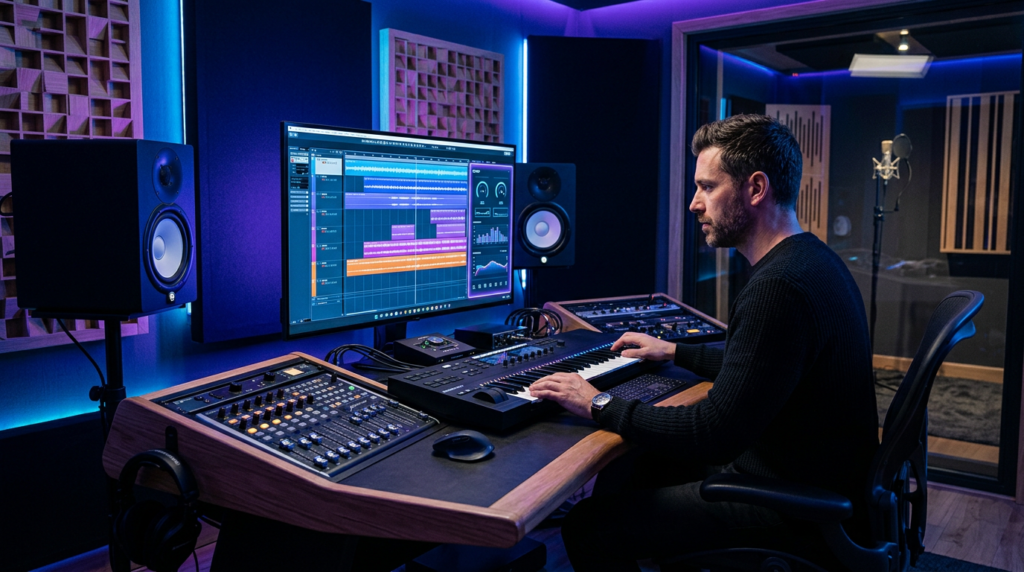
AI companies love dramatic launches. Creative professionals generally love tools that save ten minutes without wrecking the rest of their workflow.
That makes Stability AI’s digital audio workstation, or DAW, plugin particularly important.
Released shortly before the funding announcement, the plugin brings Stable Audio 3.0 into the software environment musicians and producers already use. Creators can also access the technology through StableAudio.com, but workflow integration could carry greater commercial value.
A standalone website asks professionals to leave their project, open another platform, generate something, download it and bring it back. A plugin puts the AI beside the tracks, effects and editing controls already on screen.
It sounds like a minor distinction. It is not.
The most successful professional AI tools may disappear into existing production systems. They will not demand a grand ceremonial prompt every time somebody needs a drum variation, ambient texture or sound effect. They will simply become another option inside the creative toolbox.
This is where Stability AI’s strategy begins to look less like a model race and more like an infrastructure play. Models will continue improving, but a product embedded in daily work can build habits, customer relationships and switching costs.
Forkast argues that the company is shifting toward specialized creative infrastructure instead of chasing general-purpose AI supremacy. That interpretation fits the investor mix remarkably well.
The labels do not merely need impressive technology. They need usable technology that fits the studio without knocking over the furniture.
Partners Become Shareholders
Universal Music Group, Warner Music Group and Electronic Arts were already working with Stability AI before investing in the new round.
Universal announced an alliance with the company in October 2025 to co-develop professional music-creation tools. Warner followed with its own collaboration in November. Both partnerships emphasized responsible AI development and tools designed around the interests of musicians, songwriters and producers.
Electronic Arts also formed a technical partnership with Stability AI. Its work focuses on developing generative tools for EA’s artists, designers and developers, using the game publisher’s intellectual property and production needs.
Those agreements make the Series B more than a collection of financial bets. Existing partners are increasing their commitment by becoming investors.
Sony Music’s position is slightly different. It joined the financing, but Stability AI’s announcement did not identify Sony as an existing strategic development partner.
That distinction matters. It prevents the investor list from becoming a blur of logos and buzzwords. Some participants already have active product relationships with Stability AI; others are entering through equity.
For the existing partners, investment creates stronger financial alignment. If the technology succeeds, they may benefit both operationally and financially. Stability AI, meanwhile, gains customers and collaborators that can tell its engineers what professional production actually requires.
That feedback may be blunt. Good. Creative software does not improve through polite applause.
The arrangement gives Stability AI something many startups desperately need: major partners with real workflows, enormous catalogues and enough leverage to demand useful results.
Licensed AI Becomes the Sales Pitch
The entertainment industry has spent years warning that generative-AI developers cannot treat copyrighted work like an all-you-can-scrape buffet.
Now, major rights holders are backing a company that presents licensed training as a competitive advantage.
This is not a sudden surrender to AI. It is a change in tactics.
Record labels can fight unauthorized uses of their catalogues while investing in systems built around negotiated access. Those positions are not contradictory. One defends existing rights; the other tries to turn those rights into leverage within a new market.
Stability AI’s challenge is to prove that a licensed product can compete with tools developed under looser rules. Its own Stable Audio announcement acknowledged the issue directly: responsible training alone will not win users if the licensed platform delivers a worse experience.
That is the commercial knife edge.
Producers care about rights, particularly when a song will be released or used in advertising. They also care about control, speed, sound quality and creative flexibility. A legally tidy model that produces uninspiring music will not become a studio staple. It will become an expensive ornament.
Stability AI must therefore offer both safety and performance.
If it succeeds, the company could help establish a template for creative AI: license valuable material, build models with rights holders and sell the resulting tools to professionals. If it fails, creators may continue gravitating toward alternatives that work better, even when those alternatives carry more legal uncertainty.
The cleanest paperwork in the world cannot rescue a bad chorus.
Gaming Adds Another Layer
Music dominates the headlines, but Electronic Arts gives the funding round a broader creative dimension.
Modern video games combine images, animation, dialogue, sound effects, environments, user-interface elements and oceans of background assets. Large releases employ sprawling teams, yet developers still face tight deadlines and rising production costs.
Generative AI could help with concept exploration, asset variation and repetitive production tasks. A designer might create several visual directions more quickly. An artist could test textures or environmental details. A sound team could prototype effects before committing to final recordings.
That does not mean an AI system will press a button and produce the next blockbuster game before lunch. Large games demand coherent design, reliable technology and relentless human coordination. Anyone who has encountered a bug caused by an apparently innocent door understands the chaos involved.
EA’s partnership gives Stability AI an opportunity to develop tools around real production constraints rather than imaginary ones. Enterprise users need predictable outputs, security controls, integration options and clear rights. A flashy demo may impress social media. It does not necessarily survive a commercial pipeline.
The EA relationship also lets Stability AI connect its different model families. Image, video, audio and 3D generation can all matter inside game development.
If Stability AI can turn those capabilities into dependable production tools, gaming may become as important to its business as music. EA’s investment signals that at least one major publisher wants a closer look.
Stability AI’s Difficult Road to Reinvention
The new round also marks another chapter in a dramatic corporate turnaround.
Founder Emad Mostaque stepped down in 2024 after a turbulent period involving financial pressure, staff departures, internal disruption and legal disputes. Prem Akkaraju, the former chief executive of visual-effects company Weta Digital, took over in June 2024.
Since then, Stability AI has restructured its leadership and narrowed its commercial focus. The company now emphasizes professional creative products, strategic partnerships and licensed models rather than simply releasing technology for a broad open ecosystem.
It has also assembled a board with unusually strong entertainment connections.
Coatue co-founder Thomas Laffont joined the board as part of the latest funding announcement. He sits alongside Akkaraju, Greycroft co-founder Dana Settle, executive chairman Sean Parker and filmmaker James Cameron.
That group blends venture capital, technology and entertainment experience. It also reinforces the message Stability AI wants the market to hear: this is becoming a creative-production company, not just an AI research laboratory with a famous download page.
Still, reinvention takes more than new positioning. Stability AI must turn investment into products, products into regular professional use and that use into sustainable revenue.
The company also continues to face copyright litigation connected to other parts of its business. Its licensed-audio strategy does not erase those disputes.
A comeback story is appealing. A profitable comeback is harder. The Series B buys Stability AI more time to pursue one.
The Strategy Carries Real Risks
Strategic investors can open doors. They can also fill the room with competing priorities.
Music companies want safeguards for artists and catalogues. Game developers want speed, flexibility and production efficiency. Technology investors want growth. Creative professionals want control. Nobody wants their lawyers developing a nervous twitch.
Stability AI must satisfy those groups without allowing its products to become slow, conservative or confusing.
There is also the question of adoption. Famous investors cannot force musicians and designers to love a tool. Professionals will judge Stable Audio and the company’s other products by their results, reliability and usefulness—not by the logos on a press release.
Competition will not stand still either. Generative-media companies are racing to improve quality, editing controls and workflow integration. Open models can spread rapidly, while large technology firms can bundle creative features into platforms customers already use.
Stability AI must therefore protect the openness that helped make Stable Diffusion influential while building a business that enterprise customers will pay for. That balance is tricky. Too open, and monetization may suffer. Too restricted, and the developer community may wander elsewhere.
Partnerships with major rights holders could also make independent creators wonder whose needs the company will prioritize. A product designed for giant studios may not always suit a bedroom producer or small design team.
The strategy is credible. It is not guaranteed. The next test will come from the people sitting in front of the software.
The Bigger Signal for Creative AI

Stability AI’s $76 million round suggests the entertainment business is moving beyond its initial AI panic phase.
The arguments are not over. Copyright disputes remain active, artists still worry about consent and compensation, and many questions about synthetic media remain unresolved. Yet major companies increasingly appear determined to shape the technology rather than merely resist it.
Equity gives them another route to influence.
By investing in Stability AI, record labels and EA gain closer ties to a company developing the infrastructure behind creative generation. Stability AI gains capital, credibility and direct access to industries that possess precisely the content, expertise and customers it needs.
That does not make every interest perfectly aligned. Far from it. But it creates a business framework in which AI developers and rights holders can attempt to build products together.
The decisive question is no longer whether generative AI will enter professional creative work. It already has. The question is which companies will turn it into something dependable, controllable and commercially safe.
Stability AI now has $76 million more to make its case.
Its investors are betting that the largest opportunity may not lie in generating the weirdest image or topping the latest benchmark. It may lie inside the ordinary tools used to produce songs, games, advertisements and films every day.
Less science-fiction spectacle. More studio infrastructure.
If that sounds slightly boring, good. Boring tools often make very interesting money.
Sources
- SiliconANGLE — Major record labels and AMD back $76M round for Stability AI
- The Next Web — Stability AI raises $76M from Universal, Warner, Sony Music and EA
- WTYE — Stability AI raises $76 million in entertainment-backed funding round
- Forkast — Where entertainment giants think AI value actually lives
- Stability AI — Official Series B announcement
- Stability AI — Stable Audio 3.0 announcement
The Kingy Brief
Get The Kingy Brief.
AI changes, original tests and one practical thing to try. Fridays at 09:00 Vancouver time.
Free · Double opt-in · Unsubscribe anytime
Signup help and newsletter schedule
Signup form provided by Beehiiv. After submitting, check your inbox for "Confirm your subscription to The Kingy Brief" and open its confirmation link. Check Spam or Promotions if you cannot find it.
Fridays at 09:00 Vancouver time: source-checked AI changes, original tests and one practical thing to try. The weekly restart begins October 9, 2026. We skip a week when there is not enough verified material. Free. Unsubscribe anytime.