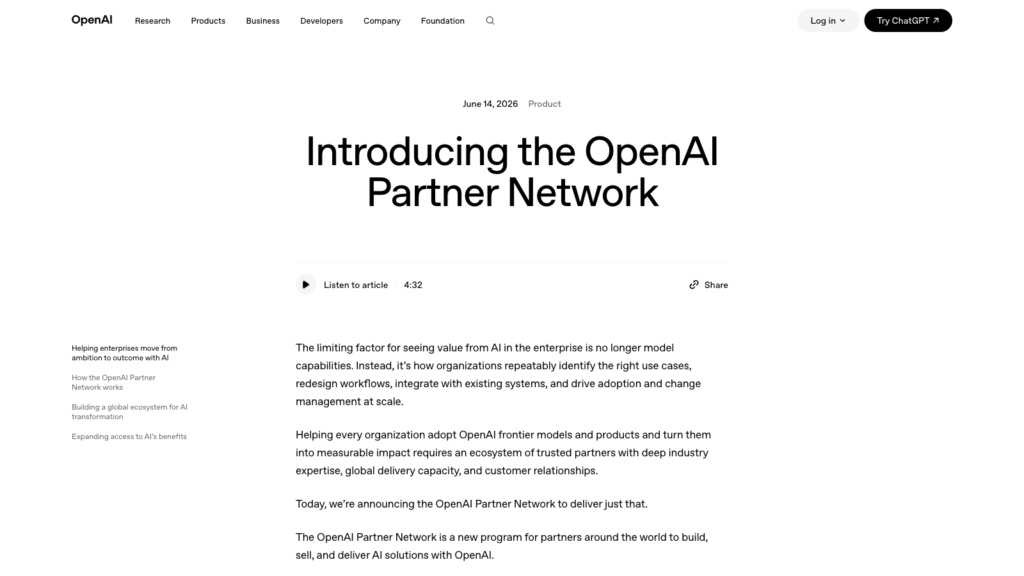
The OpenAI Partner Network is a global program for consulting firms, systems integrators, technology providers, and data specialists that build, sell, and deploy OpenAI-based solutions. OpenAI announced the program on June 14, 2026, alongside a $150 million ecosystem investment and a goal of training and enabling 300,000 certified consultants by the end of 2026.
This is not a customer subscription tier. It is a partner program with application, enablement, co-selling, and delivery functions. OpenAI has not published a general enrollment fee or a public partner price schedule.
How the program works
OpenAI says partners can work with the company across four broad activities: co-selling, deploying systems, building solutions, and connecting customer environments to OpenAI technology. The program has three progression tiers: Select, Advanced, and Elite.
OpenAI describes the tier requirements in terms of sales performance, technical capability, co-sell engagement, and deployment experience. The company also plans specializations in areas including Codex, cybersecurity, and agents so customers can identify partners with deeper experience in a specific workload.
A separate Forward Deployed Experts pilot is intended to connect qualified partner practitioners with OpenAI’s Forward Deployed Engineering teams on complex enterprise deployments.
Who the network is for
The launch group spans management consultancies, systems integrators, cloud and data companies, and specialist AI firms. OpenAI’s public partner directory lets buyers filter the current network, while interested organizations can use the partner application.
For a services firm, membership may provide training, technical support, sales coordination, and a clearer relationship with OpenAI. It does not eliminate the need to demonstrate delivery experience, security practice, industry knowledge, and measurable customer results.
Pricing and access
OpenAI has not published a universal fee schedule for joining the network. Prospective partners should use the official application path and ask which requirements, commercial terms, training costs, certification rules, and regional limitations apply to them.
Customers do not buy the Partner Network itself. They contract with a partner, OpenAI, or both for products and services. Project pricing will depend on the partner’s services, OpenAI usage, integrations, data work, support, and the operating requirements of the deployment.
What buyers should verify
- Relevant delivery evidence: Has the partner deployed the same kind of workflow in a comparable organization?
- Accountability: Which party owns architecture, data protection, model evaluation, incident response, and ongoing support?
- Total cost: Separate consulting fees, platform usage, integration work, evaluation, change management, and maintenance.
- Model independence: Ask how the design handles model changes, fallbacks, and workloads that may fit another provider better.
- Outcome measurement: Define a baseline, target metric, review window, and stop condition before a broad rollout.
Kingy assessment
The network formalizes a reality of enterprise AI adoption: model access is only one part of the job. Workflow redesign, systems integration, data controls, evaluation, training, and change management often decide whether a deployment produces value.
The $150 million commitment and 300,000-consultant target show the scale OpenAI wants, but they do not prove partner quality. Buyers should treat network membership as one signal and still evaluate the team, proposal, security model, references, and commercial terms attached to their specific project.
Primary sources
- OpenAI: Introducing the OpenAI Partner Network
- OpenAI Partner Network directory and program overview
- OpenAI partner application
Track related enterprise launches in the Kingy AI Launch Tracker.
The Kingy Brief
Get the next Kingy Brief.
Source-checked AI changes, original tests and one practical thing to try.
Free · Choose your subjects · Double opt-in · Unsubscribe anytime