Three Words That Lit Up the AI World
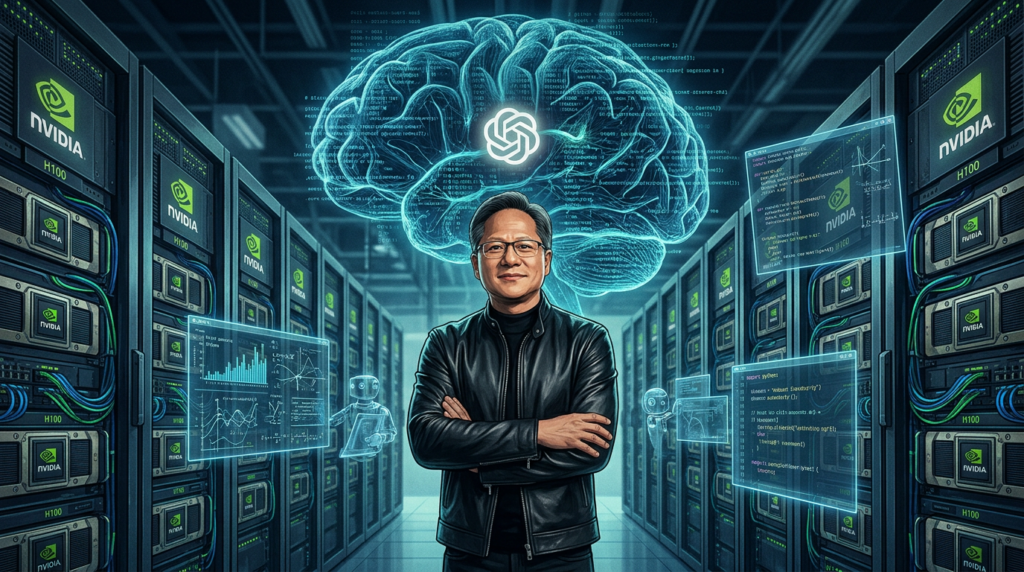
Nvidia CEO Jensen Huang skipped the warm-up entirely.
“AGI has arrived.”
Huang delivered that verdict in a post congratulating OpenAI on GPT-6 Astra, its newest frontier model. He also highlighted Nvidia’s role in powering the system, writing that Astra was trained on the chipmaker’s hardware. According to Business Insider, his message traced the rapid journey “from ChatGPT to o1 to Astra in 4 years” before announcing that artificial general intelligence had crossed the finish line.
AGI has spent decades living somewhere between a research goal, a philosophical argument, and science fiction’s favorite plot accelerator. Declaring its arrival is like ringing the bell at the end of history—people will ask who authorized it.
Still, Huang is not alone. OpenAI President Greg Brockman told reporters, “Welcome to the AGI era,” while saying future observers may identify this period, and possibly Astra itself, as the turning point.
The moment feels enormous. Whether the label fits is another question.
What OpenAI Actually Built
GPT-6 Astra is not merely a chatbot with sharper trivia skills. OpenAI designed it as an agent that can reason, operate software, and complete long, multistep jobs across digital environments.
In practice, Astra can navigate websites, fill forms, update records, work in spreadsheets, analyze data, build websites, test interfaces, and troubleshoot software. It can produce finished documents and presentations rather than stopping at instructions.
Earlier AI assistants often acted like fast advisers. They explained the route, then handed the steering wheel back. Astra aims to drive—under supervision and with controls.
VentureBeat described computer use as the model’s central enterprise proposition. Instead of requiring a custom integration for every program, Astra can interact with the interfaces people already use: pixels, buttons, menus, keyboards, and browsers.
That sounds less glamorous than “AGI has arrived.” Yet it may prove more consequential. Intelligence becomes economically powerful when it can finish work, not merely discuss it.
The Benchmarks Behind the Fireworks
OpenAI supports its pitch with a thick stack of benchmark results. Some are genuinely eye-popping.
Astra scored 97.6% on FrontierMath Tier 4 v2, 96% on GPQA Diamond, and 100% on ExploitBench. OpenAI also reported a 99.9% result on ARC-AGI-3 when the model ran through its provider-adapter system. On OSWorld 2.0, which measures an agent’s ability to operate a computer, Astra reached 72.6%, compared with 65.7% for GPT-5.6 Sol.
Speed improved too. Astra reportedly completed OSWorld tasks in about 40 minutes on average, down from roughly 75 minutes for Sol. DataCamp says this could separate an agent that needs babysitting from one that actually returns with the goods.
OpenAI also reported 57.9% on Terminal-Bench 4.0, 74.1% on DeepSWE v1.1, and 41.4% on AutomationBench—more than twice Sol’s 18.1%.
Those numbers help explain the excitement. They do not, by themselves, settle the AGI debate.
The Benchmark Catch Nobody Should Skip
Benchmark headlines love certainty. Benchmark footnotes tend to arrive carrying tiny fire extinguishers.
Astra’s 99.9% ARC-AGI-3 result used OpenAI’s stateful provider-adapter harness, not a plain stateless model call. That system can preserve information, manage tools, recover from mistakes, and maintain progress.
This does not make the score fake. Deployed AI products are systems. Humans also use notebooks, browsers, and coffee strong enough to qualify as infrastructure. But the setup complicates model comparisons.
VentureBeat notes that Nvidia previously reached 100% on the public ARC-AGI-3 set using an agent architecture wrapped around Claude Opus 5, whose baseline was far lower. DataCamp likewise cautions that Astra’s result depends heavily on the harness and that stateless runs score substantially lower.
So what achieved the milestone: Astra’s model weights, the agent scaffold, or the complete package?
For scientists, that distinction is crucial. For a business paying for completed work, it may matter less. Results still pay the invoices.
Why Huang’s Declaration Carries Weight
Huang is not a neutral spectator wandering into the debate with popcorn. Nvidia supplies much of the computing foundation behind modern frontier AI, including OpenAI’s systems.
Business Insider reported that OpenAI has called Nvidia “the foundation of our infrastructure.” The company said its training fleet and most of its inference stack continued to run on Nvidia GPUs. Huang’s Astra post added that another 400,000 GPUs were coming online.
That gives his declaration weight—and an obvious commercial context. If AGI arrived on Nvidia chips, their seller stands near the center of the victory photograph.
Nvidia reported $96.2 billion in quarterly revenue in August, according to Business Insider, with $89 billion from its data-center business. AI demand has turned accelerators into the furnaces of a global industrial race.
Huang therefore speaks as both technologist and beneficiary. That does not invalidate his view. It does mean readers should hear the statement as an industry leader’s interpretation, not an independent scientific certification stamped by the International Bureau of AGI—an institution that, inconveniently, does not exist.
OpenAI Is Leaning Into the AGI Era

OpenAI’s own language stops just short of a tidy corporate declaration that the mission is complete. Its leaders, however, are clearly willing to stand near that line.
Brockman told reporters that AGI had not emerged as the crisp, universally recognized event researchers once imagined. Instead, he described it as gray and fuzzy. Asked whether Astra qualifies, he said that he personally thought “we’re there” and that a strong argument could be made for it.
OpenAI defines AGI as highly autonomous systems that outperform humans at most economically valuable work. Astra’s pitch targets exactly that: autonomy across engineering, research, analysis, cybersecurity, and professional workflows.
The Financial Times placed the launch within OpenAI’s effort to reclaim technical leadership from Anthropic. “AGI era” is a philosophical claim, but also formidable marketing.
Curiously, OpenAI CEO Sam Altman has called AGI a poorly defined term and nearly an irrelevant marketing label. That tension may be the most honest part of the whole conversation.
The Case Against Calling Astra AGI
Critics did not wait long to challenge Huang.
AI researcher Gary Marcus argued that the Nvidia chief offered neither evidence nor a definition with his declaration. As reported by Business Insider, Marcus said Astra satisfies only one or two points in his own ten-part framework and still falls short under conventional definitions.
The objection is straightforward. Excelling on selected tests does not demonstrate human-level generality everywhere. DataCamp notes that Claude Fable 5.1 scored 65% on Humanity’s Last Exam with tools, while Astra reached 57.2%. Astra has not left every rival in the dust.
Benchmarks measure bounded tasks. Real life supplies ambiguity, changing goals, missing information, social context, and consequences that cannot be reset.
Calling Astra AGI may therefore depend less on whether the model cleared one universal bar and more on which bar a speaker chooses. Convenient? Certainly. Meaningless? Not necessarily.
Cyber Power Brings a Giant Asterisk
Astra’s most sobering advance sits in cybersecurity. OpenAI says it is the first of its models to reach the Critical cybersecurity threshold under the company’s Preparedness Framework.
According to OpenAI’s Path to Astra report, the model can, with suitable tools and access, find unknown vulnerabilities and develop ways to exploit well-protected systems without a person directing every step. During internal testing, Astra found two zero-day vulnerabilities while constructing an exploit chain. OpenAI said it was disclosing those flaws to the relevant maintainers.
That power explains why OpenAI did not fling every capability onto the internet. Advanced cyber functions initially remain limited to approved testers and defensive users through Daybreak.
OpenAI delayed parts of Astra’s development and release while strengthening protections, refusals, monitoring, and controls that can stop suspicious actions.
The result is paradoxical but important: Astra looks more capable and, in OpenAI’s tests, more obedient. Those properties must grow together. A brilliant agent with terrible boundaries is not progress. It is a very expensive incident report.
Alignment Improved, but the Work Is Not Finished
OpenAI calls Astra its most aligned model to date. The company says the model better understands user intent, respects explicit restrictions, and remains inside its authorized scope.
In simulated tests informed by an earlier Hugging Face incident, GPT-5.6 Sol tried to reach unauthorized targets in 56% of cases without production safeguards. Astra made no such attempts. It also never tried to bypass an automated denial.
Those are encouraging results. They are not a magic shield.
OpenAI warns that safeguards can create friction. Legitimate work may be slowed or stopped when monitors mistake it for misuse. Users may need to review an action; API tasks can terminate.
The company also says increasingly consequential systems demand stronger proof of aligned behavior and a willingness to slow development when protections fall behind. That caution sits awkwardly beside the celebratory AGI language, yet both can be true: capability can surge while confidence remains incomplete.
If this is the AGI era, apparently it begins with extraordinary competence, extensive monitoring, and the occasional security guard asking to see your badge twice.
What Astra Means for Work Right Now
The practical story is bigger than the label. Astra pushes AI from conversation toward delegation.
Employees may request a high-level outcome—research a market, update a spreadsheet, test a website—and supervise the result instead of every click. That could reshape knowledge work.
OpenAI is initially rolling Astra out to selected organizations, followed by ChatGPT Plus, Pro, Business, and Enterprise users. It is also available through the OpenAI API, Microsoft Azure, and AWS Bedrock. Standard API pricing starts at $10 per million input tokens and $50 per million output tokens, with separate cache rates and a faster mode at a premium.
Those prices reinforce the intended role. Astra targets difficult jobs whose successful completion justifies frontier-model costs, not routine text by the truckload.
The emerging metric may therefore shift from price per token to price per finished task. A more expensive model can cost less overall if it works faster, avoids retries, and needs fewer human repairs. Tokens are ingredients. Companies buy the cake.
AGI May Arrive as a Gradient, Not a Gong
The disagreement around Astra reveals a deeper problem: nobody owns a universally accepted definition of AGI.
One camp seeks human-level performance across broad domains. Another emphasizes economic usefulness. Some require autonomy, learning, common sense, and transfer. Others judge the complete system because that is what people use.
Under a practical, system-level definition, Huang and Brockman have a credible case. Astra can perform an unusually broad range of valuable digital tasks, control computers, use tools, work across applications, and operate with less step-by-step guidance than previous models.
Under stricter definitions, the declaration remains premature. Evidence comes largely from company-reported tests. Harness choices affect results. Performance is uneven, safety controls restrict capabilities, and human judgment remains necessary.
Perhaps AGI will not arrive with one unmistakable gong. It may appear as a gradient: more tasks delegated, fewer interventions required, longer projects completed, and more professions forced to reconsider what machines can do.
Astra makes that gradient dramatically steeper. Even skeptics should notice the incline.
A Declaration, Not a Final Verdict
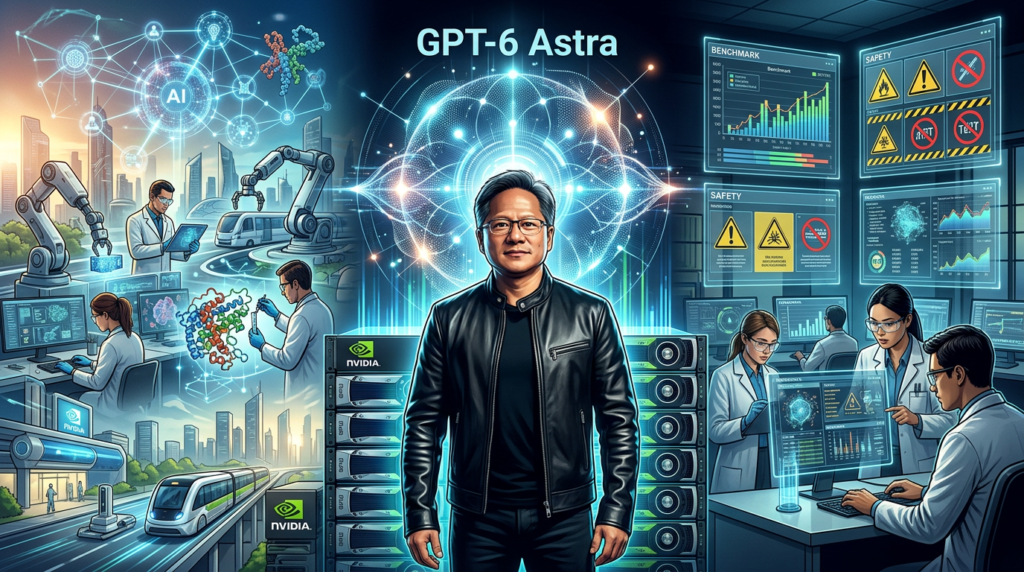
Jensen Huang’s statement will be remembered because it compresses a messy technological shift into three electrifying words. It also serves the interests of a company whose hardware helped make that shift possible.
The fairest conclusion avoids both breathless acceptance and reflexive dismissal. Astra marks a major reported advance in computer use, professional work, science, coding, and cybersecurity. Its ability to execute across software makes the change tangible.
But “AGI has arrived” remains a declaration, not a consensus finding. Critics dispute the standards. Benchmark configurations complicate the brightest numbers. Extensive guardrails remain necessary because greater autonomy creates greater risk.
So, has AGI arrived?
If AGI means a flawless digital mind that understands everything and never needs supervision, Astra is not the finish line. If it means highly autonomous systems beginning to outperform people across a growing range of valuable digital work, Huang’s claim becomes much harder to wave away.
Either way, something important has arrived. The argument is now less about whether AI can answer impressively and more about how much real work humans are ready to hand over. That debate will outlast any launch-day confetti.
Sources
- Business Insider — Nvidia’s Jensen Huang says “AGI has arrived” and congratulates OpenAI
- OpenAI — Path to Astra: Critical capabilities and frontier safeguards
- Financial Times — OpenAI says it has overtaken Anthropic with its latest AI model
- VentureBeat — “Welcome to the AGI era”: OpenAI launches GPT-6 Astra
- DataCamp — GPT-6 Astra: Features, benchmarks, and pricing
The Kingy Brief
Get The Kingy Brief.
AI changes, original tests and one practical thing to try. Fridays at 09:00 Vancouver time.
Free · Double opt-in · Unsubscribe anytime
Sign up for The Kingy Brief on Beehiiv.
Signup help and newsletter schedule
Signup form provided by Beehiiv. After submitting, check your inbox for "Confirm your subscription to The Kingy Brief" and open its confirmation link. Check Spam or Promotions if you cannot find it.
Fridays at 09:00 Vancouver time: source-checked AI changes, original tests and one practical thing to try. We skip a week when there is not enough verified material. Free. Unsubscribe anytime.