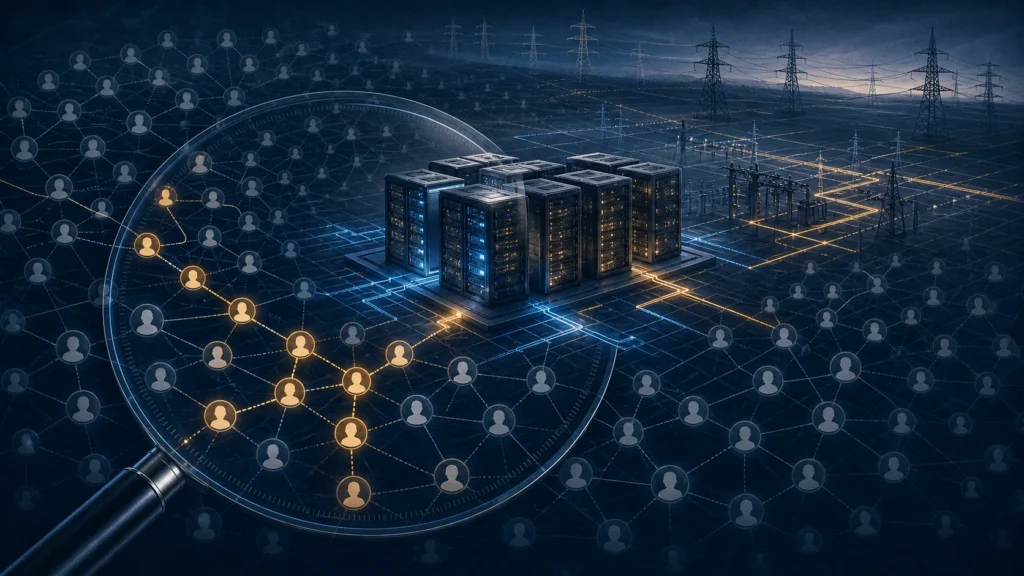
X says it dismantled a vast China-linked network, but its public disclosure does not establish who operated it, whether it was state-directed, or whether 200 energy-policy accounts influenced anyone.
Executive summary
X’s Safety team says it identified approximately 200,000 suspected Chinese inauthentic accounts, including 200 that posted about American AI data centers, household electricity costs and grid reliability. The disclosure is genuine: X published it through its official Global Government Affairs account on August 28, 2026 UTC—August 27 in Pacific time. Read X’s official statement.
The announcement nevertheless leaves most of the questions needed to evaluate its significance unanswered.
The 200 energy-policy accounts represented just 0.1% of the reported farm. X did not say what the other 199,800 accounts did, how many were actually automated, when the network operated, how much it posted, how many people it reached, or how the company attributed it to China. The post included no account handles, dataset, technical indicators or engagement measurements.
An earlier OpenAI investigation provides substantial context. In June, OpenAI described a likely China-origin campaign it called “Data Center Bandwagon.” Operators using Simplified Chinese and VPNs asked ChatGPT to produce English-language comments, cartoons and edited images posing as American criticism of data centers. OpenAI assessed that the operators were probably employees of a private Chinese technology company working for provincial-government clients. It did not establish a direct command relationship with the Chinese central government. Read OpenAI’s June 2026 threat report.
The close similarity between OpenAI’s report and X’s later announcement strongly suggests that the companies identified overlapping activity. That is an inference, however: X did not name “Data Center Bandwagon” or explicitly connect its 200 accounts to OpenAI’s investigation.
Most importantly, OpenAI found that the campaign attracted little authentic engagement. There is currently no public evidence that it changed public opinion, affected a permitting decision or penetrated an authentic American political community.
The underlying energy concerns were not fabricated. Government agencies, regulators and grid operators confirm that data-center growth is increasing electricity demand, contributing to tighter capacity markets and creating cost-allocation risks. Whether those costs reach household bills depends heavily on geography, market design, utility tariffs and regulatory decisions.
The defensible conclusion is therefore narrower than the headline: there is credible evidence of a likely China-origin operation attempting to exploit a real American dispute. There is not yet public evidence that a Chinese government-directed army of 200,000 bots successfully manipulated that dispute.
What X says it found
X’s statement makes three principal claims:
- Its Safety team investigated “suspected Chinese inauthentic accounts involved in influence operations.”
- It identified a “bot farm” of approximately 200,000 accounts.
- Within that farm, 200 accounts posted about AI data centers, electricity prices and grid strain, including AI-generated cartoons portraying operators as profiteers.
X said it suspends accounts violating its Authenticity policy, but its wording does not unambiguously say that all 200,000 accounts were suspended. Nor does it explain whether “bot farm” means fully automated accounts, manually operated fake personas, dormant inventory, compromised accounts or a mixture.
That distinction matters. X’s Authenticity policy covers unauthorized automation, mass registration, fake personas, duplicate posting, coordinated engagement and ban evasion. An account can therefore be inauthentic without being a software-controlled bot.
The scale also needs careful framing. Only 200 of the reported 200,000 accounts—one in every thousand—were tied publicly to the AI-energy narrative. The remainder may have supported other campaigns, carried ordinary spam, remained dormant or served as replacement inventory. X did not say.
As of the announcement, X had not publicly supplied:
- The accounts’ creation or active dates.
- Representative handles or posts.
- Posting languages.
- Total post volume.
- Views, reposts, likes or authentic replies.
- Geographic or infrastructure indicators.
- The proportion using automation.
- Evidence that one operator controlled the entire farm.
- A downloadable research archive.
There is an additional historical puzzle. In August 2019, Twitter disclosed a PRC-origin operation targeting Hong Kong. It released data on 936 active accounts and said it had also suspended a “larger, spammy network of approximately 200,000 accounts.” Read Twitter’s 2019 disclosure.
The identical rounded figure does not prove the two disclosures concern the same network. X’s new post does not mention the 2019 operation. But the coincidence makes it especially important for X to clarify whether the new figure represents newly discovered accounts, a continuation of an old network, or an independently estimated farm of similar size.
What the available evidence proves—and does not prove
OpenAI’s “Data Center Bandwagon” investigation supplies the strongest publicly available operational evidence.
OpenAI said the operators:
- Accessed ChatGPT through VPNs because its services were not available in China.
- Prompted predominantly in Simplified Chinese.
- Requested English- and Chinese-language material.
- Asked the model to create American personas representing workers, students, mothers, clerks and investors.
- Generated comments, cartoons and edited images criticizing data centers.
- Used content from legitimate regional reporting about capacity auctions.
- Requested code to automate login and interaction management.
- Maintained backup accounts and separated operational activity to avoid coordination detection.
- Prepared internal reports about building credible personas, using hashtags, groups and advertising, and preserving account longevity.
The cluster also sought material targeting overseas Chinese dissidents. That wider activity supports the assessment that this was more than ordinary commercial spam.
OpenAI judged the operators likely to be a social-media team inside a private Chinese technology company working for provincial-government clients. That is stronger than merely locating an IP address in China. It is still not the same as identifying a Chinese intelligence agency, central propaganda department or direct state command structure.
OpenAI’s evidence rests partly on private ChatGPT records and uploaded operational documents that outside researchers cannot fully reproduce. It did not publish the complete prompts, account list, technical indicators or internal documents. Its conclusion is credible but not independently auditable in the way a full evidentiary archive would be.
X’s attribution is even less specific. It says “suspected Chinese” and “influence operations,” not “Chinese government-directed.” Its public statement offers no explanation of whether attribution rested on IP addresses, device fingerprints, registration infrastructure, synchronized behavior, linguistic patterns or intelligence supplied by OpenAI.
The available evidence supports these conclusions:
- A likely China-origin cluster used generative AI to prepare covert social-media material.
- Its operators attempted to pose as Americans.
- Some of the material appeared on X through likely inauthentic accounts.
- The campaign exploited data-center electricity costs as a narrative.
- X later identified and acted against a much larger network it described as related.
The evidence does not currently establish:
- That all 200,000 accounts were automated.
- That all were controlled by one entity.
- That the Chinese central government directed the network.
- That 200,000 accounts discussed AI or energy.
- That the campaign materially influenced American opinion or policy.
How the alleged network operated
The documented workflow combined content generation with persona management.
OpenAI found requests to generate short comments in bulk, create illustrations, edit existing images and prepare data for spreadsheets. The operators also sought help extracting usernames, adding X or YouTube links and automating account interactions.
Their operational planning was more sophisticated than the finished content. Internal work reports emphasized slowly developing credible lifestyle personas, mixing ordinary and political posts, creating backup accounts and using cross-account interactions to simulate organic engagement.
That pattern helps explain why an operation might control a large reserve of accounts while using only 200 on one issue. Influence infrastructure is reusable. Accounts can be aged, warmed with harmless content, reassigned to new narratives or held as replacements after suspensions. Some may also exist primarily to follow, like or repost rather than publish original political material.
Those explanations remain hypotheses for X’s 200,000-account network because X has not released the behavioral data needed to confirm them.
Fact-checking the AI data-center energy claims
The campaign’s inauthenticity does not make its electricity claims false.
The Department of Energy’s Lawrence Berkeley National Laboratory estimated that US data centers consumed approximately 176 terawatt-hours in 2023—4.4% of national electricity use. It projected consumption of 325–580 terawatt-hours by 2028, or 6.7%–12% of US electricity. Read the DOE’s December 2024 summary.
The International Energy Agency expects data centers to account for nearly half of US electricity-demand growth through 2030. Because facilities are geographically concentrated, their local grid effects can be much greater than their national share suggests. Read the IEA’s Energy and AI executive summary.
The Energy Information Administration reported in March 2026 that data centers were driving near-term demand growth. Its modeling found that most regions could absorb faster growth, but warned that insufficient supply could produce wholesale-price spikes and, in extreme cases, rolling outages. ERCOT showed the largest modeled price sensitivity. Read the EIA’s March 2026 analysis.
PJM, which coordinates electricity markets across 13 states and Washington, D.C., has been more direct. It calls data centers the primary driver of its load growth and says new facilities can be developed two or three times faster than the generation needed to serve them. Its regional capacity-auction price rose from $28.92 per megawatt-day for 2024–25 to $269.92 for 2025–26, although generator retirements, market rules and slow supply additions also contributed. Read PJM’s auction results.
PJM’s independent market monitor estimated that actual and forecast data-center demand increased capacity-market revenues by a combined $23.1 billion across three delivery-year auctions. For the 2026–27 and 2027–28 auctions, it calculated increases of 82.1% and 65.5%, respectively. Read Monitoring Analytics’ 2025 State of the Market report.
Those are wholesale capacity costs, not direct measurements of household-bill increases. Whether and how they reach residential customers depends on state regulation, utility procurement and rate design.
Some jurisdictions are trying to prevent cost shifting. Georgia allows special terms for customers exceeding 100 megawatts, including longer contracts, minimum bills and recovery of site-specific and upstream infrastructure costs. Its Public Service Commission says these measures are intended to keep existing customers from subsidizing data centers. Read the Georgia PSC’s data-center rule.
In June 2026, the Federal Energy Regulatory Commission ordered all six regional grid operators under its jurisdiction to justify or reform their large-load connection rules, explicitly citing ratepayer protection, transparency and the prevention of cost shifting. Read FERC’s large-load proceeding.
The accurate verdict is therefore:
- “Data centers increase electricity demand”: True.
- “They can strain regional planning and capacity”: True, especially in concentrated markets.
- “They are raising every American household’s bill”: Unsupported as a universal claim.
- “Ordinary customers may bear some costs”: Credible in markets without adequate cost allocation.
- “Data centers always enrich operators at the public’s expense”: Political framing, not a factual conclusion.
Why this debate is vulnerable to manipulation
Data centers sit at the intersection of several genuine conflicts: national AI competitiveness, household affordability, utility investment, reliability, water use, local land decisions and public subsidies.
That makes the issue attractive to an influence operator. The campaign does not need to invent a false controversy. It can take authentic evidence, remove qualifications, attach emotional imagery and present coordinated repetition as grassroots consensus.
OpenAI assessed that the operation sought to link American technology policy to everyday economic anxiety and distrust of institutions. That interpretation is plausible, but motive should remain qualified. Other possibilities include testing account penetration, satisfying a provincial client, damaging American technology companies or building reusable personas for later campaigns.
The operation’s AI-generated cartoons compressed a complicated capacity-market dispute into a moral accusation. One disclosed cartoon carried the headline “Electricity Price Hikes!” and showed server racks and an AI robot consuming power while money flowed toward a smiling businessman. A distressed family held a large electricity bill beneath captions including “AI & Data Centers Profit!” and “Average Families Pay More!”
The image is crude, but strategically useful. It requires little policy knowledge, travels without explanatory context and turns a disputed cost-allocation problem into an immediate victim-and-profiteer story. OpenAI also documented a generic data-center image edited with the claim that AI’s costs were being borne by ordinary people.
Independent reporting found that one cartoon was made to resemble content from a Maryland news outlet and showed a cigar-smoking tycoon carrying bags of cash. Read The New York Times’ July investigation.
Measuring the campaign’s actual reach and impact
This is where the most dramatic interpretations break down.
OpenAI concluded that “Data Center Bandwagon” gained little authentic engagement. It provided no evidence of changes in public opinion, policy or media coverage caused by the accounts. X’s announcement supplies no engagement measurements at all.
The infrastructure’s potential scale should not be confused with demonstrated influence:
| Measure | What is publicly known |
|---|---|
| Infrastructure | X reports approximately 200,000 accounts |
| AI-energy participants | X identifies 200 accounts |
| Content volume | Not disclosed |
| Audience reach | Not disclosed |
| Authentic engagement | OpenAI says it was limited |
| Cross-platform activity | OpenAI documents planning for multiple platforms |
| Policy or opinion impact | No public evidence |
The strongest conclusion is that the operation had intent and infrastructure but unproven impact.
Comparison with earlier influence operations
The behavior resembles previously documented PRC-linked networks, particularly Spamouflage, also called Dragonbridge: large numbers of low-quality accounts, rapid pivots to wedge issues, fake American personas, cross-platform posting and extensive production with little organic response.
Google reported disrupting more than 175,000 instances of Dragonbridge activity by early 2024. Eighty percent of the 57,000 YouTube channels removed in 2023 had no subscribers, and most videos received fewer than 100 views. Read Google’s Threat Analysis Group report.
Meta described Spamouflage as the largest known cross-platform covert influence operation and linked parts of it to individuals associated with Chinese law enforcement. Meta published account counts, platform coverage and attribution findings. Read Meta’s 2023 threat report.
Microsoft has likewise documented China-affiliated actors using AI-generated imagery and fake personas to explore American political divisions, while finding little evidence that the material changed opinions. Read Microsoft’s Threat Analysis Center report.
X’s one-post disclosure is thinner than those reports—and thinner than Twitter’s own 2019 practice, when it published an archive containing account and post data for researchers.
Platform-policy and democratic implications
Suspending coordinated fake accounts is consistent with protecting authentic debate. Enforcement should be based on deceptive behavior—mass registration, fabricated identities, automation and artificial amplification—not on opposition to data centers.
X should publish:
- A representative account archive.
- Creation and activity dates.
- Post and engagement distributions.
- The proportion judged automated.
- Attribution confidence and supporting indicator classes.
- Any connection to the 2019 200,000-account network.
- Whether OpenAI’s campaign and X’s 200 accounts are the same operation.
- Cross-platform indicators that other services can use.
Platforms should preserve removed material for qualified researchers, share technical indicators across companies and label attribution confidence explicitly. Regulators should continue developing tariffs that assign infrastructure risks to the customers creating them.
The parallel danger is overreaction. Officials and technology companies should not cite foreign amplification to dismiss residents concerned about power, water, noise, land use or subsidies. Doing so would hand an influence operator an additional success: making authentic Americans appear suspect merely because deceptive accounts repeated similar claims.
Unanswered questions
- When did X’s 200,000 accounts begin operating?
- Were all of them controlled by one operator?
- How many were automated rather than manually managed?
- What did the other 199,800 accounts do?
- What evidence supports attribution to China?
- Was a government entity involved directly?
- How many AI-energy posts were published?
- How many authentic users saw or engaged with them?
- Did the accounts enter genuine local communities?
- Did X preserve and share the evidence?
- Is the network connected to the 200,000 accounts disclosed in 2019?
- Did it operate on Facebook, YouTube, Reddit or other platforms?
- Are related accounts still active?
Conclusion
X’s disclosure points to a real platform-integrity problem, but the public evidence does not support the broadest version of the story.
A likely China-origin operation used generative AI, fake personas and coordinated accounts to insert itself into the American data-center debate. Its operators appear to have had links to a private Chinese technology company serving provincial-government clients. That activity warranted investigation and enforcement.
But only 200 of the reported 200,000 accounts were publicly tied to this narrative, state direction remains unproven, and measurable influence appears minimal. Meanwhile, authoritative energy evidence confirms that data centers are creating genuine demand, reliability and cost-allocation challenges.
The correct response is neither to ignore the operation nor to dismiss the underlying debate as foreign propaganda. It is to demand authenticity from participants, transparency from platforms and evidence-based energy policy from government and industry.
Source audit
| Category | Source | Evidentiary role |
|---|---|---|
| Primary | X Global Government Affairs | Original 200,000/200-account claim |
| Primary | OpenAI June 2026 threat report | Operator, tactics, content and engagement assessment |
| Primary | X Authenticity policy | Definition of prohibited inauthentic behavior |
| Primary | Twitter’s 2019 Hong Kong disclosure | Historical 200,000-account network and earlier transparency practice |
| Primary | US Department of Energy | National data-center consumption estimates |
| Primary | International Energy Agency | US and global demand projections |
| Primary | US Energy Information Administration | Regional load, price and reliability modeling |
| Primary | PJM | Grid-operator assessment of data-center load |
| Primary | Monitoring Analytics | Independent calculation of PJM capacity impacts |
| Primary | FERC | Federal response to cost shifting and integration |
| Independent | The New York Times | Independent reporting on cartoons and foreign amplification |
| Independent | Alethea | Broader state-media and coordinated-activity context |
| Contextual | Google TAG | Comparison with Dragonbridge reach and tactics |
| Contextual | Meta | Comparison with Spamouflage attribution and disclosure |
| Contextual | Microsoft MTAC | Comparison with China-affiliated AI influence activity |
Research and source verification completed August 27, 2026 Pacific time. This article distinguishes platform allegations, independent corroboration and informed inference throughout.
The Kingy Brief
Get The Kingy Brief.
AI changes, original tests and one practical thing to try. Fridays at 09:00 Vancouver time.
Free · Double opt-in · Unsubscribe anytime
Signup help and newsletter schedule
Signup form provided by Beehiiv. After submitting, check your inbox for "Confirm your subscription to The Kingy Brief" and open its confirmation link. Check Spam or Promotions if you cannot find it.
Fridays at 09:00 Vancouver time: source-checked AI changes, original tests and one practical thing to try. The weekly restart begins October 9, 2026. We skip a week when there is not enough verified material. Free. Unsubscribe anytime.