
Your Glasses Could Become the Event Photographer
Imagine hosting a dinner party. Nobody reaches for a phone. Nobody lines up the group and shouts, “Wait, Brenda blinked—take another one!”
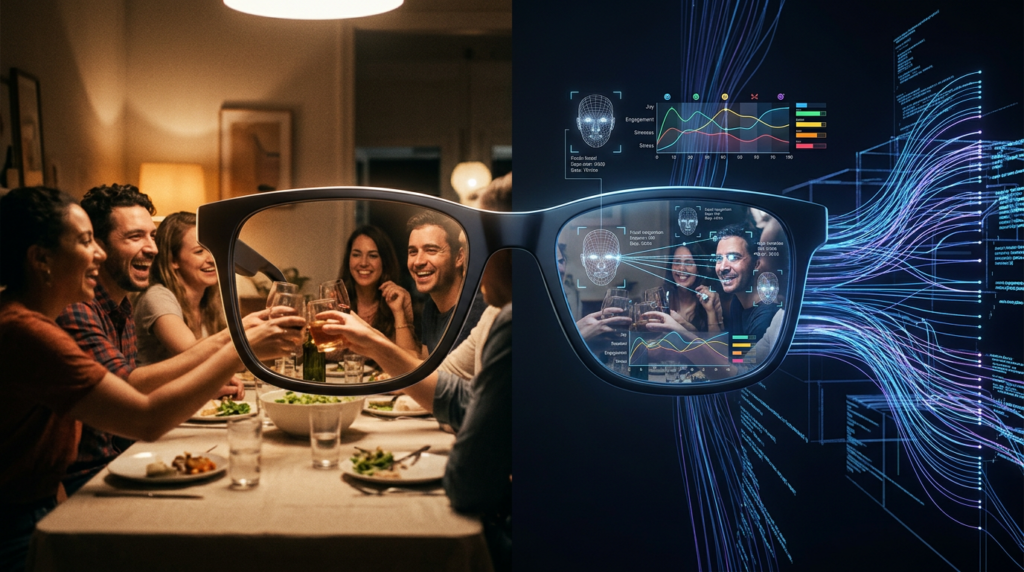
Instead, your glasses quietly study the room. They recognize your spouse, notice two friends laughing, follow where you are looking and capture the moments an AI system considers important. Later, the glasses offer a ready-made collection of highlights.
That scenario sits at the heart of a recently published Meta patent application concerning AI-powered camera systems. The technology could identify people using facial recognition, detect their actions and expressions, and organize selected photos or videos into personalized highlight reels.
Convenient? Absolutely.
Potentially unsettling? Oh, very much so.
The system promises to turn wearable cameras into intelligent memory assistants. However, it would also require those cameras to analyze people who may never have agreed to participate. Your glasses might belong to you, but the faces appearing in their field of view certainly do not.
Reports from Tom’s Guide, PCMag and other outlets have therefore raised a fairly gigantic question: When cameras begin interpreting the world continuously, where does ordinary photography end and ambient surveillance begin?
First, This Is a Patent Application—not a Product Launch
Before anyone begins checking their houseplants for hidden Ray-Bans, one distinction matters.
Meta has not announced that these features are coming to its existing smart glasses. The relevant US patent application, titled “Smart Cameras Enabled by Assistant Systems,” was published on August 13, 2026, as US 2026/0238876 A1. Meta filed it on February 4, 2026, as a continuation of an earlier application.
A patent application protects a technical concept. It does not prove that the company has built, approved or scheduled a consumer product. Technology companies routinely patent systems that remain inside filing cabinets forever, where they peacefully gather legal dust.
The application also describes a broad camera-assistant architecture. Its possible client devices include augmented-reality glasses, smartphones and smart displays. Ray-Ban Meta glasses provide an obvious real-world comparison, but the filing does not amount to a newly announced “Ray-Ban Face ID” feature.
That point is important because some online commentary has raced several laps ahead of the evidence. One DEV Community post, for example, describes specific hardware, software controls and APIs that the actual filing and stronger reporting do not establish. Those claims should not be treated as confirmed product specifications.
The real patent is already fascinating enough. It does not need decorative fiction bolted onto the temples.
How the Proposed Camera Assistant Works
The basic pipeline sounds simple, although the machinery underneath it would be anything but.
One or more cameras collect visual or sensory information. Machine-learning models then examine that information to locate “points of interest” within the camera’s field of view. A point of interest might be a person, an object, an action or an especially lively part of a scene.
The system could identify people through facial-recognition algorithms. It could separately detect what those people are doing—walking, picking something up or interacting with others. It would then generate media files associated with the recognized people, their actions or both.
Instead of handing the user several hours of unorganized footage, the assistant would deliver selected clips to a connected device for review. Think of it as an automated editor who never needs coffee, never loses an SD card and may know far too much about your social circle.
The filing also describes reactive and proactive behavior. In one scenario, a user explicitly asks the assistant to capture the best moments of a party. In another, the system may notice something potentially interesting and take action based on signals such as the wearer’s gaze.
That shift—from obeying the photographer to interpreting the photographer—is where the idea becomes genuinely significant.
AI Gets to Decide What Counts as Interesting
Traditional cameras capture what a person deliberately points them toward. Meta’s proposed system adds another layer: judgment.
The assistant could use scene understanding, facial expressions, actions and eye-gaze information to estimate which moments deserve attention. If two guests begin laughing, the system could classify that reaction as interesting and adjust the composition around them.
It could also improve the footage. The patent materials discuss automated cropping, centering, stabilization, noise reduction and adjustments to color, brightness or sharpness. Blurry or poorly lit material might receive a low score. Cleaner and more vivid images could rise into the final highlight collection.
That sounds like the familiar intelligence inside modern smartphone galleries—until you remember where the camera is located. Glasses naturally point wherever their wearer looks. They do not need to be pulled from a pocket, raised toward a subject and held in an unmistakable recording position.
The system may still require a command before saving media in some examples. However, analysis can happen before or around that command. A device may need to inspect faces, movements and expressions first so it can decide what is worth capturing.
In other words, pressing “record” may no longer mark the beginning of the interesting part.
Your Social Graph Could Direct the Camera
The proposed assistant would not judge every face equally.
According to the filing and the Tom’s Guide report, “user relationship data” could help personalize the finished highlights. Connections in a social graph might tell the system that certain people matter more to the wearer than others.
At a gathering, the assistant could therefore prioritize close friends or family members. It might center one person while cropping or blurring others in the background. The technology would not simply ask, “What happened?” It would also ask, “Who does this user care about?”
That could produce more meaningful photographs. Parents might receive better clips of their children. Travelers could locate moments involving particular companions. Someone who struggles to operate a camera could capture an event without constantly fiddling with controls.
Yet personalization creates a social ranking system inside the lens. The camera may quietly divide a room into central characters, supporting cast members and algorithmic wallpaper.
People already perform this selection when taking photographs. The difference is that a human photographer understands context, can request permission and can explain a choice. An automated system may rely on incomplete social data—and algorithms are famously bad at understanding that your cousin is technically a close connection but currently banned from discussing cryptocurrency at dinner.
The Glasses Could Search Your Personal Past

Meta’s concept extends beyond making a highlight reel. It also describes linking newly captured moments with the wearer’s “episodic memories.”
In one patent example covered by Tom’s Guide, the user asks whether they previously met a man wearing a red shirt. The system searches older posts, comments, images and videos. It then retrieves a group photograph showing that both people attended an earlier conference.
That is a powerful idea. Digital memories currently sit in scattered galleries, social-media archives and forgotten folders named things like “Photos Final FINAL 3.” An AI assistant could transform that mess into a searchable personal history.
The wearer might ask:
“Where did I meet this person?”
“When was the last time I visited this restaurant?”
“Do I have another photograph of this painting?”
For people with memory difficulties, the feature could provide meaningful assistance. For everyone else, it could eliminate the awkward conversational dance of pretending to remember somebody while desperately searching the mental filing cabinet.
However, memory retrieval requires memory storage. The system becomes more useful as its archive grows—and more sensitive as it connects faces, places, relationships and past interactions.
A searchable memory is still a database. It just wears nicer frames.
The Consent Problem Lives Outside the Glasses
The wearer can choose whether to buy smart glasses. Everyone standing nearby cannot make the same choice.
That imbalance drives the strongest ethical criticism. The camera might identify a person, study their expression, connect them to a social graph and classify their behavior before they understand that any analysis is happening.
The Bioethics.com summary places the story under both emerging technology and informed consent, which neatly captures the central collision. The technology acts on information extracted from multiple people, but control primarily rests with one—the wearer.
A friend may tolerate appearing in a photograph but object to facial recognition. A colleague may consent to a recorded meeting but not to emotion analysis. A stranger might accept neither.
Those distinctions become difficult to communicate when the device resembles ordinary eyewear.
The patent does refer to privacy settings and policies in parts of its description. That shows the designers recognize privacy as a system requirement. Yet a wearer-controlled setting does not automatically solve the bystander’s problem.
Meaningful consent usually requires awareness, choice and enough information to understand what will happen. A tiny light can indicate that a camera is recording. It cannot easily explain that software may be identifying faces, interpreting expressions and linking the result to an existing personal archive.
That is quite a lot of legal fine print for one blinking LED.
The Recording Light May Not Tell the Whole Story
Current Ray-Ban Meta glasses use a white capture light to signal when the wearer takes a photo or records video. Meta has also said that covering or disabling that light can disable the camera.
That safeguard makes deliberate recording more visible. It does not fully answer questions about the analysis that may occur before media gets saved.
If an assistant must inspect a scene to determine whether someone is laughing, whether the wearer recognizes that person or whether the moment deserves a place in a highlight reel, some form of processing has already occurred. Even if the system immediately discards most frames, it has still evaluated the people inside them.
This creates a tricky boundary.
Does temporary machine analysis count as meaningful observation if nothing enters the permanent gallery? Does local processing feel less invasive than cloud processing? Should an indicator activate whenever facial recognition runs, even if the camera saves nothing?
Those are not purely technical questions. They concern social expectations.
A visible phone usually announces, “I may be filming.” Ordinary-looking glasses announce, “I require corrective lenses.” Adding continuous computer vision changes that social meaning while preserving the familiar disguise.
The technology can follow formal recording rules and still surprise the room. Privacy does not depend solely on what a device stores. It also depends on what people reasonably believe the device is doing.
Meta’s Earlier NameTag Experiment Adds Context
The concern is not based entirely on patent diagrams.
As Tom’s Guide and PCMag note, researchers previously found unreleased facial-recognition code for a feature called NameTag inside Meta’s companion app. Reports said the experimental system could create biometric representations from faces seen through the glasses and compare them with data stored on the wearer’s phone.
Meta said the feature was not available to consumers. The company removed the relevant code after the investigation became public.
That episode does not prove that the newly published camera system will ship. It does show that facial recognition for wearable devices has existed beyond casual speculation inside Meta’s development orbit.
The patent supplies a broader architecture around that capability. Facial identification could feed into action detection, automated composition, personalized highlight creation and memory retrieval. One technical component becomes part of a complete life-logging machine.
Meta is also facing scrutiny over its glasses in Europe. Tom’s Guide reports that German digital-rights organization HateAid filed a criminal complaint involving Meta and companies selling the glasses in Germany. A complaint is not a legal judgment, but it demonstrates how quickly wearable cameras can attract regulatory attention.
The company would therefore need more than a clever demo. It would need convincing answers about consent, biometric processing, storage, security, deletion and the rights of people who never purchased the device.
The Technology Has Real Benefits
It would be easy to dismiss the whole concept as a rejected episode of Black Mirror. That would also miss why somebody might genuinely want it.
Hands-free capture is useful. A parent can remain engaged during a birthday instead of watching the celebration through a phone screen. A traveler can experience a location while still preserving selected memories. Someone with limited mobility could control a camera through voice, gaze or simple gestures.
Automated editing also tackles a real problem: people produce more media than they can reasonably review. An assistant that removes duplicates, rejects blurry clips and organizes the rest could save hours.
The memory-search component may deliver accessibility benefits too. It could help people recall names, reconstruct earlier encounters or retrieve important visual information. Even ordinary users sometimes need help remembering whether they met “the guy in the red shirt” at a conference or merely stood behind him in a sandwich queue.
The strongest version of this product would minimize data collection, perform sensitive processing locally and give both wearers and bystanders clear control. It would also make deletion simple and resist turning personal memories into advertising signals.
Those requirements are not glamorous. Nobody queues overnight for “transparent retention settings.” Still, they may determine whether intelligent glasses become trusted assistants or socially radioactive accessories.
Online Hype Is Already Outrunning the Filing
The coverage surrounding Meta’s application also offers a useful lesson in reading patent news.
Several reports accurately describe an AI camera system that can recognize people, detect actions and generate personalized media. However, some commentary transforms those concepts into a nearly finished consumer product with named hardware components, specific menus and functioning developer interfaces.
The supplied DEV Community article goes especially far, describing technical features and instructions that stronger sources do not substantiate. Its certainty that real-time identification sits on the “near horizon” also exceeds what a patent application can demonstrate.
Meanwhile, the Bitcoin Ethereum News report focuses more reasonably on the application’s central workflow: cameras collect footage, facial recognition identifies people, action analysis labels behavior and the assistant produces organized clips.
Readers should apply a simple test. Ask whether an article describes:
- What the patent explicitly proposes
- What reporters reasonably infer
- What Meta currently sells
- What an author merely predicts
Mixing those categories produces dazzling headlines and terrible understanding.
Meta may eventually ship parts of this system. It may modify them beyond recognition. It may abandon them. A patent reveals strategic imagination, not a delivery schedule.
The Bigger Shift Is From Cameras to Interpreters
The most important part of Meta’s filing is not facial recognition alone. Smartphones and photo libraries have offered versions of that technology for years.
The bigger change is agency.
A normal camera waits. This assistant watches, evaluates, selects, remembers and retrieves. It transforms visual capture from a deliberate act into an ongoing collaboration between a person and an algorithm.
That could make photography more natural. It could also make observation less visible.
If devices begin deciding what deserves preservation, their designers must answer deeper questions. What behaviors count as interesting? Whose relationships influence the ranking? Can someone remove themselves from another person’s memory archive? What happens when recognition is wrong? And who bears responsibility when an automated clip escapes its intended audience?
These issues will not disappear because the processing happens inside fashionable frames.
Meta’s patent application does not prove that facial-recognition glasses will reach stores. It does, however, show how the company is thinking about AI-powered cameras: not merely as tools that record what users request, but as assistants that interpret the world on their behalf.
The sales pitch practically writes itself: never miss a meaningful moment again.
The privacy question follows immediately: meaningful to whom?
Sources
- Tom’s Guide — Meta files patent for AI facial-recognition glasses
- PCMag — Meta wants to patent technology for facial-recognition smart glasses
- Bioethics.com — Meta patent raises facial-recognition and informed-consent questions
- Bitcoin Ethereum News — Meta patents cameras that recognize faces and log actions
- DEV Community — Commentary on Meta’s smart-glasses patent
- Google Patents — “Smart Cameras Enabled by Assistant Systems”
The Kingy Brief
Get future Kingy Brief editions.
Source-checked AI changes, original tests and one practical thing to try.
Free · Choose your subjects · Double opt-in · Unsubscribe anytime
Regular sending is paused; no restart date is set.