
Kingy’s 6:14 hands-on video shows the retail Starfire unit being worn and handled, a query answered in the Kylie voice, a hands-free photo command, a French-and-English exchange, setup screens and a daylight point-of-view clip captured by the glasses. That is enough to judge the concept, styling and kind of footage Starfire records. It is not enough to claim all-day comfort, measured battery life, low-light superiority, translation accuracy or a hardware win over Ray-Ban Meta Gen 2.
Disclosure: Curtis Pyke purchased the Starfire unit shown in Kingy’s review. This review was not sponsored. Meta, LensCrafters and EssilorLuxottica had no editorial control or pre-publication approval.
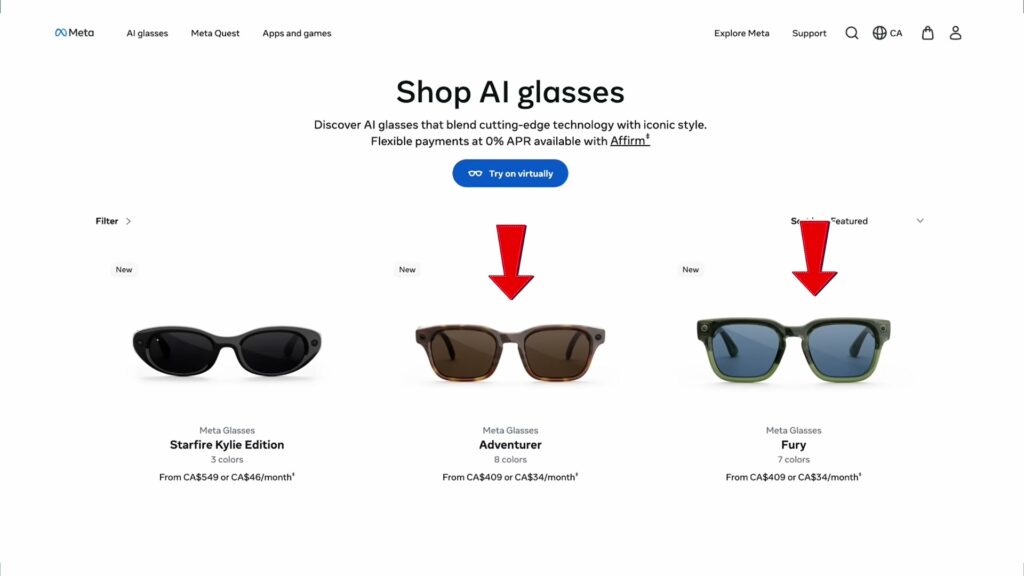
Price checked August 16, 2026: Meta lists Starfire from US$399 on its US comparison page and CA$549 on its Canadian product page. Lens choices and prescriptions can raise the total. Seller pricing and stock can change.
Quick verdict
Starfire is the most distinctive member of Meta’s first own-brand glasses line, but its strongest argument is design rather than a leap in core performance. The slim oval silhouette, glossy finish, small gem, three-way adjustable nose pads, adjustable temple tips and over-extension hinges make it a more fashion-led alternative to a Ray-Ban Wayfarer. The Kylie voice also plays in Kingy’s demonstrated setup, so the collaboration goes beyond the name on the box.
The value case is narrower. Meta’s own comparison page gives Starfire the same nominal 12MP, 100-degree camera and the same 3K/30 fps ceiling as the US$299 Adventurer and US$379 Ray-Ban Meta Wayfarer Gen 2. Starfire adds six microphones versus five on the Wayfarer, edition-specific styling and the Kylie voice, but its case is rated for 40 additional hours versus 48 for Wayfarer Gen 2. Buy it because this is the pair you want to wear, not because “Kylie Edition” means faster hardware.
What Meta Starfire is – and what it is not
Meta Starfire Kylie Edition and Meta Glasses by Kylie are names for the same product. Starfire is the retail/model name; “by Kylie” describes the collaboration. It launched alongside Meta Adventurer and Meta Fury as part of the 2026 Meta Glasses line developed with EssilorLuxottica.
These are displayless smart glasses. They combine a camera, microphones, open-ear speakers, touch and button controls, Bluetooth/Wi-Fi connectivity and Meta AI. They can take photos and video, play audio, handle calls and messages, and answer voice queries using information from what the wearer sees or hears when supported.
They are not augmented-reality display glasses. There is no floating screen, visual prompt, private monitor or image projected into the lens. Meta’s own comparison page lists “No display.” If your goal is a virtual screen or glanceable visual directions, this is the wrong product category.
Starfire is a camera-and-assistant product, not a private display. For the opposite approach—a tethered $299 pair built around games, streaming and a large virtual screen—read our VITURE Pro 2 display-glasses review.
What Kingy actually tested
Kingy’s video is a focused hands-on review of one Starfire unit. It does not provide laboratory measurements or cover every Adventurer, Fury or Ray-Ban configuration.
The review’s most useful video moments are:
- 0:26 – the Meta Starfire Kylie Edition
- 1:09 – Kylie Jenner voice demonstration
- 1:42 – photo command and point-of-view AI discussion
- 2:10 – French-and-English sequence
- 3:03 – daylight Starfire camera sample
- 3:31 – frame styling and Kylie details
- 4:17 – hardware specifications
- 5:30 – comparison and verdict
This evidence boundary matters. The footage can show that the voice option works in one interaction and that the glasses record usable daytime point-of-view video. It cannot turn Meta’s battery or camera specifications into independent test results.

Design and fit are the real upgrade
At 3:31 in the video, Curtis handles the frame close enough to show its narrow oval outline and glossy finish. Starfire looks deliberately different from the square, recognizable Wayfarer shape. The small gem near the lens is visible, and Meta’s comparison page identifies it as an edition-specific detail.
The adjustability is more consequential than the gem. Meta specifies three-way adjustable nose pads, adjustable temple tips and over-extension hinges. That gives an optician or careful wearer more room to tune the fit than a fixed plastic bridge. It does not guarantee comfort: Starfire remains a one-size-fits-most frame, and Kingy’s video does not document hours of continuous wear.
Prescription buyers have an extra decision. Meta lists a broad Rx range of -12.00 to +2.25 for Starfire, but the exact lens power and configuration available online or through an optician can differ. LensCrafters also says the gem is not included with prescription lenses. Confirm the prescription, lens treatment, final price and cosmetic result before ordering.
Kylie voice: distinctive, but not a different AI
Starfire is currently the only model on Meta’s comparison page advertised with Kylie Jenner’s voice. In Kingy’s 1:09 demonstration, Curtis asks the glasses for their specifications and receives the spoken response in that voice.
That is a genuine edition feature, but it needs a precise description. The voice is a presentation choice for Meta AI; it is not a separate Kylie-trained intelligence, a different answer engine or evidence of different silicon. Kingy demonstrated one query, not recognition accuracy, response speed or reliability across accents, noise and a large prompt set.
Meta says the 2026 Meta Glasses line launched in the US and Canada with Meta AI powered by Muse Spark, rolling out to more markets over time. Software, models and regional feature access can change after purchase. Treat the Kylie voice as a reason to choose this edition only if you like it enough to keep using it after the novelty fades.
Camera quality: useful daylight evidence, no lab victory
Meta lists a left-oriented 12MP ultra-wide camera with a 100-degree field of view. Recording modes reach up to 3K at 30 fps and 1080p at 60 fps, with adjustable stabilization in supported 1080p+ 30 fps modes. LensCrafters lists 3024 x 4032 stills, 3x digital zoom and 32GB of storage for more than 500 photos or 100 30-second videos.
Kingy’s actual Starfire clip at 3:03 shows two dogs moving through a bright backyard. The camera records the wearer’s immediate perspective without stopping to frame a phone shot. The sample is vertical, spontaneous and good enough to communicate the moment.
The clip is embedded inside an edited YouTube video, so it cannot prove the original resolution, bitrate, stabilization behavior, dynamic range or microphone quality. There is no low-light scene, controlled walking route or side-by-side phone and Ray-Ban comparison. It shows credible daylight point-of-view footage, but it cannot rank Starfire against other smart-glasses cameras.

Meta AI and translation: promising, narrowly demonstrated
The video shows a photo command and discusses contextual questions such as asking what is in view. It also includes a French-and-English exchange between Curtis and Sienna. That sequence is not a controlled live-translation test: it does not measure supported-language coverage, transcription accuracy, response delay or performance in noise.
Meta says live translation is expanding, with 14 additional languages announced at launch, but availability depends on country, account, app and rollout. Check the live support list in the Meta AI app before buying for a specific language.
The same caution applies to visual answers. Meta’s multimodal system card says these models can fabricate information and may be out of date. Use visual Meta AI for low-stakes convenience – identifying a landmark, summarizing a sign or generating ideas – and verify anything consequential. Do not rely on it for medical, legal, financial or safety-critical decisions.
Meta Starfire Kylie Edition specifications
Every figure below is a manufacturer or EssilorLuxottica-retailer specification unless the evidence column says Kingy observed it.
Starfire vs Adventurer vs Ray-Ban Meta Gen 2
This is an official-specification comparison, not a Kingy side-by-side test.
Starfire is therefore not the automatic upgrade. Against Adventurer, its US$100 premium primarily buys the Kylie design and edition experience. Against Wayfarer Gen 2, Starfire is US$20 more, adds an adjustable fit system, a sixth microphone and the Kylie voice, but gives up some rated case reserve and positive prescription range. The right choice is the pair that fits your face, prescription and taste – not the model with the most celebrity cachet.
Battery, compatibility and what is in the box
Meta rates Starfire for more than eight hours and the foldable case for up to 40 additional hours. Those are not Kingy measurements. Recording, calls, music volume, AI use, network conditions, temperature and battery age can all change endurance, so buyers who need a guaranteed full shift should wait for a controlled rundown or carry the case.
The glasses are designed around the Meta AI mobile app and a supported iPhone or Android phone. LensCrafters currently lists iOS 15.2+ and Android 10+, but an OS label alone does not guarantee every feature. You still need a supported phone, compatible Meta account, Bluetooth/Wi-Fi setup and access to the relevant service in your country. Music, messaging and AI integrations can require their own accounts.
The box includes the glasses, foldable charging case, cloth, reference guide and edition packaging with a personalized note card. Meta’s comparison page explicitly says a USB-C charging cable is not included. Add that to the purchase checklist if you do not already have a compatible cable and power source.
Privacy: the LED is notice, not consent
The camera is useful because it is always at eye level. That is also Starfire’s biggest social and privacy cost.
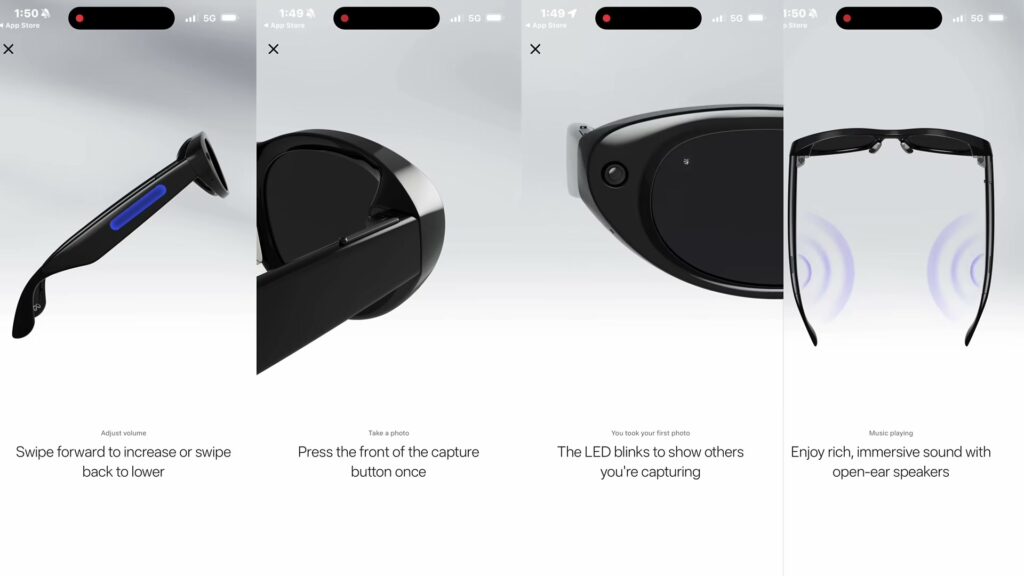
Meta says a white front capture LED blinks briefly for a gallery photo and keeps blinking during a gallery video. It has no off switch, and blocking or tampering with it disables gallery capture. The setup sequence visible at 4:39 explains the capture control and LED.
The LED is not a universal “camera active” light. Meta’s current Ray-Ban Meta FAQ says newer models can use the camera for some visual AI requests without lighting the LED because that content is not being captured for sharing. Meta also distinguishes gallery media, which remains on the glasses until import, from visual AI requests, which can send an image plus transcribed speech to the model.
That distinction may make sense inside Meta’s data architecture; it does not remove the wearer’s responsibility to other people. A light gives notice when it appears. It does not obtain consent, explain what a visual AI request is doing or override recording law and venue rules.
Meta’s own responsible-use guidance says to honor opt-outs and power the glasses off in sensitive spaces such as medical offices, locker rooms, public bathrooms, schools and places of worship. That is the right baseline. Ask before recording, stop when someone objects and remove or power off the glasses where cameras would be inappropriate.
Meta Starfire Kylie Edition FAQ
Are Meta Glasses by Kylie and Meta Starfire Kylie Edition the same?
Yes. “Meta Glasses by Kylie” is the collaboration name used in Meta’s launch material. “Meta Starfire Kylie Edition” is the retail/model name for the same slim oval frame.
Does Meta Starfire have an AR display?
No. Meta lists no display. Starfire uses a camera, microphones, open-ear speakers, voice responses and the Meta AI phone app. It cannot put directions, messages or a private screen in the lens.
Is Starfire better than Ray-Ban Meta Gen 2?
Only for certain buyers. The official pages list the same nominal camera and video ceilings. Starfire offers six microphones, adjustable nose pads and tips, an oval frame and the Kylie voice. Wayfarer Gen 2 offers classic Ray-Ban styling, multiple sizes, a wider positive prescription range and a larger rated case reserve. Kingy did not run them side by side.
Is the Kylie voice a separate AI model?
No. It is a voice option for Meta AI on the Starfire edition. It does not establish different intelligence, camera processing or hardware.
How much does Meta Starfire cost?
Meta listed Starfire from US$399 and CA$549 when checked August 16, 2026. Prescription, polarized and Transitions configurations can change the total.
Can I get Meta Starfire with prescription lenses?
Yes, subject to the supported prescription and retailer configuration. Meta’s comparison page lists -12.00 to +2.25. LensCrafters warns that its prescription version does not include the gem detail, so verify both optics and appearance before ordering.
How long does the battery last?
Meta rates the glasses for more than eight hours and the foldable case for up to 40 additional hours. Kingy did not run a timed battery test, so this review cannot confirm real-world endurance.
Does the recording LED always show when the camera is in use?
It signals gallery photo and video capture. Meta says it has no off switch and tampering disables the camera. Meta’s FAQ also says some camera-based AI features on newer glasses do not light the LED because those images are not captured for sharing. Treat the LED as a gallery-capture notice, not a universal indicator of every camera-assisted function.
Did Kingy test live translation?
Not in a controlled way. The video contains a French-and-English exchange, but it does not measure translation accuracy, supported languages, noise handling or response delay. Check current support for your language and region before buying for translation.
Final verdict
The Meta Starfire Kylie Edition succeeds at the part many smart-glasses makers underestimate: it looks like a deliberate piece of eyewear. The video supports that conclusion. It shows the real frame on two people, the Kylie voice in one interaction and credible daylight point-of-view capture without a phone in hand.
It does not support calling Starfire a major performance leap. There is no display, the camera sample is too narrow for a quality ranking, the battery figure was not measured and the official comparison gives cheaper models the same nominal camera ceiling.
Buy Starfire for the oval frame, adjustable fit, hands-free capture and Kylie voice – not for a supposed Gen 2 upgrade. If those edition features are not worth US$100 over Adventurer, choose the less expensive frame. If you want an in-lens screen, shop a different category. And if you are not prepared to handle an eye-level camera responsibly, the power switch is the feature that matters most.
Official sources
- Meta Glasses launch announcement
- Meta Starfire Kylie Edition product page
- Meta AI glasses comparison
- Meta AI glasses privacy guidance
- Meta’s capture LED and AI-glasses FAQ
- Meta multimodal generative AI system card
- LensCrafters Starfire product specifications
- Ray-Ban Meta official FAQ
- Meta Starfire Kylie Edition Canadian product page
- Kingy AI hands-on video
Related Kingy coverage
- Meta smart-glasses privacy and human-review investigation
- Meta smart glasses for blind and low-vision users
The Kingy Brief
Get the next Kingy Brief.
Source-checked AI changes, original tests and one practical thing to try.
Free · Choose your subjects · Double opt-in · Unsubscribe anytime