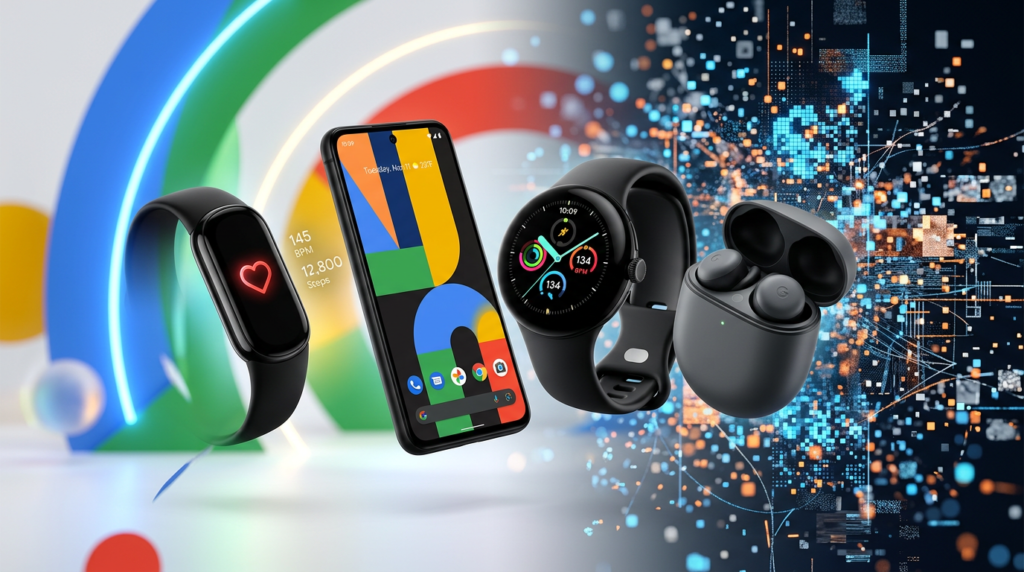
Google’s latest Pixel 11 advertising campaign was supposed to sell smartphones. Instead, it may have quietly introduced an entirely different gadget or demonstrated why letting artificial intelligence anywhere near the marketing department can produce wonderfully awkward results.
Several Google ads published on YouTube contain a mysterious wearable device. It has a slim band, a rounded rectangular screen, and an interface that looks suspiciously familiar. Yet it does not match any fitness tracker Google currently sells.
It is not the circular Pixel Watch 5. It is not the screenless Fitbit Air. It does not appear to be the aging Fitbit Charge 6, either.
So, what exactly is it?
The most tempting answer is the Fitbit Charge 7, a long-awaited successor that Google has not announced. Another possibility is a cheaper Pixel-branded wearable perhaps a Pixel Watch A-Series or Pixel Band. Then there is the strangest explanation: the product may not exist at all. It could simply be an AI-generated accessory that slipped through Google’s advertising pipeline.
Welcome to product-leak season, where every suspicious pixel becomes evidence and nobody trusts the pixels anyway.
The Mystery Hiding in Plain Sight
The wearable appeared in at least two Google Australia ads promoting the Pixel 11 family. Screenshots circulated on Reddit before technology publications began investigating the unexpected guest.
According to Tech My Money, one advertisement displays the device beside Fog-colored Pixel 11 phones and a Pixel Watch 5. Another uses a green theme and places the same tracker among Pixel phones and Pixel Buds.
That repetition matters.
If the band had appeared once, viewers could dismiss it as a generic prop, a rendering error, or a designer’s late-night espresso accident. However, the same basic product appears in different advertisements and color arrangements.
The device has a pebble-shaped body and an oblong display. Its screen reportedly shows the time 9:30 along with a heart icon and a compact interface that resembles the visual language of the Pixel Watch.
The ad promotes a “power trio” of devices for the wrist, ears, and hands. That wording presumably points to a watch, earbuds, and smartphone. Yet the mystery tracker complicates the arrangement by adding what looks like a second wrist product.
It is sitting there confidently, looking official and creating chaos without saying a word.
What the Ads Actually Reveal
The pictures offer enough detail to generate theories but not enough to confirm one. That is the perfect recipe for an internet investigation.
The tracker appears considerably narrower than the Pixel Watch 5. It avoids the familiar circular design used across Google’s smartwatch line and instead resembles a modernized Fitbit Charge. Its screen also looks larger and more rounded than the 1.04-inch display found on the Charge 6.
Gizmodo notes that the interface resembles a condensed version of Wear OS 7. That observation does not prove the tracker runs Wear OS, however. Google could simply bring Pixel Watch-inspired visuals to a lighter operating system.
The available ads reveal no visible product name. They provide no price, specifications, release date, battery claims, sensor information, or purchasing link.
Meanwhile, Google’s public store listings identify the Pixel Watch 5, the screenless Fitbit Air, and the older Fitbit Charge 6. There is no Charge 7 product page waiting behind a suspiciously unlocked digital door.
Consequently, the only hard conclusion is modest: an unannounced, screen-equipped wearable appears in multiple official Google advertisements.
Everything beyond that remains interpretation. Exciting interpretation, certainly. But interpretation nonetheless.
The Fitbit Charge 7 Theory
The obvious candidate is the Fitbit Charge 7.
Google launched the Charge 6 in 2023, making the existing model roughly three years old. In consumer-electronics time, that is not ancient, but it is old enough to receive concerned looks from newer gadgets at family gatherings.
The Charge 6 already occupies the territory suggested by the mystery device. It offers a display and fitness-focused features without adopting the larger body, richer app ecosystem, or higher price associated with a full smartwatch.
It can monitor activity, sleep, stress, and heart rate. Google also added features such as Maps, Wallet, and YouTube Music controls, strengthening the company’s pitch that the tracker combines Fitbit health tools with “Google smarts.”
The wearable shown in the Pixel 11 advertisements could represent the next step: a redesigned Charge with a larger screen, softer curves, updated sensors, and deeper integration with Google’s health software.
MobileSyrup identifies a possible Charge 7 as the most straightforward explanation. Other coverage, including the report republished by VM Virtual Machine, also focuses on the device’s resemblance to Fitbit’s screen-equipped tracker family.
Still, resemblance is not confirmation. Google has not named the product, and the Charge 7 label remains speculative.
Or Could It Be a Pixel Band?
The design raises another intriguing possibility. Google may be preparing a more affordable Pixel-branded wearable rather than another traditional Fitbit Charge.
The mystery tracker borrows visual cues from the Pixel Watch. It also appears directly beside Pixel-branded hardware in ads encouraging shoppers to unify their technology. That placement could signal something more ambitious than a routine Fitbit refresh.
Imagine a Pixel Band positioned below the Pixel Watch 5. It could deliver notifications, health data, exercise tracking, navigation prompts, and basic Google services without the size, complexity, or cost of a premium smartwatch.
Such a product would give Google a cleaner wearable ladder. The Fitbit Air could serve people who want passive, screen-free health tracking. A Pixel Band or Charge-class device could target buyers who want a display but not a full smartwatch. The Pixel Watch could remain the feature-packed flagship.
Gizmodo suggests the wearable’s positioning may indicate a cheaper alternative to the Pixel Watch rather than a conventional Fitbit. That theory makes strategic sense, but the branding remains impossible to predict.
Google could call it the Fitbit Charge 7, Pixel Band, Pixel Watch A-Series, or something entirely unexpected. Technology companies occasionally treat simple product names like a puzzle box designed by caffeinated lawyers.
Whatever its badge, the apparent middle ground is the interesting part.
Why the Fitbit Air Changes the Equation
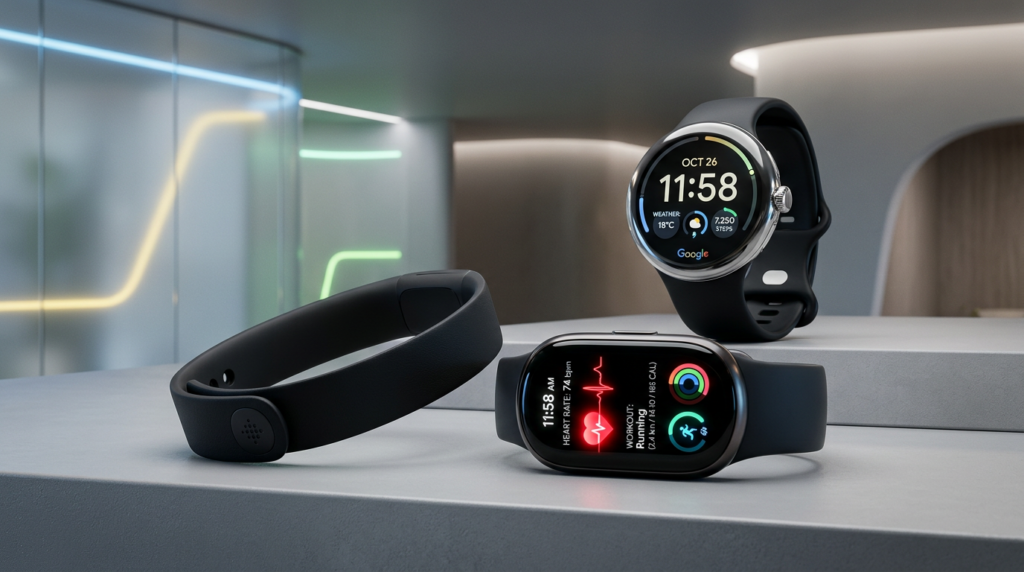
Google’s screenless Fitbit Air makes the mystery particularly curious.
The Air follows a broader wearable trend that favors discreet health tracking over constant interaction. Instead of presenting messages, app alerts, and colorful watch faces, a screenless tracker collects information while staying out of the user’s way.
That approach appeals to people who want health insights without strapping a second smartphone to their wrist. It also places the Air in the same general conversation as minimalist trackers and smart rings.
The mystery device moves in the opposite direction. It visibly includes a screen. That gives it a different job.
A display-equipped tracker can show heart-rate information, timers, workout progress, notifications, navigation cues, and basic controls without requiring users to reach for their phones. It sacrifices some minimalism but gains immediate utility.
That contrast could allow both devices to coexist. The Fitbit Air would satisfy users who want quiet data collection. The mysterious band would serve those who still want information at a glance. The Pixel Watch 5 would handle apps and the more complete smartwatch experience.
Of course, that neat three-tier strategy exists only on paper until Google confirms the device. The company may have designed a clever wearable lineup.
Or an image generator may have drawn a tiny screen where no screen belonged. Both possibilities remain alive, which is a very 2026 problem.
The AI Hallucination Theory
Here comes the plot twist: the gadget might be imaginary.
Google offers advertisers generative AI tools that can create and modify campaign assets. Gizmodo raises the possibility that Google used similar technology in its own promotional workflow and allowed an invented wearable to reach the final advertisement.
Generative image systems work by producing visually plausible results. They do not consult an internal product catalog and solemnly swear that every rendered object exists. If prompted to create a polished arrangement of Pixel phones, earbuds, and wearables, a model could blend a Fitbit Charge with a Pixel Watch and generate a product-shaped chimera.
The result might look convincing because it borrows recognizable features from real devices: a Fitbit-like band, Pixel Watch-style software, and colors coordinated with the Pixel 11 line.
The absence of a product name adds weight to this theory. So does the lack of advance reporting about a Charge 7 before Google’s major hardware event. Pixel products rarely arrive without leaks, rumors, regulatory filings, or supply-chain chatter trailing behind them like noisy ducklings.
Yet the AI explanation also has a weakness. The same wearable appeared in more than one advertising composition. A single accidental generation would be easy to understand. Reusing the same design suggests someone had a consistent asset or at least intentionally reused the output.
Repetition Makes the Mistake Harder to Explain
The two-ad detail may be the strongest argument that the wearable represents something real.
As 9to5Google reported, separate users encountered advertisements showing the same unknown tracker. The device appears with different Pixel 11 color families, suggesting it was not merely an isolated glitch rendered for one frame.
A legitimate product image would naturally appear across multiple versions of a campaign. Marketing teams routinely build numerous assets from a common collection of approved renders. One wearable could therefore surface in several ads if somebody released the campaign too early.
However, generative advertising does not rule out repetition. Designers might generate one attractive object, save it as an asset, and place it into multiple layouts without realizing that the object has no real-world counterpart. Alternatively, an AI system could use the same reference material across a group of coordinated advertisements.
There is also the possibility of an ordinary concept render. Companies sometimes use placeholder devices while composing early marketing materials. If an outdated draft entered the live campaign, the tracker might represent a design Google explored but never approved for sale.
In short, repetition strengthens the leak theory. It does not settle the matter.
That is the maddening beauty of this story. Every clue arrives with its own built-in escape hatch.
Why a Simpler Tracker Would Make Sense
Whatever its name, Google has a reasonable business case for a smaller screen-equipped tracker.
Not everyone wants a full smartwatch. Some people dislike bulky hardware. Others want longer battery life, fewer distractions, or a lower price. Fitness bands can satisfy those buyers while still delivering the essential health features that make wearables useful.
A middle-tier tracker could also reduce the leap between the screenless Fitbit Air and the Pixel Watch 5. Without such a device, shoppers must choose between minimal interaction and a premium smartwatch experience.
The Charge 6 already addresses part of that market, but its age leaves room for a modern replacement. A redesigned model could adopt Google’s newer health platform, a more polished interface, improved sensors, and closer visual coordination with Pixel phones.
Gizmodo speculates that a successor could emphasize AI-powered health features, particularly as Google expands its health-coaching software. That outcome is plausible, but no source has confirmed specific AI functions for the mystery device.
Price would matter just as much as intelligence. A lightweight tracker becomes compelling when it costs noticeably less than a smartwatch while covering the basics well.
Google does not need to reinvent the wrist. It only needs to produce something comfortable, dependable, and reasonably priced. Preferably something that exists outside an advertisement.
What Google Has and Has Not Confirmed
At the time of reporting, Google had not publicly identified the wearable.
Gizmodo contacted the company for clarification about the ads, but its report contained no response confirming a new Fitbit or Pixel device. Tech My Money similarly emphasized that the advertisement does not create an official product listing.
That distinction deserves flashing lights.
There is currently no confirmed Fitbit Charge 7 announcement. There is no verified Pixel Band. There are no official specifications, preorder details, release dates, or supported-feature lists for the device shown.
Consumers should therefore avoid treating speculative names as established facts. Retail listings, social-media posts, and enthusiastic headlines can quickly transform “this resembles a Charge successor” into “Google launches Charge 7,” even when Google has done no such thing.
For now, the wearable belongs in the intriguing-but-unconfirmed category.
Google could eventually explain that the ad previewed an upcoming product. It could remove the creative and call the device a placeholder. It could acknowledge an AI-generated error. The company could also remain silent, allowing the internet to perform unpaid detective work indefinitely.
Silence, after all, is remarkably effective marketing when the mystery already has a screen, a heart icon, and several thousand curious spectators.
A Tiny Gadget With a Much Bigger Story
The unidentified tracker offers more than a possible glimpse at Google’s hardware roadmap. It also illustrates how generative AI has changed the way audiences interpret images.
A few years ago, an unknown product in an official advertisement would look like a straightforward leak. Today, viewers must consider at least four explanations: an upcoming device, a discarded prototype, a conventional design mistake, or an AI hallucination.
That uncertainty creates a strange trust problem. Advertising traditionally presents an idealized version of a real product. Generative tools can reverse that relationship by creating an idealized product that was never real in the first place.
If the tracker exists, Google may have accidentally revealed a smart addition to its wearable portfolio. A modern Charge-style band could fill the space between the Fitbit Air and Pixel Watch 5 while giving fans a long-overdue upgrade.
If it does not exist, Google has still learned something valuable: people apparently want it.
The enthusiastic speculation shows demand for a small, attractive, screen-equipped Google fitness tracker. That is unusually useful market research, even if the research began with somebody asking, “Wait, what on Earth is that?”
Until Google speaks, the mystery wearable remains Schrödinger’s Fitbit both launching and hallucinating inside the same advertisement.
Sources
- Gizmodo — Google May Have Leaked Its Next Fitbit—or Let AI Hallucinate It
- Tech My Money — Google Pixel 11 Ads Show a Mystery Fitness Tracker
- MobileSyrup — Google Shows New Fitness Tracker in Pixel 11 Ad
- VM Virtual Machine — Pixel 11 Ads Show a Mysterious Screen-Equipped Tracker
- 9to5Google — Pixel 11 Ads Show an Unknown Google Fitness Tracker
Publishing
The Kingy Brief
Source-checked AI launch and product intelligence. See the public archive for the latest edition and cadence.