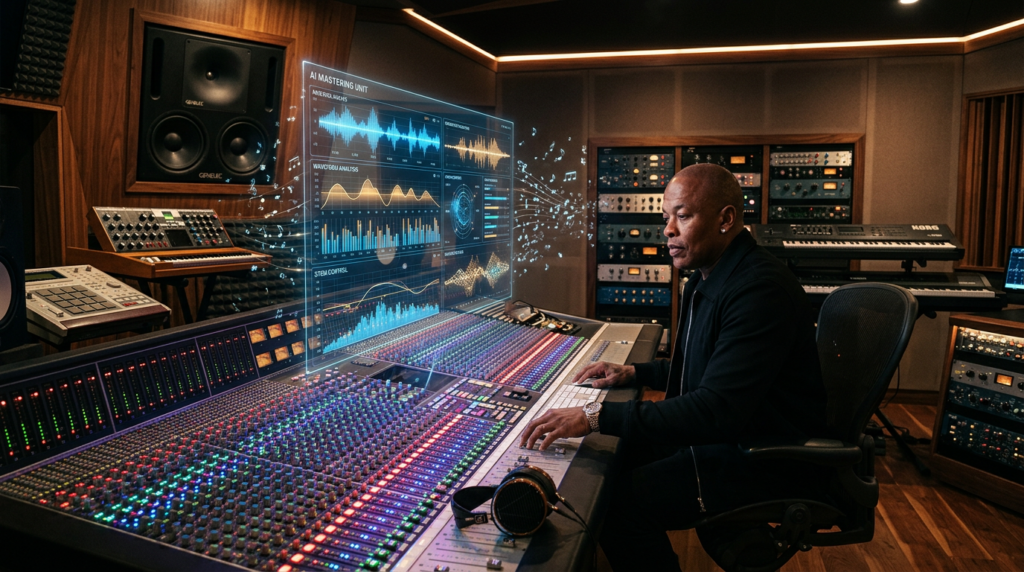
The Doctor Is In, and He Brought a Robot
Artificial intelligence has already written songs, cloned famous voices, invaded streaming platforms, and started enough arguments to fill a stadium. Now, one of hip-hop’s most influential producers has entered the debate—and he isn’t running from the machines.
Dr. Dre says he uses AI during music production and views the technology as another creative tool rather than an approaching artistic apocalypse.
In a joint interview with longtime business partner Jimmy Iovine, Dre confirmed that he has incorporated AI into his workflow. He uses it to test what the technology can do with material he has already created. In other words, he doesn’t appear to be asking a chatbot to make an entire album while he takes a very expensive nap.
He starts with his own work. Then he lets AI react to it.
That distinction matters.
Dre’s comments arrive while musicians, record companies, streaming platforms, and listeners wrestle with some uncomfortable questions. Who owns an AI-generated song? Should models train on copyrighted recordings? Can a synthetic performer compete fairly with a human artist? And how much AI assistance can enter a track before the music stops feeling human?
For Dre, however, the basic question sounds much simpler: Can the technology help a creative person create something better?
His answer is an enthusiastic yes.
Dr. Dre Doesn’t See an AI Emergency
Dre made his position remarkably clear. He doesn’t consider AI a threat to music. More provocatively, he suggested that people who do see it as one may already struggle with the creative process.
That argument will not win him universal applause. In fact, it practically arrives wearing boxing gloves.
As reported by Gizmodo, Dre compared today’s resistance to AI with the skepticism that surrounded drum machines and synthesizers when those technologies first appeared. Both devices disrupted established methods. Both also became essential parts of modern music.
Dre described AI as a new tool for creativity and said some people simply fear learning unfamiliar things.
It is an argument rooted in music history. Producers have repeatedly adopted technologies that initially looked artificial, threatening, or even lazy. Multitrack recording changed how performances were assembled. Synthesizers created sounds that acoustic instruments could not. Drum machines replaced—or supplemented—live percussion. Sampling turned existing recordings into building blocks for new compositions.
Pitch correction, digital audio workstations, plug-ins, loop libraries, and laptop production all triggered their own miniature cultural panics.
Then artists found interesting ways to use them.
Dre sees AI entering that same lineage. To him, the machine does not automatically replace imagination. It expands the producer’s toolkit.
Of course, a hammer can build a house or smash a window. The interesting part is still who holds it.
How Dre Actually Uses the Technology
Dre’s description of his own AI use sounds more experimental than automatic.
He said he employs AI to discover what it might do with something he has just made. That suggests a feedback loop: create, test, listen, adjust. AI becomes a second set of digital ears—or perhaps an unusually fast studio assistant that never asks when lunch is arriving.
He did not identify a particular AI platform. He also did not provide a detailed tour of his workflow. Consequently, it would be a mistake to claim that he uses AI for specific tasks such as writing lyrics, generating vocals, mastering tracks, or cloning performers.
What he did reveal is the philosophy behind the process.
The human creates first. The system responds. The producer then decides whether the result deserves a place in the record.
That approach differs sharply from the mass-production model that worries many musicians. One involves an established artist using AI to explore variations of original work. The other can involve generating complete tracks in seconds and uploading them by the truckload.
Both qualify as AI-assisted music, but they do not represent the same level of human participation.
That is why the phrase “AI-generated” often muddies the conversation. It can describe everything from a subtle production aid to a synthetic singer performing an entirely machine-generated composition.
Dre appears to position himself toward the tool-assisted end of that spectrum. AI offers possibilities. He retains control.
The computer can make suggestions, but the producer still runs the session.
Jimmy Iovine Sees More Upside Than Doom
Jimmy Iovine, the record executive who co-founded Beats Electronics with Dre, shares his optimism.
According to Gizmodo’s account, Iovine said he does not see a downside to talented musicians using AI. He acknowledged that the technology will produce bad music but pointed out that humans already produce plenty of bad music without robotic assistance.
Fair point. Mediocrity did not wait for a software update.
Iovine’s larger argument centers on ability. Put powerful tools in the hands of gifted people, he suggested, and they can make stronger records.
This shifts the debate away from whether AI can produce sound and toward who directs it. A system may generate hundreds of melodies, drum patterns, or arrangements, but volume does not equal judgment. Someone still needs to recognize the one idea worth developing.
That selection process represents a significant part of creativity.
A producer decides what fits the artist, what serves the song, and what should land in the musical recycling bin. AI can multiply the options, but more options may create more noise. Taste becomes even more important.
Dre built his reputation through precision: carefully shaped drums, polished arrangements, memorable instrumentation, and an almost obsessive attention to sonic detail. From his perspective, AI may offer another method for experimenting without surrendering those standards.
The technology can pitch ideas all day. Dre still decides which ones survive the meeting.
Welcome to the Era of “Closet AI Producers”
Dre and Iovine also suggested that AI use may already be more common in professional studios than artists publicly admit.
Iovine referred to the existence of “closet AI producers”—people who quietly use the technology while avoiding the backlash that might follow a public confession. He identified Timbaland as another prominent producer embracing AI, according to Music-News.com.
That silence would not be surprising.
AI carries unusual reputational baggage in creative circles. An artist who admits to using it may face accusations of cheating, replacing workers, stealing styles, or lacking talent. The actual level of assistance can become irrelevant once the dreaded two-letter abbreviation enters the conversation.
Yet producers have always used tools to accelerate work. They rely on sample libraries, presets, virtual instruments, automated mixing features, and software that corrects timing or pitch. Some of those systems already employ machine learning, although users may not advertise them as “AI.”
The boundary between ordinary production software and artificial intelligence can also become fuzzy. A tool may isolate vocals, remove noise, recommend chords, match an equalization curve, or generate an instrumental passage. Each function raises different ethical and creative concerns.
Treating every use as identical makes serious discussion nearly impossible.
Dre’s admission could encourage other producers to explain how they use AI instead of merely admitting that they use it. That added detail would help listeners distinguish assistance from substitution—and experimentation from industrial-scale imitation.
The Drum-Machine Comparison Is Powerful but Imperfect
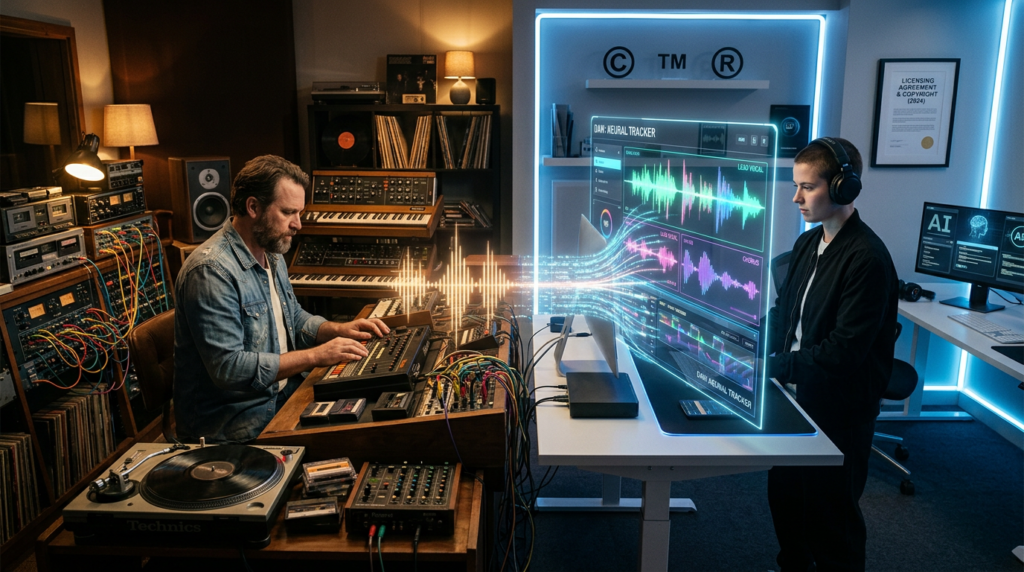
Dre’s comparison between AI, drum machines, and synthesizers makes intuitive sense. New technologies often provoke fear before artists absorb them into normal practice.
Hip-hop itself offers powerful evidence.
Turntables became instruments. Samples became compositions. Drum machines helped shape entire genres. Producers transformed equipment originally designed for one purpose into something culturally explosive.
However, generative AI introduces complications that older studio tools did not always create at the same scale.
A traditional drum machine generates programmed percussion. It does not necessarily require analyzing vast libraries of copyrighted recordings to imitate recognizable creative patterns. A synthesizer produces tones, but it does not automatically pretend to be a specific singer.
Generative systems can potentially reproduce styles, generate convincing voices, and create vast amounts of material almost instantly. That combination raises questions about consent, ownership, attribution, compensation, and market saturation.
So, yes, AI may become another instrument. But it can also behave like a tireless production studio trained on enormous quantities of existing culture.
The analogy illuminates part of the debate without settling it.
Dre is right that artists can use new technology creatively. Critics are also right to ask where the training material came from, whether creators approved its use, and who earns money from the output.
The drum machine did not arrive with a copyright lawyer hiding inside it. Generative AI practically brings an entire legal department.
Meanwhile, the Streaming Platforms Are Flooding
Dre’s optimistic comments land during an especially tense period for digital music.
As Digital Trends framed the situation, the industry is dealing with a flood of low-effort AI material while Dre encourages artists to adopt the technology.
That contrast defines the current moment.
AI can help an experienced producer explore new sounds. It can also allow someone to generate a large catalog with minimal time, expense, or musical experience. Streaming distribution turns that output into a scale problem.
When thousands of synthetic tracks compete for recommendations, playlist placement, attention, and royalties, the effects reach far beyond artistic taste. Low-quality uploads can clutter catalogs. Impersonation can confuse fans. Automated listening can manipulate revenue. Anonymous projects can imitate recognizable voices or styles without meaningful disclosure.
The problem, therefore, is not simply that machines can make bad songs. Humans have handled that job with admirable consistency for centuries.
The problem is speed.
One person might spend months recording an album. An automated system can create variations endlessly. Even when almost nobody listens to most of them, their sheer volume can overwhelm discovery systems and make moderation harder.
Dre’s artisanal use of AI—applying it to work he already created—sits far from this automated content factory. Unfortunately, platforms and audiences may struggle to distinguish between the two without reliable disclosure.
Labels May Help, but They Cannot Solve Everything
Streaming services are responding by developing ways to identify AI-related music and synthetic artist profiles.
The reports cited by Gizmodo and OloriSuperGal indicate that major platforms are moving toward clearer labels for AI-generated material. Spotify has also explored licensed AI experiences, including user-generated covers, while Apple Music has reportedly prepared its own identification measures.
Disclosure offers a sensible starting point. Listeners should know whether they are hearing a human performance, an AI-generated voice, or a hybrid production.
Still, labels create new questions.
Should a track receive an AI label if software only cleaned background noise? What if AI suggested a chord progression? Does an AI-generated harmony count? What about a fully synthetic singer performing lyrics written by a human?
A single badge may flatten dozens of very different workflows into one category.
Effective policies will need more detail. Platforms may have to distinguish between AI assistance, generated instrumentation, synthetic vocals, voice cloning, and fully generated compositions. They will also need enforcement systems that can keep pace with rapidly improving tools.
Transparency cannot fix unauthorized training or guarantee fair compensation. It can, however, give audiences valuable context.
A label will not end the argument. At least it can tell listeners which argument they are having.
Not Every Artist Shares Dre’s Enthusiasm
The music industry remains deeply divided.
Music-News.com contrasted Dre’s enthusiasm with Madonna’s criticism of AI as fundamentally opposed to art. Mick Jagger has taken a more permissive position, supporting experimentation when the result sounds original.
Those positions reveal the debate’s emotional core.
Some artists see creation as a process that matters as much as the final product. The struggle, mistakes, performance, collaboration, and lived experience give a song its meaning. From that viewpoint, automating the process does not merely improve efficiency. It removes the very thing that makes art worth creating.
Others focus on intent and outcome. If a human directs the tool and produces an original, affecting record, they see little reason to disqualify it because software participated.
Both sides ask reasonable questions.
Does art require labor? Can a prompt express genuine intention? Is choosing between generated options an act of authorship? When does assistance become replacement? And will audiences care once synthetic music becomes difficult to identify by sound alone?
Dre’s answer emphasizes human judgment. Talented people can use AI to push their work further.
His critics emphasize human origin. If technology learns from artists without permission—or replaces their contributions—the finished track may carry an ethical cost no polished mix can hide.
There is no tidy chorus here. The industry is still writing the verses.
Creativity Will Matter More, Not Less
Ironically, AI’s ability to generate unlimited music may increase the value of distinctly human decisions.
When anyone can request a polished beat, competent melody, or synthetic vocal, technical production alone becomes less remarkable. The differentiators shift toward identity, taste, story, performance, cultural connection, and trust.
Listeners rarely build lasting relationships with songs merely because the bass sounds clean. They connect with artists, eras, communities, memories, and experiences.
AI can imitate patterns. It can produce surprising combinations. It can accelerate experimentation. Yet a producer still needs a reason for making the song and a clear sense of what the song should become.
That is where Dre’s argument carries weight.
A skilled creator does not become irrelevant when tools improve. The creator may gain more choices—and a harder editing job. Knowing what to reject becomes crucial when a machine can offer endless alternatives.
The danger is not necessarily that AI will make every musician obsolete. It may instead make generic music incredibly cheap and abundant. Artists who rely entirely on familiar formulas could face pressure. Those with unmistakable voices, strong ideas, and trusted relationships with audiences may become more valuable.
AI can generate another beat.
It cannot automatically generate Dr. Dre’s history, reputation, instincts, or cultural influence. Those took decades, countless sessions, and probably more speaker testing than any neighbor should reasonably endure.
The Real Battle Is Over Control
The argument surrounding AI music often gets reduced to two extremes. Either AI will democratize creativity and supercharge artists, or it will drown culture in synthetic sludge.
Reality will probably contain both outcomes.
Dre’s workflow represents one future: experienced musicians use AI selectively, retain creative authority, and treat generated material as raw input. The streaming flood represents another: automated systems manufacture enormous catalogs designed to capture attention or revenue at the lowest possible cost.
The technology can support either model.
That means the decisive questions involve control. Who chooses the training data? Who grants permission? Who receives credit? Who gets paid? Who tells the listener what was generated? And who remains responsible when a system imitates a living artist without consent?
Dre’s confidence does not answer those policy questions. It does, however, challenge the idea that every encounter between AI and music must end with creativity losing.
He sees experimentation, not surrender.
The strongest version of his argument is not that artists should blindly embrace every AI product. It is that capable creators should investigate new tools, understand their limits, and decide how to use them on their own terms.
That approach requires curiosity—and caution.
Nobody needs to hand the robot the studio keys. Let it audition first.
What Comes Next for AI-Assisted Music?
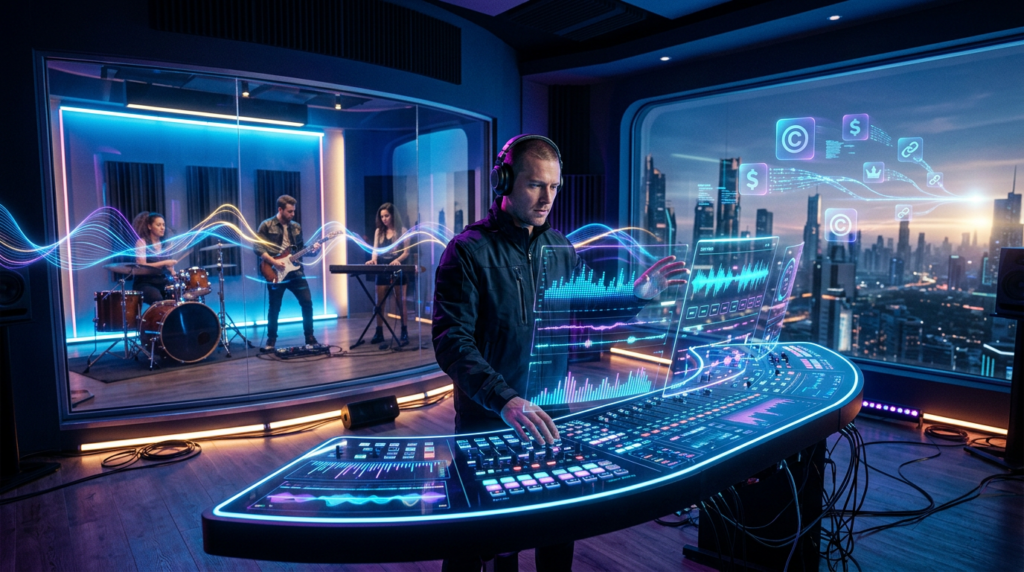
Dre said he is embracing AI and wants to see where it leads. Given his influence, that endorsement could make more producers comfortable discussing their own experiments.
It could also intensify resistance.
Fans may demand disclosure. Musicians may push for licensed training data. Record companies may develop stricter contracts governing synthetic performances and voice models. Streaming services will likely refine their labeling and detection systems as AI-generated uploads continue to multiply.
Meanwhile, producers will keep testing the tools—publicly or from inside that metaphorical AI closet.
The most productive debate will move beyond a simple yes-or-no question. “Was AI used?” reveals very little. The better questions are how it was used, what material trained it, whether everyone involved consented, and how much creative control the human retained.
Dre has planted his flag firmly on the pro-tool side. He believes confident creators have little reason to fear AI and plenty of reason to explore it.
Whether the wider industry agrees remains uncertain.
But one thing looks increasingly clear: AI has already entered the studio. The argument now concerns whether it sits quietly in the corner, assists behind the mixing desk, impersonates the lead singer, or tries to release 10,000 albums before breakfast.
The technology may be new. The central challenge is timeless.
Artists still have to make something worth hearing.
Sources
- Gizmodo — Dr. Dre Says He Uses AI to Produce Songs
- Digital Trends — As the Music Industry Reels From a Slop Flood, Dr. Dre Wants Artists to Adopt AI
- OloriSuperGal — Dr. Dre Says People Who Fear AI “Have Trouble Creating”
- Music-News.com — Dr. Dre Uses AI to Make Music: “I Don’t See It as a Threat”
The Kingy Brief
Get The Kingy Brief.
AI changes, original tests and one practical thing to try. Fridays at 09:00 Vancouver time.
Free · Double opt-in · Unsubscribe anytime
Signup help and newsletter schedule
Signup form provided by Beehiiv. After submitting, check your inbox for "Confirm your subscription to The Kingy Brief" and open its confirmation link. Check Spam or Promotions if you cannot find it.
Fridays at 09:00 Vancouver time: source-checked AI changes, original tests and one practical thing to try. The weekly restart begins October 9, 2026. We skip a week when there is not enough verified material. Free. Unsubscribe anytime.