A Deal Big Enough to Break Your Mental Calculator

Every so often, Silicon Valley coughs up a number so large it stops sounding like money and starts sounding like astronomy. This time, that number is $60 billion.
According to reports from The Economic Times, Free Press Journal, and The Federal, Elon Musk-led SpaceX is acquiring Anysphere, the company behind the AI coding assistant Cursor, in a blockbuster deal valued at $60 billion. That is not seed money. That is not “nice little startup exit” money. That is “please sit down before reading the cap table” money.
The deal has also thrown a bright spotlight on Aman Sanger, a 25-year-old Indian-American co-founder of Cursor. Reports say the transaction could push his net worth to around $5.5 billion once the deal closes. Not bad for someone who, in most group chats, would still be considered “the young guy.”
But this story is not just about one founder getting rich. It is about how AI coding tools went from nerdy sidekick to corporate rocket fuel. It is about MIT classmates who saw software development changing before the rest of the world fully caught up. And yes, it is also about Musk deciding that a space company should own one of the hottest coding platforms on Earth.
Naturally, chaos entered the chat.
Who Is Aman Sanger?
Aman Sanger is one of the four co-founders of Anysphere, the startup that built Cursor. Reports identify the other co-founders as Michael Truell, Sualeh Asif, and Arvid Lunnemark. Together, they built one of the fastest-growing companies in the AI developer-tools boom.
Sanger is 25. He is Indian-American. The Federal reports that he was born in New York to Indian immigrant parents. Free Press Journal describes him as someone raised in New York with strong Indian roots. His father, Arvind Sanger, studied at IIT Bombay and later founded Geosphere Capital, an investment firm focused on natural resources, industrial companies, and Indian equities. His mother, Shilpa Sanger, grew up in Mumbai and built a career that included orthodontics, entrepreneurship, and angel investing.
That background matters. It does not magically build a startup for you. No parent can hand you product-market fit in a lunchbox. But it does create a household where ambition is normal, education is non-negotiable, and entrepreneurship does not sound like a reckless fever dream.
Sanger reportedly started coding at 14. Later, he studied computer science at MIT between 2018 and 2022. He also played squash and stayed active in campus athletics. So yes, apparently he found time to code, study at MIT, build a company, and hit a tiny rubber ball against a wall at high speed. Some people really do make the rest of us look like we are buffering.
The MIT Spark
Cursor did not appear out of nowhere. It came out of the MIT orbit, where Sanger met Michael Truell, Sualeh Asif, and Arvid Lunnemark.
The timing mattered. The team started building around the same moment the AI world was beginning to tilt. ChatGPT arrived in 2022 and pushed artificial intelligence into the mainstream. Suddenly, every company had an “AI strategy,” even if that strategy was just adding the letters A and I to a pitch deck and hoping investors squinted.
But the Cursor founders focused on a real pain point: coding.
Software developers spend huge chunks of time reading, editing, debugging, refactoring, and navigating code. Some of that work requires deep judgment. Some of it is just digital archaeology with better chairs. Cursor aimed to make that work faster.
According to The Federal, the founders first tried an AI design tool, but it did not gain major traction. Then they pivoted. Instead of chasing a flashy idea, they turned toward a problem they personally understood: developers struggling to manage big codebases.
That pivot became Cursor.
The product helped developers write, edit, understand, and refactor code using AI. It was not just a chatbot sitting politely in the corner. It worked closer to the developer’s actual workflow. That mattered. Developers do not want circus tricks. They want tools that save time, reduce friction, and avoid breaking everything at 2:13 a.m.
Cursor gave them that promise.
What Cursor Actually Does
Cursor is an AI-powered coding assistant. In plain English, it helps developers build software faster.
It can help write code. It can help edit code. It can help explain code. It can help debug code. It can assist with refactoring, which is the glamorous engineering art of making existing code cleaner without accidentally setting the product on fire.
The product became popular because it attacked a deeply practical problem. Software development is expensive. Engineering time is scarce. Codebases grow messy. New developers join teams and need to understand old systems. Old developers leave teams and take half the institutional knowledge with them. Then someone opens a file called final_final_v3_really_final.js, and civilization trembles.
Cursor sits in that mess and says: let me help.
That is why AI coding tools became such a hot category. They do not just impress people in demos. They can change how engineering teams work every day.
Reports say Cursor gained adoption across thousands of companies. The Economic Times says it is used by millions of developers across nearly 50,000 companies, including names such as Nvidia, Adobe, Uber, Shopify, and PayPal. Free Press Journal reports that Cursor has been adopted by a large share of Fortune 500 companies, naming Salesforce, Samsung, and Budweiser among users.
The exact customer lists vary by report. The broad pattern does not. Cursor became big because developers actually used it.
The Growth Was Ridiculous
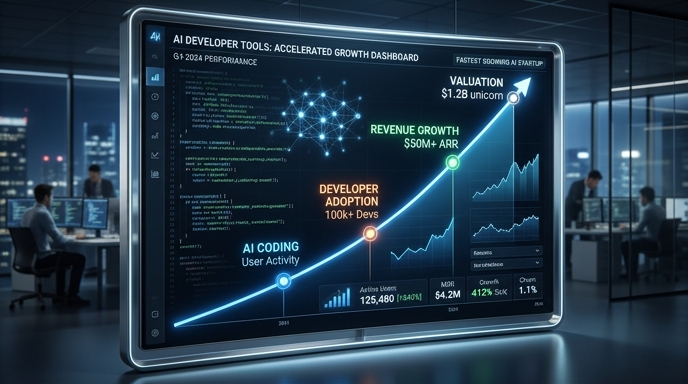
Startup growth stories often come wrapped in mythology. A founder writes code in a dorm. A team eats instant noodles. A product “goes viral.” Then someone says “hockey-stick growth,” and a venture capitalist materializes behind a ficus.
Cursor’s rise, however, appears genuinely extreme.
Free Press Journal reports that Cursor hit $100 million in annualized revenue in January 2025, roughly one year and eight months after launching its first product. It also says Slack took two and a half years to reach that mark, while Dropbox took four years.
That comparison explains why investors paid attention. Cursor was not just another AI tool. It looked like one of the rare startups that could turn hype into revenue at frightening speed.
The revenue figures differ across reports. The Economic Times says Cursor crossed $1 billion in annualized revenue and also cites company data previously shared with Reuters that put annualized enterprise revenue around $2.6 billion. The Federal says Cursor crossed $1 billion in annual recurring revenue before the SpaceX deal.
Those are monster numbers for a company founded in 2022.
Anysphere also attracted elite investors. Free Press Journal reports that the company raised $3.4 billion from investors including Andreessen Horowitz, Thrive Capital, Accel, and Coatue. It also says the company was valued at roughly $30 billion in November 2025. The Federal puts the pre-deal valuation at $29.3 billion.
Then came the $60 billion SpaceX figure. Silicon Valley did what Silicon Valley does best: acted shocked while quietly calculating who got paid.
Why Would SpaceX Want Cursor?
At first glance, the deal sounds odd. SpaceX builds rockets, satellites, and space infrastructure. Cursor helps programmers write code. One company looks toward Mars. The other looks toward your code editor and asks why your function has 47 arguments.
But the connection makes more sense if you zoom out.
Modern aerospace is software-heavy. Rockets run on software. Satellites run on software. Launch systems, telemetry, simulation, manufacturing, communications, and automation all depend on software. A company like SpaceX does not merely need engineers. It needs engineering velocity.
AI coding tools could make internal engineering teams faster. They could also feed broader AI ambitions. Musk has already pushed aggressively into AI through xAI and Grok. If SpaceX wants to compete in AI infrastructure, AI software, or AI-enabled engineering, owning a major coding platform could give it a strategic weapon.
That does not mean the deal is automatically brilliant. Big acquisitions can go sideways. Cultures clash. Founders leave. Products stagnate. A tool developers love can become corporate bloatware if the new owner gets heavy-handed.
But the strategic logic is clear enough: software is eating the world, AI is eating software, and SpaceX apparently wants a seat at the head table before dessert.
The $60 billion price tag still screams. Yet in the current AI market, screaming has become a dialect.
The Billionaire Math
Reports say the SpaceX deal could mint four new multi-billionaires: Michael Truell, Sualeh Asif, Arvid Lunnemark, and Aman Sanger.
The Federal says each co-founder is expected to be worth about $2.7 billion following the acquisition. The Economic Times gives a similar estimate, saying Sanger and Asif are expected to receive around $2.7 billion each from the transaction. Free Press Journal reports that Sanger owned a 4.5 percent stake in Cursor, matching the ownership held by each of the other co-founders.
Before the acquisition, reports say Sanger’s net worth was already estimated around $1.3 billion, helped by Cursor’s previous valuation. After the deal closes, Free Press Journal and The Federal report that his estimated net worth could rise to nearly $5.5 billion.
That number comes with an asterisk: reported net worth is not the same as cash in a bank account. A founder’s wealth usually depends on stock value, deal terms, taxes, vesting, lockups, and whether the transaction closes as expected. Billionaire math can look clean in headlines and messy in real life.
Still, the headline is hard to ignore. A 25-year-old co-founder of an AI coding platform may soon be worth more than entire publicly listed companies.
Capitalism, ladies and gentlemen: occasionally elegant, frequently absurd, never boring.
Sualeh Asif and the Cross-Border Founder Story
Aman Sanger has received plenty of attention because of his Indian roots, but the Cursor story also includes Sualeh Asif, a Pakistan-born co-founder.
The Economic Times describes Asif as a mathematician-turned-tech founder from Karachi. It also reports that he represented Pakistan at the International Mathematical Olympiad from 2016 to 2018. Before Cursor, he reportedly founded an AI-powered search engine startup.
That detail gives the story a wider emotional punch. An Indian-American founder and a Pakistani founder helped build one of the defining AI software startups of the moment. In a region where India-Pakistan stories are too often framed through rivalry, conflict, or cricket scorecards shouted at maximum volume, this one lands differently.
It is not sentimental fluff. It is practical. Talent moves. Ideas travel. MIT classrooms mix people from everywhere. AI does not care about passports. Code compiles or it does not.
The Cursor founding team also included Michael Truell and Arvid Lunnemark, making the company less a single-founder legend and more a team-built rocket. That matters because startup mythology loves lone geniuses. Reality usually prefers small groups of intense people making thousands of decisions under pressure.
Cursor was not one person waving a wand. It was a team building into a market that exploded at exactly the right time.
The Immigrant Dream, With a Code Editor
Aman Sanger’s story fits neatly into a familiar but still powerful pattern: immigrant family, elite education, early technical curiosity, and a high-risk leap into entrepreneurship.
But it also updates that story for the AI age.
Previous generations built fortunes in oil, steel, railroads, chips, software, search, social media, and e-commerce. This generation is building fortunes in models, agents, infrastructure, and tools that change how knowledge work gets done.
Sanger reportedly started coding at 14. He went to MIT. He interned at places including Google and Bridgewater Associates, according to The Economic Times and The Federal. Then he helped build a startup at the exact intersection of two enormous markets: artificial intelligence and software development.
That combination created leverage. Cursor did not need to sell a vague dream about “AI transformation.” It sold something concrete: better coding workflows.
There is a lesson here, and it is not “drop out and become a billionaire.” That is survivorship-bias confetti. For every Cursor, there are hundreds of startups that pivot into a wall.
The better lesson is sharper: find an urgent problem in a giant market, build for users who are picky enough to reject nonsense, and move before the obvious becomes obvious.
Cursor did that. Then SpaceX arrived with a number large enough to make everyone check whether they had read it correctly.
What This Means for AI Coding
The reported acquisition sends a loud signal: AI coding tools are no longer side products. They are strategic infrastructure.
For years, developers treated coding assistants as helpful add-ons. Nice to have. Useful sometimes. Occasionally annoying. But the Cursor deal suggests that major companies now see AI coding platforms as core assets. Not toys. Not demos. Assets.
That shift could reshape the market.
Large tech companies may buy more AI developer-tool startups. Investors may pour even more money into the space. Developers may see faster product improvements, but also more lock-in. Startups may find it harder to stay independent if giant companies decide that coding assistants are too important to outsource.
There is also a tension. Developers love tools that feel fast, flexible, and independent. Big corporate ownership can complicate that. If Cursor becomes too tied to one ecosystem, users may look elsewhere. If SpaceX gives Cursor more compute, better models, and deeper engineering resources, the product could become much stronger.
The future depends on execution. Always does.
For now, Cursor has become the company everyone is watching. And Aman Sanger has become one of the faces of a new AI-founder class: young, technical, global, and moving at a speed that makes the old software playbook look like it was printed on parchment.
The Bottom Line
The reported $60 billion SpaceX-Cursor deal is huge because it combines three powerful stories at once.
First, it shows how valuable AI coding tools have become. Cursor turned developer frustration into a product that scaled fast and attracted major enterprise adoption.
Second, it turns Anysphere’s young founders into global business figures almost overnight. Aman Sanger, in particular, has become a breakout name because of his age, Indian-American background, MIT path, and reported billionaire status.
Third, it shows how aggressively Elon Musk’s companies are moving beyond their original lanes. SpaceX may be a space company, but software and AI now sit at the center of almost every ambitious technology business. Rockets need code. AI needs distribution. Developers need better tools. Cursor sits right in the middle.
The deal still needs to close, according to the reports. Net-worth estimates can shift. Valuations can wobble. Big acquisitions can lose their shine once the champagne goes flat.
But even with those caveats, one thing is clear: Cursor has already changed the AI coding conversation.
A few years ago, it was a startup built by young MIT-linked founders chasing a developer problem. Now it is the subject of a $60 billion acquisition story involving SpaceX, Elon Musk, and four newly minted or soon-to-be multi-billionaire founders.
Not every startup gets a moonshot. Cursor may have just sold one to the rocket company.
Sources
- Mashable India: “Who Is Aman Sanger? Indian-Origin 25-Year-Old Becomes Billionaire After SpaceX’s $60 Billion AI Deal”
- The Economic Times: “Two techies from India and Pakistan built an AI startup — Now both are billionaires thanks to Elon Musk”
- Free Press Journal: “Who Is Aman Sanger? The 25-Year-Old Who Co-Founded Cursor & Sold It To Elon Musk For $60 Billion”
- The Federal: “Aman Sanger, 25, the billionaire behind Cursor’s $60-billion SpaceX deal”
The Kingy Brief
Get the next Kingy Brief.
Source-checked AI changes, original tests and one practical thing to try.
Free · Choose your subjects · Double opt-in · Unsubscribe anytime