
The Deal That Made the Market Blink
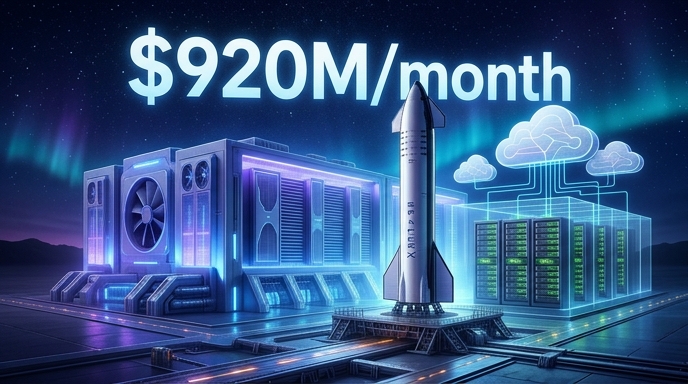
SpaceX has spent years making giant machines look almost normal. Reusable rockets? Sure. Satellite internet? Why not. The June 2026 reports added another item to the “because apparently that’s possible” shelf: a planned deal to rent a mountain of AI computing power to Google for $920 million a month.
CNBC reported on June 5, 2026 that SpaceX had entered a cloud services agreement with Google. The reported deal covered about 110,000 Nvidia GPUs, plus CPUs, memory, and related hardware, with full monthly fees scheduled from October 2026 through June 2029 and a reduced fee during the ramp-up through September. The contract details below are drawn from June 2026 reporting; they do not establish current capacity delivery, actual payments, or IPO completion.
That is not a typo. It is not $920 million a year. It is $920 million per month.
The June 2026 reports landed at a dramatic moment. SpaceX was preparing for a public listing, and the numbers around this agreement offer investors a very shiny object to inspect. Rockets may still grab the headlines, but GPUs now get their own spotlight. In today’s AI economy, compute capacity has become the oil, the railroad, the factory floor, and the VIP backstage pass all at once.
Why Google Wants SpaceX’s Chips
Google already owns one of the deepest AI infrastructure benches on Earth. So why rent compute from SpaceX?
Because AI demand has been running hot. Very hot. Google said the agreement helps meet stronger-than-expected demand for Gemini Enterprise and other AI products. A Google Cloud spokesperson described the contract as a short-term bridge capacity arrangement. Translation: customers want more AI power now, and Google does not want to tell them to take a number and enjoy the lobby magazines.
That matters. Modern AI systems need huge clusters of chips to train models, serve users, and power enterprise tools. When businesses plug AI agents into customer service, coding, analytics, document search, and internal workflows, the demand does not politely wait for new data centers to finish construction.
So Google is doing what a giant cloud company does when it needs capacity fast. It is buying time. Expensive time, yes. But in the AI race, slow can be worse than costly. The company gets access to Nvidia hardware without waiting for every piece of its own infrastructure plan to land perfectly.
SpaceX, meanwhile, gets a customer with very deep pockets. Everybody gets a giant invoice. Capitalism puts on sunglasses.
SpaceX’s New Side Hustle Is Not Small
Calling this a side hustle feels almost rude. A $920 million monthly contract would be a career-defining business line for most companies. For SpaceX, the deal as reported in June 2026 could turn available AI infrastructure into a large revenue stream and strengthen its pitch to prospective public-market investors.
The June 2026 reports described the full monthly fee running from October 2026 through June 2029. If the reported agreement ran as planned, the payments could approach $30 billion. The Decoder and The Hindu BusinessLine framed the figure in that neighborhood. That is a conditional contract-value estimate, not evidence of money already paid.
The broader message is simple: SpaceX is no longer just selling launches, Starlink connections, or dreams of Mars. It is also selling compute. That may sound less cinematic than a rocket plume at sunset, but Wall Street tends to enjoy recurring revenue. Monthly payments have a way of making spreadsheets purr.
The deal also follows another major arrangement with Anthropic. Reports say Anthropic agreed to pay SpaceX for large-scale compute capacity tied to the Colossus 1 facility near Memphis, Tennessee. That puts SpaceX in an odd but powerful position. It built AI infrastructure for internal needs, especially around xAI, and now it can rent some of that power to major AI players.
That is not a pivot. It is more like finding a second engine strapped to the first one.
The Anthropic Context
The Google agreement did not appear from nowhere. It follows a big compute deal involving Anthropic, the company behind Claude. Several reports said Anthropic secured access to SpaceX’s Colossus 1 data center, a facility associated with huge Nvidia chip deployments and heavy power requirements.
The Decoder reported that SpaceX had already locked in a $1.25 billion monthly agreement with Anthropic. Crypto.news also noted that the Google contract appears to cover about half the compute made available to Anthropic at Colossus 1, while SpaceX did not identify which data center Google would use.
That detail matters. It suggests SpaceX may be assembling an AI infrastructure business with multiple large customers, not just a one-off emergency rental desk for chip-hungry tech giants.
The June 2026 reports gave the hardware count and payment terms, but Crypto.news said SpaceX had not identified which data center Google would use. That is important because AI infrastructure is not just about chips. It also needs land, power, cooling, networking, permits, and logistics. You do not simply toss 110,000 GPUs into a garage and call it a cloud. Not unless that garage has its own substation and a suspiciously large fan.
The Fine Print Has Teeth
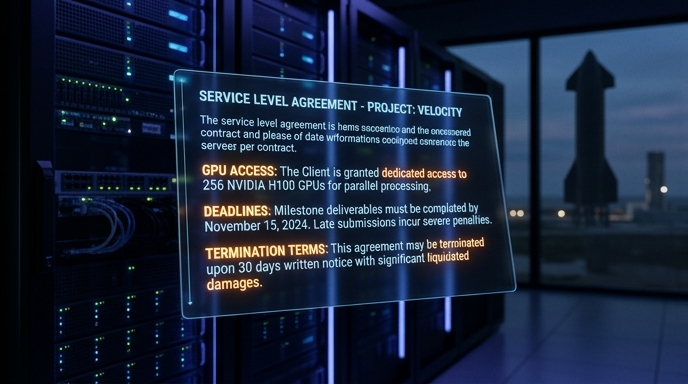
The headline number is huge, but the contract is not a blank check.
CNBC’s June 5 report described a September 30, 2026 deadline for access to the committed GPU capacity. Under the reported terms, a failure to deliver would give Google options after a one-month grace period: termination or acceptance of partial capacity at a reduced fee. This article does not establish whether that delivery condition was met.
That clause keeps the deal grounded. Google is not just buying promises. It is buying access. If the chips do not show up, the bill changes or the deal can end.
Crypto.news reported another escape hatch: after December 31, 2026, either party could terminate the agreement with 90 days’ notice. That gives both sides flexibility. Google can adjust if its own infrastructure catches up or demand changes. SpaceX can also manage capacity if its internal needs shift.
The Free Press Journal reported that Google retained ownership and intellectual property rights over its content, AI models, and related data. In plain English, Google is renting the kitchen, not handing over the recipe book. That distinction matters in AI, where model weights, data pipelines, and enterprise content sit at the center of competitive advantage.
Why the IPO Timing Matters
The timing in those June reports was not subtle. SpaceX disclosed the agreement ahead of a planned Nasdaq debut. Crypto.news reported that SpaceX planned to raise about $75 billion at a valuation near $1.75 trillion, which would make it the largest IPO in history if completed on those terms.
That is a staggering number. It is also exactly why the Google deal matters. Public investors like growth stories, but they love growth stories with contracts attached. A cloud agreement worth hundreds of millions per month gives SpaceX something concrete to show beyond the long-term promise of rockets, satellites, and interplanetary ambition.
Google also has history with SpaceX as an investor. Reports noted that Google holds a stake in the company, which means a strong listing could benefit Alphabet financially as well as strategically. That creates an interesting loop: Google is both customer and investor, buying compute while also potentially cheering for SpaceX’s valuation.
Of course, investors will still have questions. Big contracts require big delivery. AI data centers eat power and cash. Hardware ages. Competition moves fast. Still, this agreement gives SpaceX a fresh story to tell: it is not only a space company. It is becoming an AI infrastructure landlord with rocket posters on the wall.
The AI Race Has a Compute Problem
The SpaceX-Google agreement says something bigger about the AI market. The bottleneck is no longer only talent, data, or clever algorithms. It is also metal. Chips. Power. Buildings. Cooling systems. Supply chains. The unglamorous stuff now carries glamorous valuations.
Every major AI company wants more compute. Cloud providers want more compute. Startups want more compute. Enterprises want AI tools that work instantly and at scale. Nobody wants to hear that the model is brilliant but the servers are taking a nap.
That is why Nvidia GPUs have become strategic assets. They train and run the models that power chatbots, coding assistants, image tools, enterprise agents, and research systems. Companies that control large clusters can do more, faster. Companies that cannot may need to rent from those that can.
SpaceX appears to have found itself on the right side of that shortage. It has access to a large chip base. It has experience building technically demanding infrastructure. It has a brand that investors already understand as bold, risky, and unusually ambitious. Now it is applying that formula to AI capacity.
The funny part? The least futuristic word in the whole story may be “capacity.” Yet capacity is the crown jewel.
What Google Gets, and What SpaceX Gets
Google gets breathing room. That may sound modest, but breathing room is priceless when demand spikes and customers expect enterprise-grade AI tools to work immediately.
The agreement can help Google support Gemini Enterprise while its longer-term infrastructure plans continue. It also gives Google flexibility. The termination provisions mean it can treat this as a bridge, not a forever marriage with matching GPU-themed towels.
The June 2026 reports pointed to something equally valuable for SpaceX: predictable revenue if the contract ran as planned. The monthly payments could turn AI infrastructure into one of the company’s most important business lines. That would have strengthened its pre-IPO pitch in those reports: SpaceX could monetize assets beyond launch pads and satellites.
The partnership also strengthens SpaceX’s credibility as a cloud and AI infrastructure provider. Google does not rent compute at this scale casually. A deal this large signals that SpaceX’s capacity is not just impressive on a slide deck. It is commercially useful.
There is also a strategic layer. SpaceX can rent out capacity while keeping flexibility for its own AI work. If demand from xAI or other internal projects grows, the contract terms give the company some room to maneuver later. That balance will matter.
The Risks Hiding Behind the Wow
Big numbers make great headlines. They also create big expectations.
The reported deal depended on SpaceX delivering the promised GPU access. That means the operational side has to work. Power must be available. Cooling must hold. Networking must perform. Hardware must stay reliable. Security must be tight. Customers must trust the service. None of that is easy, even for a company used to landing rockets on floating platforms.
Google also has to manage cost. Paying $920 million per month for bridge capacity suggests intense demand, but it also raises questions about AI economics. Can revenue from Gemini Enterprise and related services justify that kind of spending? How quickly can Google’s own infrastructure absorb demand? Will AI customers pay enough to support the industry’s massive capital expenditures?
Then there is competitive pressure. Anthropic, OpenAI, Meta, Amazon, Microsoft, Nvidia, and others are all fighting for advantage in the same compute-heavy arena. The market can shift fast. Today’s scarce capacity can become tomorrow’s expensive legacy setup if technology changes or supply loosens.
None of these risks erase the deal. They simply remind us that AI infrastructure is not magic. It is engineering, finance, power procurement, and timing, all stacked in a trench coat pretending to be destiny.
A New Chapter for SpaceX

The Google deal expands the definition of SpaceX. The company still launches rockets. It still operates Starlink. It still carries the Musk-sized aura of impossible deadlines and oversized ambitions. But now it also sits closer to the center of the AI infrastructure boom.
That is the story beneath the headline. SpaceX is turning compute into a product. Google is turning to an unlikely supplier for short-term AI capacity. The IPO narrative gets a fresh jolt. And the broader tech industry gets another reminder that chips are the new strategic battlefield.
The deal may run through June 2029. It may change. It may terminate early under the contract’s flexibility clauses. But even as written, it marks a striking moment. A company famous for reaching orbit is now renting the machinery that helps AI systems think, answer, summarize, code, and occasionally explain things with the confidence of a caffeinated intern.
The future, apparently, needs rockets and GPUs. Preferably lots of both.
Sources
- CNBC: Google to pay SpaceX $920 million a month for xAI compute capacity
- The Decoder: SpaceX signs $920 million per month deal with Google
- The Hindu BusinessLine: SpaceX inks $30 billion computing power deal with Google
- Free Press Journal: SpaceX secures multi-year $920 million monthly cloud deal
- Crypto.news: SpaceX lands Google GPU deal as record IPO countdown begins
- SEC Filing: SpaceX Cloud Service Agreement with Google
The Kingy Brief
Get The Kingy Brief.
AI changes, original tests and one practical thing to try. Fridays at 09:00 Vancouver time.
Free · Double opt-in · Unsubscribe anytime
Sign up for The Kingy Brief on Beehiiv.
Signup help and newsletter schedule
Signup form provided by Beehiiv. After submitting, check your inbox for "Confirm your subscription to The Kingy Brief" and open its confirmation link. Check Spam or Promotions if you cannot find it.
Fridays at 09:00 Vancouver time: source-checked AI changes, original tests and one practical thing to try. We skip a week when there is not enough verified material. Free. Unsubscribe anytime.