TL;DR: This daily Radar summarizes source-checked AI launch candidates for Kingy AI readers, with pricing notes, use cases, and human-review caveats where details are still emerging.
Launch Snapshot
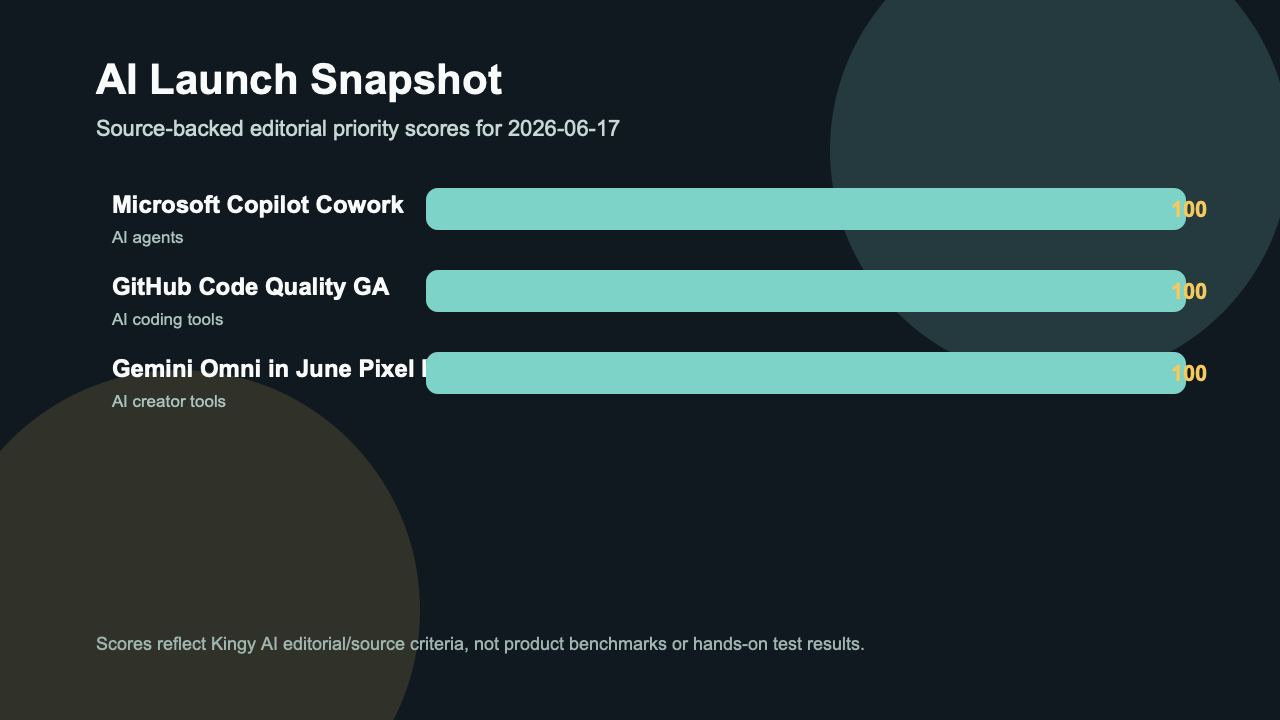
The snapshot below compares the strongest source-checked launches by Kingy AI score. It is a research-priority visual, not a benchmark chart or hands-on test result.
Strongest Launches
Microsoft Copilot Cowork
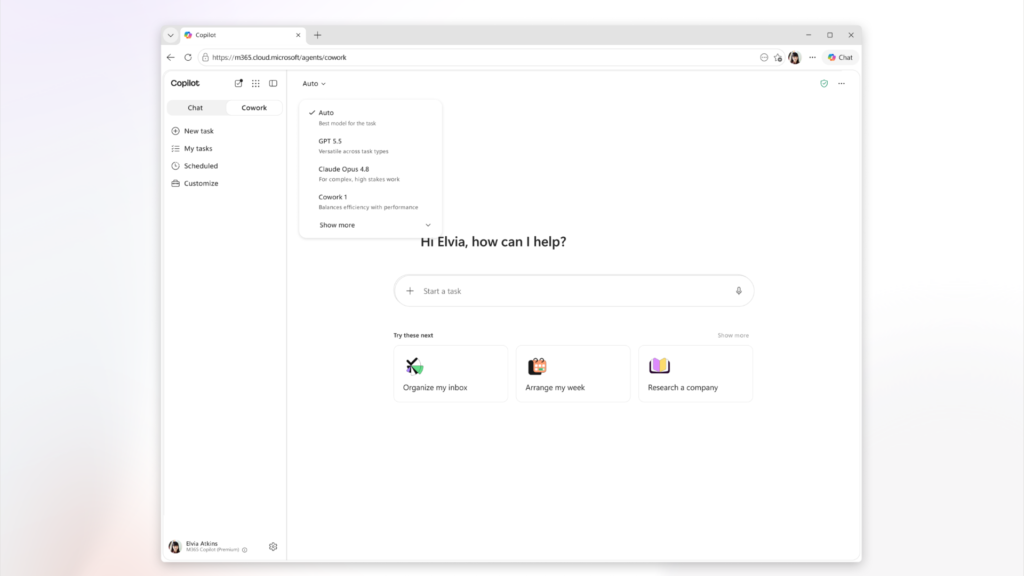
Microsoft made Copilot Cowork generally available worldwide for Microsoft 365 Copilot customers, adding a usage-billed agentic system for long-running work across Microsoft 365 apps, files, and work data.
Checked launch source, docs for the current Radar entry.
Why it matters: Enterprise AI is moving from chat assistance into supervised work execution; Copilot Cowork is important because it ties long-running agents to Microsoft 365 identity, data context, cost controls, usage-based billing, and familiar Office workflows.
Who should care: AI Platform Teams, Sales Teams, Enterprises, Operators
For broader Kingy AI context, compare Microsoft Copilot Cowork with other AI launch radar coverage and recent AI News before treating this as a standalone buying decision.
Pricing: Microsoft says Copilot Cowork requires a Microsoft 365 Copilot user subscription license and then bills Cowork usage through Copilot Credits based on model use, context retrieval, tool calls, and runtime. Microsoft 365 Copilot Business pricing pages currently show $25.20 per user per month on a monthly commitment and $18.00 per user per month paid yearly in the U.S.; actual Cowork costs vary by task usage and should be confirmed through Microsoft’s Copilot Credits guidance and admin cost-management tools. Confirm current pricing on the official pricing/source page.
What launched: On June 16, 2026, Microsoft announced general availability of Copilot Cowork worldwide after a Frontier preview, positioning it as an agentic system that can execute complex, long-running, multi-tool tasks and return completed results. See the official launch source.
What feels promising: Enterprise AI is moving from chat assistance into supervised work execution; Copilot Cowork is important because it ties long-running agents to Microsoft 365 identity, data context, cost controls, usage-based billing, and familiar Office workflows.
What feels unproven: [‘Real task cost depends on model use, context retrieval, tool calls, runtime, and workflow design.’, ‘Organizations need admin controls, spending limits, approval policies, and governance before broad rollout.’, “Microsoft’s cost-savings comparison is based on internal testing and should not be treated as an independent benchmark.”]
GitHub Code Quality GA
GitHub announced that GitHub Code Quality will become generally available as a paid product on July 20, 2026, with organization dashboards, quality gates, APIs, and AI-powered Copilot review and Autofix usage.
Checked launch source, docs, GitHub repo for the current Radar entry.
Why it matters: AI-generated pull requests and agentic coding workflows increase the need for enforceable quality gates; GitHub Code Quality matters because it puts static analysis, AI-assisted detection, Copilot Autofix, scoring, coverage checks, and organization rollout controls directly inside GitHub.
Who should care: AI Platform Teams, AI Engineers, Developers, Enterprises
For broader Kingy AI context, compare GitHub Code Quality GA with other AI launch radar coverage and recent AI News before treating this as a standalone buying decision.
Pricing: GitHub says Code Quality will be priced at $10 per active committer per month on enabled repositories starting July 20, 2026, plus usage-based billing for AI-powered capabilities such as Copilot code review, AI-assisted detection, and Copilot Autofix; deterministic CodeQL analysis consumes GitHub Actions minutes. Confirm current pricing on the official pricing/source page.
What launched: On June 16, 2026, GitHub announced the July 20, 2026 general availability and pricing plan for GitHub Code Quality, including organization-wide deployment, organization-level quality dashboards, coverage enforcement through rulesets, repository and organization quality scoring, and APIs for enablement and findings management. See the official launch source.
What feels promising: AI-generated pull requests and agentic coding workflows increase the need for enforceable quality gates; GitHub Code Quality matters because it puts static analysis, AI-assisted detection, Copilot Autofix, scoring, coverage checks, and organization rollout controls directly inside GitHub.
What feels unproven: [‘Paid billing begins July 20, 2026, so teams need to model active-committer costs and AI-powered usage before enabling broadly.’, ‘AI-assisted findings and Autofix suggestions still require human review and CI validation.’, ‘GitHub Code Quality is available for GitHub Team and GitHub Enterprise Cloud, not GitHub Enterprise Server.’]
Gemini Omni in June Pixel Drop
Google’s June Pixel Drop added Gemini Omni video creation and editing, Gemini music generation, Ask Photos editing, Screen reactions, and other AI creator features to supported Pixel devices.
Checked launch source, docs for the current Radar entry.
Why it matters: The update makes AI video, music, and photo creation a native mobile workflow instead of a separate desktop tool, which matters for creators, marketers, small businesses, and Pixel buyers comparing device ecosystems around generative AI features.
Who should care: Small Business Owners, Creators, YouTubers, Marketers
For broader Kingy AI context, compare Gemini Omni in June Pixel Drop with other AI launch radar coverage and recent AI News before treating this as a standalone buying decision.
Pricing: Google’s Pixel Drop announcement points to Gemini features with availability footnotes, and Google AI subscription pages list Google AI Plus at $4.99 USD per month, Google AI Pro at $19.99 USD per month, and Google AI Ultra starting at $99.99 USD per month in the U.S.; feature availability, device eligibility, country availability, account type, age requirements, and trial offers can vary. Confirm current pricing on the official pricing/source page.
What launched: On June 16, 2026 in the U.S. and June 17, 2026 on Google’s India blog, Google announced the June Pixel Drop with creator-focused Gemini upgrades, including Gemini Omni video creation and editing on Pixel, Gemini music generation, Screen reactions, and Ask Photos editing. See the official launch source.
What feels promising: The update makes AI video, music, and photo creation a native mobile workflow instead of a separate desktop tool, which matters for creators, marketers, small businesses, and Pixel buyers comparing device ecosystems around generative AI features.
What feels unproven: [‘Feature availability depends on Pixel model, region, rollout timing, subscription plan, and Google account eligibility.’, “Google’s launch page does not make every feature’s exact subscription requirement obvious in the visible article body.”, ‘AI-generated video, music, and avatar content should be reviewed for rights, disclosure, brand-safety, and platform policy issues.’]
Related Kingy AI Links
For more launch tracking and founder resources, see AI Launches, AI Tools, and the AI News archive. Founders can also use the AI Sponsored Video ROI Calculator.
Sponsor path
Sponsor Kingy AI launch coverage
Launching an AI product that needs clear demos, creator education, and buyer trust? Sponsor a Kingy AI video or launch feature.
The Kingy Brief
Get the next Kingy Brief.
Source-checked AI changes, original tests and one practical thing to try.
Free · Choose your subjects · Double opt-in · Unsubscribe anytime