TL;DR: This daily Radar summarizes source-checked AI launch candidates for Kingy AI readers, with pricing notes, use cases, and human-review caveats where details are still emerging.
Launch Snapshot
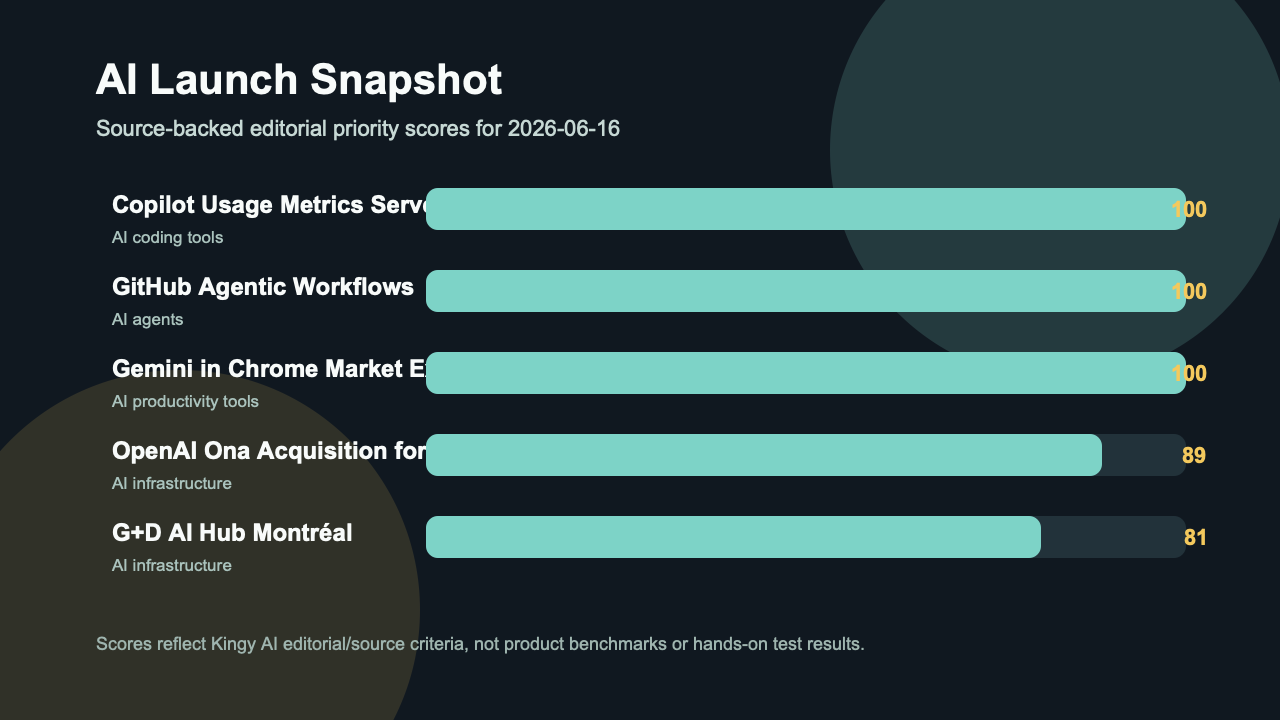
The snapshot below compares the strongest source-checked launches by Kingy AI score. It is a research-priority visual, not a benchmark chart or hands-on test result.
Strongest Launches
Copilot Usage Metrics Server-Side Telemetry
GitHub updated Copilot usage metrics so enterprise reports include additional server-side telemetry for active users that client signals may miss.
Checked launch source, docs, GitHub repo for the current Radar entry.
Why it matters: Enterprise AI leaders need adoption, billing, and activity reporting that matches real Copilot usage; better active-user coverage reduces support escalations and gives platform teams a cleaner view of AI tool adoption.
Who should care: AI Platform Teams, AI Engineers, Developers, Enterprises
For broader Kingy AI context, compare Copilot Usage Metrics Server-Side Telemetry with other AI launch radar coverage and recent AI News before treating this as a standalone buying decision.
Pricing: GitHub Copilot includes a Free plan with limited completions. Official plan pages list Pro at $10 USD per user per month, Pro+ at $39, and Max at $100 for individuals, with Business and Enterprise plans also available; AI Credits and plan availability should be verified on GitHub’s current pricing pages. Confirm current pricing on the official pricing/source page.
What launched: On June 15, 2026, GitHub announced that Copilot usage metrics now combine client-side telemetry with server-side signals so more active users appear in enterprise single-day and 28-day reports. See the official launch source.
What feels promising: Enterprise AI leaders need adoption, billing, and activity reporting that matches real Copilot usage; better active-user coverage reduces support escalations and gives platform teams a cleaner view of AI tool adoption.
What feels unproven: [‘Server-side telemetry improves active-user counts but may not yet include detailed IDE, feature, model, or lines-of-code breakdowns for every newly surfaced user.’, ‘The usefulness depends on plan eligibility, admin access, and whether teams already rely on the new Copilot usage metrics API.’, ‘Usage reporting should not be treated as a complete ROI measurement without workflow, satisfaction, and code-quality context.’]
GitHub Agentic Workflows
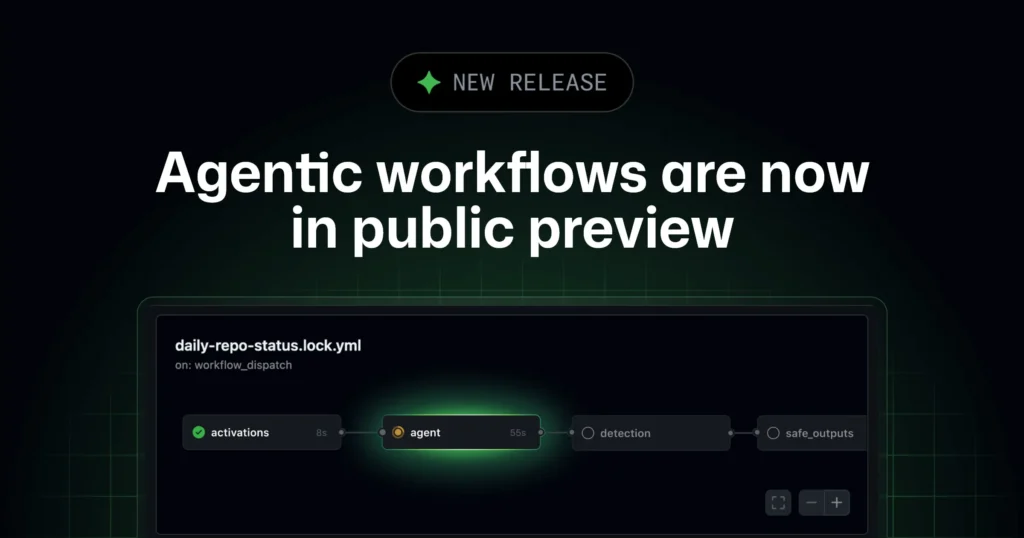
GitHub Agentic Workflows lets teams define AI-powered repository automations in Markdown and run coding agents through GitHub Actions with guardrails.
Checked launch source, docs, GitHub repo for the current Radar entry.
Why it matters: Engineering teams are moving from one-off coding-agent sessions to repeatable AI operations; Agentic Workflows puts that automation inside GitHub Actions where platform teams already manage triggers, permissions, runners, checks, and review gates.
Who should care: AI Platform Teams, AI Engineers, Developers, Enterprises
For broader Kingy AI context, compare GitHub Agentic Workflows with other AI launch radar coverage and recent AI News before treating this as a standalone buying decision.
Pricing: The GitHub changelog says GitHub Agentic Workflows can use Copilot, Claude, Gemini, or OpenAI Codex engines. Copilot-backed usage depends on a GitHub Copilot plan and AI credit consumption; GitHub’s Copilot pricing pages list individual Free, Pro, Pro+, and Max plans plus Business and Enterprise options. Confirm current pricing on the official pricing/source page.
What launched: On June 11, 2026, GitHub announced GitHub Agentic Workflows in public preview, bringing agentic repository automations for tasks such as issue triage, CI failure analysis, documentation updates, and reusable maintenance workflows. See the official launch source.
What feels promising: Engineering teams are moving from one-off coding-agent sessions to repeatable AI operations; Agentic Workflows puts that automation inside GitHub Actions where platform teams already manage triggers, permissions, runners, checks, and review gates.
What feels unproven: [‘Public preview behavior, supported engines, and billing details may change.’, ‘Agentic workflows need careful permissions, safe outputs, firewall rules, and review policies before production use.’, ‘AI-generated changes still require human review, CI validation, and security checks.’]
Gemini in Chrome Market Expansion
Google expanded Gemini in Chrome to more markets and highlighted browsing assistance, app integrations, image transformation, memory, and Personal Intelligence features.
Checked launch source, docs for the current Radar entry.
Why it matters: Browser-native AI assistants are becoming an everyday distribution layer for AI productivity; this update broadens access and makes Chrome a more direct surface for AI summaries, task help, personalization, and controlled web actions.
Who should care: Small Business Owners, Marketers, Students, Operators
For broader Kingy AI context, compare Gemini in Chrome Market Expansion with other AI launch radar coverage and recent AI News before treating this as a standalone buying decision.
Pricing: Google’s current subscription pages list Google AI Plus at $4.99 USD per month, Google AI Pro at $19.99 per month, and Google AI Ultra starting at $99.99 per month in the U.S.; availability and included Gemini in Chrome features vary by country, platform, age, and feature tier. Confirm current pricing on the official pricing/source page.
What launched: Google announced that Gemini in Chrome is rolling out to desktop and iOS users in Latin America, Africa, the Middle East, and more, with features such as page summarization, multi-tab comparison, Google app integrations, Nano Banana 2 image transformation, memory, and Personal Intelligence. See the official launch source.
What feels promising: Browser-native AI assistants are becoming an everyday distribution layer for AI productivity; this update broadens access and makes Chrome a more direct surface for AI summaries, task help, personalization, and controlled web actions.
What feels unproven: [‘Availability varies by region, platform, plan, and rollout timing.’, ‘Personal Intelligence relies on connected personal data and should be reviewed for privacy fit.’, ‘Google notes safeguards for sensitive actions, but users should still verify browser-agent outputs before acting.’]
OpenAI Ona Acquisition for Codex
OpenAI announced plans to acquire Ona to bring secure, customer-controlled cloud execution and orchestration into the Codex ecosystem.
Checked launch source, docs for the current Radar entry.
Why it matters: Long-running coding agents need more than model intelligence; enterprise buyers need durable execution environments, credential scoping, logging, governance, review paths, and infrastructure control before agents can operate safely in production workflows.
Who should care: AI Platform Teams, AI Engineers, Developers, Enterprises
For broader Kingy AI context, compare OpenAI Ona Acquisition for Codex with other AI launch radar coverage and recent AI News before treating this as a standalone buying decision.
Pricing: unknown
What launched: On June 11, 2026, OpenAI announced that it will acquire Ona, subject to customary closing conditions, to expand Codex with secure persistent environments for long-running agent work. See the official launch source.
What feels promising: Long-running coding agents need more than model intelligence; enterprise buyers need durable execution environments, credential scoping, logging, governance, review paths, and infrastructure control before agents can operate safely in production workflows.
What feels unproven: [‘The transaction had not closed at announcement time, so product packaging, timeline, pricing, and customer availability are unknown.’, ‘OpenAI did not provide a standalone Codex/Ona pricing page for the new capability.’, ‘Enterprise deployment still depends on governance, security controls, cloud architecture, auditability, and human review.’]
Arcade MCP Runtime
Arcade.dev raised $60 million while positioning Arcade as an MCP runtime and secure action layer for production AI agents.
Checked launch source, docs, and GitHub organization for this Radar entry.
Why it matters: As enterprises move agents from demos into production, the hard problem is proving which agent acted for which user against which system; Arcade is aiming at that authorization, reliability, and governance layer rather than another chatbot surface.
Who should care: AI Engineers, AI Platform Teams, Developers, Enterprises
For broader Kingy AI context, compare Arcade MCP Runtime with other AI launch radar coverage and recent AI News before treating this as a standalone buying decision.
Pricing: Arcade says it is free to start and priced by usage for agent scale, but no complete numeric public pricing table was verified during this run. Confirm current pricing on the official pricing/source page.
What launched: On June 15, 2026, Arcade.dev announced a $60 million Series A led by SYN Ventures, with strategic investment from Morgan Stanley and Wipro, to expand its secure action layer for production AI agents. See the launch source.
What feels promising: Arcade focuses on delegated authorization, policy enforcement, reliable tool execution, and audit trails for production agents.
What feels unproven: Public numeric pricing was not fully verified, and production use still needs security review, policy design, and human oversight.
Related Kingy AI Links
For more launch tracking and founder resources, see AI Launches, AI Tools, and the AI News archive. Founders can also use the AI Sponsored Video ROI Calculator.
Sponsor path
Sponsor Kingy AI launch coverage
Launching an AI product that needs clear demos, creator education, and buyer trust? Sponsor a Kingy AI video or launch feature.
The Kingy Brief
Get future Kingy Brief editions.
Source-checked AI changes, original tests and one practical thing to try.
Free · Choose your subjects · Double opt-in · Unsubscribe anytime
Regular sending is paused; no restart date is set.