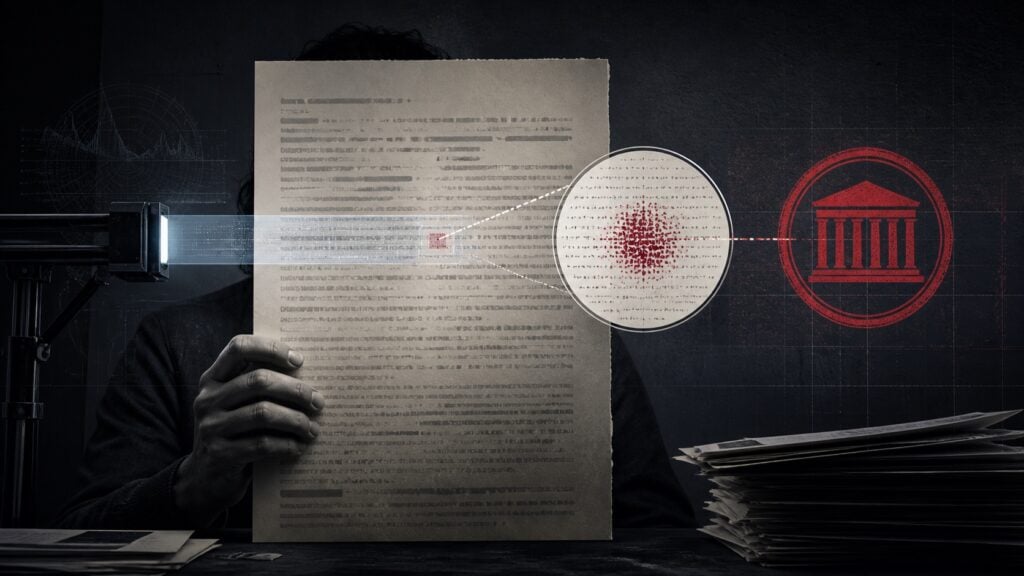
I cancelled my paid Claude subscription after reading Anthropic’s announcement that supported Claude models will embed invisible watermarks in text.
There was no theatrical exit and no claim that one cancelled subscription will bend a large AI company to my will. I was a paying customer. Anthropic changed the trust bargain. I stopped paying. That is what a functioning market is supposed to look like.
My objection is not to transparency. I want better ways to distinguish synthetic media, investigate fraud and establish provenance. I object to Anthropic introducing a hidden signal before telling customers enough about its detector, its error characteristics, the models it covers, notice and opt-out rules, or the process for challenging a damaging interpretation.
Anthropic’s own documentation says a detected mark can mean only that content may have been processed by Claude. The company also acknowledges that Claude may not be the original author. Yet the mark can travel with copied text and survive some editing. That puts a narrow technical signal into a world of employers, schools, publishers, clients, platforms and automated systems that routinely turn ambiguous evidence into blunt verdicts.
I am unwilling to pay a company to silently mark work that may still substantially be mine.
What Anthropic actually announced
Anthropic published its “How Claude marks AI-generated content” help page on August 10, 2026. The company had signed Section 1 of the European Union’s voluntary Code of Practice on Transparency of AI-Generated Content, a compliance framework for the binding transparency duties in Article 50 of the EU AI Act.
The announcement describes two different marking systems.
First, supported Claude models will embed an imperceptible watermark directly into generated text at the model level. Anthropic says that mark will accompany copied text and may persist after some editing. Because the marking happens at model level, it is meant to follow output across Claude, Claude Code, Claude Cowork, Claude Tag, the API and supported deployments through AWS, Google Cloud and Microsoft Foundry. Anthropic says it will apply worldwide, not only in the EU.
Second, supported files such as SVG, PNG and JPG will receive digitally signed provenance metadata using the C2PA standard. The text watermark is separate. C2PA is a signed record attached to a file. A valid credential can help show what a signer asserted about the file’s history and whether the signed record has been altered. It cannot certify that the picture is true, that the person presenting it created it, or that an uncredentialed file is fraudulent.
The rollout description is narrower than the viral version of this story. Anthropic says Claude models launched in the EU on or after August 2, 2026 will support marking at launch. Models released before that date are covered by a transition period, and Anthropic says it is working to add support. As of August 11, its page did not name a currently supported model or say that every existing Claude model was already watermarking output. It promised updates as support becomes available.
That ambiguity matters. I am cancelling over an announced product policy and the governance around it, not claiming that every sentence Claude produces today already carries a detectable mark.
Anthropic also has not published the Claude detector, its thresholds, Claude-specific reliability measurements, an opt-out policy, or a dispute procedure. The page says technical documentation is forthcoming. I checked for later documentation and revised dates before publication; none of those missing details had appeared by August 11.
For a deeper technical and legal breakdown, Kingy.ai’s analysis of the Claude watermark and the attribution trap examines the EU rules, detection limits and downstream risks in detail.
One more distinction is necessary. This output-marking announcement is not the earlier Claude Code prompt-steganography controversy. In June, a reverse engineer reported that Claude Code could alter punctuation and date separators in a request-side system prompt when a custom API endpoint was used, encoding information about the client environment. The reported Claude Code mechanism concerned text sent to the model. Anthropic’s new policy concerns a mark embedded in text coming from supported models. Conflating the two makes both stories less precise.
Nor has Anthropic said its output watermark identifies an individual user. I found no authoritative evidence that it tracks a person, transfers copyright, changes ownership, or conclusively proves AI authorship. Those claims would go beyond the record.
A watermark can prove contact, not authorship
Anthropic’s most consequential admission sits in its limitations section. A detected mark is a signal that content may have been processed by Claude, the company says, but it does not establish the content’s full provenance.
Claude might have proofread a human draft. It might have translated it, summarized it, converted a file or changed its format. A person might then edit the result, excerpt it or combine it with other material. In all of those cases, Anthropic says a mark may remain even though Claude did not originate the underlying ideas, text or data.
The negative result is equally limited. No detected mark does not prove human authorship. The text may be too short, heavily edited, translated, paraphrased, mixed with other writing, produced by an unsupported model or generated through a surface that did not support a particular marking type. File metadata can disappear when a file is converted, resaved or captured in a screenshot.
So the detector, even if it performs exactly as designed, cannot answer the question that institutions will want to ask: who wrote this?
It can answer a smaller question: does this sample contain a supported signal associated with Claude processing? That can be useful in an investigation. It establishes neither plagiarism, deception, policy violation nor authorship. It says nothing by itself about how much intellectual work the person contributed.
The semantic limit survives perfect statistics. Imagine a detector with perfect sensitivity and no false positives. If it correctly flags a human-authored essay that Claude translated, the detector is technically right and the accusation of machine authorship is still wrong.
Anthropic understands this. Its documentation says so. The danger begins when an official-looking detector result moves into a learning-management system, a freelance marketplace, an employer’s screening process or a publisher’s integrity workflow. The caveat will occupy a help page. The flag will occupy the dashboard.
I was paying Anthropic to mark work that may still be mine
AI services are often sold as tools for thinking, drafting, editing and transforming a customer’s material. The customer supplies instructions, source documents, judgments, corrections and final approval. Contribution varies enormously from one task to another.
Anthropic’s planned mark collapses that variation into evidence of contact.
If I hand Claude a paragraph I wrote and ask for a cleaner transition, whose work is the returned paragraph? The honest answer depends on what changed. It may remain overwhelmingly mine. If I supply an original analysis and ask for a translation, the language changes while the research, structure and argument remain mine. If I ask for a summary, Claude may make a much larger creative contribution. These are not equivalent acts, and a mark that does not distinguish them invites someone else to treat them as equivalent.
I am not alleging that Anthropic claims ownership of marked output. Its consumer terms say users retain their rights in inputs and receive any Anthropic interest in outputs. This is not an ownership dispute. My objection is the product relationship: I pay for processing, and the provider embeds a signal that can follow the result into contexts the provider does not control.
A word processor can record revision history. A camera can attach metadata. Those features are visible, inspectable and often configurable. Anthropic is proposing a model-level text signal that the customer cannot see, while promising the means to detect it later. The customer receives the marked object; third parties may eventually receive the interpretive tool.
That asymmetry is not made acceptable by calling it transparency. Transparency for whom matters.
Notice, choice and the missing appeal
A help-center announcement supplies archival notice without giving customers meaningful choice at the moment they submit work.
Anthropic’s page does not promise a persistent in-product warning identifying which selected model is currently marking text. It does not describe a per-request indicator, a receipt showing that a mark was applied, or a way to inspect the marked portion. It does not offer customers outside the EU an opt-out. It does not explain whether routine editing can avoid marking. It does not say how a person can challenge a detector result used against them.
The legal backdrop makes that silence harder to excuse. Article 50(2) of the EU AI Act requires covered providers to make synthetic content machine-readable and detectable, using measures that are effective, interoperable, reliable and technically resilient. But the same paragraph exempts systems to the extent that they perform an assistive function for standard editing or do not substantially alter the user’s input or its meaning.
The European Commission’s July 2026 guidelines give examples. Grammar correction, spellchecking, minor linguistic polishing, translation and format conversion can fall within the exception when they do not materially change meaning, style or intent. Summarization and substantial rewriting fall on the marking side.
Anthropic, by contrast, says embedded watermarks will apply to all generated text from supported models and warns that translated or proofread work may carry a mark. Perhaps its eventual implementation will make finer distinctions. The announcement does not say that. A blanket model-level rule appears to reach beyond what the EU’s editing exception requires.
The EU’s AI Omnibus transition rule gives generative systems already on the market before August 2 until December 2, 2026 to comply. Anthropic therefore has a compliance reason to move. It does not have a customer-trust reason to leave the essential product rules unpublished while announcing a worldwide regime.
Due process becomes urgent once a mark can trigger consequences. An accused writer should be able to obtain the exact tested text, detector version, supported model range, threshold, confidence or abstention state, timestamp and signed result. They should be able to reproduce the test and submit evidence of their workflow. An institution should be warned that a mark cannot establish authorship or misconduct and should never be the sole basis for punishment.
Anthropic has announced none of that.
The false-attribution machine
There are two different failure modes here.
A technical false positive occurs when a detector reports a Claude mark in material that does not contain one. Anthropic has not published the measurements needed to estimate that risk across languages, passage lengths, genres, model settings or highly constrained text.
A false attribution occurs when the detector correctly finds a mark and a decision-maker draws a conclusion the mark cannot support. That risk exists even with flawless detection. A marked translation becomes “AI-written.” A proofread report becomes “inauthentic.” A passage that incorporates a marked quotation contaminates a larger document in the eyes of a simplistic scanner.
The EU Code recognizes how unstable free-form text detection can be. It says text longer than 200 tokens should be watermarked, but acknowledges lower reliability than very long text. It permits access to free-form-text detection mechanisms to be restricted temporarily to verified experts when results may be misleading or low-confidence. The Code also requires signatories to measure error rates across varied content and to make detection results clear about the technique used.
Anthropic has announced the mark before publishing that evidence. The result is an extraordinary ordering of priorities: mark first, explain the detector later, and let customers hope downstream institutions read the footnotes.
Schools and employers already have experience with generic AI-text detectors that convert probabilities into suspicion. A provider-applied watermark is better evidence than a classifier guessing from prose style, but better evidence can still be abused. Official provenance will look more authoritative, which raises the duty to define its limits before distribution.
Anthropic’s best argument
The case for marking synthetic content is serious.
Generative systems can produce fraud, impersonation, spam and coordinated manipulation at a scale that manual investigation cannot handle. Generic detectors are brittle because they infer origin from writing patterns. A watermark deliberately inserted by the provider can supply a more principled signal. Signed file provenance can help journalists, platforms and investigators reconstruct an asset’s history. The EU did not invent the problem.
Anthropic is also not acting alone. Google has deployed SynthID text watermarking in parts of its ecosystem, and other major AI providers signed the EU Code. The Code calls for free detection access in many circumstances, privacy safeguards, testing, clear results and cooperation across the content supply chain. Used as one clue among several, provenance can improve public trust.
No security control must be perfect to be useful. A watermark that raises the cost of mass abuse or helps authenticate one document can earn its place.
That is Anthropic’s strongest defense, and I accept most of it. It still does not justify asking paying customers to accept an opaque global marking policy without task-sensitive scope, current model status, public performance evidence, meaningful notice and a remedy when the signal is misused.
What Anthropic Would Have to Do to Win Me Back
Anthropic can change my mind by publishing the entire trust layer around the mark.
-
Identify marked output before generation. The model picker and API documentation should state which exact model and version applies which mark. Every marked response should include a visible, exportable receipt.
-
Respect assistance as a distinct category. Standard proofreading, minor polishing, translation and format conversion should follow the EU’s editing exception when they do not substantially alter the work. If Anthropic cannot scope this reliably, customers outside jurisdictions requiring the mark should get an opt-out.
-
Publish the measurements. Report false-positive, false-negative and abstention rates by model, language, text length and content type. Test quotations, code, legal text, academic prose, constrained factual answers, mixing, paraphrasing and translation. Fund independent evaluation and publish the results.
-
Make the detector legible and privacy-preserving. It should distinguish “mark detected,” “mark not detected” and “insufficient evidence.” It should say whether the evidence came from a text watermark or C2PA metadata. Uploaded material should receive the Code’s zero-retention treatment, with local detection offered where feasible.
-
Build a dispute process before integrations spread. An affected person must be able to obtain a signed result, reproduce the test, correct an error and contest an overbroad interpretation. Anthropic should prohibit its detector from serving as the sole evidence for academic, employment, publishing or professional sanctions.
-
Say plainly what the mark does not prove. Every detector result should state that Claude contact is not proof of Claude authorship, plagiarism, deception, ownership or misconduct.
-
Publish dates and change logs. Name rollout dates for existing models, document revisions, preserve detection for retired models and disclose material changes before they affect customer output.
These are not demands that Anthropic reveal a secret key or publish a removal manual. They are the normal controls expected when a private technical signal may become public evidence.
Cancellation is consumer feedback
I was a paying Claude subscriber. Anthropic’s announcement caused me serious concern, and I cancelled because of it.
I am not asking anyone to stage a boycott. Other customers may decide that the fraud-prevention benefits outweigh the governance gaps. Enterprises may prefer consistent worldwide marking. People who use Claude only for disposable queries may not care. Those are rational positions.
Mine is also rational. Anthropic wants customers to trust a hidden provenance system before it has supplied the information needed to judge that system or the safeguards needed when others overread it. The company admits that its mark may show processing rather than authorship. It still plans to place that mark into customer work across products and regions.
I do not owe a subscription business patience while it finishes the rules for a feature that changes the evidentiary status of my output. I can reassess when Anthropic publishes the detector, the numbers, the scope, the notice, the choice and the appeal.
Until then, my cancellation is the clearest feedback I can give: I will not pay to have my work silently marked first and properly explained later.
Frequently asked questions
Is Claude watermarking all writing right now?
Anthropic has not said that every existing Claude model is already marking output. Its August 10 page says models launched in the EU on or after August 2, 2026 support marking at launch, while support for earlier models is still being added. It did not publish a named supported-model list as of August 11.
Can a Claude watermark prove that Claude wrote a document?
No. Anthropic says a detected mark means content may have been processed by Claude. Proofreading, translation, summarization or conversion can leave a mark even when the ideas or source text came from a person.
Is the Claude text watermark just metadata or hidden Unicode?
Anthropic describes it as a model-level watermark embedded in generated text, not ordinary file metadata. It has not published enough technical detail to identify the exact method. C2PA metadata for supported files is a separate marking layer.
Can I opt out of Claude watermarking?
Anthropic’s public announcement does not provide an opt-out. It says marks will apply worldwide to output from supported models. Customers should check the current help page and model documentation because rollout details may change.
What are the best Claude alternatives after watermarking?
Do not assume another hosted model is unmarked; the EU rule affects the wider industry. Compare providers on visible notice, task-level controls, detector documentation, error reporting and dispute procedures. Local or self-hosted models may offer more control, but their licenses, quality, security and legal obligations still need review.
What the watermark question means for code, essays, Word files, and PDFs
The practical question is broader than whether a detector returns a signal. A responsible interpretation separates four things: contact with marked output, authorship, the file container, and any later transformation such as editing, copying, conversion, or translation.
| Question | Responsible answer |
|---|---|
| Does a positive signal prove Claude wrote the work? | No. It may support contact with marked output, but it does not by itself establish authorship, intent, ownership, or how much human work followed. |
| Is a text watermark necessarily hidden Unicode or document metadata? | No. Statistical text watermarking, hidden characters, file metadata, and C2PA provenance are different mechanisms and should not be treated as interchangeable. |
| What about code and Claude Code output? | Product-specific scope and detector behavior must be documented before anyone makes a categorical claim. Formatting, refactoring, and mixed human/AI authorship make attribution especially fragile. |
| What about Word documents and PDFs? | The document container can add or remove metadata independently of any statistical signal in the text. Converting a file does not turn a detector result into proof of authorship. |
| Does a negative result prove no Claude use? | No. Absence of a detectable signal is not proof of non-use. |
A practical risk rule
Do not use a private detector as an automatic disciplinary, academic, employment, or client-compliance verdict. Publish the detector’s error rates, scope, version, transformations tested, appeal path, and evidence standard before attaching consequences to a result.
Historical evidence note: this section retains the unique technical and file-format analysis from Kingy’s August 11, 2026 watermark reports while keeping the higher-performing consumer-impact article as the canonical owner.