Alibaba's Qwen team released Qwen3.8-27B at 15:00 UTC on August 14, 2026. The launch-day conclusion is unusually clear: this is the most convincing candidate yet for the best dense, locally deployable multimodal model around 30 billion parameters.
The exact checkpoint contains 27.78 billion parameters, accepts text, images and video, ships under Apache 2.0, and has a native 262,144-token context window. Qwen reports large improvements over Qwen3.6-27B in agentic coding, computer use and vision-language work without increasing the published decoder size. The official model card shows Terminal-Bench 2.1 rising from 63.4 to 73.0, DeepSWE 1.1 from 13.3 to 42.2, OSWorld-Verified from 63.9 to 84.3 and SWE-MM from 25.7 to 38.6.
That is the strong version of the story. The careful version matters just as much. Every launch score comes from Qwen. Several benchmarks are in-house, corrected or modified. The SWE-bench Pro comparison imports Anthropic's Opus result instead of rerunning it under Qwen's setup. The most dramatic local-hardware claims ignore KV cache. One million tokens require YaRN scaling rather than the native context, and Qwen warns that static YaRN can hurt shorter prompts.
During Kingy.ai's August 14 launch-day review, we inspected the model card, configuration, license, repository metadata, official BF16 and FP8 artifacts, and third-party GGUF file inventory. We recalculated benchmark deltas and memory lower bounds but did not run inference then: the exact managed Qwen Cloud endpoint was marked "coming soon," and that review did not download a 55.6GB checkpoint or use paid third-party compute. Kingy later tested the exact model and RTX 4090 24GB pairing linked below; that result does not independently validate every launch benchmark or hardware tier. Kingy.ai found no independent Qwen3.8-27B benchmark reproduction in the launch-day search completed at 11:00 PDT (18:00 UTC).
Updated August 22, 2026 — observed result: Kingy has now tested this exact model/hardware pairing. See the observed configuration, speed, memory boundary, failures, and reproducible evidence in Local Lab.
Qwen3.8-27B verdict
Qwen3.8-27B looks like the new model to beat when the requirement is strong multimodal intelligence in a checkpoint that can realistically be quantized onto a high-end workstation. It is not an honest one-for-one replacement for today's strongest frontier APIs or data-center-scale open mixtures.
The release is especially compelling for local coding assistants, bounded agents, document and image analysis, private research workflows and multimodal automation where 27.78B dense weights are manageable and Apache 2.0 matters. The launch evidence shows a consistent upgrade over Qwen3.6-27B rather than one isolated benchmark spike.
The main caveats are material:
- Kingy.ai found no independent reproduction by the 11:00 PDT research cutoff.
- Qwen Cloud hosting and exact-model pricing are not live yet.
- Only BF16 and FP8 checkpoints are official; the workstation-friendly GGUF files are third-party conversions.
- A 24GB GPU is a plausible target for a four-bit quant at moderate context, not for BF16, FP8 or the full 262K window.
- The training corpus, token count, knowledge cutoff, post-training recipe, safety evaluation and supported-language count are undisclosed.
- "Open weight under Apache 2.0" is precise. "Fully open source" overstates a release without training data or a reproducible training package.
In this guide
- Specifications and architecture
- Text, coding and agent benchmarks
- Multimodal and computer-use benchmarks
- Open-weight model comparison
- Frontier-model comparison
- Local hardware and memory
- Context, reasoning and API availability
- FAQ and primary sources
What launched on August 14
The model is exactly Qwen/Qwen3.8-27B, not Qwen3-8B and not the 2.4-trillion-parameter Qwen3.8-Max. Alibaba's ModelScope metadata records the release at August 14, 2026, 15:00 UTC; the final Hugging Face launch card followed one second later.
The repository contains one post-trained multimodal checkpoint. Qwen did not publish separate Base and Instruct variants at launch. The Hugging Face page was staged before release, so its August 5 repository-creation date is not the public launch date.
This is also a different operating proposition from the proprietary Max model. For the flagship context, see Kingy.ai's Qwen3.8-Max evidence-led guide. The 27B release trades enormous cloud-scale capacity for downloadable weights and workstation-class quantization.
Qwen3.8-27B specifications
On a phone, the table fields stack vertically for readability.
| Specification | Qwen3.8-27B | Evidence and practical meaning |
|---|---|---|
| Release date | August 14, 2026, 15:00 UTC | Official ModelScope metadata and final Hugging Face commit |
| Checkpoint type | Post-trained dense causal VLM | Text, image and video input; text output |
| Exact stored parameters | 27,781,427,952 | Hugging Face Safetensors metadata; the marketed name rounds to 27B |
| Decoder layers | 64 | 48 Gated DeltaNet layers and 16 full-attention layers |
| Hidden / FFN size | 5,120 / 17,408 | Published configuration |
| Full attention | 24 query heads, 4 KV heads, head dimension 256 | Grouped-query attention; partial RoPE dimension 64 |
| Linear attention | 48 value heads, 16 QK heads, head dimension 128 | Three linear-attention blocks precede each full-attention block |
| Vocabulary | 248,320 padded entries | Separate embeddings and output projection; weights are not tied |
| Vision encoder | 27 layers, width 1,152, 16 heads | Patch size 16, temporal patch 2, spatial merge 2 |
| Native context | 262,144 tokens | Model configuration's maximum position length |
| Extended context | Up to 1,000,000 tokens | YaRN scaling; not native 1M |
| Reasoning | Thinking on by default | Can be disabled per request |
| Reasoning effort | xhigh default, medium, low |
Controls reasoning depth; does not guarantee lower total task cost |
| Thinking continuity | preserve_thinking on by default |
Retains prior reasoning blocks across turns |
| MTP | Trained for multi-token prediction | Configuration contains one MTP hidden layer |
| Official weights | BF16 and blockwise FP8 | No official Qwen GGUF, AWQ, GPTQ or MLX checkpoint at launch |
| Official serving | Transformers, vLLM, SGLang, TokenSpeed | Qwen recommends current framework releases |
| License | Apache License 2.0 | Permissive weight license; training data and full recipe are not published |
| Managed API | Qwen Cloud "coming soon" | Exact price unavailable at publication time |
Primary technical evidence comes from the commit-pinned configuration, model card and Apache 2.0 license.
The architecture is familiar; the capability jump is not
Qwen3.8-27B uses a hybrid decoder rather than a conventional all-attention transformer. Its 64 language layers repeat one pattern 16 times: three Gated DeltaNet linear-attention layers, each followed by an FFN, then one grouped-query full-attention layer and another FFN.
That arrangement aims to keep most sequence processing efficient while periodically using full attention to recover richer token-to-token interaction. Only 16 layers build the conventional full-attention KV cache. This is why the model's cache is smaller than an all-attention 64-layer model with the same dimensions, although it is still large at hundreds of thousands of tokens.
The striking point is how closely the published decoder matches Qwen3.6-27B. Layer count, hidden size, FFN width, head layout and native context are essentially the same. Qwen has not disclosed a new decoder geometry that explains the benchmark jump.
The defensible inference is that the gains come mainly from different model weights, training and post-training, plus changes to reasoning and agent behavior. Qwen does not publish enough about the corpus, training schedule, reinforcement-learning environments or distillation to separate those contributions. "Same shape" does not mean "same model," but it does make this a behavior-and-training release more than an architecture release.
The Hugging Face config still says model_type: qwen3_5 and loads through Qwen3_5ForConditionalGeneration. That is a software compatibility choice, not evidence that the checkpoint is secretly Qwen3.5.
How to read Qwen's benchmark table
Qwen's launch card is valuable because it puts Qwen3.8-27B, Qwen3.6-27B, Qwen3.7-Plus, Muse Glimmer-30B and Opus4.6 Max in a single table. It is still a vendor table, and its footnotes change the meaning of several rows.
Five rules prevent the biggest mistakes:
- Attribute every number to Qwen. Public tasks do not make a vendor-run result independent.
- Do not treat the Opus SWE-bench Pro cell as a controlled rerun. Qwen reran the other models on a corrected task set with Claude Code, but imported Opus's official score.
- Separate in-house benchmarks. QwenSWEBench, CoWorkBench and RecreationBench are designed by Qwen; their tasks and graders do not yet offer the external auditability of a mature public suite.
- Record tools and judges. HLE uses GPT-4o as judge; Vision2Web uses a GPT-5.4 snapshot; code-interpreter and no-code-interpreter vision results are different conditions.
- Do not merge unlike rows into an average. GPQA, terminal agents, Android control and document parsing measure different systems under different scaffolds.
Text, coding and agent benchmarks
The following values reproduce Qwen's launch table. Higher is better. A dash means Qwen did not report a result.
| Benchmark | Qwen3.8-27B | Qwen3.6-27B | Qwen3.7-Plus | Muse Glimmer-30B | Opus4.6 Max |
|---|---|---|---|---|---|
| Terminal-Bench 2.1 | 73.0 | 63.4 | 64.0 | 51.7 | 78.2 |
| SWE-bench Pro | 61.7 | 53.5 | 57.6 | 51.2 | 53.4† |
| NL2Repo-Bench | 42.3 | 36.2 | 41.1 | — | 47.6 |
| DeepSWE 1.1 | 42.2 | 13.3 | 14.2 | — | — |
| QwenSWEBench | 79.0 | 49.3 | 59.2 | — | 63.8 |
| CoWorkBench | 70.7 | 61.0 | 65.1 | — | 68.2 |
| JobBench | 33.4 | 21.8 | 27.6 | — | — |
| Agents' Last Exam, Pass@1 / score | 20.4 / 42.9 | 10.6 / 27.3 | 13.2 / 33.6 | — | — |
| IFBench | 79.5 | 69.1 | 79.1 | 77.0 | 62.5 |
| GPQA Diamond | 89.2 | 87.8 | 90.3 | 83.5 | 91.3 |
| Humanity's Last Exam | 30.8 | 24.0 | 34.7 | 22.0 | 40.0 |
| LiveCodeBench v6 | 90.3 | 83.9 | 89.6 | — | 88.8 |
† Qwen says its SWE-bench Pro runs use Claude Code, temperature 1.0, top-p 0.95, 256K context and a refined task set with corrected problematic tasks. Opus4.6 Max uses its separately published official score. The bold display is Qwen's table convention, not proof of an apples-to-apples Qwen win.
The generational result is broad: Qwen3.8-27B exceeds Qwen3.6-27B on every displayed text benchmark. The gains include 9.6 points on Terminal-Bench 2.1, 8.2 on SWE-bench Pro, 28.9 on DeepSWE, 29.7 on QwenSWEBench, 10.4 on IFBench and 6.4 on LiveCodeBench v6.
Against Qwen3.7-Plus, the 27B model wins 10 of the 12 benchmark rows and loses GPQA Diamond and HLE. Against Muse Glimmer-30B, it leads every overlapping text row Qwen reports. Those are meaningful launch signals for a compact dense model.
They are not proof that Qwen3.8-27B beats the current frontier. Qwen's strongest clean losses in its own table are informative: Opus4.6 Max remains 5.2 points ahead on Terminal-Bench, 5.3 on NL2Repo, 2.1 on GPQA and 9.2 on HLE. A 27B model being competitive in some rows is remarkable; selective parity is not universal parity.
Qwen's deeper footnotes matter. NL2Repo disables Bash commands such as pip download, pip install and git clone when they could reveal the target repository. DeepSWE uses Claude Code at 256K context. QwenSWEBench is an average of three runs with an eight-hour timeout and max_tokens=32,768, a generated-token cap rather than the total context window. CoWorkBench is an in-house long-horizon benchmark spanning professional domains. HLE is judged by GPT-4o.
Multimodal and computer-use performance
Qwen's launch card evaluates the checkpoint across browser, desktop, Android, document, scientific-chart, visual-coding and embodied-reasoning tasks.
| Benchmark | Qwen3.8-27B | Qwen3.6-27B | Qwen3.7-Plus | Muse Glimmer-30B | Opus4.6 Max |
|---|---|---|---|---|---|
| OSWorld-Verified | 84.3 | 63.9 | 73.3 | 65.9 | 72.7 |
| WebArena-Verified | 64.8 | 48.8 | 55.3 | — | — |
| AndroidWorld | 81.9 | 70.3 | 81.0 | — | 62.0 |
| RecreationBench | 47.1 | 29.8 | 30.2 | — | — |
| ClawEval-MM, Pass@3 / average | 57.4 / 56.9 | 42.6 / 50.4 | 57.4 / 60.1 | — | 52.5 / 54.7 |
| SWE-MM | 38.6 | 25.7 | 30.0 | — | 27.1 |
| Vision2Web | 62.9 | 45.0 | 42.1 | — | — |
| MathVision, without / with code interpreter | 90.0 / 94.6 | 85.1 / — | 90.3 / — | — | 65.5 / — |
| BabyVision, without / with code interpreter | 65.7 / 85.6 | 28.9 / — | 64.7 / 70.4 | — | 12.6 / — |
| CharXiv RQ, without / with code interpreter | 83.7 / 90.2 | 78.4 / — | 85.8 / 85.9 | 78.8 | 66.0 / — |
| OmniDocBench 1.5 | 91.1 | 89.4 | 91.4 | 75.8 | 86.6 |
| RealWorldQA | 85.9 | 84.1 | 86.9 | — | 73.9 |
| ERQA | 65.5 | 62.5 | 69.8 | — | 40.8 |
Again, the predecessor comparison is consistently positive: Qwen3.8 beats Qwen3.6 on every displayed multimodal row. The largest practical deltas include +20.4 on OSWorld, +16.0 on WebArena, +17.9 on Vision2Web and +12.9 on SWE-MM.
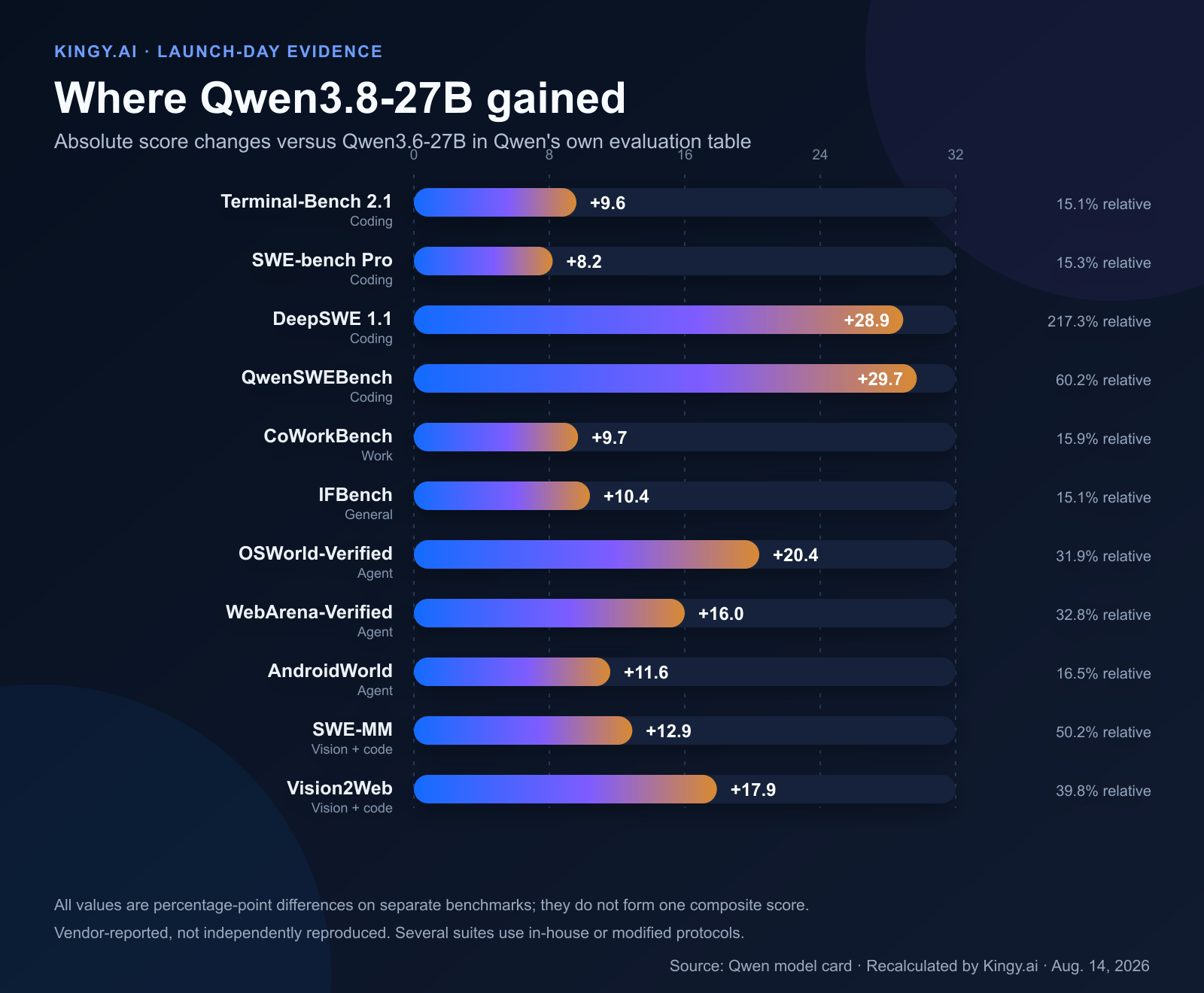
The table also shows why "best multimodal model" is too broad. Qwen3.7-Plus is higher on several general vision rows and on ClawEval-MM's average score. Qwen3.8's clearest advantage is in hybrid agent tasks: operating interfaces, building software from visual context and completing longer environment loops.
The caveats are unusually important. RecreationBench is an in-house application-recreation test. WebArena-Verified uses the official grader under the OSWorld scaffold. ClawEval-MM Pass@3 means success in at least one of three trials; its average is the mean score across those trials. Vision2Web is averaged across frontend, webpage and website categories, uses Claude Code and is judged by gpt-5.4-2026-03-05. SWE-MM uses a modified public dev split. Qwen manually corrected some MathVision and CharXiv labels. MathVision prompting is asymmetric: Qwen3.8 uses one fixed prompt while the comparison models receive the better of two prompt variants.
How Qwen3.8-27B compares with open-weight models
The useful open-model comparison is not one leaderboard. It is a deployment decision: how much model can an operator actually host, under what license, with which modalities and context behavior?
| Model | Architecture and scale | Modalities | Context | License | Practical position |
|---|---|---|---|---|---|
| Qwen3.8-27B | 27.78B dense hybrid decoder | Text, image, video | 262K native; 1M YaRN | Apache 2.0 | Apparent new quality leader in the locally realistic ~30B dense class; official BF16/FP8 only |
| Qwen3.6-27B | Approximately 27.8B dense; same published decoder shape | Text, image, video | 262K native; ~1M extended | Apache 2.0 | Direct predecessor with a mature quantization ecosystem; materially weaker in Qwen's launch table |
| Muse Glimmer-30B | Roughly 29.6B dense including vision encoder | Text, image | 131K+ | Apache 2.0 | Closest launch-table size peer; Qwen3.8 leads every overlapping reported text row |
| Gemma 4 31B | Roughly 31B dense | Text, image | Up to 256K | Apache 2.0 | Google's closest dense size peer; useful ecosystem alternative, but no launch-day same-harness head-to-head |
| Mistral Small 4 | 119B total / 6.5B active MoE | Text, image | 256K | Apache 2.0 | Lower active compute per token but a much larger stored checkpoint; official NVFP4 repository is about 70.8GB |
| DeepSeek V4 Flash 0731 | 284B target / 13B active MoE; roughly 304B released checkpoint including DSpark | Text | 1M | MIT | Higher vendor-reported agentic-coding scores, but roughly 149GiB in its mixed serving format and a multi-GPU class |
| Kimi K3 | 2.8T total / 104B active MoE | Text and vision | 1M | Custom Kimi license | Open-weight frontier scale; a data-center deployment, not a workstation alternative |
Official comparison sources include the Muse Glimmer-30B model card, Gemma 4 overview, Mistral Small 4 model card, DeepSeek V4 Flash 0731 model card and Kimi K3 repository.
The central trade-off is simple. Mistral's 6.5B active parameters can make generation efficient, but the 119B checkpoint is far less convenient to store and load. DeepSeek V4 Flash and Kimi K3 offer stronger frontier-class capability, but "open weight" does not make hundreds of billions or trillions of stored parameters local. Qwen3.8 occupies the unusually valuable middle: large enough to be broadly capable, small enough for community four-bit builds to fit on a single high-end consumer GPU at moderate context.
For the wider licensing and deployment distinction, Kingy.ai's open-model versus closed-model guide explains why downloadable weights, open source and cheap inference are three separate claims.
Is Qwen3.8-27B frontier-level?
On selected Qwen-run tests, yes: the 27B model reaches or exceeds older frontier comparators. As a general statement, no.
Current frontier and large-open-model figures remain higher on several difficult coding-agent benchmarks. The table below is directional context, not a controlled leaderboard. Providers used different harnesses, effort settings, context limits, task revisions and trial counts.
| Benchmark | Qwen3.8-27B | DeepSeek V4 Flash 0731 | GPT-5.6 Sol | Claude comparator |
|---|---|---|---|---|
| Terminal-Bench 2.1 | 73.0 | 82.7 | 88.8 | Opus 4.8: 78.9 |
| DeepSWE 1.1 | 42.2 | 54.4 | 72.7 | Opus 4.8: 59.0 |
| SWE-bench Pro | 61.7, refined Qwen set | — | 64.6 | Opus 5: 79.2 |
| GPQA Diamond | 89.2 | — | 94.6 | Opus 4.8: 92.0 |
The GPT-5.6 launch material, DeepSeek model card, Claude Opus 4.8 announcement and Claude Opus 5 launch do not use one shared Qwen harness. The value of the table is therefore categorical: Qwen3.8 is impressively close for its size, while the best current systems still hold meaningful leads on the hardest long-horizon work.
There is also a product-system gap. A frontier API includes managed capacity, optimized inference, tools, safety controls, uptime engineering, cache products and support. A downloaded Qwen checkpoint gives control, privacy and customization, but the operator owns serving, quantization validation, monitoring, upgrades and incident response.
Kingy.ai's Claude Opus 5 analysis reaches the same practical conclusion from the opposite direction: the winning architecture often routes routine or private work to a smaller open model and escalates ambiguous, high-value tasks to a managed frontier endpoint.
Local hardware: the weight file is not the whole memory bill
The official BF16 checkpoint occupies 55.58GB decimal, or 51.76GiB. Qwen's official blockwise FP8 repository is 30.88GB decimal, or 28.76GiB. The FP8 checkpoint retains about 3.08 billion parameters in BF16 and stores about 24.70 billion in FP8.
Those figures describe weights, not a running model. Inference also needs KV cache, linear-attention state, activations, vision processing, CUDA graphs, allocator slack and framework buffers.
The full-attention KV cache has a useful lower-bound calculation:
16 layers × 4 KV heads × 256 dimensions × 2 for K and V × 2 BF16 bytes = 65,536 bytes per token
That equals exactly 16GiB for 262,144 tokens and about 61.0GiB for one million tokens. It covers only the conventional full-attention KV component.
| Format / target | Weight footprint | Context memory reality | Practical conclusion |
|---|---|---|---|
| Official BF16 | 51.76GiB | At least 67.76GiB with native-context BF16 full-attention KV | Treat as an 80GB-class or multi-GPU deployment; full context still needs engine-specific proof |
| Official FP8 | 28.76GiB | At least 44.76GiB with native-context BF16 full-attention KV | Fits 48GB only at reduced context or with additional cache optimization; full 262K leaves no safe overhead margin |
| Third-party Q4_K_M GGUF | 15.93GiB plus ~0.87GiB vision projector | About 2GiB full-attention BF16 KV at 32K; 4GiB at 64K, before overhead | Plausible on 24GB at moderate context; exact engine, offload and KV precision decide the result |
| Third-party Q6_K GGUF | 21.31GiB plus projector | Little room remains on 24GB for cache and runtime | Better suited to 32GB+ total accelerator memory or partial offload |
| Third-party Q8_0 GGUF | 27.05GiB plus projector | A 32GB card is tight once cache and runtime are included | Prefer 48GB or combined VRAM/RAM unless context is small |
The launch-day Unsloth GGUF repository is a third-party conversion, not an official Qwen artifact. Its Q4_K_M file is 17.11GB decimal and its multimodal projector is about 0.93GB. Kingy.ai did not test its speed or quality. Quantization can change reasoning, vision, tool-use and long-context behavior even when a file loads successfully.
This is why "runs on 17GB" and "supports 262K" should not be fused into "runs 262K on a 17GB GPU." The first claim describes a quantized weight file. The second describes model context capacity. The cache joins them, and it is not free.
The one-million-token claim, correctly stated
Qwen3.8-27B has a native 262,144-token context window. The model card documents extension to one million tokens with YaRN.
YaRN changes rotary-position scaling. Qwen recommends a factor of 4.0 for one million tokens and a smaller factor when the expected maximum is lower. The team also warns that current open serving frameworks generally implement static YaRN: the scaling factor remains active on short prompts and can reduce their performance.
The correct operating rule is to enable extension only when a workload needs it. A 500K document service may prefer a factor near 2.0; a normal coding assistant should not pay a short-context quality or memory penalty merely because one million sounds better in a spec table.
Long video is another special case. Qwen's released preprocessor is conservative for normal image and text efficiency. The model card recommends raising longest_edge dramatically for hour-scale video, potentially allowing up to 224K video tokens. That setting has a direct memory and latency cost and should be tested on the actual serving stack.
Thinking mode, effort control and agent behavior
Qwen3.8 thinks by default. The model emits a reasoning block before its final response, but applications can disable thinking for direct answers.
Qwen adds three effort levels:
| Effort | Intended use | Main trade-off |
|---|---|---|
low |
Fast, bounded tasks | Less analysis can increase failure and retries on complex agents |
medium |
Balanced default for many production tests | Needs workload evaluation; "medium" is not a fixed token budget |
xhigh |
Complex coding, research and long-horizon work | Default in the released template; highest latency and token exposure |
The release also preserves prior thinking by default. In multi-turn agents, earlier reasoning blocks remain in the conversation rather than being stripped. Qwen says this improves decision continuity and KV-cache reuse. It also means applications must budget for growing reasoning context and decide deliberately what they store, replay and expose in logs.
Qwen recommends temperature 1.0 and top-p 0.95 in thinking mode. For non-thinking mode, it recommends temperature 0.7, top-p 0.8 and presence penalty 1.5. These are vendor defaults, not universal optima. A production migration should hold prompts, tools and acceptance tests constant while varying effort and sampling.
Availability, API pricing and serving support
The weights are available now. The official managed endpoint is not.
The model card says a Qwen Cloud version is coming with a default one-million-token context and official built-in tools. The Qwen Cloud model marketplace did not publish a live exact-model price during this review. Do not substitute Qwen3.7-Plus or Qwen3.7-Max rates.
Official launch formats are:
- BF16 Safetensors in 18 shards.
- Fine-grained block-128 FP8 Safetensors.
- Configuration, tokenizer, chat template, image preprocessor and video preprocessor files.
Qwen names Transformers, vLLM, SGLang and TokenSpeed as compatible serving paths. The configuration was produced against a Transformers 5.8.0 development build, and the launch card advises current framework versions. That does not establish a single minimum version across every engine.
The managed-endpoint delay creates an unusual launch posture: developers can download the exact weights before they can buy the official hosted 27B service. Specialist providers and community runtimes may fill the gap quickly, but their model IDs, quantization, context defaults, tool parsers and pricing must be verified separately.
How to evaluate Qwen3.8-27B for real work
Do not begin with a trivia question or a one-file toy app. The claimed gains are in long-horizon execution, so the evaluation should preserve that structure.
Use five controlled workloads:
- Repository repair: a real failing test, fixed tools, a time limit and an unambiguous passing gate.
- Terminal administration: a container task with observable end state, restricted network access and a rollback.
- Visual software work: a screenshot or design plus code, graded on both appearance and behavior.
- Document research: long source material with answer citations, adversarial distractors and known facts.
- Computer use: a sandboxed UI workflow with checkpoints, explicit permissions and recovery from one injected failure.
Compare the same quantization, context, effort, prompts and scaffold against Qwen3.6-27B first. That isolates the generational value better than comparing a four-bit local Qwen build with a premium frontier API using a different agent.
Measure accepted task completion, retries, human correction, wall-clock time, energy or accelerator time, peak memory and total generated reasoning tokens. A model can be cheaper per token and more expensive per finished task. It can also look slower per turn while finishing faster because it avoids retries.
For consequential automation, require tests for code, citations for research, schema validation for structured output and human approval before external writes. High benchmark scores do not convert an agent into an unsupervised authority.
What Qwen has not established
The launch does not include a model-specific technical report, training-token count, dataset inventory, knowledge cutoff, training-compute figure, supported-language count, safety or red-team report, independent benchmark reproduction, official latency table or minimum-GPU matrix.
Qwen also does not prove that the 27B checkpoint reproduces Qwen3.8-Max behavior at a smaller scale. The model-card citation points to the broader Max blog, but the downloadable 27B model has its own architecture, capacity and deployment constraints.
The official FP8 card describes performance as nearly identical to BF16. That is a vendor claim until the two artifacts are evaluated under the same prompts, seeds, vision inputs and agent harness. Community GGUFs add another variable.
Finally, no launch table establishes the model's reliability under production load. Throughput, time to first token, concurrency, cache hit rate, long-context degradation, tool-call formatting and failure recovery depend on the engine, precision and hardware as well as the weights.
Final verdict
Qwen3.8-27B is probably the new dense open-weight model to beat around 30B parameters. Its cleanest launch evidence is the predecessor comparison: Qwen reports a win over Qwen3.6 on every displayed row while keeping essentially the same published decoder shape. The conclusion stops short of "frontier model on one GPU" because the suite is vendor-run, the strongest closed agents and much larger open mixtures remain ahead on difficult coding work, and full native context changes the memory class completely.
Use it for local control, private multimodal work, bounded coding agents and cost-sensitive routing. Quantize deliberately, cap context deliberately, and validate the exact artifact rather than the model name. Escalate the hardest or highest-value failures to a frontier endpoint.
Qwen3.8-27B FAQ
When was Qwen3.8-27B released?
Alibaba released the official Qwen3.8-27B weights on August 14, 2026 at 15:00 UTC, or 08:00 Pacific time. The Hugging Face repository existed earlier as a staged page; the release timestamp comes from official ModelScope metadata and the final launch commit.
Is Qwen3.8-27B open source?
Its weights and checked repository license are Apache 2.0, which permits broad commercial use, modification and redistribution subject to the license. "Open weight" is the most precise description because Qwen does not publish the model's training data, complete training recipe or all artifacts needed to reproduce training.
Is Qwen3.8-27B a text-only model?
No. It accepts text, images and video and produces text. The checkpoint includes a 27-layer vision encoder and dedicated image and video preprocessing files.
Does Qwen3.8-27B have a native one-million-token context?
No. Its native context is 262,144 tokens. Qwen documents extension to one million with YaRN and warns that static YaRN can reduce short-context performance.
Can Qwen3.8-27B run on a 24GB GPU?
A third-party four-bit GGUF can plausibly fit on a 24GB card at moderate context, depending on the engine, vision projector, KV precision and overhead. Official BF16 and FP8 checkpoints do not fit in 24GB. The full 262K BF16 full-attention KV cache alone is 16GiB, so a weight file that fits is not proof that full context fits.
Which Qwen3.8-27B quantization should I use?
Start with a reputable four-bit build only if single-GPU fit is the constraint, then test it against the official BF16 or FP8 endpoint when one is available. Use Q5 or Q6 if memory permits and the workload is sensitive to reasoning or vision quality. Kingy.ai did not validate the launch-day community quants, so no specific GGUF is an endorsed quality winner.
Is Qwen3.8-27B better than Qwen3.6-27B?
Qwen's launch table says yes across every reported text and multimodal row, often by large margins. That is strong vendor evidence and a good reason for a controlled upgrade test. It is not yet an independent reproduction.
Does Qwen3.8-27B beat Claude or GPT-5.6?
It beats older frontier comparators on selected Qwen-run rows and loses others. Current GPT-5.6 and Claude figures remain higher on several hard coding and scientific-reasoning benchmarks, but the evaluation protocols differ. Qwen's main advantages are local control, permissive weights and much lower deployment scale—not a universal score lead.
How much does the official Qwen3.8-27B API cost?
No exact price was published during this launch-day review. Qwen Cloud says hosted Qwen3.8-27B is coming soon. Verify the live model page before budgeting and do not reuse another Qwen model's rate.
Primary sources and methodology
- Qwen: Qwen3.8-27B model card, commit-pinned — architecture, reasoning controls, context, benchmark tables, serving guidance and evaluation footnotes.
- Qwen: Qwen3.8-27B configuration, commit-pinned — decoder, attention, vision encoder, MTP and context fields.
- Qwen: Apache 2.0 license — checked repository license.
- ModelScope: Qwen3.8-27B release metadata — release timestamp and official model identity.
- Qwen: official FP8 checkpoint — quantization format and file inventory.
- Qwen Cloud model marketplace — exact-model hosting and pricing status checked at the research cutoff.
- Qwen: Qwen3.6-27B model card — predecessor architecture and context comparison.
- Unsloth: Qwen3.8-27B GGUF repository — third-party launch-day quantized artifact sizes.
- Terminal-Bench 2.1 leaderboard — independent/public leaderboard status checked at publication time.
Research completed August 14, 2026. Benchmark values are reproduced from the named sources and interpreted with their documented harness, tools, effort, context and trial settings. Model access, prices, repository files and live leaderboard values may change after publication.