
Verdict: Prime Agent is one of the most technically interesting coding-agent harnesses of 2026. Its key idea is not “more agents.” Claude Code, Codex and OpenCode already delegate work. Prime Agent goes further by giving a frontier model a persistent Python runtime in which context, tools, memory and recursive subagents become programmable objects. It can also review its own trajectory and revise the supplemental harness state that shapes later work.
That architecture is genuinely useful for long-context analysis and long-running autonomous tasks. It is also unusually candid about its sharpest edge: model-generated Python and shell commands run with the user’s operating-system permissions. Prime Agent’s worker and kernel boundaries help with lifecycle management; they are not a security sandbox. This is an advanced research and engineering tool, not something to point at an untrusted repository and leave unattended.
Kingy score: 8.3/10. Architecture and ambition are excellent. The default trust model, benchmark opacity and launch-day maturity keep it from being a universal recommendation.
Disclosure: I inspected the open-source v0.7.0 code and documentation, installed its dependencies, built it and verified the CLI, local session state and diagnostics. I did not run a paid end-to-end model session or reproduce Prime Intellect’s benchmark suite. Performance claims below are separated into published research, company-reported results and direct local observations.
What is Prime Agent?
Prime Intellect introduced Prime Agent on August 5, 2026 as “a self-improving RLM harness for coding and long-running autonomous tasks.” The project is available under the MIT licence in the Prime Agent GitHub repository.
RLM stands for recursive language model. In a normal chat-style agent, the model receives a prompt, calls tools through a schema chosen by the harness, receives tool output and continues. Prime Agent changes the centre of gravity. It gives the model one primary interface, a persistent IPython kernel, then lets the model write Python to inspect data, invoke tools, transform context and launch other language-model sessions.
That sounds like an implementation detail. It is not. The harness no longer needs to squeeze every file, message and result into the model’s immediate context window. Large inputs can live in Python variables. The model can search, slice, rank or summarize them, then send only the useful pieces to itself or to child agents. Delegation patterns can be expressed with ordinary code: loops, conditions, functions, asynchronous gathers and files.
Prime Agent also adds a continual harness: it can make small, evidence-backed changes to supplemental prompts, memories, skill descriptions and subagent specifications. The base model is not retrained. “Self-improving” here means explicit, persisted and reversible changes to the scaffolding around it.
| Use it when | Skip it when |
|---|---|
| You have a trusted repository, an experienced operator, a long-context or long-running task, explicit budgets, and active review. | The repository or instructions are untrusted, you require a built-in security sandbox, you need independently reproduced benchmarks, or you cannot monitor cost and long-running work. |
The architecture, without the marketing fog
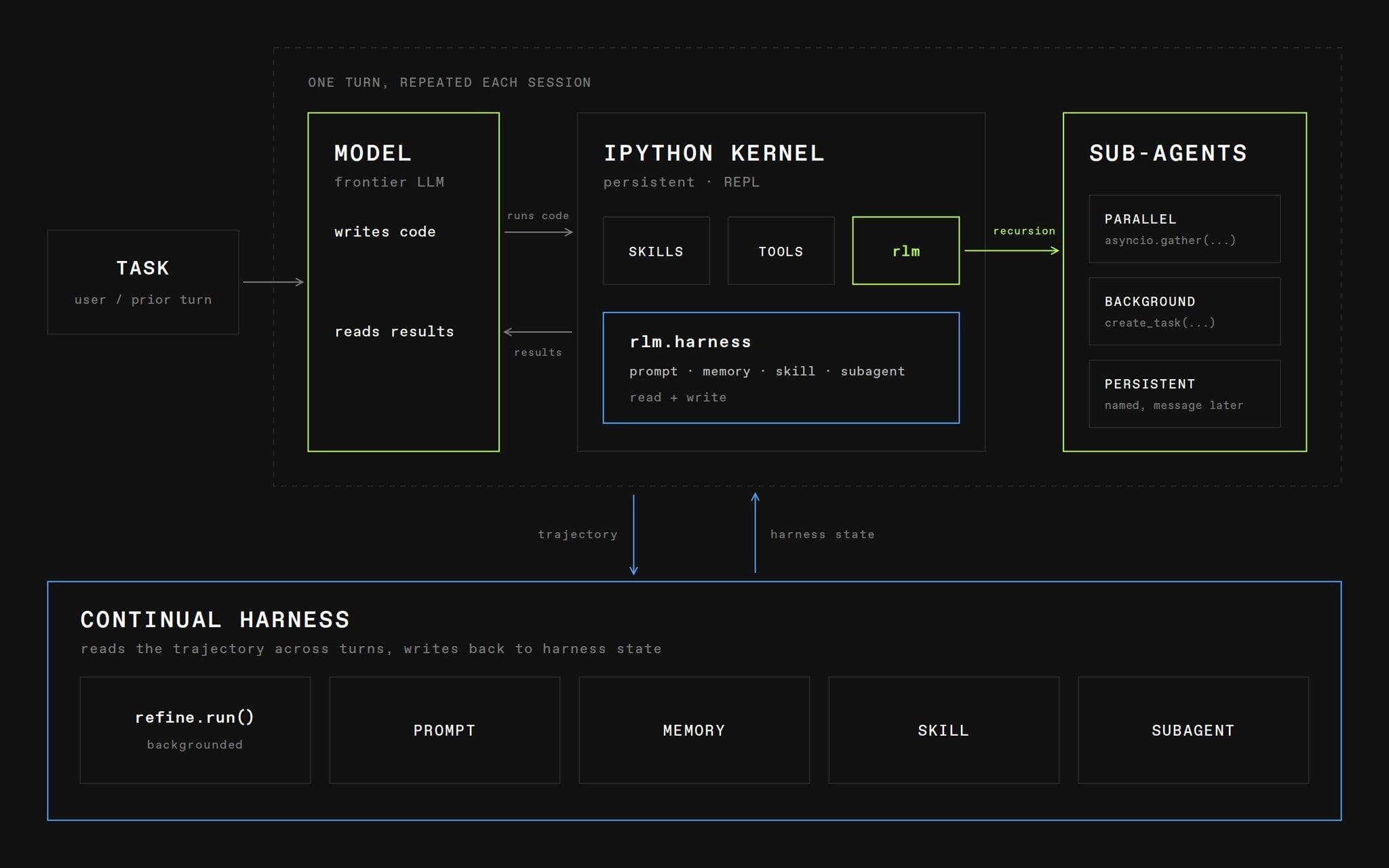
A Prime Agent session has several cooperating layers:
- The model-facing loop. A frontier LLM reasons, writes Python and reads results. The built-in model-facing tool is the IPython interface.
- A persistent IPython kernel. Variables and imports survive across turns. Context can remain outside the token window and be retrieved programmatically.
- Tools and skills. File operations, shell commands and reusable workflows are called from Python rather than selected from a long flat tool menu.
- RLM child sessions. The root can launch specialist agents, in parallel or in the background, and communicate with them directly.
- A daemon-backed runtime. The terminal client can detach while sessions, schedules, goals and heartbeats continue under a supervisor.
- Continual harness state. Supplemental prompts, memories, skills and subagent definitions can be read, changed, reviewed and rolled back.
The separation between the terminal client, daemon supervisor, session worker and Python kernel is good systems engineering. A closed terminal does not have to kill a job. A stalled child process does not have to erase the whole session. The repository stores session events as JSONL and writes artifacts to disk, giving operators evidence to inspect after a long run.
But process isolation should not be confused with permission isolation. Prime Agent’s own documentation warns that generated code and commands execute with the user’s OS permissions. The kernel boundary makes the runtime manageable; it does not make untrusted execution safe.
Why context as a variable is the important part
Most agent harnesses treat context like a conveyor belt. The system prompt, conversation, tool outputs and retrieved files are assembled into a request. When the request grows too large, the harness compacts or summarizes the history. Useful detail may disappear, while irrelevant detail can consume tokens repeatedly.
An RLM treats the large input as data in an external environment. The model can ask Python for filenames matching a pattern, split a document collection into chunks, compare multiple results, or send different slices to different submodels. The full source need not be copied into every model call.
The foundational Recursive Language Models paper reported that its GPT-5 RLM configuration could process inputs beyond ten times the model’s native context window, including tasks with more than ten million tokens. Across four long-context evaluations, the paper reports a 26% median improvement over compaction, 130% over a CodeAct-plus-subcalls baseline and 13% over Claude Code at comparable cost. Those are research results for the paper’s RLM implementations, not a benchmark of the Prime Agent application.
The paper also explains why this is not a free win. Weaker models may struggle to write reliable orchestration code, overuse subcalls or burn tokens on syntax mistakes. Costs have a long tail because one bad decomposition can spawn many expensive calls. RLMs increase the amount of strategy delegated to the model, which makes model capability and budget controls more important, not less.
Recursive subagents are more than a “team” button
Prime Agent’s child sessions use the same runtime, providers, tools and skills as the parent. A root agent can launch children with rlm(...), retain them, inspect a family roster and exchange messages through the daemon. Children can work in parallel, continue in the background or persist by name for later contact.
One implementation detail reveals the project’s philosophy: await rlm(...) returns an admission handle, not a giant result dumped back into the parent’s context. The child can send a concise agent_message or place a larger artifact in a file. That encourages agents to coordinate through explicit interfaces rather than flooding each other with transcripts.
In the v0.7.0 build tested for this review, recursion depth defaulted to one level. Since v0.8.1, new sessions default to two; operators can still set the limit deliberately. Deeper trees may explore a problem faster, but every branch adds cost, variance and supervision overhead. Prime Agent gives advanced users an expressive language for orchestration; it does not make the economics of orchestration disappear.
What “self-improving” actually means
/refine reviews a trajectory and can edit supplemental prompts, durable memory, skill descriptions and named subagent configurations. Changes are session-local by default; global scope is explicit. The base system prompt is immutable, and before-and-after snapshots support rollback.
The evidence is promising but conditional. In the Continual Harness paper, Gemini 3.1 Pro completed all evaluated Pokémon milestones at a median $130, versus 98% completion at $215 for the minimal baseline. Flash-Lite variants underperformed their baseline, suggesting a capability floor. A separate Recursive Harness Self-Improvement study reported gains on 30 synthetic ML research tasks and up to 60% lower cost in one Opus 4.8 setup, but used synthetic tasks, an LLM judge and a task-specific harness.
Prime Agent turns those ideas into a usable product; it does not guarantee convergence. Bad evidence can become durable memory, so explicit scope and rollback matter.
Long-running autonomy is treated as an operating problem
Prime Agent has more than a “run in background” toggle. Its long-running machinery includes daemon-backed sessions, persistent goals, scheduled prompts, recurring heartbeats, background child agents and an autonomous continuation mode with explicit gates.
The documented autonomous defaults are deliberately finite: three continuations, 12 turns, 80,000 accumulated tokens and 30 minutes of wall-clock time. Cache-read tokens are excluded from that token counter. Gates may retry up to three times with a five-minute timeout. Reaching a limit ends the run; it does not declare success.
This is the right conceptual model. Long-running agents need budgets, liveness signals, durable state and a clear distinction between “stopped” and “finished.” Prime Agent exposes those primitives instead of pretending that one enormous prompt creates reliability.
What Prime Agent gets right
- Expressive orchestration: Python can route on intermediate results, fan work out with
asyncio.gather(), retry selectively and keep large artifacts outside the prompt. - Coherent state: the kernel holds working data, the daemon preserves continuity, JSONL and files preserve evidence, and harness state preserves reusable lessons.
- Auditable refinement: local scope, an immutable base prompt and rollback snapshots make “learning” inspectable instead of magical.
- Provider breadth: documented options include OpenAI, Anthropic, Prime Intellect, Google, DeepSeek, Mistral, xAI, OpenRouter, Groq, Cerebras and others. OAuth paths cover ChatGPT/Codex, Claude and GitHub Copilot, although provider policies and billing still apply.
- Open control plane: the MIT licence and readable state make Prime Agent useful for research, custom policy hooks and externally sandboxed deployments.
What is bad, risky or still unproven
1. The default execution boundary is too trusting
Generated Python and shell commands inherit the user’s OS permissions. Skills and extensions are trusted code. Containers, disposable VMs and extension-built permission gates can reduce risk, but they are operator choices rather than a strong default posture. A malicious instruction in a repository or document may influence a model that can execute commands, persist memory and schedule work. Keep secrets and production credentials away from unsandboxed sessions.
2. Recursion multiplies cost and mistakes
A bad plan can multiply model calls, cache writes and runtime; RLM research reports long-tailed cost outliers. Persisted memory can also preserve a misconception. Prime Agent’s limits and rollback help, but operators still need provider budgets, cancellation and review.
3. The launch benchmarks are not yet transparent enough
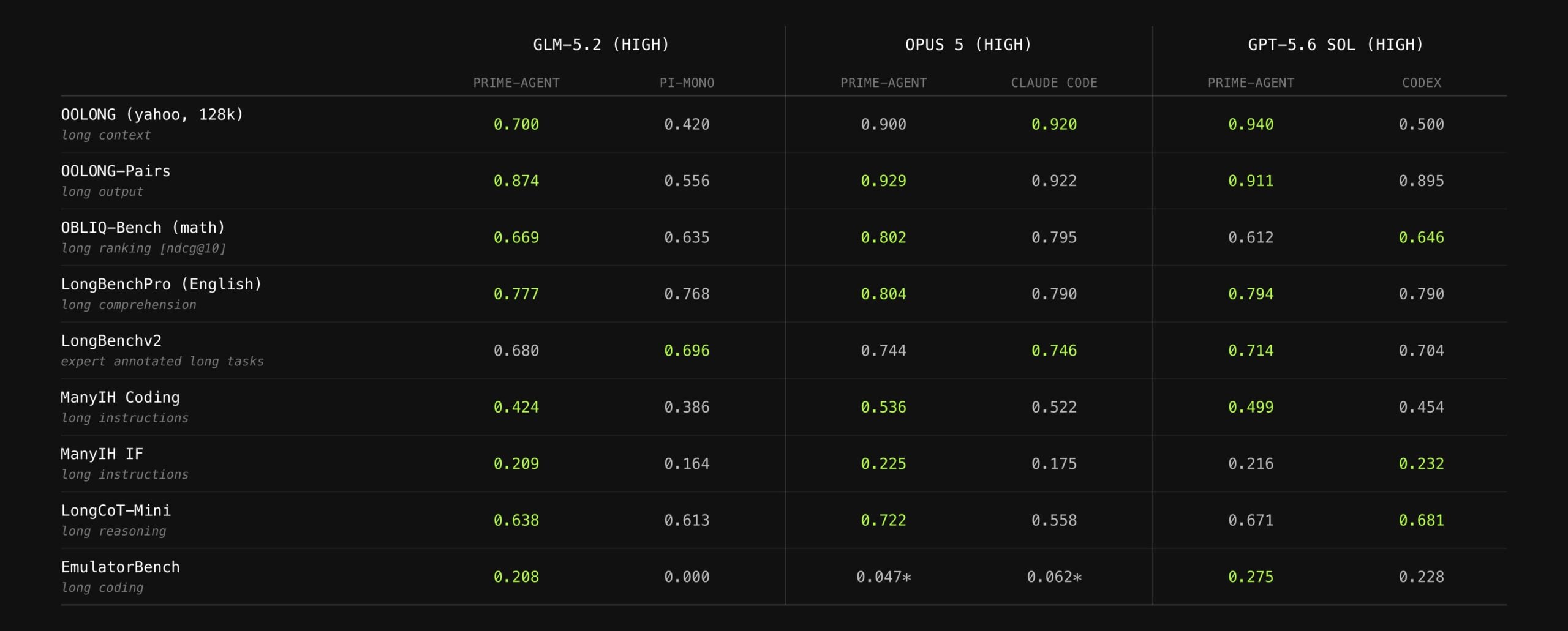
Prime Intellect supplied a broad launch table comparing Prime Agent against pi-mono, Claude Code and Codex across long-context, instruction-following and emulator tasks. Several pairings favour Prime Agent, while some rows favour the comparison harness. The table is useful as a set of hypotheses, not as a final leaderboard, because the launch materials do not provide enough public detail about prompts, run counts, variance, environment, model snapshots and cost accounting for independent reproduction.
The launch video also reports a 95.54% score on ARC-AGI-3: 178 of 183 levels across 24 of 25 games and 11,244 actions, using Prime Agent with Opus 5. It compares that result with 38.3% for “native coding harnesses” and notes a 95.4% human baseline. ARC-AGI-3 is an interactive benchmark built around exploring unfamiliar environments, inferring goals and planning actions. The claimed result is striking, but it remains a Prime Intellect-reported launch result until the run configuration and traces can be independently examined.
4. Launch maturity is a constraint
The repository moved from v0.5.1 to v0.7.0 around launch and reached v0.9.1 on September 1. Pin versions rather than assuming launch-day behavior. macOS and Linux are the direct paths; Windows needs WSL, Git Bash or Cygwin. The current v0.9.1 package requires Node.js 22.8+ for source builds.
Hands-on: what I verified in v0.7.0
I cloned the public repository, installed the pinned npm dependencies and ran Prime Agent in isolated local state and session directories. The build and startup path completed cleanly. The CLI reported version 0.7.0, exposed a detailed help surface, and returned clean “no background services” results from both status and doctor checks.
I also invoked a one-shot prompt without credentials. Prime Agent stopped with a clear authentication message and directed the user to /login; it did not fail with an opaque stack trace. I did not attach a paid model provider, run autonomous coding against a live repository or execute the project’s model-backed evaluation suite. This is a product architecture and implementation review, not an independent performance benchmark.
The stable installer downloads a versioned release archive and verifies published SHA-256 checksums. Inspect any installer before piping it to a shell. For serious evaluation, use a disposable container or VM, mount only the target repository, provide scoped credentials, set conservative limits and review persisted state before reuse.
Prime Agent vs Claude Code, Codex and OpenCode
Prime Agent’s competitors are not primitive single-agent chats. Claude Code supports custom subagents, background work, per-agent tool restrictions and project memory. Codex is built around a long-running agent loop, and OpenAI documents sandboxing and approval controls. OpenCode supports primary agents and subagents with fine-grained allow, ask and deny permissions.
| Tool | Architecture, safety and best fit |
|---|---|
| Prime Agent | Python composes tools and recursive children inside a persistent RLM runtime. /refine edits supplemental harness state. Broad provider support; user-level OS permissions make external sandboxing essential. Best for agent researchers and programmable long-running workflows. |
| Claude Code | Configured subagents, background tasks and project memory with granular permission modes. Anthropic-centred. Best for developers who value a polished terminal agent and guarded tool access. |
| Codex | Long-running local and cloud tasks, tools, skills and multi-agent workflows with sandboxing and approvals. OpenAI-centred. Best for teams wanting isolated execution and deep OpenAI integration. |
| OpenCode | Primary agents, subagents, skills and broad provider choice with explicit allow, ask and deny rules. Best for developers seeking an open terminal agent with fine-grained permissions. |
The practical conclusion is not that Prime Agent replaces all three. Its differentiator is the combination of a Python-first control plane, context as a variable, direct agent messaging and a self-refining persisted harness. Its competitors currently offer more mature default safety controls. Users choosing between them should read Kingy’s practical map of AI coding agents and decide whether programmability or guarded execution matters more for the job.
Who should use Prime Agent?
- Agent researchers testing RLMs, recursive delegation, memory policies or harness improvement.
- Experienced developers working with repositories too large for comfortable transcript-style context management.
- Evaluation teams running long interactive tasks that need durable artifacts, heartbeats and explicit budgets.
- Open-source builders who want to inspect the control plane and route work across multiple model providers.
Skip it for now if you want guided per-action approvals, cannot isolate untrusted code, will not monitor recursive cost, or need slow-moving enterprise stability. It is also the wrong fit if “self-improving” sounds like guaranteed model training; Prime Agent changes harness state, not model weights.
FAQ
Is Prime Agent free?
The code is open source under the MIT licence. You still pay for any model APIs, subscription overages, cloud compute or sandbox infrastructure used by your sessions.
What is an RLM?
A recursive language model treats a large prompt or dataset as an external variable that can be inspected programmatically. It can call other model instances on selected portions, combine results and recurse when useful.
Is Prime Agent sandboxed?
Not by default at the operating-system boundary. Generated code runs with the user’s permissions. Put it inside a container, disposable VM or other external sandbox for untrusted or sensitive work.
Does Prime Agent beat Claude Code and Codex?
Prime Intellect reports several strong launch-day results, including an ARC-AGI-3 claim and a multi-benchmark comparison table. The published materials do not yet provide enough methodology for an independent “best agent” conclusion. Prime Agent’s clearest advantage today is architectural expressiveness, not a settled universal leaderboard win.
Final verdict
When agents work for hours, inspect millions of tokens and coordinate specialists, a chat transcript becomes an awkward operating system. Prime Agent’s persistent runtime, durable services and explicit harness state are a serious alternative. Use it if you can isolate the environment and want RLM-style orchestration; wait if you need conservative permissions, benchmark certainty or enterprise stability.
Its most exciting feature is not “more agents,” but a language for organizing their work. Its most dangerous feature is that the language is Python running with your permissions.