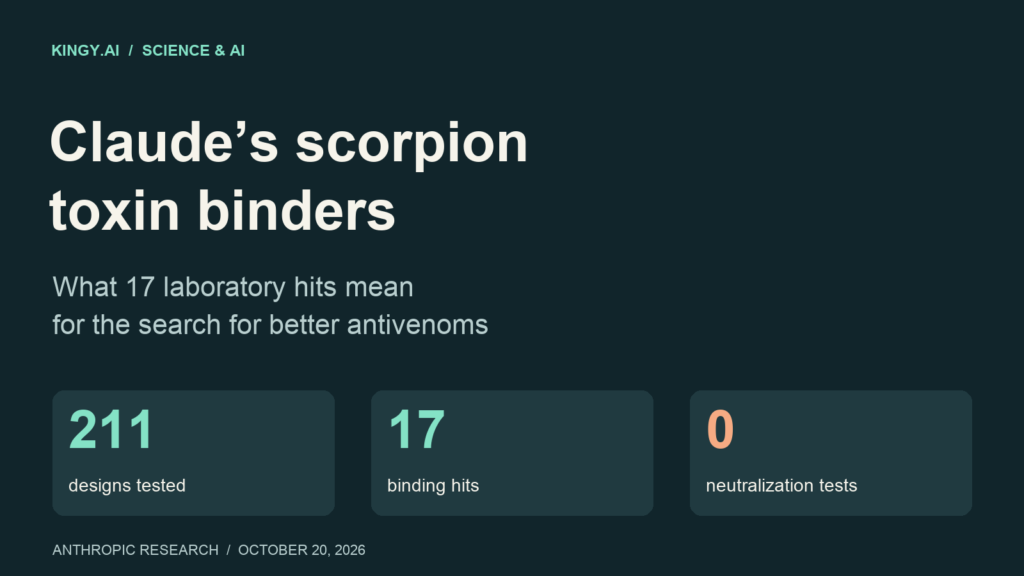
Claude has designed proteins that bind to dangerous scorpion toxins, and laboratory testing has confirmed that some of those designs work. That is a meaningful result for AI-assisted science and a possible starting point for better antivenoms. Whether these proteins can prevent poisoning remains an unanswered question.
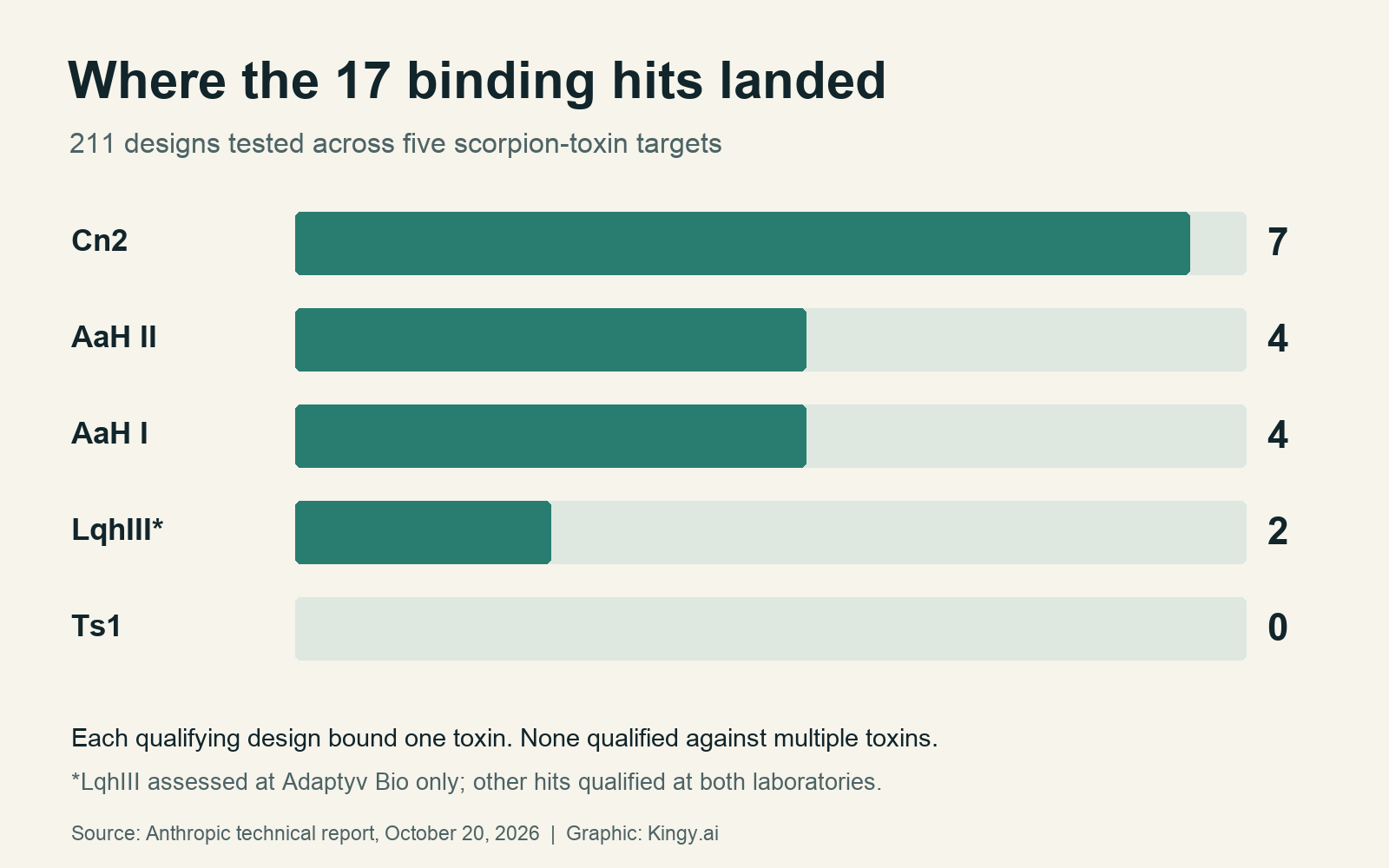
In research published on October 20, 2026, Anthropic reports that 17 of 211 tested protein designs met its criteria for binding to a scorpion neurotoxin. The successful designs covered four of the five toxins targeted. Two candidates bound particularly tightly to Cn2, a toxin from the Mexican scorpion Centruroides noxius.
The importance goes beyond those 17 molecules. A general-purpose AI research model coordinated specialized protein-design software, managed a large computational search, and selected candidates that laboratories could manufacture and measure. This suggests a way to expand the number of disease targets researchers can investigate, including conditions with weak commercial incentives.
The study also makes the remaining barriers unusually clear. No candidate has demonstrated toxin neutralization in cells or protection in animals. The campaign did not produce a validated multitoxin binder, measure manufacturing costs, or establish that Claude outperformed a matched expert team. Those limits determine how much weight the headline deserves.
What the experiment established
Anthropic and collaborators, including the investment research firm Citrini Research, asked an internal model working within Claude Science to design small proteins called minibinders. These are engineered molecules intended to attach to a chosen target. Here, the targets were five scorpion neurotoxins associated with medically dangerous stings.
The technical report describes a 64-hour computational campaign that generated 318,484 designs and screened 553,052 design–toxin pairs. Claude selected 180 designs; the researchers subsequently added 31 with its help. Contract laboratories Adaptyv Bio and Twist Bioscience performed the experimental work.
Seventeen designs passed the authors’ binding criteria. Fifteen had qualifying results at both laboratories. The remaining two targeted LqhIII, which only Adaptyv Bio assessed because the toxin did not reach Twist Bioscience in time. That exception matters whenever the results are described as independently confirmed at two labs.
Across all 211 tested designs, that is approximately 8.1%, calculated as 17 divided by 211. Within the 60 designs intended for a single toxin, 11 qualified, approximately 18.3%. The denominators describe different tasks: much of the full collection attempted the harder problem of binding several toxins.
Neither percentage is a drug-development success rate. It counts an early molecular property. Binding is useful evidence because the proteins were made and tested, but it cannot tell us whether a patient would benefit.
Why scorpion envenomation deserves this attention
A successful AI research demonstration matters more when it addresses a neglected need. Scorpion stings can cause severe poisoning, with children particularly vulnerable. Anthropic cites estimates of at least 1.2 million stings and more than 3,250 deaths annually. A 2025 BMJ Global Health commentary cites more than 1.5 million cases and over 3,250 deaths and warns that incomplete reporting obscures the true burden. These are estimates from the literature, rather than a precise worldwide count for 2026.
That commentary also highlights gaps in antivenom supply, distribution, and clinical training. It argues for formal recognition of scorpion sting envenomation as a neglected tropical disease. That argument should not be confused with evidence that the WHO has already granted the designation.
The economic problem is straightforward. A disease can cause substantial suffering without offering the sales needed to attract conventional pharmaceutical investment. Reducing the effort required to identify promising molecules could make more projects worth pursuing. It would leave the costs of testing, manufacturing, regulation, and delivery to be addressed.
For affected communities, the useful outcome would be a treatment that works against locally relevant venoms, remains available, and can reach patients promptly. A design that performs well on a laboratory instrument helps only if subsequent development can meet those conditions.
How a binder could become useful against venom
The toxins studied interfere with voltage-gated sodium channels, proteins involved in electrical signaling in nerves. Disrupting that signaling can trigger dangerous downstream effects. The research aimed binders at the toxin surfaces involved in interacting with those channels.
A molecule that occupies the right surface might prevent a toxin from attaching to its biological target. This is the functional hypothesis behind the project. Attaching somewhere else, attaching too weakly, or failing to reach the toxin in the body could all leave a seemingly promising binder without useful therapeutic activity.
Conventional antivenoms generally contain antibodies or antibody fragments obtained from immunized animals. Their mixtures can recognize multiple venom components. Their production and regional coverage create challenges, but they provide an established therapeutic reference point. A new molecule has to earn its place through functional evidence.
Designed proteins offer a different route to discovering candidates. Researchers can specify a target and search for a protein that fits it, then investigate whether that protein has useful properties. Potential advantages such as consistent production, stability, or lower cost are reasons to do the work. This study did not establish those advantages for its scorpion binders.
What Claude contributed, and what people supplied
The experiment is best understood as an AI agent coordinating a scientific workflow. Humans selected the indication and targets, supplied an initial prompt, defined tools and selection rules, and followed up four times. Claude made many decisions within that structure, including choosing target structures, selecting regions to aim at, allocating work among design tools, and setting filtering thresholds.
It used 12 design tools. Those specialized systems supplied the machinery for proposing proteins; structure-prediction tools helped evaluate candidates. Claude connected these steps and managed the search. Describing the result as a language model inventing therapeutic molecules unaided would erase much of the scientific infrastructure that made it possible.
Claude initially ran for 24 hours without further prompting. Follow-ups extended the campaign and concentrated on multitoxin designs. Most of its final selections, including its strongest Cn2 binder, came after the third follow-up. The result therefore supports substantial autonomy with human direction, rather than a completely unattended discovery process.
The physical work remained essential. Laboratories produced the proteins and measured their behavior. Anthropic also discloses that Claude helped analyze the data, produce figures, and draft the report under human supervision. That makes access to the underlying measurements especially useful for readers assessing the conclusions.
For non-specialists, the plausible benefit is a lower barrier to organizing complex computational research. The study began with a question from collaborators outside traditional drug discovery. Its execution still depended on Anthropic’s life-science expertise, an internal model, cloud infrastructure, specialized software, and contract laboratories.
How convincing are the binding measurements?
Both laboratories used surface plasmon resonance to assess binding, with different protein-production and presentation formats. Using complementary setups helps reveal whether a result depends on a particular experimental arrangement. It does not eliminate all measurement uncertainty.
The authors required evidence of binding in every relevant replicate, a dissociation constant of one micromolar or tighter, and no qualifying signal against CLEC12A, an unrelated human protein used as a specificity control. A dissociation constant, usually written KD, describes binding affinity. Lower values generally indicate tighter binding under the measurement conditions.
The strongest Cn2 candidates reached the single-digit nanomolar range. That is encouraging affinity. The technical report gives Cn2-B1 estimates of approximately 3.1 nanomolar at Adaptyv Bio and 1.7 nanomolar at Twist Bioscience, explicitly treating them as upper limits rather than exact measurements. The second candidate, Cn2-B2, measured about 5.6 and 3.4 nanomolar, respectively.
The numerical precision deserves restraint. The authors describe affinities as preliminary and discuss surface effects, baseline drift, and limited replication. Some results changed when the experimental orientation was reversed. These are reasons to refine the measurements before ranking candidates as though every reported value were settled.
Specificity also remains incomplete. A clean result against CLEC12A does not show that a protein avoids every unintended interaction. Two qualifying binders, including Cn2-B1, showed binding to ovalbumin in an additional assay. The report describes that signal in context; it neither establishes clinical harm nor supports calling the molecules comprehensively selective.
The strongest clue concerns where the Cn2 binders attach
Affinity alone leaves an obvious question: does the binder occupy a useful site? The researchers investigated this using competition experiments involving LR, an antibody fragment with prior evidence of neutralizing Cn2.
If an existing antibody substantially reduces a new binder’s ability to attach, their binding sites may overlap or lie close together. The Cn2 results support attachment on or near LR’s site, which overlaps the toxin surface involved in sodium-channel interaction.
The prior evidence comes from work such as research on antibody fragments against Cn2 and scorpion venom. That work combined structural and animal evidence and showed how complementary antibodies could improve protection. It gives the new competition result biological context.
The inference is that these new binders may obstruct the toxin in a useful way. Anthropic regards neutralization as likely for its strongest Cn2 candidates. A competition assay still cannot demonstrate that they restore normal channel function or protect an animal after envenomation. Those outcomes require their own experiments.
The unsuccessful multitoxin designs expose a practical challenge
Venom contains multiple components, and dangerous scorpions differ across regions. A treatment intended for broad use must address that diversity. Claude was therefore asked to pursue binders against individual toxins, groups of related toxins, and all five targets.
None of the 151 designs intended for two or more toxins met the study’s criteria against more than one. The validated hits each qualified against a single target. There were also no qualifying binders for Ts1, the Brazilian target.
These findings narrow the result considerably. The study produced a collection of candidate binders, with gaps in coverage. It did not produce a universal antivenom molecule or show that the collection covers the medically important components of a regional venom.
The authors caution against interpreting the multitoxin failure as proof that the goal is biologically impossible. Some designs shared backbones, limiting the diversity of the test. The negative Ts1 result could involve the designs or the recombinant target used in the assays. Prompting and available design tools could also contribute.
One protein that binds all five geographically separated targets was a demanding research test, rather than an essential specification for every useful treatment. A carefully chosen regional cocktail could still have value. Each component and the mixture would need functional testing, and adding components creates further manufacturing and characterization work.
Sixty-four hours is a speed result, with a large compute bill behind it
The campaign’s elapsed time is striking. Its resource use changes how that speed should be interpreted: the technical report estimates roughly 10,000 H100 GPU hours, with substantial parallel computation. That is a very different resource requirement from one person using a chatbot for a weekend.
The report does not provide a complete project cost. Compute, model access, protein production, laboratory measurements, staff time, and follow-up development all belong in an economic comparison. Assigning a precise dollar saving without that information would be speculation.
More fundamentally, there was no matched baseline using an expert team or a fixed software pipeline with the same tools and resources. The authors explicitly acknowledge that they cannot separate Claude’s contribution from its tools or quantify time and cost savings against a conventional campaign.
Anthropic points to separate work accelerating biomolecular models, and to a simplified workflow that achieved comparable computational scores using one GPU for 24 hours. The scorpion campaign used neither advance. Comparable predicted scores also do not establish comparable laboratory success, particularly when prediction and experiment already diverged on multitoxin designs.
For researchers and funders, a useful next comparison would measure validated functional candidates per total project cost and elapsed time. That would test whether this approach expands what smaller teams can afford to investigate.
Why the open data may matter as much as the demonstration
Anthropic has released all 211 tested designs and their data under a CC BY 4.0 license. The release includes predicted structures and scores, experimental binding measurements, and supporting assay data.
Releasing the failures alongside the successes gives other researchers something more useful than a gallery of selected hits. They can examine where computational confidence failed, compare measurement formats, and test alternative ways of choosing candidates. The project therefore creates material for evaluating future scientific agents as well as potential antivenom research.
There are two separate questions to investigate: can an agent generate plausible candidates, and can it reliably identify which candidates deserve scarce laboratory resources? This campaign offers evidence for the first and exposes difficulty in the second. The report says its final computational ranking did not reliably pick out binders within a design set.
Releasing data does not itself guarantee reproducibility, independent confirmation, or a path to treatment. It does make scrutiny and follow-up more practical. For a vendor-led demonstration, that is a substantial strength.
What must happen before this becomes an antivenom story
The immediate scientific task is to establish function. The study measured binding to recombinant toxins, rather than toxins purified from venom, and did not establish those recombinant preparations’ biological activity. Researchers need to connect the binding result to the behavior of real venom components.
Next comes evidence that a candidate prevents the toxin’s harmful effects on cells, followed by appropriate preclinical evidence of protection. Treating an already envenomed subject is a more relevant therapeutic test than showing an interaction on an instrument. Human safety and effectiveness would require further development and clinical investigation.
Drug properties remain open questions. The study did not measure immune responses to these proteins, serum half-life, thermal stability, or production costs. Those properties affect whether a binder can become a practical medicine, how it might be administered, and whether it could survive the supply conditions where it is needed.
Earlier work provides a reason to pursue these questions. A 2025 Nature study of designed proteins against snake toxins reported functional neutralization and protection in mice. It shows that designed toxin binders can progress beyond binding. The snake results belong to different molecules and toxins; their efficacy cannot be transferred to Claude’s scorpion designs.
How much credit should this result receive?
This is a credible early demonstration of an AI agent coordinating a protein-design campaign that yielded measurable laboratory hits against several medically relevant targets. It supports further work on AI-assisted discovery for conditions that receive too little investment.
Confidence should be calibrated to the evidence. The announcement and technical report are from Anthropic and its collaborators. The report discloses that Anthropic and Citrini paid the contract laboratories. Testing by separate laboratories adds experimental credibility; it does not turn the project into an independently funded replication or a clinical trial. Outside expert review described by Anthropic should also be distinguished from formal journal peer review.
The model was an internal research system working within Claude Science. This publication does not establish that an ordinary Claude subscription provides the same capabilities or resources. Anthropic’s earlier protein-design coverage also discusses controlled access to sensitive biological capabilities. Readers should assess access from documented product availability, rather than infer it from a research demonstration.
The next meaningful milestone is a candidate that demonstrably blocks toxin activity, with stronger specificity and developability evidence. A verified treatment for affected communities will require sustained laboratory work, funding, clinical expertise, and delivery systems after the computational search has finished.
Reporting note: This article reviews the October 20 announcement, technical report, released dataset documentation, and cited scientific literature. Kingy.ai has not independently tested these proteins. Calculated hit rates are identified above; therapeutic benefits and cost savings remain prospective.
The Kingy Brief
Get The Kingy Brief.
AI changes, original tests and one practical thing to try. Fridays at 09:00 Vancouver time.
Free · Double opt-in · Unsubscribe anytime
Sign up for The Kingy Brief on Beehiiv.
Signup help and newsletter schedule
Signup form provided by Beehiiv. After submitting, check your inbox for "Confirm your subscription to The Kingy Brief" and open its confirmation link. Check Spam or Promotions if you cannot find it.
Fridays at 09:00 Vancouver time: source-checked AI changes, original tests and one practical thing to try. We skip a week when there is not enough verified material. Free. Unsubscribe anytime.