Claude Fable 5.2 has the stronger published capability case against GPT-6 Astra, including a lead on Artificial Analysis’s independent Intelligence Index and several demanding coding evaluations. Astra has a strong cost argument: despite higher prices per token, it cost much less per benchmark task in the same Artificial Analysis snapshot.
At maximum effort, Artificial Analysis reports an index score of 65 for Fable with its default fallback configuration, versus 57 for Astra. Its estimated cost per index task is $26.54 for Fable and $6.24 for Astra. That is about 4.25 times as much for Fable in this particular evaluation. Your workload, effort setting, cache use and acceptance criteria can produce a different result. Fable results; Astra results.
Not tested by Kingy. This comparison draws on published evaluations and provider documentation; Kingy did not run a new matched test of these models. Evidence was checked November 9, 2026, Pacific time. Prices are in US dollars before tax. Our recommendations are editorial interpretations, not guarantees of performance on your work.
The quick verdict
| Your priority | Starting point | What to check |
|---|---|---|
| Difficult coding and reasoning | Fable 5.2 | Its independent composite and reported coding scores lead; verify results in your own tools. |
| Cost per completed hard task | Test both | Astra’s higher token rates did not translate to higher cost per task in the AA snapshot. |
| Large documents | Fable for a price baseline | Astra’s entire request costs more above 272,000 input tokens. Test retrieval quality separately. |
| Business automation | Test both with safeguards | Measure correct final states, unwanted actions, refusals and fallback behavior. |
| Existing integrations or retention requirements | Start with your platform requirements | Check model availability, feature-specific policies and actual serving model. |
These are starting points for evaluation. Anthropic itself recommends starting most workloads with its latest Opus and moving to Fable when higher-effort Opus evaluations still miss requirements. The largest model is not automatically the best purchase. Anthropic’s guidance.
Specifications and direct API prices
We compare the exact API models claude-fable-5-2 and gpt-6-astra. Astra is distinct from the less expensive GPT-6.1 Sol and other GPT-6 variants. Rates below are standard direct API prices per million tokens, excluding separate tool charges, taxes and applicable modifiers.
| Specification | Claude Fable 5.2 | GPT-6 Astra |
|---|---|---|
| Context window | 1 million tokens | 1,050,000 tokens |
| Maximum output | 128,000 tokens | 128,000 tokens |
| Input and output | Text and image input; text output | Text and image input; text output |
| Knowledge cutoff | June 2026 | April 30, 2026 |
| Standard input / output | $8 / $40 | $10 / $50 |
| Cache read | $0.20 | $1 |
| Cache write | $10 for five minutes; $16 for one hour | $12.50 for the default 30-minute lifetime |
| Batch input / output | $4 / $20 | $5 / $25 at standard short-context rates |
Sources: Fable model overview, Anthropic pricing and Astra model page. Both models have effort controls from low through max, but matching labels do not establish equal compute. Fable uses adaptive thinking and defaults to high in the API. Anthropic effort documentation.
Above 272,000 input tokens, Astra’s whole request uses twice its standard input and cache rates and 1.5 times its standard output rate. Fable’s standard token rates apply throughout its context window. Anthropic’s US-only inference option adds 10%; cloud partners may set different prices. Context capacity is not proof that a model will reliably find and reason over every detail in a long document.
Independent results: Fable leads, with a larger task bill
| Artificial Analysis Intelligence Index v5.0.1 | Fable 5.2, max, default fallback | GPT-6 Astra, max |
|---|---|---|
| Composite score | 65 | 57 |
| Estimated cost per index task | $26.54 | $6.24 |
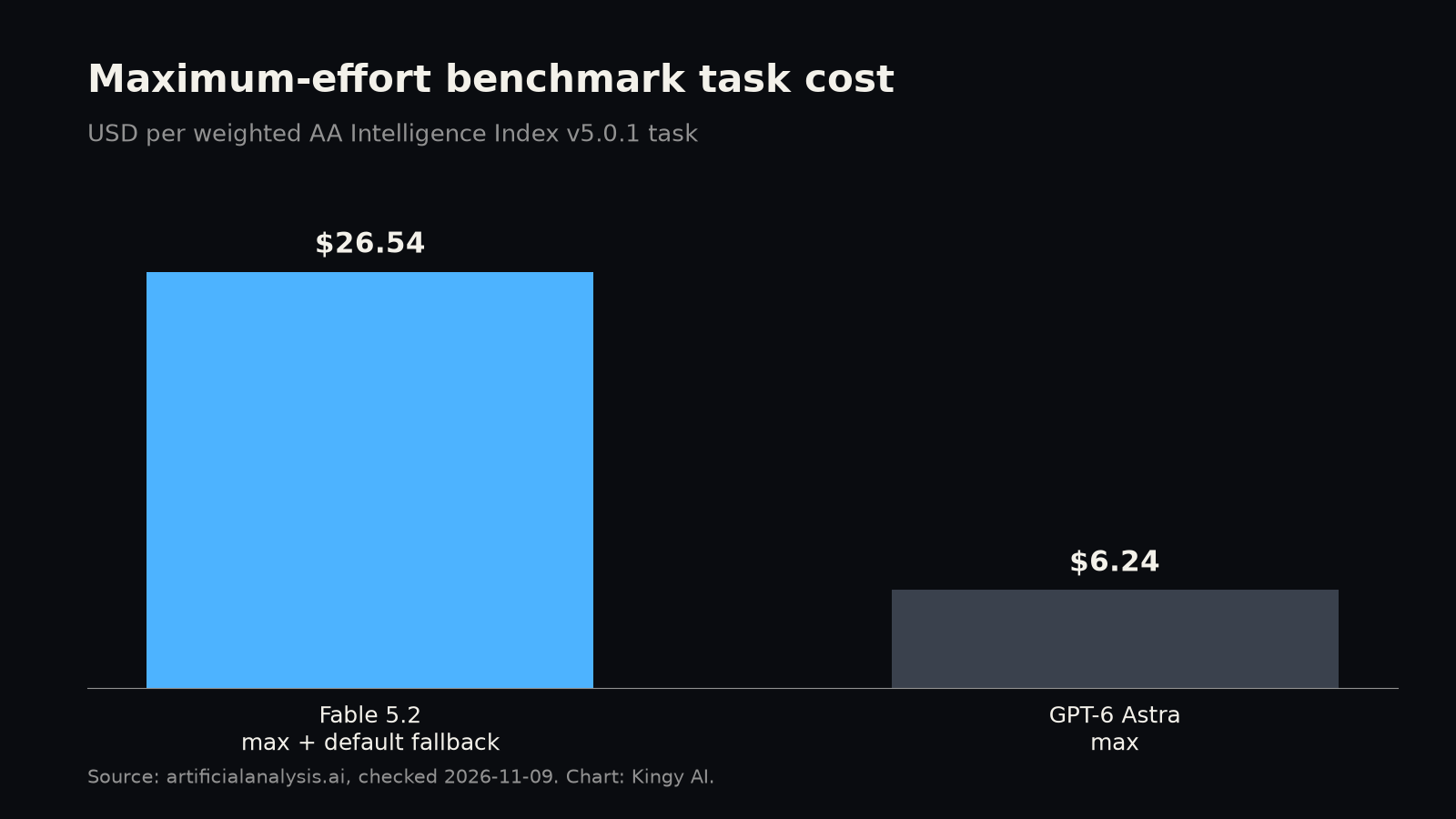
Artificial Analysis combines nine evaluations covering professional work, coding, science and knowledge. Its score is an index, not the percentage of every real-world job a model can complete. Its cost estimate weights token use across the component tasks and uses typical cache-hit rates. A weighted benchmark task is not the same unit as a finished project. Read the methodology.
The Fable result is labelled Default Fallback; it should not be described as a pure Fable-only run. Anthropic says a configured default fallback can retry certain refusals on a recommended model, and returned model and usage metadata can identify the model that served a response. Some refusals remain final. We did not find a per-fallback-model breakdown on the inspected AA page. Fallback documentation.
These are current v5.0.1 results. Older Astra scores from a different index version cannot be used as if they came from this same comparison. AA’s estimated inference time is also not an end-to-end measure of how quickly a team finishes a project.
Coding: effort can change the bill more than the score
Anthropic’s launch comparison reports Fable at 49.1% on FrontierCode 2.0 at xhigh effort and Astra at 42.8% at max. The more useful buying detail is the effort sweep in Anthropic’s system card:
| FrontierCode 2.0 configuration | Score | Cost per task |
|---|---|---|
| Fable 5.2, high | 45.3% | $6.72 |
| Fable 5.2, xhigh | 49.1% | $14.19 |
| Fable 5.2, max | 45.7% | $44.70 |
| GPT-6 Astra, max | 42.8% | $6.68 |
More effort did not produce a higher score at every setting in this run. Cognition’s evaluation used 132 tasks and averaged five attempts, using Claude Code for Fable and Codex CLI for Astra. The Fable max figure includes graded timed-out attempts; counting those as zero gives 44.4%. The system card does not provide uncertainty intervals for these results, so small gaps deserve caution. Cognition describes the benchmark’s mergeability criteria.
This is evidence about complete coding-agent setups, not an isolated model contest. If you already use one CLI, test it against the alternative in comparable repositories and account for code review, retries and integration time as well as token charges.
Other vendor-reported benchmarks
Anthropic’s launch table also reports the following comparisons. These are vendor-published results from different runs and, in some cases, different tools or harnesses. They should not be combined into a single score.
| Benchmark | Fable 5.2 | GPT-6 Astra |
|---|---|---|
| FrontierSWE v2 | 69.9% | 65.5% |
| Terminal-Bench-Science 0.1 | 74.6% | 68.1% |
| Humanity’s Last Exam, with tools | 74.2% | 57.2% |
| AutomationBench | 51.4% | 41.4% |
Anthropic’s general rule for the table is highest available effort unless otherwise marked. Its system card says the Fable science run used offline cached resources and default fallback. The later Astra science figure also appears in OpenAI’s later evaluation and differs from the 64.6% on OpenAI’s September launch page; these are reported results from different points, not repeated matched trials. Tool-enabled HLE scores also depend on their setups. The table supports examining Fable for difficult work, but it does not establish a winner for every science task, business workflow or document.
What the API bill can look like
Fable’s base input and output token rates are each 20% below Astra’s short-context rates. The examples below use equal billed token counts to make the arithmetic visible. They are hypothetical calculations, not measured runs, and exclude cache, tools, retries, residency charges and tax. Reasoning output is included in billed output. Different tokenizers and reasoning lengths mean the same text does not necessarily produce equal token counts.
| One hypothetical request | Fable 5.2 | GPT-6 Astra |
|---|---|---|
| 100,000 input + 10,000 output tokens | $1.20 | $1.50 |
| 300,000 input + 10,000 output tokens | $2.80 | $6.75 |
For the 300,000-token example, Astra’s premium applies to the whole request: 0.3 million input tokens at $20 per million plus 0.01 million output tokens at $75 per million. Fable’s calculation uses $8 and $40 respectively. The 272,000 threshold concerns input tokens, not the combined input and output total. Astra pricing conditions.
Cache reads can reduce the cost of repeated context, but cache writes have their own prices and lifetimes. Minimum eligible prompt lengths and provider-specific cache rules also matter; do not apply the read rate to every repeated prompt without checking eligibility and actual usage. Longer cache lifetimes can have different write rates. OpenAI’s prompt-caching guide documents its default 30-minute lifetime. Compare total billed usage for your traffic pattern. Anthropic pricing details; OpenAI model details.
The AA result shows why equal-token arithmetic is only a starting point: actual systems can spend very different amounts of reasoning and tool-use tokens on a task. Track cost per accepted result, including retries and human correction, before deciding which is cheaper for your workload.
Access, tools and data handling
Anthropic says Fable 5.2 is available through the Claude API and cloud providers including Bedrock, Google Cloud and Microsoft Foundry. Its plan guide describes paid-plan access and how credits or weekly limits apply by plan or seat; administrators can restrict access. Promotions and limits can change. OpenAI’s current models guide lists Astra for ChatGPT Work and Codex; availability depends on the product and account. Check the current entitlement in the product you intend to use. Subscription access and API token pricing are separate purchases.
The surrounding product matters: a model’s native text output does not by itself describe every image, browsing, file or coding tool an application can attach. Confirm which tools are available in your account, what they cost and whether a fallback may send work to a different model.
For sensitive data, read the terms for the specific API and features you use. OpenAI’s Astra announcement says it supports zero data retention for eligible API customers. Anthropic’s retention documentation says Fable 5.2 requires 30-day retention unless Anthropic expressly authorizes zero data retention. Eligibility and exceptions matter; neither statement is a blanket compliance certification for an application.
How to evaluate them for your work
- Collect a representative set of tasks with known answers or clear acceptance criteria, including difficult cases and ordinary work.
- Run both models with the tools, data access and safeguards you would use in production. Record model IDs, effort, fallback settings, token use and total cost.
- Blind-review outputs where practical. Record incorrect claims, failed actions, incomplete work and the time needed to correct them.
- Repeat at more than one effort level. Compare cost and elapsed time per accepted outcome, including retries, rather than treating the list price or a single benchmark as the final bill.
Limits
Kingy did not run either model for this comparison. The cited results use different harnesses, effort settings, fallback arrangements and benchmark tasks. They do not establish relative writing quality, hallucination rates or production reliability. Prices and access can change, and the published index cost is a snapshot. Check current provider terms and run an evaluation before committing a critical workflow.
Sources
- Anthropic: Claude Fable and Mythos 5.2 launch and benchmark table
- Anthropic: Fable and Mythos 5.2 system card
- Artificial Analysis: Claude Fable 5.2 and GPT-6 Astra
- Anthropic: Fable overview and pricing
- OpenAI: GPT-6 Astra model documentation
- Cognition: FrontierCode 2.0 methodology
For more context, read our Claude Fable 5.2 launch guide and our earlier GPT-6 Astra vs Claude Opus 5.5 comparison.
Revision log
November 9, 2026: Published. Sources and prices checked.