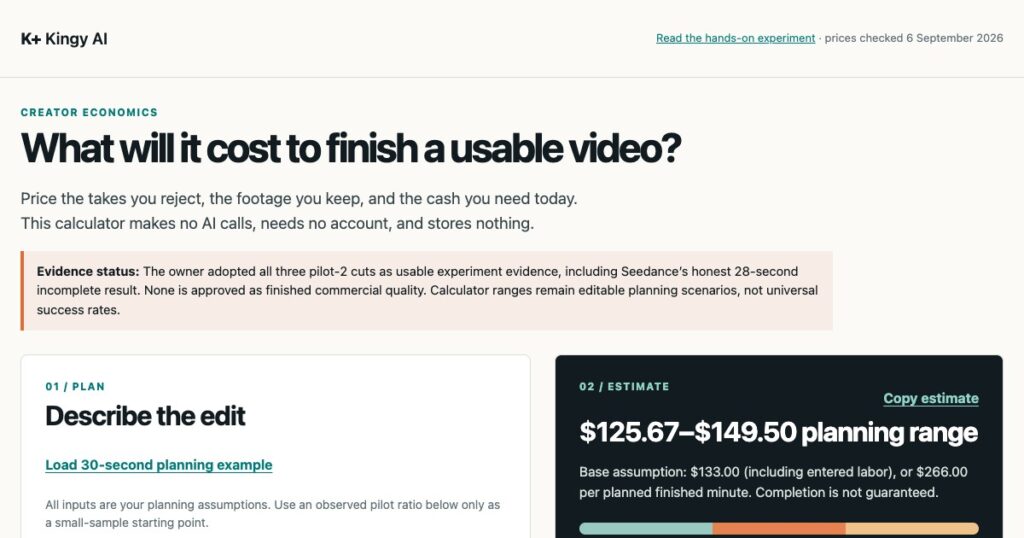
Two models completed the same six-shot, 30-second product-ad test on their first six attempts. The cheapest model did not. We retained every returned clip, counted the footage we rejected, and reconciled actual Runpod charges instead of quoting an optimistic per-second price.
Verdict: Kling v2.1 I2V Pro was the best buy in this narrow experiment. It completed the brief for $5.40 in video generation. WAN 2.6 cost $6.00 but supplied more editing margin. Seedance 1.5 Pro cost $3.12 and was most efficient per retained minute, yet its strongest honest cut stopped at 28 seconds.
Estimate your own usable-video cost
Watch the three evidence cuts
These silent edits use only the logged retained intervals at original speed. There are no loops, freeze frames, generated padding, cleanup passes, titles, music, or transitions. They are usable experiment evidence, not finished commercial advertisements.
What the experiment cost
| Runpod API route | Video charge | Returned / retained | Five-second keepers | Best honest edit | Video cost / retained minute |
|---|---|---|---|---|---|
| WAN 2.6 I2V | $6.00 | 60.132s / 60s | 6/6 | 30s | $6.00 |
| Kling v2.1 I2V Pro | $5.40 | 60.250s / 58s | 6/6 | 30s | $5.59 |
| Seedance 1.5 Pro I2V | $3.12 | 60.250s / 43s | 5/6 | 28s | $4.35 |
Six shot-specific P-Image Edit references added $0.06 to the shared experiment. Including all six references in a standalone route, the observed 30-second result cost $6.06 with WAN and $5.46 with Kling. Normalized to a finished minute, that is $12.12 for WAN and $10.92 for Kling. Seedance has no strict finished-minute result because it did not complete the brief.
The full pilot used $14.58 in additional gross Runpod usage. Added to a $20.65 exploratory pilot, cumulative project usage was $35.23. Credit purchases during the experiments were $0 because the account already had prepaid balance. That last number matters: credits consumed and cash required today are not necessarily the same thing.
Where Seedance lost the brief
Seedance’s material-detail shot supplied only three usable seconds before the camera drifted into an upward orbit and tightened the crop. Padding the beat would have made the comparison look neater while answering the wrong question. The final cut therefore uses 5 + 3 + 5 + 5 + 5 + 5 seconds and stops at 28 seconds.
Kling retained 58 seconds, including a conservative 0-8 second interval for its opening hero shot. WAN retained the full planned ten seconds from every shot. That extra WAN footage is not visible in the 30-second cut, but it is useful editing margin.
What the owner validation means
The owner adopted seven Pass decisions: the three final cuts as honest experiment evidence, plus four material trim boundaries. The original agent judgments remain preserved separately. Review time could not be recovered and is recorded as unknown, not zero.
This does not convert the edits into finished commercial work. They are silent, generic, and unbranded, with no product message or call to action. Seedance is also two seconds short. A campaign-ready asset would still need creative direction, sound, branding, legal review, and measured human production time.
How we ran the test
- One synthetic, unbranded matte deep-green tumbler.
- One frozen six-shot storyboard and one shot-specific reference per beat.
- One ten-second image-to-video request for each model and shot: 18 video calls total.
- A keeper required one continuous five-second interval at original speed, the intended scene, restrained action, a structurally plausible unchanged tumbler, and no people, text, duplication, scene cut, or blocking motion defect.
- The agent inspected 20 evenly spaced frames from every preserved clip. The owner-adoption pass covered the final cuts and four material trim decisions, not an independent full-frame-rate review of all 18 originals.
Delivery was not technically identical
| Route | Observed delivery | Audio stream | Important caveat |
|---|---|---|---|
| WAN 2.6 | 1284×716 at 30fps | 6/6 clips | We requested 720p. Audio was returned but not evaluated. |
| Kling v2.1 Pro | 1924×1076 at 24fps | 0/6 | The Runpod route exposes no documented resolution selector. |
| Seedance 1.5 Pro | 1280×720 at 24fps | 0/6 | We requested 720p, 16:9, with generated audio off. |
The public evidence files are silent 1280×720 derivatives optimized for browser playback. The preserved local originals and normalized 1080p review edits remain unchanged.
Frequently asked questions
Why does the calculator separate credits from cash?
A prepaid balance can fund generation without a new charge today. Conversely, a minimum top-up can require more cash than the workload consumes. The calculator shows credits consumed, allocated usage cost, additional cash required, and remaining balance separately.
Are these success rates representative?
No. They describe one product, one prompt suite, one service, and six attempts per model. Use the observed ratios as editable starting assumptions, not population success rates.
Does the calculator make paid AI calls?
No. It runs entirely in the browser, requires no account, and stores no inputs.
Which service and model versions were tested?
Runpod Public Endpoints: wan-2-6-i2v, kling-v2-1-i2v-pro, and seedance-v1-5-pro-i2v. These findings do not describe the vendors’ consumer subscription apps.
Sources and disclosure
Pricing and supported settings were rechecked 6 September 2026 against Runpod’s official documentation for WAN 2.6 I2V, Kling v2.1 I2V Pro, Seedance 1.5 Pro I2V, P-Image Edit, and Runpod billing. Kingy paid for the experiment using an existing prepaid Runpod balance. There is no claim of sponsorship or vendor endorsement.
Buying details checked October 22, 2026: WAN 2.6 I2V buying profile: Generated seconds are not finished seconds. Audio quality was not evaluated in the retained study; branding, sound and editing remain separate. Kling v2.1 I2V Pro buying profile: The page contains conflicting price text; confirm the live quote. The tested Runpod documentation now redirects, so current Runpod access is unresolved. Seedance 1.5 Pro I2V buying profile: Save outputs promptly. A cheap generated minute is not a complete advertisement or guaranteed keeper duration. P-Image Edit buying profile: The retained experiment establishes reference preparation, not broad edit fidelity, typography or brand consistency. Runpod buying profile: A prepaid balance is spent credit, not free inference. Failed experiments and unused generated footage can still consume the budget. The original article keeps its existing dates and evidence scope; the linked profiles describe their own demonstrations.
Buying details checked October 22, 2026: Seedance 2.5 buying profile: A CapCut subscription does not grant Runway API credits. Extensions, previews and enhancement can create separate charges. Kling Video 3.0 buying profile: Audio and model tier change the bill. A model label shared across platforms does not establish identical defaults or included credits. Kling Video 2.6 buying profile: Audio doubles this endpoint’s listed rate. Inspect lip sync, physical interactions and individual details before approving a clip. Kling O1 Video buying profile: Endpoint control does not guarantee every intermediate frame preserves identity, lettering or geometry. Allow budget for rejected takes. Kling 2.5 Turbo Pro buying profile: Credits buy generated footage, not approved footage. The historical description contains conflicting 2.6/2.5 wording; the text-to-video chapter names 2.5 Turbo. Runway Gen-4 buying profile: Do not use the cheaper Turbo rate for original Gen-4. A small selected montage cannot establish reliable product-text preservation. MiniMax Speech 2.8 buying profile: Characters are not tokens or minutes. Test pronunciation, timing and usage rights for the exact voice; the demo does not measure listener preference. MiniMax Speech-02 HD buying profile: Historical free-credit and voice-match claims are not current guarantees. Obtain permission for reference voices and check pronunciation and rights. Kling O1 Image buying profile: Reference-guided editing is not a guarantee of exact pixel, logo or face preservation. Check the still image before paying to animate it. Kling 3.0 Motion Control buying profile: Reference-video rights and output identity need review. A selected motion transfer does not establish reliable face, hands or timing preservation. The original article keeps its existing dates and evidence scope; the linked profiles describe their own demonstrations.
The Kingy Brief
Get The Kingy Brief.
AI changes, original tests and one practical thing to try. Fridays at 09:00 Vancouver time.
Free · Double opt-in · Unsubscribe anytime
Sign up for The Kingy Brief on Beehiiv.
Signup help and newsletter schedule
Signup form provided by Beehiiv. After submitting, check your inbox for "Confirm your subscription to The Kingy Brief" and open its confirmation link. Check Spam or Promotions if you cannot find it.
Fridays at 09:00 Vancouver time: source-checked AI changes, original tests and one practical thing to try. We skip a week when there is not enough verified material. Free. Unsubscribe anytime.