AI companies publish plenty of prices. They do not publish one clean market.
The first release of the Kingy.ai AI API Price Index 2026 accepts 40 exact offerings from eight access providers, backed by 45 official sources. It separates first-party APIs from managed-cloud copies, standard service from batch and faster tiers, ordinary contexts from premium context bands, and cache reads from ordinary input.
That pedantry changes the answer.
The cheapest row is not automatically the cheapest choice
For a representative workload of one million input tokens plus 250,000 output tokens, accepted prices span from $0.06 for Gemma 4 E2B on Amazon Bedrock to more than $20 for premium models and tiers. That spread says something useful about the market, but not whether a six-cent model will do your job.
The index is deliberately not a quality leaderboard. Price belongs beside task success, latency, rate limits, tool use, context needs and engineering overhead. A cheap failed run is still waste.
Output tokens punish sloppy comparisons
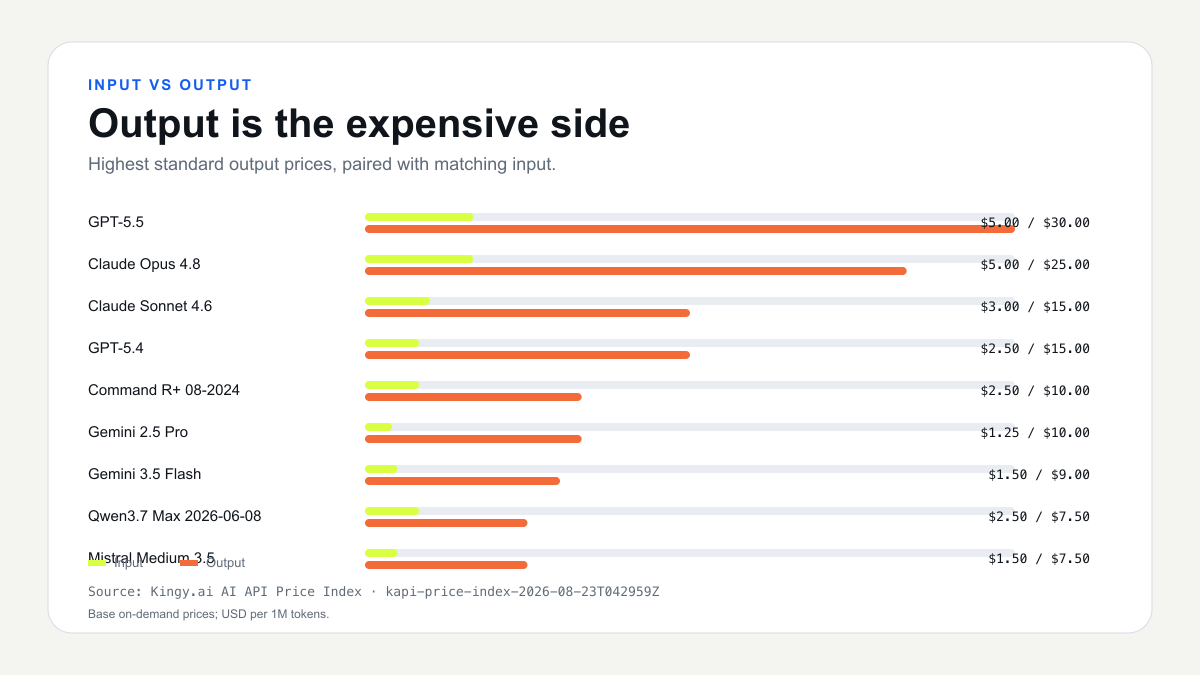
Many pricing pages lead with the input rate. The representative-workload calculation exposes why that can mislead: output commonly costs several times more. GPT-5.4 is $2.50 per million input tokens and $15 per million output tokens in its standard context band. Claude Sonnet 4.6 is $3 and $15. Their input rates differ; their output rate does not.
That makes workload shape decisive. Retrieval, classification and extraction can be input-heavy. Agents, reports and code generation can be output-heavy. Comparing only the first number on a vendor pricing page is not cost analysis.
Cache discounts are large, but “cache” is not one product
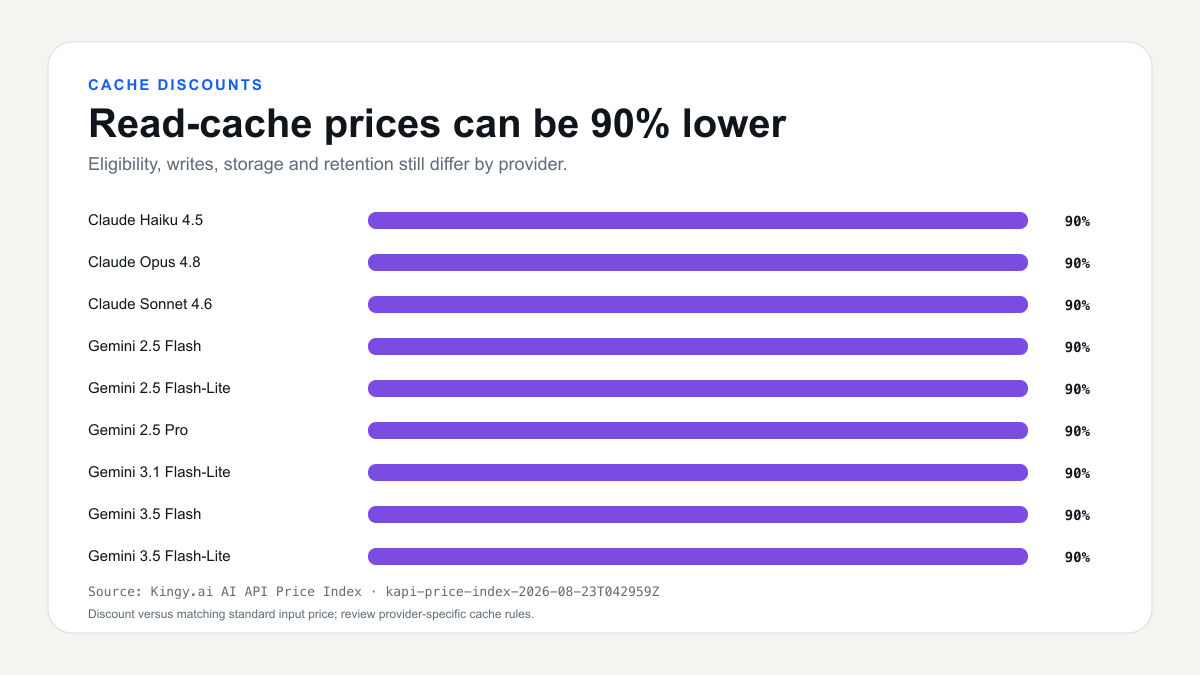
The accepted standard rows for several Claude, Gemini, Mistral and OpenAI models show 90% read-cache discounts against matching input prices. Grok’s documented cache rate is lower than standard input too. Those discounts can dominate repetitive workloads.
But the eligibility rules, write charges, storage behavior and retention semantics differ. The index records comparable token components and leaves the operational rules with the official source. Do not paste “90% cheaper” into a forecast until your prompt reuse actually qualifies.
High context is a separate price
OpenAI’s accepted GPT-5.4 record moves from $2.50 input and $15 output to $5 and $22.50 above 272,000 tokens. Grok 4.3 moves from $1.25 and $2.50 to $2.50 and $5 above 200,000 tokens.
Those are not footnotes. They are different price identities. A comparison table that shows one blended row erases the point where a long-context application changes economics.
Cloud-hosted and first-party are not aliases
The release includes both first-party and managed-cloud routes when official evidence supports them. That does not mean a Bedrock, Alibaba Cloud or other managed offering can be substituted silently for a first-party API. Seller, endpoint, region, model ID and service tier remain part of the key.
This is also why promotional aliases and unsupported Grok Build Batch pricing were not allowed into the accepted set. An attractive number without a complete identity is a lead for review, not a publishable fact.
What to do with the index
Start with the default first-party view. Filter to the route and billing mode you can actually use. Compare the representative workload, then open the exact endpoint and official sources. If your design depends on cache, batch or unusually long context, switch to all exact scopes and select the matching row.
For reproducible analysis, download the canonical JSON or CSV, record the release ID, and verify its SHA-256 checksum. The dataset and generated charts are reusable under CC BY 4.0 with attribution.
The useful question is no longer “What does this model cost?” It is: “What does this exact offering cost for my workload, through my route, at my tier, in my context band?”
That is the market the AI API Price Index is built to measure.
The Kingy Brief
Get The Kingy Brief.
AI changes, original tests and one practical thing to try. Fridays at 09:00 Vancouver time.
Free · Double opt-in · Unsubscribe anytime
Signup help and newsletter schedule
Signup form provided by Beehiiv. After submitting, check your inbox for "Confirm your subscription to The Kingy Brief" and open its confirmation link. Check Spam or Promotions if you cannot find it.
Fridays at 09:00 Vancouver time: source-checked AI changes, original tests and one practical thing to try. The weekly restart begins October 9, 2026. We skip a week when there is not enough verified material. Free. Unsubscribe anytime.