Weco’s AIDE² research agent scored higher after seven rewrites. A separate test left open whether the revised agent could drive further improvements.
On Friday, a team of AI agents is trying to make a small weather model cheaper to train. One agent proposes experiments, another runs them, and a third checks whether changes hurt forecast accuracy. On Monday, every agent starts in a fresh session. The shared workspace contains Friday’s results, the reasons earlier ideas failed, and a new procedure for deciding which experiments to run first.
The team is hypothetical. Monday’s handoff lets us ask how much work the fresh sessions can recover and whether the revised procedure helps them find a better way to train the model on the same computing budget. Then give Monday’s team the chance to revise the procedure again. If Tuesday’s team inherits that change, does it get better at finding further improvements?
In a September 2026 preprint, Weco reported that a research agent scored higher after successive rewrites. The researchers then put an evolved version in charge of finding further rewrites. They found the second comparison inconclusive. That test matters when the claim is that each generation could speed up the development of the next. Weco’s AIDE² preprint
How persistent AI teams resume work
The term highly persistent multi-agent, or HPMA, appeared in coverage of Situational Awareness LP’s November 24, 2026 investor letter. In the letter’s proposed virtual departments, AI agents coordinate projects over extended periods under AI managers. Refine’s account of the letter · Kingy’s coverage of the investor letter
A highly persistent team can recover assignments, artifacts, evidence and unresolved decisions from a shared workspace across sessions or interruptions. Someone can inspect the record and tell which version ran, why an experiment stopped and who can authorize the next step. The agents might all run the same underlying model. Distinct roles come from their assignments, tools and access to shared state.
Anthropic demonstrated part of this pattern with a coding agent that left a progress file and used Git history so later sessions could recover what had happened. In a separate five-day experiment, nine agents worked on ways for weaker AI models to supervise stronger ones. Each had its own environment, and they shared findings and code. Anthropic reported roughly 800 combined agent-hours and US$18,000 in compute and API costs. The team could learn from a clear score for each experiment. The human comparison used a different research setup and resource budget, which limits what we can infer about relative productivity. Anthropic’s long-running agent experiments · Anthropic’s nine-agent research experiment
Five days is the elapsed time. The 800 agent-hours add up work that could happen in parallel. METR’s task-completion time horizon measures a third thing. A four-hour horizon at 50% means the agent is predicted to succeed half the time on benchmark tasks that take a human expert four hours. To test whether a team can resume a project after an interruption, you still need to interrupt it. METR’s time-horizon methodology
Whether you need a team depends on how the work divides. Google researchers tested 260 configurations across six benchmarks in a revised study. They found substantial gains on some work that agents could split up and losses on sequential planning. METR likewise found cases where cooperating agents beat the best of several independent attempts at the same total token spend. Its experiments suggest that quick feedback, a clear metric and work that can proceed in parallel give teams a better chance. Results were mixed or negative on other tasks, especially when the group had to invent its own proxy for success. Google’s revised scaling study · METR’s swarm experiments
For Monday’s team, the practical implication is that shared memory can help with continuity even where parallel work contributes little. If one training decision depends on the result of the previous run, the team may spend most of its time waiting for the same experiment. The useful thing to record is which dependency every agent is waiting on.
What makes the improvement recursive?
Suppose Friday’s agents deliver a better weather model. That is a gain in the product they were asked to improve. If they also change how they allocate experiments and Monday inherits the change, the research process itself has changed. With recursive self-improvement, or RSI, an accepted change becomes part of the system that carries out the next round of improvement. The boundary matters. Weco uses the term for a fixed outer process that repeatedly improves a research agent. Anthropic describes a stronger version in which AI can autonomously design and develop a successor. A system that helps build its successor can still depend on people for research judgment and decisions about which changes go live. AIDE²’s two-loop method · Anthropic’s definition · The Economics of Recursive Self-Improvement · Kingy’s RSI primer
The change could be in the model’s weights, the numerical parameters learned during training. It could also be in the harness, the software that decides how an agent gets context, calls tools, handles failures and judges candidate solutions. A team using the same model can become better at research by changing its harness. A switch to a stronger model supplied by someone else is a different causal explanation and belongs in the experiment log. AIDE²’s fixed-model experiment · RSI-Env’s harness and model changes
What Weco’s AIDE² experiments found
The inner agent worked on research tasks, testing candidate solutions within a fixed per-task budget. A separate outer agent proposed rewrites to the inner agent’s code using past candidates and their grades. In the main run, Weco used a fixed, human-engineered research agent to drive the outer loop. It ran on Claude Opus 4.7. The inner loop used Gemini 3 Flash for every version under evaluation. A grade calculated on private test data determined which version of the inner agent became the starting point for the next rewrite. AIDE², §§2.1–2.2
Over eight days, the system accepted seven of 99 proposed rewrites. The best-so-far grade on the selection benchmark rose from 0.703 to 0.778. The result shows repeated improvement of the research agent’s harness under that selection process. In a separate experiment Weco called the ignition test, the authors asked which agent would do a better job producing the next set of rewrites. Both groups started from the same evolved inner agent, AIDE₄₇. One group used AIDE₄₇ as the outer agent as well. The other kept the human-engineered outer agent. After 50 steps, the three runs in each group averaged 0.780 and 0.782, respectively. The authors found the comparison inconclusive. AIDE²’s main run · The ignition test
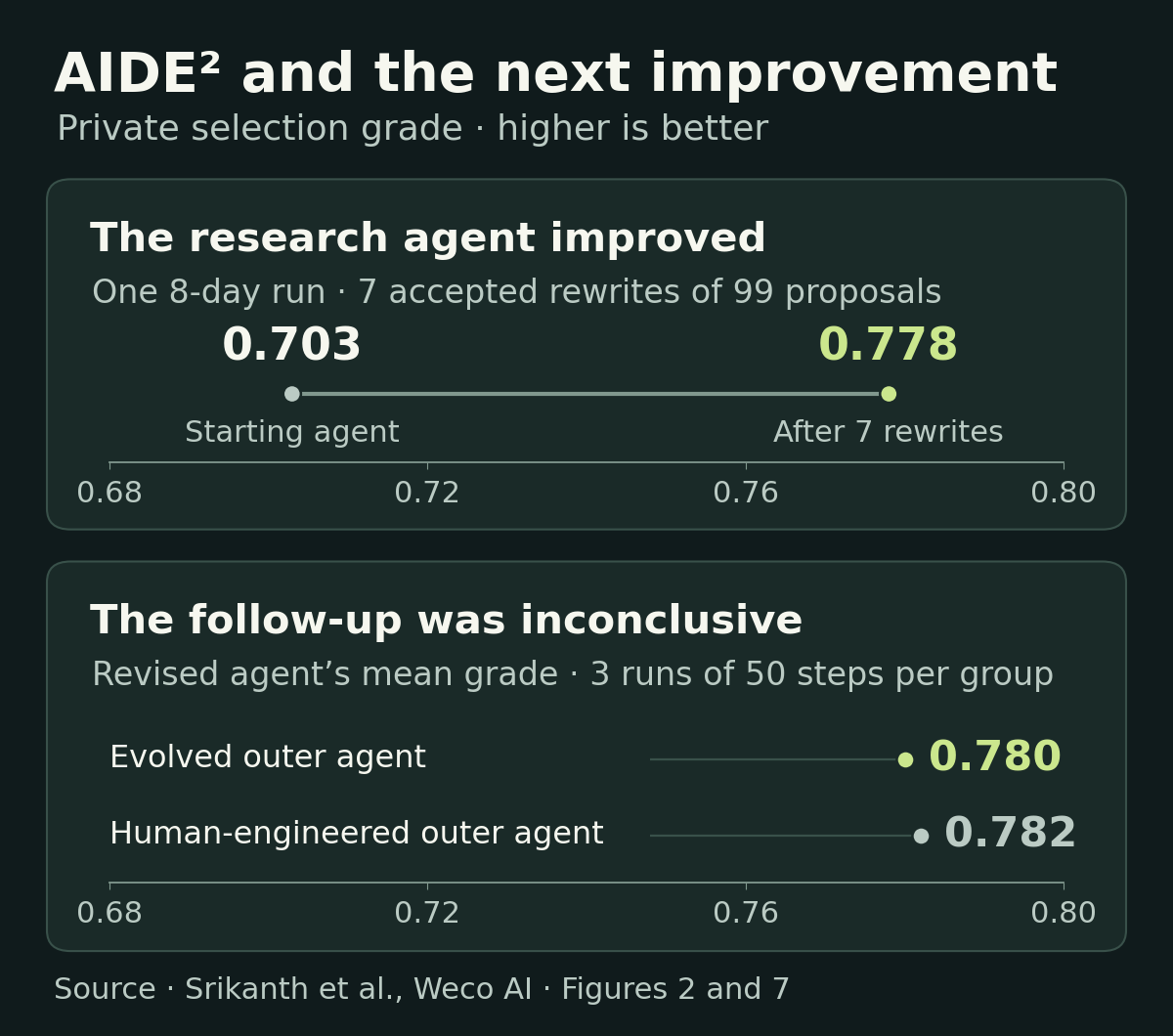
The first panel shows the best-so-far grade at the start and end of the main run. The second shows the mean final grades of the research agents produced by each outer agent. Both groups started from the same inner agent. Graphic by Kingy.ai. Weco’s Figure 2 · Weco’s Figure 7
Two other full runs accepted two and four rewrites. In the main run, the final version changed how the agent split its effort between trying new approaches and refining promising ones. It also condensed its record of past attempts so later iterations could use it. Weco tested two evolved versions on four benchmarks that played no role in selection. Both versions beat the starting agent on all four by the reported averages, and the best version varied by benchmark. The weather result came from one physics-based forecasting task run with three random seeds. Those tests tell us about the agents’ ability to do research. The ignition test asks how well they can improve the agents that do it. Repeat runs · Held-out benchmarks · What the rewrites changed
Other preprints show why the distinction matters. In one RSI-Env run, a system based on Qwen3.8-27B raised its SimpleQA score from 82% to 85% after a harness update. The updated system then generated examples and fine-tuned its model, taking the score to 88%. On other benchmarks, the final system did worse than the initial one on GPQA Diamond and Terminal-Bench 2.1. You can see the change carry forward and still ask whether it improved the set of capabilities the team needs. RSI-Env, Table 1 and §4.5
The Hyperagents authors tested whether the improvement process itself could transfer. An evolved system carried methods from paper review and simulated robotics into building Olympiad math graders. It produced better graders than the initial improver did in that experiment. A separate 200-iteration comparison of the ability to keep improving was statistically inconclusive. Hyperagents, §§5.2–5.3
How to test whether the next team improves
Replace the team mid-project. In the hypothetical forecast project, start two sets of fresh sessions from identical copies of Friday’s work. One gets the completed artifacts and task list. The other also gets a record of attempted hypotheses, failed runs and the conditions under which each decision made sense. Include a failed idea that might work now. Perhaps a faster model architecture previously missed rare storms when the training set came from a single region. Monday’s data cover several climate zones. A good handoff gives the successor enough evidence to decide whether the old failure still applies. Measure work repeated, time spent reconstructing past decisions, independent reviewer time and the result on new forecast data.
Reasoning about what to carry forward is already testable. In a November study, a system that kept the reasons and observed results behind past harness edits scored better on average across ten paired coding continuations than one given the evolved harness alone. A different November benchmark found that retaining state helped unevenly across its task streams. Those results suggest a reason to test the contents of the handoff as carefully as you test whether the team can load it. Self-Improvement Memory · EvoLink-Bench
Give the old and revised team the same next starting point. Ask both to improve the same candidate model or research workflow on a new assignment. Fix the available compute and human review time. Use an outside evaluator with unseen tasks and repeat the comparison across runs. Publish verified gains, regressions, elapsed time and resource use, along with the version history and who approved each change. A single-agent comparison at the same inference budget can help isolate what working as a team contributed. If successive teams keep finding better improvements under these conditions, you have evidence about the improvement process itself. This applies the matched-start idea used by Weco and Daice Labs to a team that also needs to recover work across restarts. Weco’s ignition test · Daice Labs’ matched-baseline method
Count the work waiting for review. Imagine a serial research cycle with six hours of coding and 24 hours of training and review. Agents cut coding to one hour. The cycle falls from 30 hours to 25, so the same pipeline can finish 20% more cycles per unit of time. Now suppose extra proposals from around the lab add six hours to the review queue. The cycle takes 31 hours. Tracking the time from selecting an experiment to independently verifying the result would capture that delay.
How much can an AI lab speed up?
OpenAI’s November 2026 internal report estimated that success without human intervention on delegated tasks rated at two to four hours of human work rose from 23% in March to 46% in October. On four-to-eight-hour tasks, the estimate rose from 13% to 35%. OpenAI says changes in the kinds of work researchers entrusted to agents may explain part of the increase. Running more of those tasks concurrently can make a lab more productive if other parts of the process absorb the extra work. OpenAI’s research acceleration report
In a separate assessment, METR estimated that Anthropic’s internal model capability index was rising at 1.9 times its pre-October 2025 rate. The 95% confidence interval under METR’s main statistical model was 1.5 to 2.8 times. METR judged AI use in research likely responsible for a majority of the acceleration as of October 2026, with substantial uncertainty. Anthropic redacted much of the evidence METR found most informative for its risk conclusions. METR’s separate analysis of public frontier models found no strong acceleration or deceleration on its overall composite measure. One lab can speed up on its own benchmark mix while a different measure across public models shows a steadier trend. METR’s Anthropic assessment · METR’s public-model evaluation · Kingy’s analysis of the 1.9× estimate
Tracking verified research output would help connect these findings. Say the lab ships a cheaper training method. How much of the improvement came from earlier AI-generated work? Did the cheaper method make the next research model good enough to tackle experiments the previous one struggled with? Which people and resources did both cycles still depend on? A version history with those details would start to show whether faster work is feeding faster improvement.
What would make this a singularity?
In his essay on ultraintelligent machines, I. J. Good proposed that a machine capable of designing a more capable machine could set off successive improvements. He called it an intelligence explosion. In 1993, Vernor Vinge argued that creating greater-than-human intelligence could bring a change profound enough to break familiar forecasts of technological progress. A singularity in that sense would be a change that reaches well beyond a single lab or class of experiments, fast enough to make the old forecasts a poor guide. Good’s essay · Vinge’s 1993 paper · Kingy’s guide to the singularity
The same Monday handoff could lead to three different paths.
- A step up, then a plateau. Agents save time on familiar tasks. After the first gains, the lab still depends on slow training runs, rare data or expert review. Look for a one-time drop in cycle time followed by little further change.
- Sustained acceleration in particular research domains. Successive teams learn to prioritize experiments and get measurable results faster on fresh tasks in domains with reliable feedback. Work that needs long field trials or difficult judgments still moves at a different pace. Look for repeated gains at matched cost alongside clear limits to where they transfer.
- Broad acceleration. Stronger successors improve several stages at once. They devise cheaper experiments, improve the systems running them and help make results easier to verify. Look for sustained gains across domains and evidence that the systems are easing the constraints that previously slowed each cycle. How quickly those gains spread would depend in part on the people and institutions adopting them.
An economic model by Tom Cunningham and colleagues makes the compounding question explicit. How strongly does better AI raise research output, and how strongly does that research output raise the capabilities of later AI? The authors’ rough September 2026 calibration suggested that the feedback loops were still too weak for self-sustaining acceleration. The result depends on how those relationships and their constraints are estimated. Faster coding or cheaper experiments can change one part of the calculation. The pace of verified improvements across successive generations is the evidence that would change the larger conclusion. The Economics of Recursive Self-Improvement
When a lab says its AI team improved itself, ask for the version it handed to the next team, the work that team attempted with the same budget, and the result an independent evaluator could reproduce. Then ask how many times the lab has seen that happen.