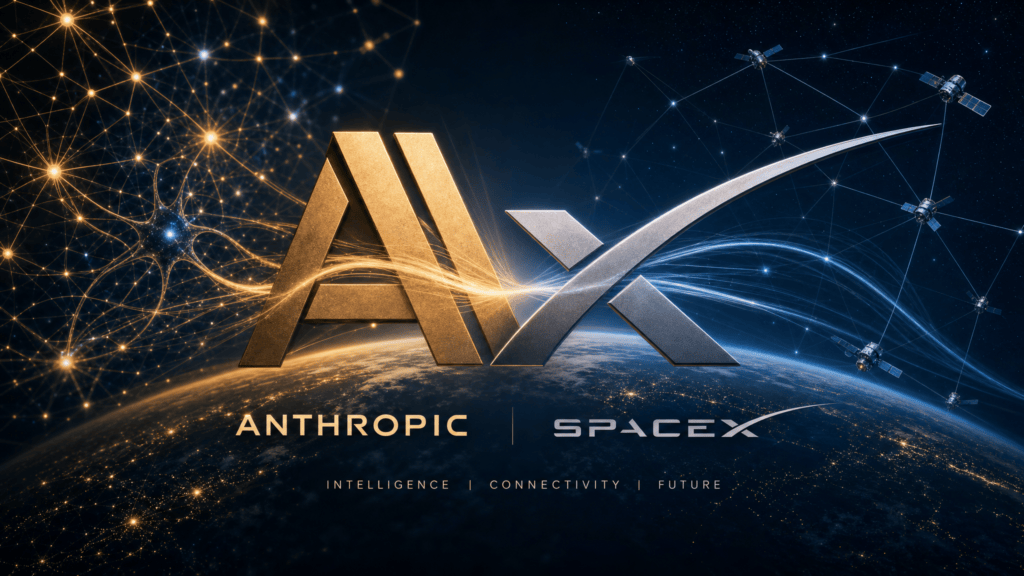
Anthropic just rented every last GPU at Elon Musk’s Colossus 1 supercomputer — and floated the idea of putting data centers in orbit. Here’s what the SpaceX–Claude pact really means.
On May 6, 2026, Anthropic did something that, only a few months ago, would have read like satire: it signed a compute partnership with Elon Musk’s SpaceX. Under the terms announced on stage at Anthropic’s developer conference in San Francisco — and confirmed in a blog post on anthropic.com — the maker of Claude will use all of the compute capacity at Colossus 1, the Memphis, Tennessee supercomputer owned by the newly merged SpaceXAI.
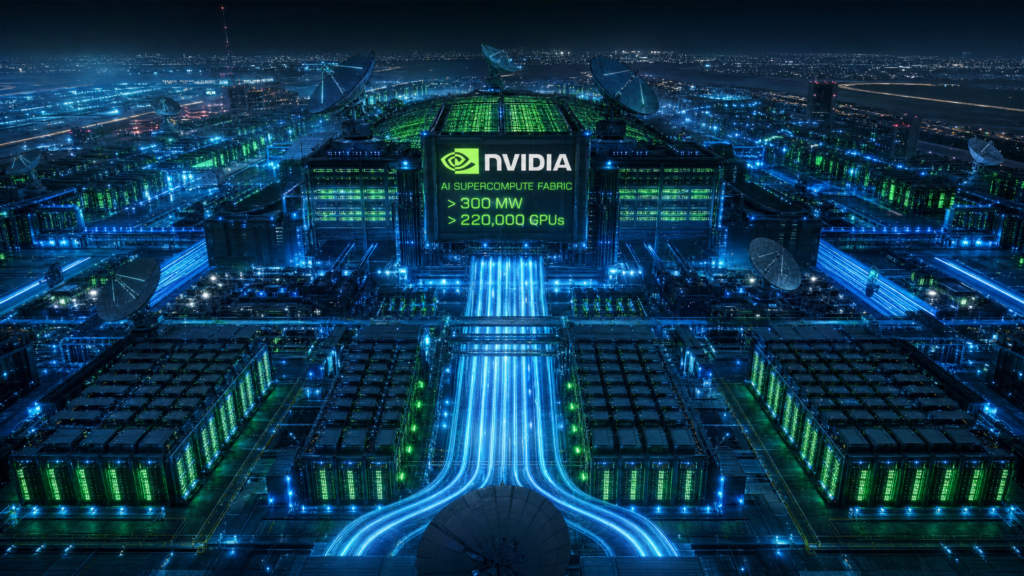
The deal hands Anthropic more than 300 megawatts of additional capacity and access to over 220,000 NVIDIA GPUs within the month — and, almost as a footnote, opens the door to something far stranger: data centers in space.
For an AI industry that has spent 2026 watching demand collide with the hard physical limits of power, land, and silicon, this is one of the most consequential — and unlikely — handshakes of the year.
The headline: more Claude for everyone who pays
Before getting to the orbital sci-fi, it’s worth grounding the story in what users will actually feel. Effective immediately, Anthropic announced three changes aimed squarely at its heaviest users:
- Claude Code’s five-hour rate limits are doubling for Pro, Max, Team, and seat-based Enterprise plans.
- The peak-hours limit reduction on Claude Code is being removed for Pro and Max accounts.
- API rate limits for Claude Opus models are being raised considerably.
If you’ve spent the last several months babysitting Claude Code through “you’ve hit your limit” walls during the workday — or watching agentic runs stall out at 3 p.m. PT — those changes are the practical payoff. As WIRED reported, Anthropic estimates the average developer is now spending at least 20 hours per week running Claude Code, a workload that has pushed the service into chronic congestion.
Anthropic’s own framing is unusually candid for a frontier lab: the company has acknowledged that Claude’s surging popularity has created “inevitable strain on our infrastructure,” with reliability and performance suffering during peak hours, as CNBC noted. The SpaceX deal is, fundamentally, an admission that the only way out is more silicon — fast.
What Anthropic is actually getting
Colossus 1 is no ordinary cluster. Built from the ground up by xAI on a former Electrolux site in Memphis, SpaceXAI claims the supercomputer was stood up in 122 days — a feat its marketing department will not let anyone forget. The facility houses dense deployments of NVIDIA’s H100, H200, and next-generation GB200 accelerators, totaling roughly 220,000 GPUs.
Anthropic isn’t getting a slice. It’s getting the whole pie.
According to Data Center Dynamics, the deal effectively transfers a little under half of SpaceXAI’s total ~500,000-GPU fleet to Anthropic’s workloads — an extraordinary concession given that xAI’s own Grok model competes directly with Claude. Cursor, the AI code editor, retains some Colossus capacity from a separate April agreement, but the bulk of the headline cluster is now Anthropic’s.
For Claude Pro and Claude Max subscribers, Anthropic says the new capacity will translate “directly” into better availability. For developers banging on the API, the Opus rate-limit increases tell the same story in a different dialect.
A startling pivot from Musk
Part of what makes this deal so jarring is the personal history behind it. Elon Musk has spent much of 2026 publicly trashing Anthropic. In February, he wrote on X that the company “hates Western Civilization,” and elsewhere accused it of being “doomed to become the opposite of its name” — i.e., misanthropic. CNBC catalogued the feud as recently as last week.
Then, abruptly, the tone shifted. In a post on X coinciding with the deal’s announcement, Musk wrote that he had “spent a lot of time with senior members of the Anthropic team over the last week” and was “impressed.”
“Everyone I met was highly competent and cared a great deal about doing the right thing. No one set off my evil detector. So long as they engage in critical self-examination, Claude will probably be good.” — Elon Musk
It’s an awkward pirouette, but a profitable one. As WIRED’s Lauren Goode points out, SpaceXAI is reportedly planning to go public as soon as next month, and locking in a marquee customer like Anthropic — a company in talks to raise at a $900 billion valuation — is exactly the kind of demand signal an IPO roadshow needs.
The same Musk who spent the past week testifying in federal court in his lawsuit against Sam Altman and OpenAI is, on this occasion, a businessman first.
Anthropic’s compute portfolio, in context
The SpaceX agreement does not exist in isolation. It joins a remarkably aggressive infrastructure buildout that Anthropic has stitched together over the past several months:
- An up to 5 gigawatt agreement with Amazon, including nearly 1 GW of new capacity by the end of 2026 (Trainium2 and Trainium3).
- A 5 GW agreement with Google and Broadcom for next-generation TPU capacity beginning in 2027.
- A strategic partnership with Microsoft and NVIDIA that includes $30 billion of Azure capacity.
- A $50 billion commitment to American AI infrastructure with Fluidstack.
- A reported $200 billion commitment to Google’s AI cloud services and TPUs, first reported by The Information and a further $40 billion Google investment in cash and compute.
Most of those deals are forward-loaded — capacity arriving in 2027 and beyond. The SpaceX agreement is different because it is immediate. Three hundred megawatts within the month is not a roadmap promise; it’s hardware that’s already humming in Tennessee.
As Seeking Alpha summarized it, the SpaceX deal “provides immediate access to large compute resources, while deals with Amazon, Google, and Microsoft are for future capacity expansions coming online in subsequent years.” It’s the bridge from now to then.
Anthropic also continues to insist on hardware diversity. The company runs Claude on AWS Trainium, Google TPUs, and NVIDIA GPUs — a portfolio strategy that hedges against single-vendor risk and keeps negotiating leverage alive. Adding Colossus 1 reinforces the NVIDIA leg of that triad.
The orbital twist
If the Memphis capacity is the practical news, the more provocative passage in Anthropic’s announcement is buried near the bottom: “we have also expressed interest in partnering with SpaceX to develop multiple gigawatts of orbital AI compute capacity.”
Translation: data centers in space.

This is not entirely new ground for SpaceX. As Data Center Dynamics noted, the company filed with the FCC in January to deploy a million-satellite orbital AI data center megaconstellation. SpaceXAI’s argument, laid out in its own blog post, is that “the compute required to train and operate the next generation of these systems is outpacing what terrestrial power, land, and cooling can deliver on the timelines that matter.” Orbital compute, the company contends, offers “near-limitless sustainable power with less impact on Earth.”
Anthropic isn’t committing to anything — just expressing interest. But the symbolism is significant. As TechRepublic put it, “one of the leading AI labs is not just renting more data center capacity. It is flirting with the idea that some future AI infrastructure may leave Earth entirely.”
The engineering challenges, of course, are enormous: launch costs, radiation, heat dissipation in vacuum, latency, hardware reliability, orbital debris, and the small matter of being unable to send a tech to swap a failed GPU. SpaceX’s own filings reportedly acknowledge the venture involves “significant technical complexity and unproven technologies” and may never be commercially viable.
For now, orbital compute is more useful as an investor narrative than as a deployment plan. But the fact that a serious AI lab is willing to put the idea in writing tells you exactly how desperate the industry is for power that isn’t gated by zoning boards and substation queues.
The Memphis problem
The more uncomfortable subtext of this deal is on the ground in Tennessee. Colossus 1’s electricity demand has, until now, been partially met by dozens of natural-gas-burning turbines that xAI installed without obtaining a federal permit, claiming the equipment was “temporary.” Local civil rights and environmental groups have argued otherwise, and air-quality complaints have dogged the facility, as both CNBC and WIRED reported. Protesters demonstrated at a SpaceX investor gathering as recently as last month.
Anthropic, in the same announcement, reiterated its commitment to cover any consumer electricity-price increases caused by its US data centers and said it’s exploring extending that pledge internationally. It’s a meaningful gesture — but one that sits in tension with running 220,000 GPUs at a facility whose neighbors are already filing pollution complaints.
This is the part of the AI buildout that the term “compute” tends to launder. Megawatts come from somewhere. The Memphis arrangement makes that fact unusually visible.
What it means for the AI race
Step back, and the SpaceX–Anthropic deal tells a clean story about where frontier AI is in 2026:
- Models are differentiated, but not enough to win on capability alone. The bottleneck is no longer just research talent — it’s wattage and silicon.
- Compute is now a portfolio problem, not a vendor choice. Anthropic is simultaneously a top customer of Amazon, Google, Microsoft, NVIDIA, Broadcom, Fluidstack, and now SpaceX. That kind of stack-spanning is unprecedented in cloud history.
- Rivalries bend to capacity. Musk’s public hostility toward Anthropic mattered less than Colossus 1’s GPUs being on, paid for, and available now.
- The race has metastasized into infrastructure. As The Information has reported, contracts with Anthropic and OpenAI now account for more than half of the $2 trillion in backlogs at major cloud providers. AI is becoming the substrate of the entire hyperscale buildout.
For Claude users, the immediate takeaway is mundane and welcome: more headroom, fewer rate-limit walls, and faster Opus calls. For the industry, the deal is a reminder that the AI race in 2026 is not really about who has the smartest model. It’s about who can plug the most chips into the most outlets, in the most jurisdictions, on the fastest timeline — and, perhaps soon, in the highest orbit.
The Kingy Brief
Get the next Kingy Brief.
Source-checked AI changes, original tests and one practical thing to try.
Free · Choose your subjects · Double opt-in · Unsubscribe anytime