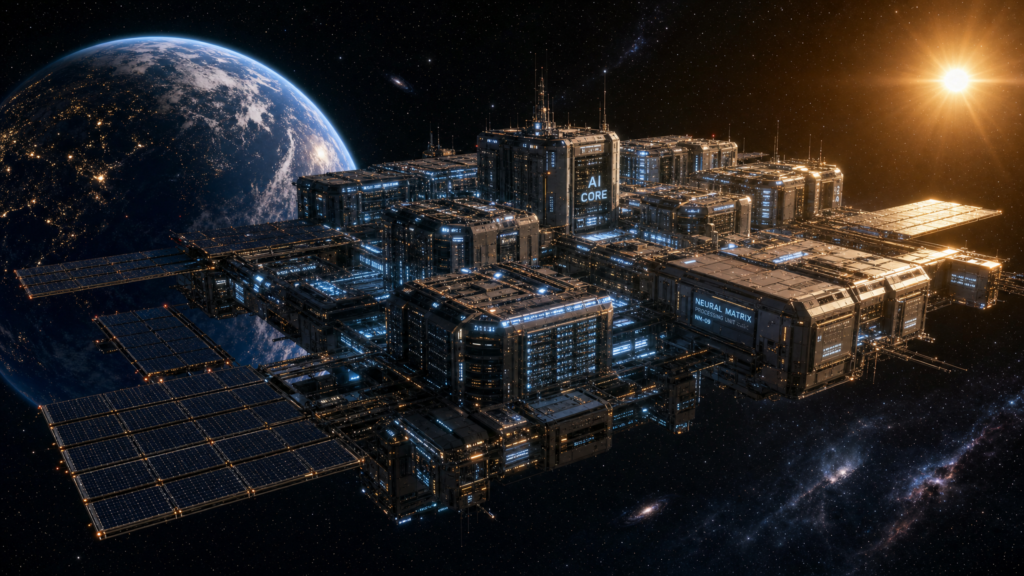
A look at why Elon Musk, Google, Amazon, and a wave of startups are racing to build orbital AI data centers — and why the physics, the rockets, and the regulators may not be ready.
The pitch sounds like science fiction polished up for a board meeting: take the world’s most power-hungry industry, AI compute, and lift it off the planet. Bathe it in 24-hour sunlight. Cool it in the vacuum of space. Skip the NIMBY fights, the water permits, the multi-year grid interconnect queues. Stop torturing Earth’s electricity grid to train ever-larger language models, and let the Sun — which radiates roughly 100 trillion times humanity’s total electricity production — do the heavy lifting.
That, more or less, is the marketing. And in the past year, it has stopped being a thought experiment. SpaceX has filed with the U.S. Federal Communications Commission for a constellation of up to one million satellites functioning as orbital data centers. Google has unveiled Project Suncatcher, a moonshot to fly TPUs in tight constellations starting in 2027. A startup called Starcloud has already put an Nvidia H100 GPU into low Earth orbit, trained a small language model in space, and raised $170 million at a $1.1 billion valuation. China’s Zhejiang Lab has launched the first satellites of a “Three‑Body Computing Constellation.” Amazon’s Jeff Bezos says gigawatt-scale orbital data centers are about a decade away. Even former Google CEO Eric Schmidt bought a rocket company partly to put compute in orbit.
So: is this real? The honest answer is yes and no, and it matters enormously which one you mean.
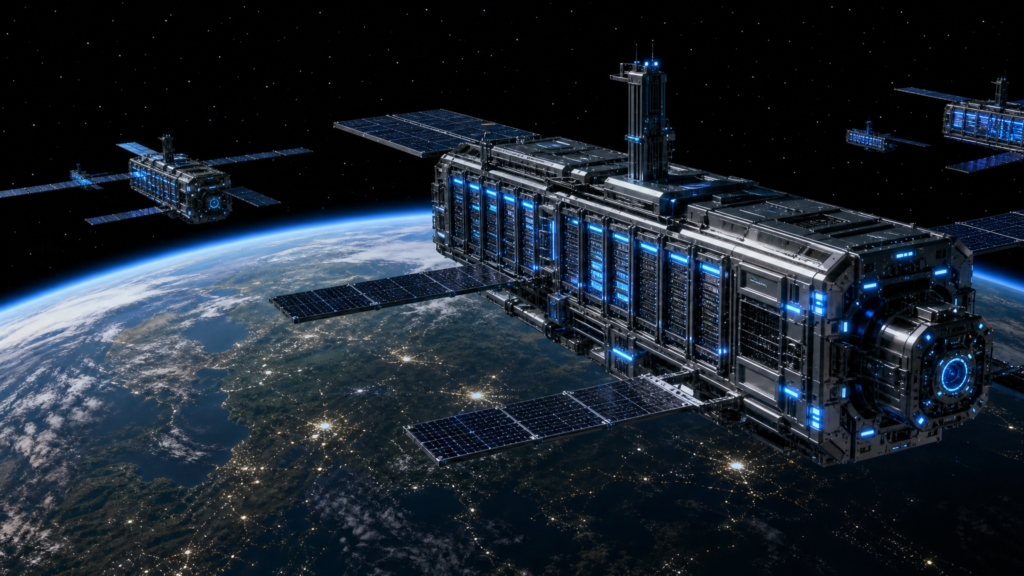
The right mental model is not “data centers are moving to space.” That is too broad and, on any near-term commercial timescale, mostly false. The right mental model is: space is acquiring its own native compute layer, because satellites, defense sensors, Earth-observation platforms, and crewed stations increasingly benefit from processing data where the data is born. For that use case, orbital compute is feasible now. For the much grander claim — that mainstream AI training will migrate to orbit because Earth cannot power it — the evidence still says: no, not on any serious scale this decade.
This piece walks through what is actually happening, what physics permits, what economics blocks, and the most plausible timeline.
What’s actually been launched, filed, or funded
Strip away the renders and the press conferences, and the orbital data center industry is at very different stages of maturity depending on whom you ask.
SpaceX filed plans on January 30, 2026 for an orbital data center constellation of up to one million satellites operating between 500 km and 2,000 km, leaning on optical inter-satellite links and Starlink relays for ground communications. The FCC’s Space Bureau accepted the application for filing five days later. As SpaceNews reported, the application is light on technical detail — no satellite mass, no specific cost estimate, no deployment schedule — but heavy on rhetoric: SpaceX described the plan as “a first step toward becoming a Kardashev Type II civilization.” The Register reported that astrophysicist Jonathan McDowell put the number of currently active satellites at about 14,500, of which roughly 9,500 are Starlink. A million-satellite constellation would multiply the entire active orbital population by a factor of nearly 70.
Blue Origin has separately filed for Project Sunrise — a constellation of 51,600 satellites in sun-synchronous orbits between 500 km and 1,800 km — alongside a related TeraWave optical-comms system that pushes inter-satellite link capacity toward 6 Tbps.
Google announced Project Suncatcher in November 2025, framing it as a “moonshot” akin to its early bets on quantum computing and autonomous vehicles. The company’s preprint paper proposes constellations of 81 satellites in a 1 km radius cluster at roughly 650 km in a dawn–dusk sun-synchronous orbit, equipped with Google TPUs and connected by free-space optical links capable of tens of terabits per second. Google has partnered with Earth-imaging firm Planet to launch two prototype satellites by early 2027 — what Sundar Pichai has called a “learning mission.” Pichai also told Fox News in late 2025 that “a decade or so away we’ll be viewing it as a more normal way to build data centers” (Fortune).
Starcloud, a Y Combinator and Nvidia‑backed startup based in Redmond, Washington, has gone furthest in concrete hardware. Its 60 kg Starcloud-1 satellite launched in November 2025 on a SpaceX rocket, carrying the first Nvidia H100 GPU ever flown to space. In December 2025, the satellite ran a version of Google’s Gemma open model and trained Andrej Karpathy’s NanoGPT on the complete works of Shakespeare — the first LLM trained on-orbit (CNBC). In March 2026, Benchmark and EQT Ventures led a $170 million Series A at a $1.1 billion valuation (TechCrunch). The company’s roadmap envisions a 5 GW orbital data center backed by a 4 km × 4 km solar/cooling array.
Axiom Space says it launched the first two dedicated nodes of its orbital data center concept on January 11, 2026, building on prototype work conducted on the International Space Station in 2025. Other entrants include Aetherflux — founded by Robinhood co-founder Baiju Bhatt, targeting Q1 2027 for an operational orbital data center — and Aethero, which flew Nvidia’s first space-based Jetson GPU in 2025. Lonestar Data Holdings is targeting the lunar surface itself.
China’s Zhejiang Lab says its “Three-Body Computing Constellation” has 12 satellites in orbit and has demonstrated networking, on-orbit AI processing, and model deployment.
The most institutionally cautious roadmap belongs to the European Commission–backed ASCEND study led by Thales Alenia Space, which defines a 10 MW minimum viable product, an operational system “from 2030,” and 1 GW deployed by 2050.
That’s the actual landscape. SpaceX and Blue Origin are at the filing stage. Google is at the prototype-mission stage. Axiom and Starcloud are at the first-operational-node stage. China is at the demonstrated edge-compute stage. ASCEND is the official European concept study. None of this equals an operational replacement for terrestrial hyperscale.
It’s also worth noting what SpaceX itself told prospective IPO investors in 2026: its orbital AI initiatives are early, technically complex, and may never become commercially viable — even as Elon Musk publicly described the idea as a near-term “no-brainer.” There is real money. There is real engineering. But the people writing the risk disclosures are clearly not seeing what the keynote slides show.
The power case is the strong case
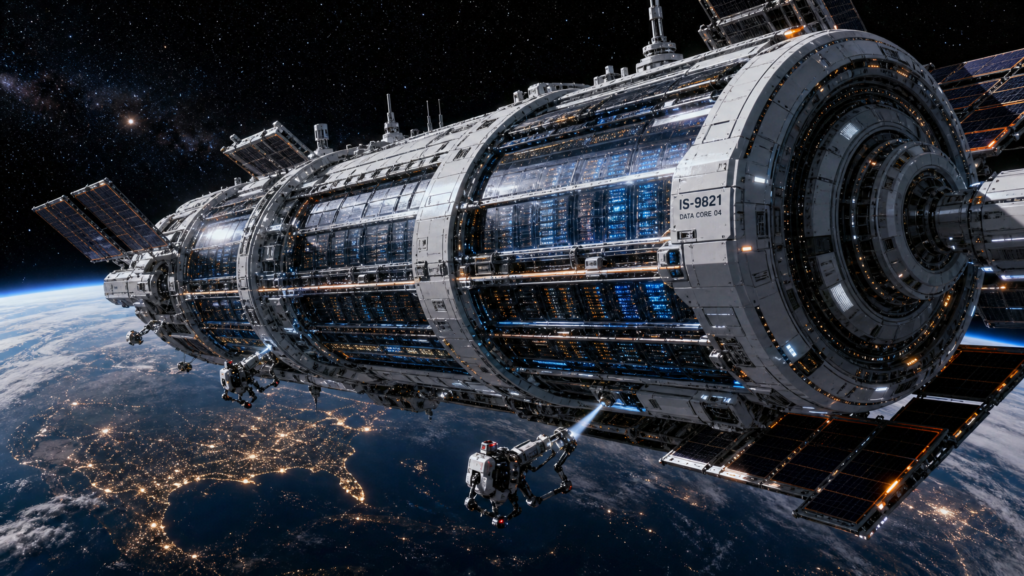
The reason serious people keep pursuing this concept isn’t because it’s easy. It’s because the energy economics in orbit are genuinely compelling.
Google’s preprint puts numbers on it: in a dawn–dusk sun-synchronous low Earth orbit at roughly 650 km, a solar panel can be up to eight times more productive over a year than one at mid-latitude on Earth. The satellite stays in near-continuous sunlight, eliminating the need for heavy onboard batteries that would otherwise dominate spacecraft mass. NASA puts total solar irradiance above the atmosphere at about 1,361 W/m² — uninterrupted by clouds, dust, weather, or night.
This is not marketing. ASCEND chose the same orbital regime — a dawn–dusk SSO around 1,400 km — for the same reason: “always sunny,” low latency to the ground, and battery-free architecture. Thales has said publicly that a 10 MW orbital data center would need roughly 35,000 m² of solar panels — already about 4.7× the equivalent solar surface area of the International Space Station.
For perspective: terrestrial data centers consumed more than 4% of U.S. electricity in 2023 and are projected to hit up to 12% by 2028, according to a December 2024 U.S. Department of Energy report cited by Fortune. Google alone used 30.8 million MWh through its data centers in 2024, more than double its 2020 figure. The IEA projects global data-center electricity demand to roughly double by 2030 to 1,200–1,700 TWh. Hyperscalers are signing nuclear PPAs, gas peakers, geothermal pilots, and a 45 GW pipeline of conditional offtake agreements with small modular reactor projects — and they still aren’t sure it’ll be enough.
So the intuition that there is more usable, continuous, clean power in orbit is correct.
The intuition about cooling, however, is where the marketing collapses.
Where the physics actually bites: heat
The pitch deck line is “space is cold.” This is misleading bordering on wrong. Space is a vacuum, which means there is no convection — no air, no water, no atmosphere — to carry heat away from a chip. As NASA’s thermal control guidance makes clear, in vacuum, the only outbound heat-transfer mechanism is thermal radiation from a radiator surface. That is much less efficient per unit area than the evaporative cooling, chilled water, or forced-air systems that terrestrial hyperscale relies on.
The ISS gives us a concrete reference. One official ISS photovoltaic radiator rejects up to 14 kW of heat, weighs 740.7 kg, and deploys to about 42.4 m². If you used that as a crude upper-bound benchmark, a 10 MW orbital data center would need on the order of:
- ~714 ISS-equivalent radiators
- ~30,000 m² of radiator surface
- ~529 metric tons of radiator mass
…before counting servers, solar arrays, structure, propellant, shielding, redundancy, or spares. SpaceX’s Starship advertises a 150-ton reusable LEO payload. That’s several Starships worth of just heat-rejection hardware for a single 10 MW node — and a 10 MW node is what ASCEND calls a minimum viable product. Scale to a gigawatt and the problem becomes hundreds of 150-ton-class shipments.
Modern deployable radiators will beat 1990s-era ISS hardware. NASA’s smallsat thermal-management work points to lighter, more efficient designs. But geometry is geometry. Reddit’s commentariat on the SpaceX subreddit caught the issue cleanly: even if “radiative cooling” is real, moving the heat from the chip to the radiator still requires conduction, pumped two-phase loops, or heat pipes — the same kinds of plumbing terrestrial racks use, only now in a vacuum where any loss of working fluid is unrecoverable.
Starcloud CEO Philip Johnston has acknowledged this directly: Starcloud-2 will fly “the largest deployable radiator ever flown on a private satellite,” and he expects multiple iterations before the design is mature (TechCrunch).
Cooling, not power, is the gating physical problem at scale.
Communications: the second wall
Distributed AI training is brutally communication-bound. Modern training jobs spread weights and gradients across thousands of GPUs connected by NVLink, InfiniBand, and optical interconnects pushing terabits per second per chip with sub-microsecond latency.
Google is refreshingly honest about this in its Suncatcher paper: to deliver data‑center‑class distributed ML in orbit, inter-satellite links need aggregate bandwidth on the order of 10 Tbps per link — far beyond current inter-satellite-link practice, which sits at 1–100 Gbps. To close that link budget with reasonable transceiver power, satellites must fly in very tight formation: hundreds of meters to a few kilometers apart. Google’s bench demonstrator has hit 1.6 Tbps total (800 Gbps each way) using a single transceiver pair via dense wavelength-division multiplexing. That’s promising — but it’s a lab bench, not 81 satellites flying at 7.5 km/s 650 km up.
The orbital-mechanics problem is non-trivial too. Google modeled an 81-satellite cluster at 650 km using a JAX-based differentiable physics simulator built on the Hill–Clohessy–Wiltshire equations. Their conclusion is cautiously optimistic: modest station-keeping should hold the cluster together. But this is still a constellation more tightly packed than anything that has ever flown.
The deeper point is strategic. Orbital compute makes its strongest case when the data is already in orbit. Earth-observation imagery, synthetic aperture radar (SAR) data — which Starcloud’s Johnston cites as generating about 10 GB/s — defense surveillance feeds, station and spacecraft telemetry. These are workloads where downlink bandwidth is the bottleneck and processing in orbit avoids shipping petabytes through congested ground stations. For Earth-originating AI training data — text, video, code, user interactions — the case weakens dramatically. Ground-to-orbit bandwidth is the limiting factor, and even Google admits long-term high-bandwidth ground links remain “future work.”
Reliability without humans
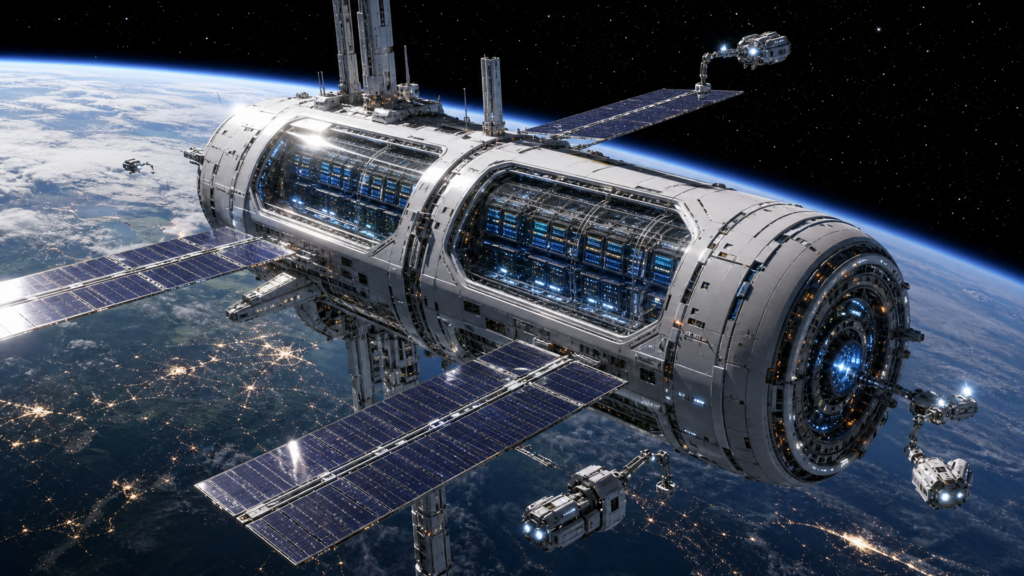
In a terrestrial data center, a failed GPU is replaced in minutes by a technician with a service cart. In orbit, that same GPU is, as Google delicately puts it, “obviously impractical” to swap.
Google’s own paper places radiation-tolerant compute and thermal management among the foundational unsolved problems. Tests of the Trillium TPU (v6e) in a 67 MeV proton beam were promising — the chip survived a cumulative dose of 2 krad(Si), nearly three times the projected five-year mission dose with shielding, before the High Bandwidth Memory subsystem began producing irregularities. No hard failures up to 15 krad(Si). The honest caveat: the impact of single-event effects (SEEs) on training runs “requires further studying,” because a single energetic particle striking a transistor can flip a bit mid-gradient and silently corrupt a multi-million-dollar training job.
Zhejiang Lab has framed the same challenge in nearly identical terms: SEEs are a primary obstacle requiring self-healing software. SpaceX’s investor risk language admits the same. The solution at small scale is brute-force redundancy. The solution at hyperscale is unsolved.
The economics: where the dream meets the spreadsheet
This is the part most prospectuses skip past quickly.
A widely cited public benchmark from SpaceX’s rideshare program is $7,000/kg to sun-synchronous orbit for additional mass. Google’s own analysis in the Suncatcher paper argues that orbital AI economics start to look comparable to terrestrial energy costs only if launch falls to ~$200/kg by the mid-2030s. That’s a roughly 35× improvement from today’s public benchmark — and that’s where one of the concept’s most sophisticated advocates says the math starts getting interesting, not where it wins.
Even Starcloud’s Johnston told TechCrunch that his Starcloud-3 spacecraft will only be cost-competitive with terrestrial data centers if commercial launch costs land around $500/kg — and he expects the necessary Starship cadence to open up “in 2028 and 2029” at the earliest. “We’re not going to be competitive on energy costs until Starship is flying frequently,” he said.
A recent European Parliament research note observed that a complete orbital data center could require upwards of 100 launches, against roughly 300 launches globally in 2025 across all payloads. SpaceX itself noted that all orbital payload launched worldwide in 2025 totaled only about 3,000 tons. SpaceX’s own filing imagines launching one million tonnes per year of orbital data center mass — and that’s where the thought experiment runs into raw industrial reality. As one Reddit commenter calculated: at 200 tons per Starship flight to SSO, that’s 5,000 launches per year, or roughly 14 Starship flights per day. The current entire U.S. liquid oxygen production capacity could support about four Starship flights per day, per a 2024 Ars Technica analysis. The orbital data center economy is not just competing with terrestrial data center economics; it’s competing against the global launch-industrial base and the global cryogenics supply chain.
Meanwhile, the IEA notes that terrestrial data centers can often be brought online in two to three years. Hyperscalers issued $121 billion in new debt in 2025 versus $40 billion in 2020, per Fortune’s reporting on Alphabet, Amazon, Meta, Microsoft, and Oracle. AWS CEO Matt Garman put it most bluntly at a San Francisco tech conference in February 2026: “I don’t know if you’ve seen a rack of servers lately: They’re heavy. And last I checked, humanity has yet to build a permanent structure in space.”
That’s not skepticism from a luddite. That’s the CEO of the company that runs the world’s largest cloud, looking at his own physics.
The “green” claim is weaker than the marketing implies
Orbital advocates argue — correctly — that space data centers eliminate the land, water, and grid impact of terrestrial hyperscale. Starcloud projects 10× lower carbon emissions over a satellite’s lifetime versus terrestrial alternatives, even after accounting for launch.
But the actual ASCEND lifecycle analysis — the most rigorous public study to date — concluded that to significantly reduce lifecycle CO₂ relative to ground data centers, the launcher itself would need to be roughly 10× less emissive over its lifecycle than today’s baseline. That is, orbital AI is greener only if launch is radically cleaned up and heavily reused.
This is the part enthusiasts keep sliding past. Methalox combustion, even fully reused, isn’t free. Every Starship flight burns roughly 5,200 tons of liquid oxygen and methane. Multiply by thousands of flights per year, and the orbital cloud’s “clean” story depends entirely on the assumption that the launch industry decarbonizes faster than the terrestrial grid does — a non-obvious bet.
Governance and the orbital crowding problem
Set aside physics and economics for a moment. The regulatory question alone is sobering.
There are about 14,500 active satellites in low Earth orbit today. SpaceX’s million-satellite filing alone would multiply that by ~70×. Blue Origin’s 51,600-satellite Project Sunrise filing would multiply it by ~3.5×. The Secure World Foundation argues these are precedent-setting, non-routine applications that require system-level analysis of cumulative collision risk, post-mission disposal, and aggregate spectrum interference — analysis that current FCC processes are not built to deliver.
Astrophysicist Jonathan McDowell, speaking to The Register, warned that a million-satellite constellation “will absolutely be required to have a fleet of tow-truck satellites to remove failed ones to avoid Kessler” — Kessler Syndrome being the runaway-collision scenario that could render parts of LEO unusable for generations. He also flagged the impact on astronomy: “One million satellites are going to be a big challenge for astronomy, especially as they are in higher orbits which is worse for us.”
The European Parliament’s research note has likewise raised major concerns about data jurisdiction (whose laws apply to a satellite hosting EU citizens’ data over Brazil?), orbital sustainability, and existing legal frameworks — most of which were drafted decades before this scale of activity was imaginable.
This is not a footnote. It is a first-order timeline variable.
Where orbital compute does make sense — now
It would be a mistake to read all of the above as “this is hype, don’t bother.” The genuinely useful version of orbital data centers is the version most of the headlines underplay: edge compute for space-native workloads.
- Earth observation analytics. SAR satellites generate ~10 GB/s of raw data. Most of it is uninteresting. Running inference in orbit and downlinking only the relevant detections — wildfires, ship wakes, troop movements, crop stress — collapses bandwidth requirements by orders of magnitude and shrinks alert latency from hours to minutes. Starcloud is already running this against Capella Space’s SAR feeds.
- Defense and intelligence sensing. Sovereign, sealed, latency-sensitive workloads with no need to talk to terrestrial hyperscale.
- Station and spacecraft autonomy. As crewed and robotic activity in cis-lunar space grows, on-orbit compute reduces dependence on Deep Space Network bandwidth and human-in-the-loop control loops.
- Inference for satellite constellations. Starcloud’s H100 is offering “high-powered inference and fine-tuning capabilities for other satellites,” in CEO Johnston’s framing.
- Sovereign or disconnected cloud. Some governments and militaries may pay a premium for orbit-based compute that physically cannot be subpoenaed or seized on foreign soil.
Through 2028, this is the realistic playing field. Multi-MW commercial systems are conceivable in the late 2020s and early 2030s. Gigawatt-class orbital AI training clusters intended to relieve Earth’s power crisis are not a credible near-term plan and are most plausibly a late-2030s or 2040s story — if they happen at all.
A plausible timeline
Putting the public evidence together:
Through 2028 — narrow pilots, space-native edge workloads. Axiom’s nodes in operation, Google’s two prototype satellites by early 2027, Starcloud-2 with a Blackwell GPU and AWS server blade, Aetherflux’s targeted Q1 2027 deployment, and additional Chinese constellation expansion. Reuters’ analyst sources expect first small-scale orbital data center deployments in 2027–2028 to test technology and economics. This phase will succeed, because it targets workloads with a clear orbital advantage.
Late 2020s into early 2030s — kilowatt to low-megawatt commercial constellations. Real services in defense sensing, sovereign cloud, EO analytics, perhaps premium inference. Axiom places its own roadmap at this level. China is heading the same direction. What we will not see in this window is an orbital challenger to terrestrial hyperscale training.
Early to mid-2030s — multi-megawatt systems possibly viable, contingent on three curves bending right simultaneously: launch cost (toward $200–500/kg), autonomous operations and reliability, and optical networking (toward 10 Tbps per inter-satellite link). Google’s whole economic model assumes the mid-2030s launch cost transition. AWS’s Garman calls the timeline “pretty far.” This is where the concept becomes a serious industrial experiment, not a dominant architecture.
Late 2030s and beyond — gigawatt-class orbital AI training clusters: speculative. ASCEND defines its long-run goal as 1 GW by 2050. The European Parliament note targets operational (not gigawatt) systems “from 2030.” Strip away rhetoric and gigawatt orbital compute is a long-duration infrastructure bet, not an imminent industry inevitability.
Bottom line
Are Musk, Bezos, Pichai, Schmidt, and the rest serious? Yes. Seriousness, however, is not the same as feasibility. They are serious enough to file with regulators, raise funds, fly hardware, and publish real research. They are not nearly far enough along to credibly claim that Earth-bound AI training clusters are about to be displaced.
The honest one-paragraph version of the answer:
- Small orbital compute nodes: feasible now.
- Orbital AI services for space-native workloads: plausible in the late 2020s and early 2030s.
- Multi-megawatt commercial systems: possible but speculative.
- Gigawatt-class orbital AI data centers intended to relieve Earth’s power crisis: not a credible near-term plan, and probably not a dominant architecture before the 2040s — unless launch economics, thermal engineering, autonomous maintenance, and regulation all improve much faster than the public record currently supports.
Terrestrial data center infrastructure is ugly, power-hungry, contentious, often dirty, and politically inflamed. It is also still vastly easier to build than a space cloud. The interesting near-term story is not that AI is leaving Earth. It’s that the space economy is finally getting the compute it has always needed to use the data it has always collected.
The Sun is waiting. So is Kepler’s geometry, the second law of thermodynamics, and the FCC docket. We’ll see which one wins.
The Kingy Brief
Get future Kingy Brief editions.
Source-checked AI changes, original tests and one practical thing to try.
Free · Choose your subjects · Double opt-in · Unsubscribe anytime
Regular sending is paused; no restart date is set.