
It isn’t NIMBYism. It’s a distributional and governance dispute — and the public is reading the situation more clearly than the industry wants to admit.
If you live in Northern Virginia, the suburbs of Phoenix, the San Gabriel Valley, or any of dozens of rural counties from Georgia to Iowa, you have probably heard the same speech. A developer arrives with renderings of a windowless rectangle and a slide deck full of jobs numbers. Local officials nod. Critics are dismissed as cranks, Luddites, or — the favorite word — NIMBYs. The implication is that the country needs digital infrastructure and these communities are being selfish.
That framing is wrong. And the more carefully you look at the polling, the state-level oversight reports, and the case studies from the most contested host regions in America, the more obvious it becomes that the data-center backlash is not irrational. It is a rational political response to an infrastructure model that asks local communities to absorb industrial-scale burdens for benefits they cannot clearly see, audit, or enforce.
This article walks through the evidence: what residents actually believe, why they believe it, what the case studies prove, and what would actually fix the problem.
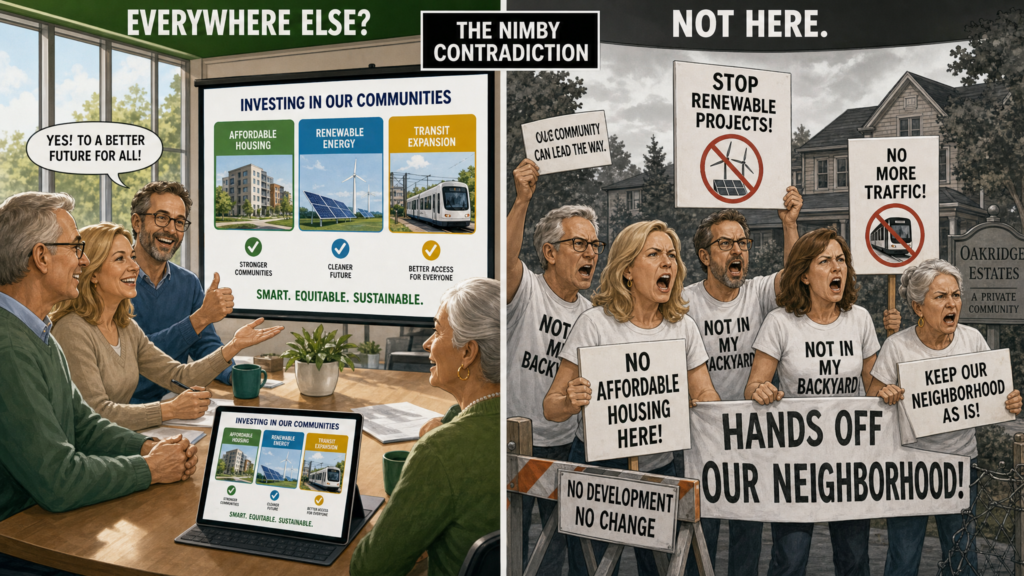
The Strongest Counterargument: The Word “NIMBY” Is Doing Too Much Work
The standard tech-industry rebuttal to data-center opposition assumes three things at once: that the underlying project is socially beneficial, that the host community is being selfish, and that the problem is mainly bad attitudes. In a large share of fights, that framing is backwards.
Start with what Americans actually say. In the first major national poll specifically focused on data centers, Pew Research Center surveyed 8,512 U.S. adults in January 2026 and found that 39% say data centers are mostly bad for the environment versus 4% who say mostly good; 38% say mostly bad for home energy costs versus 6% mostly good; and 30% say mostly bad for the quality of life of people living nearby versus 6% mostly good. Views of jobs and tax revenue are more positive, but even there, ambivalence dominates.
The most damaging finding for the industry’s “they just don’t understand” defense is the relationship between knowledge and opposition. Pew found that 67% of adults who have heard a lot about data centers say they’re mostly bad for home energy costs, compared with only 42% of those who have heard a little. The pattern repeats on every dimension. As Business Insider summarized: the more Americans learn, the less they like.
In other words, opposition rises with information. That cuts directly against the lazy claim that residents are simply ignorant.
The deeper point is that data centers are not hated as such. Poorly sited, weakly disclosed, lightly conditioned, heavily subsidized data centers are hated. Even in the most contentious state in America, the Joint Legislative Audit and Review Commission of Virginia found that most facilities are not near residential areas and that only a minority of sites generate serious noise complaints. Opposition is therefore not proof that all data centers are objectionable. It is proof that siting and governance quality determine whether communities perceive them as legitimate.
The Actual Root Causes
1. Electricity and Ratepayer Anxiety
This is the dominant driver, and the arithmetic is brutal.
A landmark Lawrence Berkeley National Laboratory report estimated that U.S. data centers consumed 176 terawatt-hours in 2023 — roughly 4.4% of the nation’s electricity — and projected demand to climb to between 325 and 580 TWh by 2028, equal to 6.7%–12% of national electricity use. The U.S. Department of Energy has separately reported that connection requests for hyperscale facilities in the 300–1,000 MW range are stretching local grids in ways that mid-sized U.S. cities have never faced.
Residents do not need to understand every technical detail to grasp the practical implication: if a single campus can demand the power of a small city, somebody must finance the new generation, substations, and transmission lines.
What turns this from a logistics problem into a political detonation is cost allocation. Households are routinely told that the project will “pay its own way.” But transmission and generation costs are frequently socialized onto the broader rate base unless regulators install strong guardrails. In a striking concurrence at the Federal Energy Regulatory Commission, Commissioner Lindsay See and others have warned that bilateral agreements with individual large-load customers can still leave other customers paying more — particularly if a hyperscaler departs before the new transmission assets are paid off.
That is the precise nightmare residents fear: the data center arrives, the utility overbuilds, and ordinary ratepayers own the downside for decades. As the Brookings Institution has documented, this concern is now central to state legislative debates and has driven public-utility commissions in multiple states to begin re-examining how large-load tariffs are structured.
The political toxicity is amplified when developers have negotiated tax incentives or special pricing on top of the cost-allocation risk. “Your power bill may rise so a hyperscaler can train models faster” is a sentence designed to lose elections — and it becomes more potent in places that already feel economically squeezed. The concern is not merely that data centers use a lot of electricity. It is that they may exercise market and political leverage to privatize the upside while collectivizing the risk.
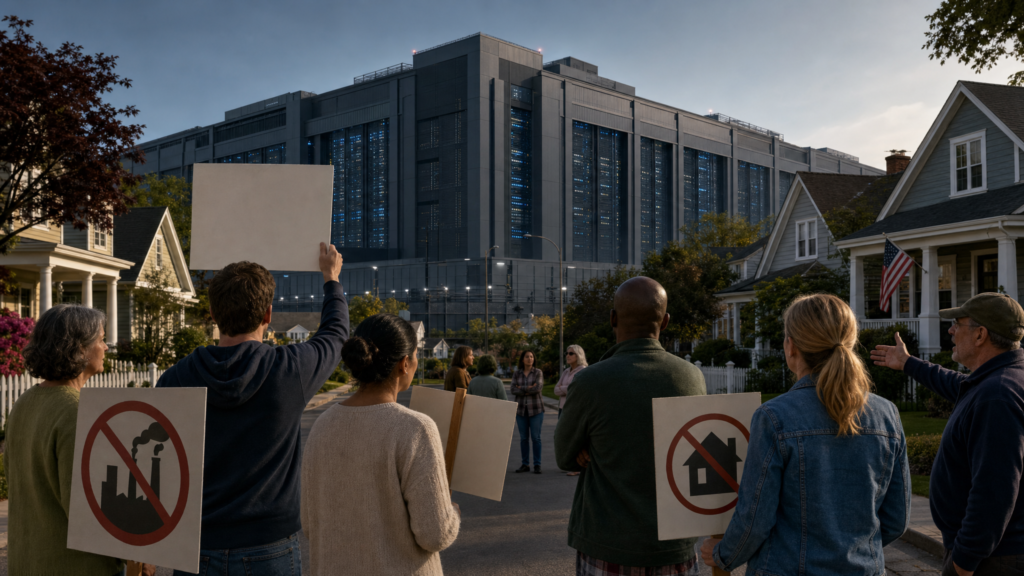
2. Water and Drought
Water is the second great trigger, particularly in the arid West and in rural aquifer-dependent communities.
The same Berkeley Lab report estimated that U.S. data centers directly consumed 66 billion liters of water in 2023, plus nearly 800 billion liters indirectly through electricity generation. Hyperscale direct water use in 2028 is projected at 60–124 billion liters.
The industry’s standard rebuttal is correct as a national arithmetic claim: data-center water consumption is small relative to total U.S. use. But that argument misses where the politics actually live, which is local. A widely cited peer-reviewed analysis in npj Clean Water found that data centers compete with other users for local water resources, that some operators have historically sourced more than half their water from potable supplies, and that transparency was so weak that fewer than a third of operators were measuring water consumption at all at the time of that review.
A 2025 life-cycle assessment in Nature confirmed why local water remains the political fault line: server-level air or liquid cooling can be water-light, but facility-level heat rejection often still relies on evaporative cooling, where roughly 80% of withdrawn water can be lost to evaporation.
Residents do not draw fine distinctions between Scope 1 and Scope 2 water use. They ask a simpler question: Why should local households conserve while a remote computing facility gets priority access to the aquifer? That question becomes vastly harder for officials to answer when developers are vague about cooling technology, water sourcing, drought contingencies, or whether reclaimed water will be used.
3. Noise and the Industrialization of Daily Life
Noise is unusually important because it converts abstraction into lived experience. Electricity demand is an idea; the low-frequency hum outside your bedroom is not.
The Virginia JLARC review — the most exhaustive state-level study of data-center impacts in the country — documented that data-center noise is often not loud enough to violate traditional decibel-based ordinances, yet residents still report migraines, sleep disruption, loss of concentration, and lower quality of life. The problem is constant, tonal, low-frequency sound: not the dramatic bang the legal system was built to regulate, but the 24/7 droning that makes people feel as if an industrial machine has been planted into a formerly residential soundscape.
This is a design mismatch in law as much as in acoustics. Conventional noise codes were written for short, loud, obvious nuisances. Data centers can stay safely under those thresholds while still driving residents mad. That is why Prince William County, Virginia revised noise enforcement in 2026 specifically to address steady tonal noise associated with data centers and similar industrial equipment, and why JLARC’s recommendations report urged the state to give local governments explicit authority to require sound modeling and alternative low-frequency metrics before approval.
The constant-noise problem also explains why data-center opposition can feel more intense than opposition to many other industrial uses. A warehouse may be ugly but quiet. A data center can be visually bland yet acoustically invasive every day and night. Residents experience that as a direct assault on domestic life — not a remote environmental trade-off.
4. Air Pollution, Backup Generators, and Adjacent Infrastructure
Communities do not just evaluate the white box. They evaluate everything the box drags with it: backup generators, substations, new transmission lines, and increasingly, dedicated gas-fired generation.
The U.S. Environmental Protection Agency maintains a data-center resource page under the Clean Air Act for a reason. Diesel emergency generators emit nitrogen oxides, particulate matter, sulfur dioxide, carbon monoxide, and hydrocarbons. Even when used intermittently, they become a flash point because the host community bears the local health risk while the service beneficiary may be national or even global.
This is also a credibility issue. A developer may advertise low-carbon ambitions and then ask for dozens of diesel units or gas-fired backup because reliability is “non-negotiable.” Residents read that as a bait-and-switch — particularly in communities already worried about asthma, environmental injustice, or ozone non-attainment status. The Virginia recommendations propose conditioning state tax benefits on cleaner generator standards in the region’s ozone non-attainment area, a sign that this concern is no longer fringe.
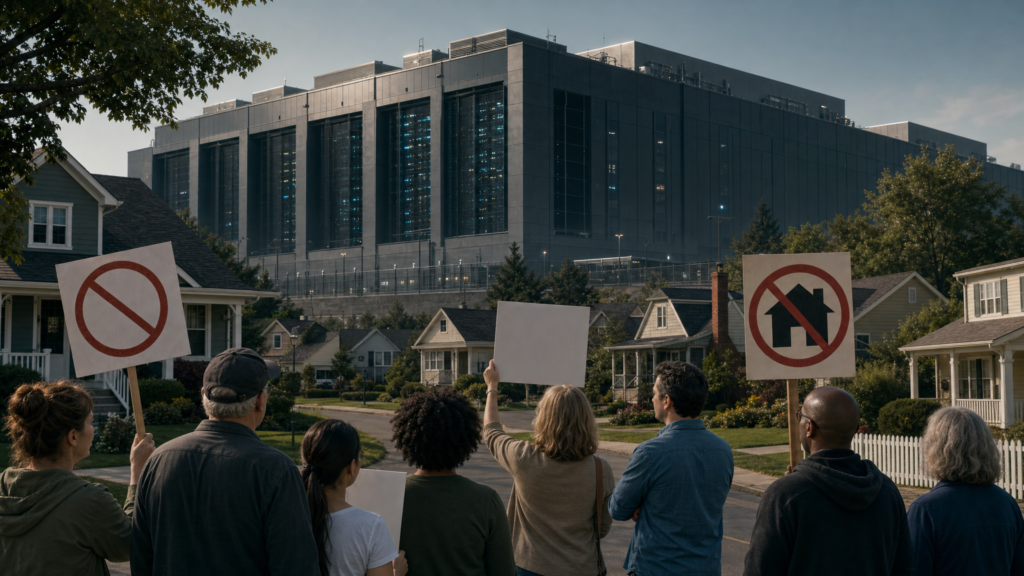
5. Land Use, Visual Impacts, History, and Traffic
The anti-data-center movement is not driven only by resource flows. It is also driven by place identity. Large campuses can consume hundreds or even thousands of acres, alter rural and suburban landscapes, and damage what communities understand themselves to be.
The Virginia review found that one-third of facilities studied were near residential areas, that large projects can take up to seven years to complete, and that residents reported heavy-vehicle traffic, road damage, blocked school buses, and repeated disruption from campus-style buildouts where one building begins as soon as the previous one finishes. The same review emphasized viewshed impacts and weak protections for historic resources on private land in the absence of other permitting triggers.
This is why the backlash is sharpest when data centers press into farmland, edge suburbs, scenic corridors, or historically sensitive landscapes — like the battlefield-adjacent terrain of the now-infamous PW Digital Gateway. Communities do not see “digital infrastructure.” They see irreversible conversion of land into low-employment industrial use with little street life, blank walls, security lighting, and chain-link fencing. When defenders say, “You use the internet, so you need this,” they miss the central social fact: people are not objecting to the function. They are objecting to being selected as the sacrifice zone.
6. Trust, Secrecy, and Loss of Local Control
This is the political accelerant that turns concern into revolt.
Multiple analyses, including a comprehensive Brookings Institution study, highlight compressed timelines, confidential negotiations, NDAs, asymmetrical expertise, and the widespread sense that the real decisions were made before the public meeting began. When that happens, even objectively manageable impacts become symbolically intolerable — because the fight is no longer about water or noise. It becomes a referendum on whether local government still works for locals.
Official planning language is starting to reflect that lesson. Prince William County’s Data Center Opportunity Zone Overlay District Comprehensive Review emphasizes public outreach, predefined siting areas, design standards, and identification of locations where infrastructure already exists. The City of Chandler, Arizona, adopted a General Plan update that explicitly discourages data centers as by-right uses absent council rezoning approval. These are not anti-technology gestures. They are attempts to reclaim political control over what had begun to feel like a developer-led fait accompli.
Why the Economic Case Often Fails to Persuade
The pro-data-center case is not fake. It is incomplete.
Data centers can generate substantial tax revenue, construction employment, and secondary business activity. The Virginia JLARC review estimated meaningful statewide impact: roughly 74,000 jobs, $5.5 billion in labor income, and $9.1 billion in GDP annually, with mature host localities receiving meaningful local revenue.
But the same study found that a typical 250,000-square-foot facility may have only about 50 full-time workers, roughly half of them contractors, while most of the broader economic impact derives from the construction phase rather than ongoing operations. In plain English: the jobs spike is real, but the durable employment base is thin.
That mismatch is politically fatal when the project is next to homes. Communities compare a permanent industrial footprint with a small steady-state payroll. When the locality has also cut equipment tax rates or granted long-term abatements, the deal can look worse still. The Virginia review calculated the state’s data-center sales-and-use tax exemption at roughly $573 million annually in recent fiscal years and noted a structural problem: most local benefits accrue during construction, while tax advantages continue afterwards, when local economic benefits have declined.
There is also a visibility problem. Data-center tax benefits are often invisible to residents, while the downsides are conspicuous. People hear the hum, see the walls, watch the trucks — and are then told that the real value will appear in a county spreadsheet. As Brookings has argued in its analysis of long-term local prosperity strategies, if a local government cannot show, in concrete terms, how a project lowers tax pressure, funds schools, or upgrades public services, the economic-development narrative collapses into “corporate giveaway.”
The most important synthesis is therefore this: opposition is strongest when costs are private and immediate while benefits are public, delayed, and hard to verify. That is not a communications problem. It is an incentive-design problem.
What the Case Studies Prove
Prince William County, Virginia
The PW Digital Gateway controversy showed how root causes can stack: rural and battlefield-adjacent land conversion, noise complaints, viewshed and historic-resource concerns, procedural objections, and broader distrust about whether the county was letting the industry spread well beyond the boundaries originally intended for it. Official county materials show the county has now spent significant time trying to channel facilities into an overlay district where infrastructure already exists, while the JLARC review urged stronger water, sound, historic-resource, and stranded-cost protections.
The lesson is not that data centers are impossible in the county. It is that sprawling expansion into symbolically sensitive landscapes is now politically radioactive.
Chandler, Arizona
Chandler’s fight was different in surface details but identical in structure. The city’s 2026 General Plan Update discourages data centers as by-right uses absent council approval. In late 2025, the council unanimously rejected a major AI data-center rezoning proposal after intense public opposition centered on water, power demand, and whether the project would actually deliver commensurate local value.
The lesson is that the desert Southwest is not “anti-technology.” It is anti-allocating-scarce-desert-resources to a land use many residents see as low-touch, low-employment, and highly extractive.
Monterey Park, California
Monterey Park first adopted, then extended a moratorium on data-center development while preparing rules that could prohibit data centers citywide. Official notices framed the pause as time to evaluate environmental and community impacts, and the city signaled that future proposals would face a much tougher standard.
The lesson here is the bleakest for developers: when public trust collapses, local governments stop trying to bargain and instead move toward categorical exclusion. Once a city decides the entire land-use category is incompatible with local priorities, no amount of post-hoc messaging will save the project.
Across all three cases, the pattern is identical. Residents are not demanding zero digital infrastructure everywhere. They are demanding that the burden of hosting it not be imposed through secrecy, weak standards, and asymmetric bargains.
What Would Actually Fix the Problem
1. Better siting, not better spin. Data centers should be steered into true industrial zones, brownfields, retired industrial and power sites, and places where transmission, roads, and water already exist — not into edge-suburban or freshly rezoned rural land. That is exactly the logic behind the Virginia overlay districts and behind federal recommendations to reuse retired energy infrastructure, including former coal sites.
2. Full pre-approval disclosure. Before rezoning, developers should be required to publish independently reviewable estimates of peak load, annual energy use, direct water use, source-water strategy, drought contingency plans, noise modeling, generator counts, generator testing schedules, traffic volumes, and infrastructure dependencies. The Virginia JLARC recommendations report explicitly proposes giving local governments authority to require water-use estimates and sound modeling before approval. If a project cannot survive that level of transparency, it does not deserve approval.
3. Ratepayer protection by design. Large-load tariffs should require minimum-demand commitments, study fees, collateral, and exit provisions so that speculative filings and stranded infrastructure are not socialized to ordinary customers. The clearest concrete model is the AEP Ohio Data Center Tariff, which now requires new large data centers to pay load-study fees, sign long contracts, post collateral, reimburse buildout costs if they cancel or delay, and accept minimum billing demand at no less than 85% of contracted demand. FERC’s own warnings make clear this is a floor, not a ceiling.
4. Operational standards that match the actual nuisance. Traditional decibel caps are insufficient. Local codes should regulate low-frequency steady-tonal noise, mandate setbacks, require building orientation that minimizes off-site sound, demand acoustic enclosures for backup generators, and establish continuous post-occupancy monitoring with enforceable penalties.
5. Water discipline instead of vague “sustainability” rhetoric. Approvals in water-stressed regions should require explicit water budgets, seasonal operating plans, drought triggers, and preference for dry cooling, hybrid systems, and direct-to-chip cooling. The 2025 Nature life-cycle study found that cold-plate and immersion systems can reduce blue-water consumption by 31%–52% while also cutting greenhouse-gas emissions and energy demand. The engineering alternatives exist; the policy problem is forcing developers to internalize the trade-offs instead of defaulting to the cheapest locally permissible option.
6. Cleaner reliability architecture. If developers insist that reliability is mission-critical, they should be pushed away from diesel and toward batteries, cleaner backup technologies, and explicitly disclosed on-site power strategies. Where diesel is still used, communities should demand cleaner engine standards, runtime limits, and permit conditions tied to local air-quality goals. Reliability cannot be a magic word that waives public-health scrutiny.
7. Real community benefit agreements, not ceremonial public meetings. As Brookings has argued in its analysis of why community benefit agreements are necessary for data centers, the recoverable model is not “we’ll host a town hall after the deal is mostly done.” It is a binding contract that ties abatements and approvals to measurable commitments: local hiring and apprenticeship targets, prevailing-wage standards, water caps, noise standards, public dashboards, direct community payments, digital-access investments, and clear consequences for nonperformance.
8. End the secrecy. No NDAs on core public-interest terms. No hard-redacted infrastructure assumptions. No “Project Falcon” shell games that hide the sponsor until the last possible moment. Negotiations about energy demand, water, subsidies, and cost-sharing should be public by default. The anti-data-center movement feeds on distrust because distrust is often warranted. The cure is not better PR. It is procedural justice.
9. Phased approvals and decommissioning discipline. Large campuses should not receive blank-check entitlements for every future building on day one. Approvals should be phased, with each stage contingent on performance against prior commitments. Developers should also fund decommissioning or repurposing plans so that localities are not left with subsidized stranded assets when technology, market conditions, or the AI cycle shift.
10. Change the political sales pitch. Communities are done hearing that hosting a data center is a patriotic duty or an inevitable side effect of AI progress. If firms want public legitimacy, they need to make a credible case that the host community becomes better off in concrete, measurable, local ways. Anything less will continue to be read — often correctly — as extraction.
Confidence and Open Questions
The central conclusion is high-confidence: the main drivers of community opposition are not abstract hostility to technology, but a repeated pattern of locally concentrated costs, weakly protected ratepayers, insufficient transparency, and benefits that are either overstated or badly distributed. These conclusions are supported by federal energy analysis, state oversight reports, peer-reviewed environmental research, utility tariff design, national polling, and municipal case studies.
A few things remain less settled. The evidence on direct home-value effects is thinner than the evidence on noise, utility costs, and land-use conflict. The long-run rate impacts of individual projects are also difficult to apportion because many drivers affect electricity prices simultaneously — and FERC itself has warned that protecting customers requires more than one-off bilateral agreements. Some of the strongest public claims about national opposition are based on newer polling and case-study counts rather than long-running official time series.
But the bottom line is blunt. Data-center opposition in the United States is not a quirky cultural irritant to be managed away with messaging. It is the rational political response to an infrastructure model that too often asks local communities to absorb industrial-scale burdens for benefits they cannot clearly see, audit, or enforce.
If policymakers and developers want less backlash, they need fewer euphemisms, fewer subsidies without strings, fewer secrecy clauses, stronger tariffs and permit conditions, tougher siting rules, and much more explicit reciprocity with the people asked to host the machines.
Calling the resistance “NIMBYism” is no longer just lazy. It is increasingly the single biggest obstacle to building the digital infrastructure the country actually needs.
The Kingy Brief
Get future Kingy Brief editions.
Source-checked AI changes, original tests and one practical thing to try.
Free · Choose your subjects · Double opt-in · Unsubscribe anytime
Regular sending is paused; no restart date is set.