AI Tool Profile
GitHub Copilot Code Review
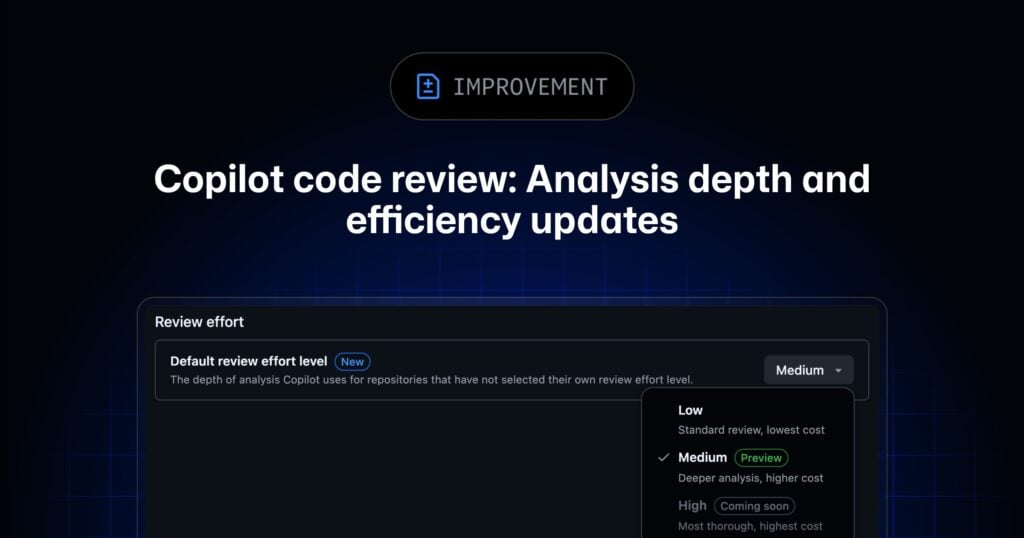
GitHub updated Copilot code review on June 25, 2026 with organization defaults and visible attribution for the Medium review-effort preview, plus a new file-exploration path built on Copilot CLI and SDK tools.
Verification & Sources
- Evidence state
- Recheck due
- Source links
- 3
- Freshness
- Needs recheck: checked July 9, 2026
- Last updated
- July 9, 2026
What this evidence state means
- Definition
- The claim was previously checked, but its review window expired or a material change may have invalidated it.
- Required provenance
- The prior evidence and check date are retained, together with the expiry or change signal that triggered recheck.
- Owner
- Kingy freshness queue owner and assigned editorial reviewer
- Freshness rule
- This is already outside its freshness rule. It must not be presented as current until reviewed against current evidence.
- Disputes and corrections
- Use “Suggest a correction” on the record. Kingy editorial reviews the cited evidence, records material corrections, and changes or removes the state when it is not supported.
Key source checks
Suggest a correction
GitHub Copilot Code Review is a product or capability from GitHub documented by first-party sources. GitHub updated Copilot code review on June 25, 2026 with organization defaults and visible attribution for the Medium review-effort preview, plus a new file-exploration path built on Copilot CLI and SDK tools.
What it does
Organizations can set a default review effort for repositories that do not have their own configuration, and Medium runs are identified in the pull-request overview. Behind the scenes, Copilot code review now uses built-in grep, rg, glob, and view tools from the CLI and SDK instead of custom file-exploration tools.
Availability and pricing
Medium review effort remains a public preview for eligible Copilot users. GitHub reports that the new file-tool path reduced Copilot code review costs by about 20 percent while maintaining its standard review quality in GitHub’s offline and online evaluations; this is a vendor-reported result, not an independent Kingy benchmark. Current plan eligibility and usage charges should be confirmed with GitHub.
Who it is for
Developers, engineering teams, security teams, and enterprise platform administrators configuring AI-assisted pull-request review.
What teams should review
Medium effort is still a preview, GitHub’s cost result is vendor-reported, and teams must measure finding quality, false positives, Actions usage, AI credit consumption, and repository-specific policy fit themselves.
Official sources
The Kingy Brief
Get The Kingy Brief.
AI changes, original tests and one practical thing to try. Fridays at 09:00 Vancouver time.
Free · Double opt-in · Unsubscribe anytime
Signup help and newsletter schedule
Signup form provided by Beehiiv. After submitting, check your inbox for "Confirm your subscription to The Kingy Brief" and open its confirmation link. Check Spam or Promotions if you cannot find it.
Fridays at 09:00 Vancouver time: source-checked AI changes, original tests and one practical thing to try. The weekly restart begins October 9, 2026. We skip a week when there is not enough verified material. Free. Unsubscribe anytime.
Tool Links
Launch History
Copilot Code Review Analysis Depth
GitHub updated Copilot code review on June 25, 2026 with organization defaults and visible attribution for the Medium review-effort preview, plus a new file-exploration path built on Copilot…
- Launch readiness
- 6.8 / 10
- Demo evidence
- Not scored yet
- Creator-story fit
- Not scored yet
Score definitions and rubric
These are launch-record readiness heuristics, not product ratings.
Launch readiness
How complete and reviewable the launch record is, not the quality of the product.
Inputs and weights: Launch date 15%; qualifying source 10%; what launched 10%; demo 15%; category 10%; audience 10%; editorial assessment 10%; traction evidence 10%; creator or audience fit 10%.
Evidence inputs: Reviewed launch metadata, public source links, demo links, taxonomy, audience, editorial notes, and recorded traction signals.
Demo evidence
Whether the record contains useful, reviewable demonstration evidence; it is not a rating of product output quality.
Inputs and weights: Working demo URL 45%; video walkthrough 25%; clear description of what launched 10%; audience 10%; editorial assessment 10%.
Evidence inputs: Demo and video URLs plus the reviewed launch description, audience, and editorial notes.
Creator-story fit
Whether a launch has enough demonstrable evidence and audience relevance for a useful creator story; it does not predict views or guarantee coverage.
Inputs and weights: Demo evidence 25%; visual creator category 15%; audience 15%; editorial assessment 15%; traction evidence 10%; pricing clarity 10%; API or open-weight evidence 10%.
Evidence inputs: Reviewed demo, category, audience, editorial, traction, pricing, API, and open-weight fields.
- Scale
- 0.0–10.0. A present qualifying input receives its published weight; a missing input receives zero. Scores are rounded to one decimal.
- Assigned by
- Suggested by the deterministic field-completeness helper and assigned or approved by a Kingy editorial reviewer.
- Rubric and check date
- Rubric version P0-2026-08-10. The record’s “Last verified” date is the score check date. Checked: 2026-07-09.
- Confidence and missing data
- Confidence depends on source completeness. “Not scored yet” means no reviewed value; “Needs review” means the value or score set failed validation.
- Freshness
- Recalculate after a material launch, source, demo, pricing, audience, or traction change and during the record freshness review.
- Disputes
- Use “Suggest a correction” on the record and cite the relevant evidence. Commercial relationships cannot buy or alter a score.
GitHub updated Copilot code review with organization defaults, visible attribution for the Medium review-effort preview, and a new file-exploration path built on Copilot CLI…