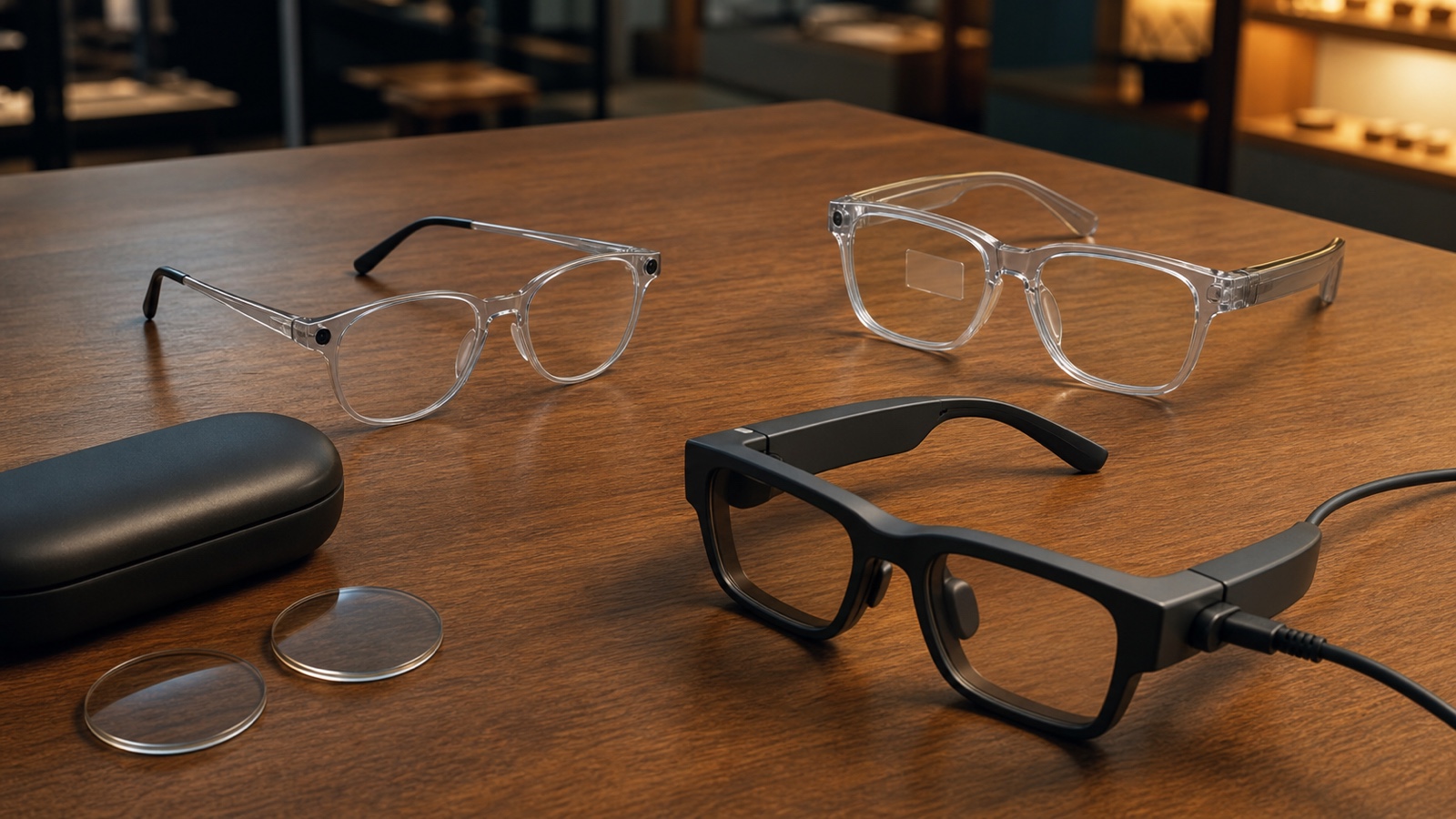
Design-class buying guide
“AI glasses” describes several incompatible product classes. Decide whether you need a display, camera and audio capture, or an assistant workflow before comparing frames.
Choose the design class first
Display glasses
These act primarily as a wearable screen for a phone, computer, or companion device. Verify video output, supported host, display mode, prescription insert, app or SDK, and whether any cameras are for sensing rather than photography.
Display glasses solve a different job from camera-and-assistant eyewear. For a current gaming-first example with a 1080p-per-eye display, 120Hz support and built-in focus correction, see Kingy’s hands-on VITURE Pro 2 review.
Camera and audio glasses
These prioritize capture, calls, open-ear audio, and voice interaction. Verify the phone app, account, internet path, capture indicator, media transfer, storage, permissions, and service availability.
Assistant-first display glasses
These show short text such as prompts, notes, directions, captions, or translations. Verify phone dependency, microphone source, cloud path, supported scripts, display limits, and subscription terms.
Development platforms
These expose sensors or spatial-computing SDKs. Confirm exact hardware revision, supported host devices, SDK version, engine and operating-system support, sensor access policy, licensing, and deployment rights.
Documented examples by class
These examples demonstrate different architectures; they are not directly comparable winners. “Purchase path present” refers to the July 18 documentation review, not current stock. Even Realities now states that G1 is no longer available for purchase; this availability check was made October 11, 2026 UTC. Existing G1 devices remain supported under the maker’s stated warranty, customer-support and security-update policies.
| Exact product or platform | Verified class and dependency | Prescription, capture, and status checks |
|---|---|---|
| XREAL Air 2 Ultra developer platform | Display and spatial-computing glasses. XREAL documents USB-C DisplayPort video for general use, specific supported Samsung hosts for spatial computing, and an SDK for the Air and One series. The product page says its environment sensors do not support photo or video capture. | Uses a removable prescription insert. Official developer documentation and a purchase route are present; verify host compatibility, current SDK support, country, and inventory before ordering. |
| Even Realities G1 platform | Assistant-first display glasses controlled through the Even app. The July 18 source review recorded teleprompting, navigation, notes, transcription, AI voice input, and real-time translation. The retained October 8 FAQ still documents teleprompting, navigation, voice input, notifications and reminders, and translation; it does not independently recertify every original term. | The July 18 purchase guidance described non-prescription and single-vision options and restricted returns for customized prescription products. As of October 11, 2026 UTC, the official G1 A product page says G1 is no longer available for purchase and shows Sold out. Check support and replacement options for an existing G1; do not plan a new G1 order from the historical purchase guidance. |
| Ray-Ban Meta smart-glasses platform | Camera and open-ear audio glasses. The July 18 author source review recorded a compatible smartphone, Meta AI app, Meta account, and wireless internet as requirements. Meta’s retained October 8 system card independently supports the image-and-speech AI path, but the direct Ray-Ban FAQ was inaccessible on October 10. | The July 18 author source review recorded prescription compatibility. Meta’s retained system card states that a capture LED indicates camera use. Treat phone, country, language, service terms, and feature availability as unverified until the current Ray-Ban documentation is accessible. |
Map the complete service chain
Record what the glasses can do when the phone is absent, the app is signed out, the network is unavailable, or the vendor service is not offered in the selected language. Separate Bluetooth audio, local display, local sensor processing, phone processing, and remote AI. A model running locally for one function does not prove that every assistant or translation request stays on the frame.
Availability gate: announced, scheduled, waitlisted, developer-only, password-gated, or country-restricted features remain unavailable for buying-guide purposes until an official support page documents access for the intended customer and configuration.
Treat capture and bystander context as product requirements
Verify the camera and microphone controls, recording indicator behavior, storage location, automatic uploads, cloud gallery, retention, deletion, export, account recovery, and factory reset. A visible indicator does not settle whether recording is appropriate in a workplace, school, venue, healthcare setting, or private conversation.
Ask the vendor what is stored on the glasses, phone, and cloud; whether voice activity or media appears in an account history; how a lost frame is unpaired; and what happens to unsynced media during reset or transfer. Apply the rules and consent requirements of the actual jurisdiction and context.
Prescription, fit, and service are gates—not footnotes
Record the prescription range, lens type, pupil-distance process, insert versus integrated lens, certified fitting route, warranty effect of third-party lenses, return limits for customized products, frame dimensions, replaceable parts, repair location, and software-support path. Do not infer comfort or visual safety from weight or marketing language.
Use a real fitting and the vendor’s health-and-safety instructions. Test the exact prescription configuration for display position, legibility, reflections, controls, hearing interaction, and the longest representative session during the return period.
Acceptance gates
Identity and availability
The delivered generation, frame, lenses, accessories, country, app, firmware, account, plan, and warranty match the approved order, and every required feature is shipping rather than announced.
Functional path
Display, capture, audio, assistant, translation, navigation, and notification workflows pass with the intended phone, language, network, and permissions.
Privacy and transfer
Indicators, media import, cloud sync, retention, deletion, export, guest or bystander procedure, loss response, unpairing, and reset are understood and tested.
Fit and sustained use
The prescribed user completes representative sessions without relying on an unverified comfort, field-of-view, battery, or safety claim.
Official documentation
- XREAL: Air 2 Ultra specifications, compatibility, capture limits, and SDK support
- Even Realities: G1 features, firmware, and translation support
- Even Realities: historical G1 ordering and prescription guidance (the authored URL returned 404 on October 8, 2026)
- Even Realities: current G1 A product page and availability statement, checked October 11, 2026 UTC
- Ray-Ban: July 18 authored source for phone, app, account, internet, and prescription requirements; the direct page was inaccessible on October 10, 2026
- Meta: multimodal AI processing, controls, capture indicator, and data guidance