
The Cryptography Incident Review Group (CIRG) has a public website, a roster of 21 cryptographers and a placeholder for its first statement. As of November 29, 2026, the group gives no publication date, names no affected system and says nothing about RSA-2048. Kingy found no public proof or independently verified demonstration that a frontier AI lab has cracked normally generated 2,048-bit RSA keys. CIRG homepage · CIRG statement page
What the Cryptography Incident Review Group has said
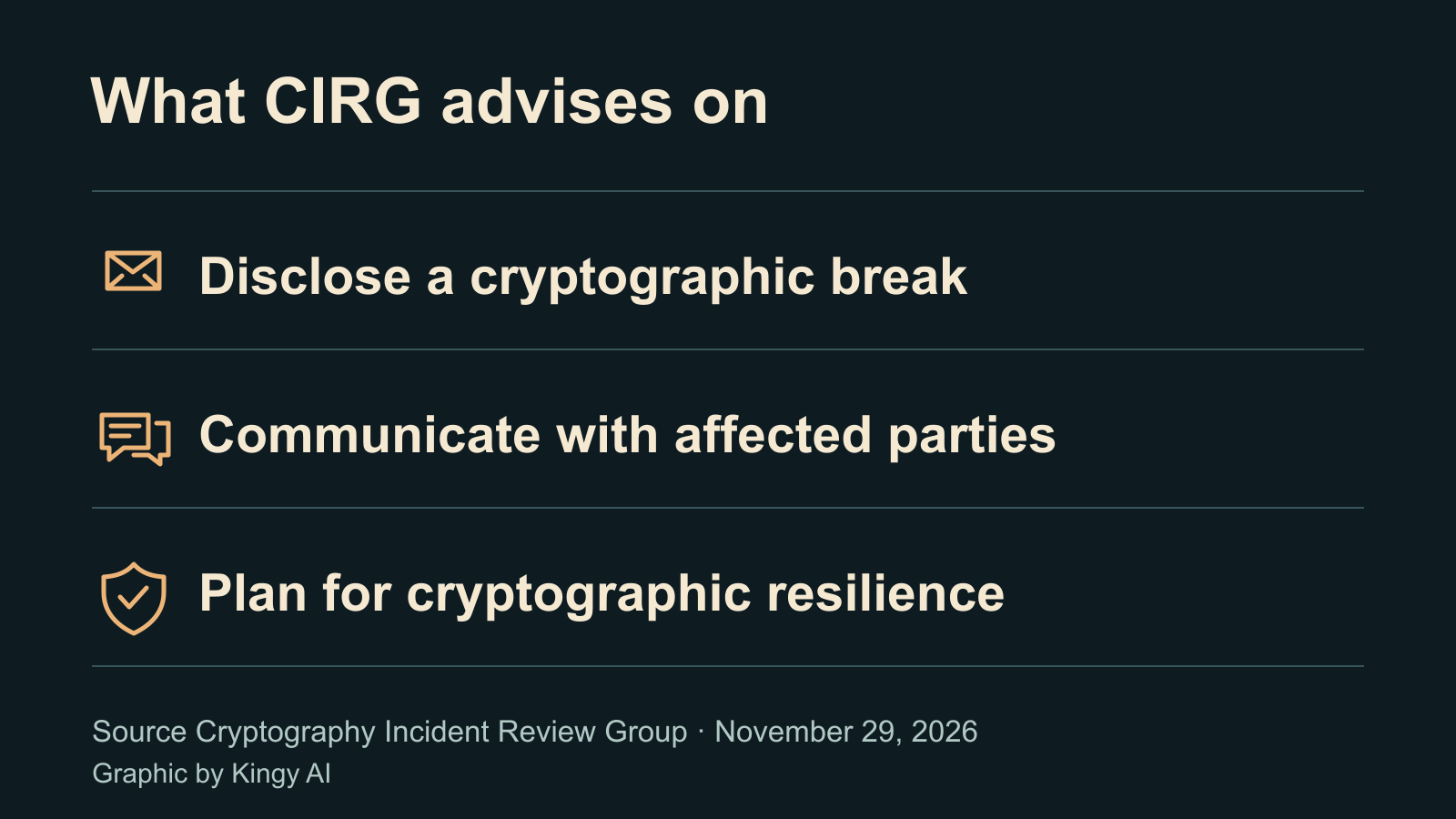
CIRG says it reviews advances in cryptanalysis, the study of how cryptographic protections can fail. The group advises on how to disclose a break, how to “communicate with those affected,” and how to plan for cryptographic resilience. Its homepage invites contributions and labels the first item under Statements “Forthcoming statement.” The linked page says, “This statement has not been published yet.” CIRG’s remit and roster · First statement
The roster includes Dan Boneh of Stanford, Matthew Green of Johns Hopkins, Nadia Heninger of UC San Diego and Inria Saclay, Yael Tauman Kalai of MIT, and Vadim Lyubashevsky of IBM Research. CIRG says members serve in a personal capacity and lists their affiliations for identification. Its homepage gives no institutional sponsor or indication of whether it is advising on a particular disclosure. CIRG’s member list
View the 21 members
- Divesh Aggarwal
- Dan Boneh
- Alessandro Chiesa
- Giacomo Fenzi
- Matthew Green
- Nadia Heninger
- Aayush Jain
- Yael Tauman Kalai
- Huijia (Rachel) Lin
- Vadim Lyubashevsky
- Alexander May
- Daniele Micciancio
- Phong Nguyen
- Chris Peikert
- Jonathan Rouach
- Noah Stephens-Davidowitz
- Stefano Tessaro
- Justin Thaler
- Eran Tromer
- Vinod Vaikuntanathan
- Ryan Williams
How the RSA-2048 rumor spread
November 24. Computer scientist Scott Aaronson wrote in a blog comment that he had heard rumors about AI labs and “Factoring in P,” meaning a classical factoring algorithm whose runtime grows polynomially with the number of input bits. He struck through those remarks and added that the result he felt virtually certain about fell “well short of Factoring in P.” The correction is visible below the original comment. Aaronson’s comment and correction
November 27. Writing as himself in a satirical dialogue, Aaronson said he had specific information about a forthcoming advance in theoretical cryptanalysis and said that result would pose no imminent danger to deployed cryptosystems. He gave no algorithm, key size, lab name or publication date for the result. He also described hearing other rumors for which he had no specific, actionable information. Aaronson’s November 27 post
November 29. Steve Weis, who identifies himself as an engineer on Anthropic’s Secure Frameworks team, shared CIRG’s name and a link on X. Kingy checked a reproduced copy of the post because X blocked direct access. CIRG’s roster omits Weis. One same-day post used the appearance of CIRG’s website to suggest that a frontier lab might have cracked RSA-2048. The post, as reported, supplied no named lab, paper or factored 2,048-bit number. Weis’s bio · Reproduced Weis post · Report on the RSA-2048 claim
The public sources leave two questions open. CIRG has yet to identify the subject of its statement, and Aaronson has yet to identify the theoretical result he described. Kingy checked CIRG’s pages and searched the public research sites of OpenAI and Anthropic for an announcement matching the RSA-2048 claim. We found none in the sources we checked. CIRG statement page · OpenAI Research · Anthropic Research
What the public cryptography research shows
| Public record | What it establishes |
|---|---|
| CIRG’s forthcoming statement | The group has set out its advisory remit. The placeholder gives no technical finding or release date. Statement page |
| Weis’s September RSA-896 run | Weis reports factoring an 896-bit challenge number with Claude’s help using an established factoring algorithm. He says the run did not materially improve the algorithm or affect deployed RSA-2048 keys. Weis’s RSA-896 account |
| Google’s Cogentic factoring preprint | It claims a theoretical subexponential runtime guarantee. The result’s stated scope is a proof about scaling, and its public summary gives no successful RSA-2048 run. Preprint summary and materials |
| Anthropic’s published cryptanalysis | Anthropic reported improvements against certain research targets and errors in cryptographic software implementations. Those findings apply to the particular algorithms, variants and software examined. Anthropic’s July report |
The numbers in Weis’s write-up can be easy to conflate. The 896 in RSA-896 is the challenge number’s bit length. 2,048 is also the peak number of GPUs Weis says were available for that run. The challenge was 896 bits throughout. A result at that size does not measure the cost at 2,048 bits. Weis’s reported run · Kingy’s factoring explainer
What would establish a practical RSA-2048 break?
RSA-2048 uses a 2,048-bit public modulus. In ordinary two-prime RSA, that modulus is the product of two large primes. Finding both primes would let someone recover the corresponding private key. A claim about RSA-2048 therefore needs to explain how the target keys were generated and what the result can do with keys of that size. NIST’s RSA key-establishment specification
- Which keys? A result on a deliberately weak test key or one faulty key generator can reveal a real problem for that implementation. To support a broad claim about RSA-2048, the evidence must cover representative, normally generated 2,048-bit keys.
- How practical? Look for observed time, hardware and memory at the claimed size. A new bound can matter mathematically while the work required for a single key stays beyond practical reach. A quantum resource estimate describes a machine and a computation under stated assumptions. A measured run describes a computation that took place.
- Who verified it? For a public challenge, independent reviewers can check that the reported factors multiply back to the original number. Checking one answer establishes that instance. Evidence across independently generated keys and a credible account of the resources would support claims about how broadly the result applies.
A technical review could establish more than a short public notice discloses. If a result goes through coordinated disclosure, look for a precise statement of affected uses, independent assessment and a timetable for sharing more evidence. The first group statement may offer only part of that record. CIRG’s disclosure remit
What a confirmed RSA-2048 break could affect
Signatures. Recovering an RSA signing key could allow forged signatures under that key. The consequences would depend on what relies on it, such as a software update system or a certificate used to authenticate a server. NIST Digital Signature Standard · IETF TLS 1.3 specification
Encrypted traffic. In older deployments that used static RSA key transport, recovery of the relevant private key could expose session keys from previously captured handshakes. TLS 1.3 removed static RSA key transport. A TLS 1.3 connection that used forward-secret key exchange and an RSA authentication signature keeps its past session secrets protected against later compromise of that signing key alone. The stolen key could still put future authentication at risk wherever it remains trusted. IETF TLS 1.3 specification
Questions readers are asking
Does an RSA-2048 break automatically affect Bitcoin?
Bitcoin’s transaction signatures use secp256k1 elliptic-curve cryptography, with ECDSA and, for Taproot, Schnorr signatures. An RSA factoring result alone would not establish a break of those signatures. A claim about Bitcoin would need evidence involving the cryptography it actually uses. Bitcoin Improvement Proposal 340
Should organizations replace RSA keys because of the rumor?
The sources Kingy checked establish no incident that warrants an emergency RSA-2048 key rotation. Security teams can use their existing migration plans to inventory where RSA is used, distinguish authentication from key transport, and check vendor support for post-quantum alternatives. NIST’s October 2026 transition report and the UK NCSC’s guidance spell out migration priorities for their respective audiences. NIST post-quantum transition report · UK NCSC migration guidance
Update log
ShowHide
- November 29, 2026. First edition. Kingy verified the public CIRG roster and statement placeholder, traced the RSA-2048 rumor and checked the relevant public research.
Sources and further reading
- CIRG’s official remit and member list and the group’s first statement page.
- Aaronson’s November 24 comment and later correction and his November 27 follow-up.
- Kingy’s guide to the polynomial-time factoring rumor and Kingy’s mathematics and science breakthrough tracker.
Trending on Kingy
Keep reading with the stories getting the most attention now.