Four markets, one shipment pause
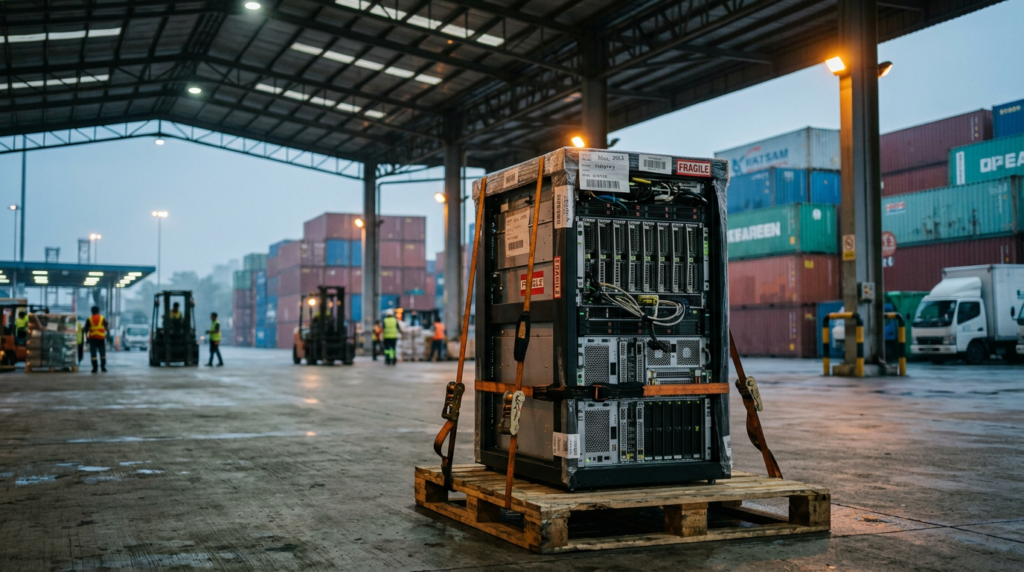
Nvidia has told manufacturing partners to pause shipments of servers containing its chips to Malaysia, Singapore, Thailand and Indonesia, according to reporting by the Financial Times and The Wall Street Journal.
The Financial Times said Dell and Supermicro were among the suppliers that informed buyers their orders could not ship, and Nvidia declined to comment to the newspaper.
The reports gave no date for deliveries to resume.
A pause at that point in the supply chain can leave a buyer with a signed order and a prepared data hall, but no reliable date for installing the machines.
That uncertainty is the immediate story for Southeast Asia’s AI industry, where a delivery date can determine when a customer starts training a model or when a cloud provider starts billing.
How the pause became public
Nikkei Asia reported as early as November 21 that at least two Nvidia server partners had suspended shipments to Southeast Asian customers as the industry reviewed orders under the new rules.
State of the Nation later relayed an account that cited Nikkei and described suppliers responding differently, with some holding deliveries while another continued shipping.
The Financial Times subsequently identified four affected markets and named Dell and Supermicro, while The Wall Street Journal separately reported Nvidia’s instructions, citing a person familiar with the pause.
Semafor’s briefing put the frozen orders in the context of the region’s rapid data center buildout.
The sequence shows how scattered reports of supplier holds developed into a clearer account of the countries and companies involved, although the start date for Nvidia’s instruction remains unclear.
What Washington actually changed
The US Bureau of Industry and Security’s interim final rule took effect on November 19.
The agency is accepting public comments on the rule through January 19, 2027.
One provision requires licenses for covered advanced semiconductors and related items destined for Indonesia, Malaysia, Singapore, Thailand or Brazil, subject to the rule’s conditions.
Brazil appears in the regulation, while the reported Nvidia shipment pause discussed here names four Southeast Asian countries.
The destination-based requirement includes an exception for qualifying US-headquartered companies or companies whose ultimate parent is headquartered in the United States, provided the reporting conditions are met.
That exception has its own conditions, and the rule contains separate controls tied to how the computing power is used, so a project’s eligibility depends on more than the country printed on its delivery label.
The other question is who uses the chips
The second provision covers certain shipments and transfers involving data centers that provide significant computing power to companies headquartered in specified jurisdictions, including China, or whose ultimate parent is headquartered there.
It can apply to direct or indirect customer access, which matters when a cloud provider sells capacity through another company.
The Bureau of Industry and Security says the measures are intended to limit access to advanced US computing power on national security grounds.
The rules also include a carve-out for commercial recommender systems, the tools that help decide which products or posts a user might see.
For operators and suppliers, customer ownership and intended use can now be as consequential to a deal as the location of the server racks.
Why renting GPUs became so important
A company can rent time on a graphics processing unit, or GPU, through the cloud and use it to train an AI model while the hardware sits in another country.
The customer buys access to the processing power over the network, and the cloud provider handles the machines, electricity and cooling.
That arrangement helped make Southeast Asia an attractive place to build data centers serving Chinese technology companies, as the Financial Times reported.
For Washington, it created a problem that a restriction on physical shipments to China could only partly address.
The new rule brings certain remote computing arrangements into the licensing system, so the distance between a customer’s office and the machines doing its work offers less insight into whether the deal can proceed.
What the 90-day period covers
The rule gives data centers already providing covered computing services before it took effect 90 days to obtain a license if they want to continue providing those services under the new framework.
That provision concerns qualifying existing arrangements and addresses the operators that were already serving customers when the rules changed.
The reported shipment pause is a separate commercial decision, and the public reports supplied no timetable for it.
Operators face two different planning problems as a result.
A provider may have to assess whether a current customer can keep using an installed cluster while its procurement team waits for an answer on the next batch of equipment.
In practice, those decisions can affect different projects, contracts and revenue dates within the same company.
Where Dell and Supermicro fit
Nvidia supplies the chips and computing platforms, while companies such as Dell and Supermicro build them into servers that customers can put to work.
A GPU server brings several components together, including processors, memory, networking and cooling, and large AI clusters depend on many such servers working as a system.
A missing shipment can therefore affect more than the number of machines on the floor.
A buyer expecting a cluster of a particular size may have to reschedule setup and testing or postpone a training run that needs the whole cluster.
The Financial Times identified the two manufacturers in its reporting, but the public record it described gave buyers little visibility into which configurations would clear review first.
When a server delay becomes a financing problem

A finished data hall can be ready for tenants and still generate little revenue if the servers it was built to house are stuck in the supply chain.
The longer that lasts, the wider the gap can grow between when a project starts paying its bills and when its customers start paying for compute.
Fitch Ratings warned that tighter chip restrictions could make lenders more selective, particularly when projects have uncertain hardware supplies or depend on customers whose eligibility is unclear.
A delay can also affect how much cash an operator needs while it waits to bring capacity online.
For facilities still under construction, the same uncertainty can change which phase of the project makes sense to fund first.
For a lender deciding whether to release the next round of funding, the practical question is when the equipment can arrive and start earning money.
ByteDance and the Aolani financing case
The Financial Times reported that Singapore-based cloud provider Aolani planned to supply computing power to ByteDance, the Chinese company behind TikTok.
According to the newspaper, some lenders that had agreed to finance the project stopped extending roughly $500 million in credit, and ByteDance could walk away from the arrangement.
The report described financing that had been held back and a customer deal whose future was uncertain.
It shows how problems can surface before the first planned training run.
If lenders reconsider a project, the cloud operator may have to review its equipment orders, and the customer may have to rethink the capacity it expected to use.
When one large tenant anchors a project, uncertainty about that tenant can spread through the budget quickly.
Why projects in the same market can diverge
The four destinations share a place on the reported shipment list, but their projects serve different customers and depend on different hardware deals.
Fitch pointed to Johor, Malaysia, as an example of how facilities in the same location can have different exposures, because some serve major US technology companies while others have closer links to Chinese customers.
A provider with several customers and confirmed access to hardware can have more room to adjust when one contract slips.
A facility designed around a single large computing tenant has fewer options, particularly if changing customers means finding someone who needs the same capacity on similar terms.
Looking at local construction activity alone can therefore miss the differences that determine which sites open on schedule.
The Singapore revenue figure needs context
Semafor highlighted the scale of Nvidia’s Singapore business, citing the Financial Times finding that Nvidia’s Singapore subsidiary booked $104 billion in revenue in 2025.
The Financial Times also reported that Nvidia records some revenue from Taiwan and China through the same unit.
A subsidiary’s accounts tell readers where a sale was recorded, while hardware shipments and installation records answer where the equipment went.
That distinction matters when estimating the company’s exposure because a revenue figure can appear to describe the market for machines physically installed in one country when the accounting covers a broader customer base.
Estimating Nvidia’s sales at risk would require more detail on the actual orders affected, their destinations and how many ultimately go through.
Why specialized GPU clouds face pressure
A neocloud is a cloud provider that specializes in renting computing power, often for AI workloads.
Its business depends on keeping costly hardware busy, which can mean lining up customers well before a new cluster is ready.
Fitch said providers exposed to affected Chinese customers may have to find other tenants, rely longer on existing equipment or offer less advanced computing where permitted.
Any of those changes can affect how much a provider earns from a cluster and when it earns it.
A buyer that only needs an occasional batch of GPUs may be happy to rent some unused capacity, but replacing a customer that expected to reserve most of a cluster for months takes a much larger contract.
How Chinese AI labs could feel it
Reuters reported that people familiar with Z.AI and Moonshot AI saw risks to upcoming model schedules from tighter restrictions on computing access, alongside other factors affecting development.
A person familiar with Moonshot’s operations said the interval between its major releases could stretch from roughly six months to a year or longer if the company lost overseas compute access entirely.
That estimate depends on how much capacity the company actually loses and how much it can replace.
Training a large model also requires a cluster that can run jobs reliably for long periods, so switching providers or equipment can add engineering work.
A licensing decision made far from a research lab could ultimately affect when users get to try its next flagship model.
Which signs will show whether supply is recovering
The Wall Street Journal reported that a person familiar with the pause said there was a process for eventually releasing shipments, while the reporting left open how long that would take.
An updated delivery date from a supplier would give a buyer more to work with than a general statement about progress.
Details about which orders can clear and how suppliers handle new orders would help operators judge whether they are working through a backlog or planning around a longer disruption.
Analysts will also be watching projects near completion, where changes in chip deliveries can shift the timing of customer service and revenue.
One delivery would show that an order cleared review, with broader recovery requiring evidence across more buyers and markets.
The next test comes at the loading dock

The export rule is in force, and multiple outlets have reported the pause, but the record still leaves the number of affected orders and the schedule for resuming deliveries open.
For a data center developer, those details determine whether the project can keep its opening date or has to work out a new one with customers and lenders.
Nvidia, the practical question is how quickly its manufacturing partners can give buyers reliable answers about the servers they ordered.
For AI teams further down the chain, the news becomes tangible when their cloud provider can set a date for turning on the promised capacity.
A revised delivery notice may lack the drama of a chip launch, but for the people waiting to put those servers to work, it will be the headline.
Sources
- Bureau of Industry and Security, via the Federal Register — Export licensing and remote access to advanced computing
- Financial Times — Nvidia’s instructions to server manufacturers and the Aolani financing case
- The Wall Street Journal — Separate reporting on the four-country shipment pause
- Semafor — Frozen orders and Southeast Asia’s AI infrastructure buildout
- Nikkei Asia — Early shipment suspensions among Nvidia server suppliers
- State of the Nation — Secondary account of supplier responses drawn from Nikkei Asia
- Reuters — Coverage of the Financial Times shipment report
- Reuters — Fitch’s outlook for Asian data center investment
- Reuters — Potential effects on Chinese AI model development
- The Edge Malaysia — Fitch’s assessment of data center projects in Johor