
November 26 update. An external audit reconstructed Qwen3.5-27B’s strongest reported weight edit. Applying that change to other Qwen checkpoints produced mixed results, and a small repair test found that a script could match the model-written fix. Fan’s 490-problem math gain and six-benchmark vision result still await a matched outside rerun. Read the outside findings and their limits.
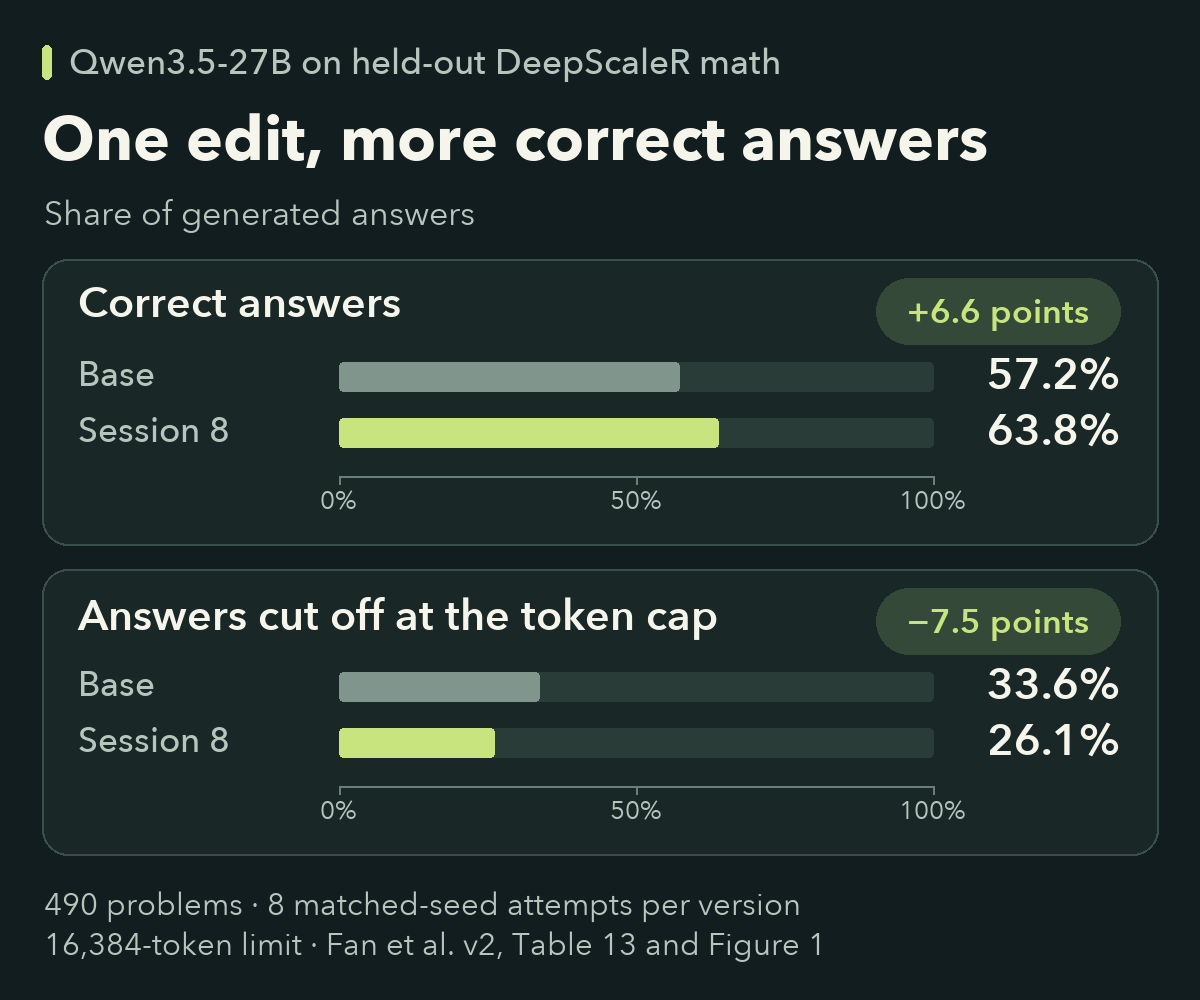
An open-weight model gave itself a patch that made it more likely to finish a math problem. In Language Models Can Rewrite Their Own Weights, Jiajun Fan and ten co-authors report that Qwen3.5-27B wrote a small edit to its own parameters and raised its accuracy from 57.2% to 63.8% across 490 held-out problems, with eight attempts per problem. Answers that hit the 16,384-token limit fell from 33.6% to 26.1%. The edit changed the model’s checkpoint, the saved numbers that determine how it responds. A fresh session loaded from that checkpoint would inherit the change. The paper was submitted to arXiv on November 16 and revised on November 18. Version history · Fan et al., v2 and Figure 1
The team also gave an intact Qwen3.5-27B a damaged copy of the same checkpoint to diagnose. The editor found an extreme outlier in the right matrix and wrote a repair. Across six sets of visual tasks, the damaged copy went from 7.3% to 70.2% after that repair, against 84.3% for intact Qwen. The failures, diagnosis and practice tests used to find the repair came from text math problems. Repair method and visual evaluation
In the math experiment, the editing model and the model under test began with the same weights. The editor stayed fixed during each session, and all eight sessions restarted from the original checkpoint. The upward run of scores came from replacing earlier patches with better candidates. In the repair experiment, a clean instance did the reasoning on behalf of the damaged one. Methods §2 and Appendix E.9
What the model was allowed to touch
Weights are the numbers a model learns during training. They define the operations that turn a prompt into a sequence of new tokens. Most inference applications load those numbers and leave them in place. A prompt tells the model how to approach the next answer, and external memory can bring old information back into context. A weight edit changes the computation that future prompts go through, even in an empty chat. It still takes a serving system that loads the edited checkpoint. Fan et al., §2
The researchers started each session with a report card from a set of practice math problems. The model could inspect its graded answers, read or replace selected weight tensors in a persistent Python session, sample a fresh batch of answers, and ask to see its hidden states. A hidden state is a vector of numbers passed through the network as it processes a token. Looking at it lets the editor ask whether answers that stall leave a different numerical trace from ones that finish. The harness also supplied a helper that could dampen the contribution of a chosen direction in a weight matrix. Methods §2.2 and the task prompt in Appendix D.4
Python ran on a CPU with gradient computation disabled. The experiment blocked optimizers and edits to the input embeddings, final normalization and output layer. It also blocked multiplying an entire tensor by a constant. The model could use up to 200 code runs and 20 calls to the testing or inspection tools. A call could batch many generations or hidden-state reads, so that limit allowed far more than 20 answers. When testing both versions, the harness switched the weights used for those tests and restored the editor’s original weights for its next reply. The editor could see what it had changed without making its own next decision from a potentially broken checkpoint. Methods §2.2–2.3 and Table 5
The researchers supplied the questions, the success criterion, the grader, the tool boundaries and the budget. Qwen chose what to inspect, wrote the patch and judged the feedback. The numerical changes came from the operations the model programmed. Methods §2 and Appendix D
The edit made old information decay faster
Qwen3.5-27B has 64 layers. Forty-eight use a form of linear attention called Gated DeltaNet. Those layers carry a running state forward as the model reads or writes a sequence, and a learned gate controls how much of the previous state they retain. The remaining 16 layers use full attention. The winning patch added 0.5 to a learned time-step bias in each of the 48 linear-attention layers. At the same incoming activation, a larger bias increases the decay on the older state. Qwen’s diagnosis was that faster decay would make it easier to break out of repeated lines of reasoning. The experiment measured the downstream change in answers, while that particular explanation of the loops remains a mechanism to test. Fan et al., Appendix E.9 · Qwen model card · Transformers implementation
One problem asks for the twentieth number in a modified base-four counting sequence. The unedited model repeated a sentence 549 times and ran out of room to answer. The patched checkpoint answered the same question correctly in 5,341 tokens in the authors’ paired example. Repeated runs with the same seed can still diverge in this engine, and the authors chose the example from cases where the patch helped. Figure 1(c) and Appendix D.3 · Project examples
The paper reports two other successful edits. In the first protocol, Qwen measured a direction in its own hidden states and reduced what two output matrices in layer 8 wrote along it by 5%. That edit raised accuracy from 57.2% to 58.3% on the larger held-out test, with a one-sided p-value of 0.038. In session 2 of the verification protocol, Qwen used the contrast between finished and unfinished replies to alter two output matrices in layer 63. It subtracted five times their projection in the measured direction. In the idealized matrix calculation, that flips the sign and quadruples the magnitude of that component, while leaving other orthogonal components unchanged. That edit reached 61.3%. Table 1, Table 8 and Appendix E.9
What 6.6 percentage points means
The main DeepScaleR test contained 490 math problems. Each version of the checkpoint answered each question eight times, with the same eight seeds for each pair and a budget of 16,384 new tokens per response. Math-Verify compared the final boxed answer after the thinking segment with the reference. Reasoning still open at the token limit got no credit. Each checkpoint therefore generated 3,920 attempts, and the statistical test paired results by problem to account for the correlation across eight attempts at the same question. The authors say they fixed the evaluation plan before running the main test. Table 5 and Appendix D.3
| Checkpoint | Correct | Gain vs. base | Reported 95% interval for gain | One-sided p-value |
|---|---|---|---|---|
| Original Qwen3.5-27B | 57.2% | — | — | — |
| Verification session 1 | 57.8% | +0.5 points | −0.9 to +1.9 points | 0.25 |
| Verification session 2 | 61.3% | +4.0 points | +2.3 to +5.7 points | <0.00001 |
| Verification session 8 | 63.8% | +6.6 points | +5.0 to +8.1 points | <0.00001 |
The paper computes the gains from unrounded values, which explains the tenth-of-a-point differences you can get by subtracting the displayed accuracies. For session 8, the edited model alone got 439 paired attempts right, and the original alone got 182 right. The balance is 257 extra correct answers across 3,920 attempts, or 6.56 percentage points. A patch that helps overall can still turn a correct answer into a wrong one. The interval and p-value compare this edit to the original on these problems. They leave the success rate of future editing sessions open. Figure 1 and Table 13
Dividing reported accuracy by the share of replies below the token cutoff gives roughly 86% correct below the cutoff in both conditions, assuming all correct responses are among replies below the cutoff. The published rates leave the exact overlap unknown, and the two models finish different sets of replies. The estimate is consistent with more attempts reaching an answer. A replication could test both models with several token caps and compare accuracy at matched token expenditure. Figure 1, Table 5 and Appendix E.9
The held-out split also had a small overlap with practice material. The team removed ten literal repeats from the 500 candidate test questions and later identified eight paraphrases among the remaining 490. The two larger gains stayed statistically significant after removing those eight, according to the appendix. Held out here describes the editing experiment. How much of the underlying problem material appeared in the model’s original training remains unknown. Appendix D.3 and E.9
Eight sessions, three submitted patches
The authors ran eight sessions under their finalized verification protocol. Each had up to three hours for editing and started from the same unedited checkpoint with a different seed for the editor’s replies. After a session landed on a candidate, the harness ran it once against the original on 256 reserved practice problems with two attempts each at 4,096 tokens. The editor could see the result and decide whether to submit. Three sessions ended with no edit worth taking to that check. Two withdrew their edits after it. The three submissions went through a further 200-problem screen with two sets of seeds, and all three advanced to the 490-problem evaluation. Two earlier sessions under a variant of the protocol also ended without a submission. Appendix E.9 and Table 13
Figure 1 tracks the checkpoint the researchers selected after each session. Its score rises from 57.2% to 57.8%, then 61.3%, then 63.8%. Each accepted patch replaced the prior one. The reserved check compared every candidate to the original checkpoint. One of the submitted edits cleared that check but had a weak result on the larger held-out set. Those details put a limit on what the graph predicts about a ninth session or a process that asks already-edited models for another upgrade. Figure 1 and Appendix E.9
How the damaged copy recovered
The authors built a deliberately easy-to-state fault. They overwrote eight adjacent rows of the output matrix in layer 30’s feed-forward block with Gaussian noise. The noise had a standard deviation 200 times that of the matrix. In calibration, they tried multiples of 20, 60 and 200, and only the highest produced the near-collapse they wanted to study. In the held-out text test, the corrupted model went from 58.5% correct to zero. The researchers told a clean instance of Qwen that a copy had been corrupted and gave it diagnostic access to that copy. Every hidden-state read and trial generation in the repair task came from the damaged checkpoint. §2.4, Table 6 and Appendix E.3
The editor examined 112 output matrices. The biggest absolute value in the layer 30 matrix was roughly 1,397 times that matrix’s median magnitude. The largest such ratio anywhere else it looked was about 162. The model used a clipping rule to limit extreme values to 15 times the median magnitude. Its submitted patch changed the damaged matrix and 19 other output matrices. The replacement values came from calculations on the damaged copy. The first implementation allowed file access. The authors audited 573 code calls from that protocol and report that none read the clean weights, the damage files or the held-out set. The later verification protocol restricted the Python session to its working folder and tool interface. Table 1 and Appendices E.3 and E.9
The repair brought down the size of the bad values while leaving the rows numerically distant from their originals. The authors report that the norm, a measure of the combined magnitude of the damaged rows, dropped from 825 to 39.7 after clipping. The intact rows had a norm of 3.85. The repaired and intact rows had a cosine similarity of 0.002, so their values pointed in almost unrelated directions. The experiment tests recovery of behavior from an outlier-heavy fault. Appendix E.3
On 200 held-out text problems, the full patch solved 66. The authors later isolated the part of the model’s patch that touched the identified matrix. That version solved 110, against 117 for intact Qwen. Applying just the other 19 changes solved one. That ablation, an experiment that tests parts of a change separately, sharply narrows where the text recovery came from. The authors report the matrix-only ablation on text. The visual scores below use the full model-submitted patch. Figure 26 and Appendix E.3, E.6
| Visual benchmark | Intact Qwen | Damaged copy | With model-written repair |
|---|---|---|---|
| MathVista | 86% | 3% | 67% |
| MathVerse | 76% | 0% | 55% |
| MMStar | 73% | 4% | 60% |
| HallusionBench | 89% | 14% | 69% |
| POPE | 89% | 23% | 81% |
| ScreenSpot-v2 | 93% | 0% | 89% |
| Pooled across six sets | 84.3% | 7.3% | 70.2% |
Each visual set contributed 100 items and each checkpoint made one attempt per item. The repaired model got 421 of 600 correct, compared with 44 for the damaged model and 506 for the intact one. That is about 83% of intact accuracy on this pooled sample. On ScreenSpot-v2, which tests where an agent would click in an interface image, the gap to the intact model narrowed to four correct items out of 100. The transfer from text feedback to image tasks matters because a repair to a shared part of the model can restore behavior the editor never graded. It establishes recovery from this particular injected fault. Other layers, corruption patterns, and more subtle faults remain separate tests. Visual protocol and Table 12
What happened at 2B, 4B and 9B
Fan’s team ran the task on four sizes in the Qwen3.5 family. The 2B model made no edit. The 4B model’s candidates got zero correct in its own paired practice tests, and it withdrew. The 9B model submitted an edit that took its held-out math result from 47.5% to zero, after testing on problems it already failed. In that setup the editor could see an improvement, but a test set made up of failures has no room to show a loss in accuracy. The 27B model used its own measurements more productively and was the only size that both improved and repaired a copy in Fan’s experiments. Table 2 and Appendix E.2
The size comparison is a finding about this tool interface, task and set of sessions. The four checkpoints differ in more than parameter count. The successful 27B run in the first protocol used a 4,096-token practice-answer cap. The smaller models used 16,384, and the 27B session reported at that cap withdrew. The shorter cap made it cheaper to test more candidate answers. A threshold for self-editing would require more trials at each size with matched effective budgets, and evidence from other families and editing interfaces. Appendix A and Table 4
Three newer studies put the result in context
A smaller model can edit under tighter instructions. Guoming Ling and colleagues’ November 21 Self-WSP preprint tried a different interface with Qwen3.5-0.8B. A structured tensor catalogue and constrained editing operations narrowed the search. The authors report selected continued-run best scores of 62.2% on GSM8K and 32.2% on MATH500, up from baselines of 11.8% and 7.0%. Progress after the first accepted edit was typically more modest. In one condition with a shuffled tensor catalogue, random search was competitive on GSM8K. That comparison makes the edit interface and its search space part of the scientific result. Parameter count alone is a poor description of what a model can do with a particular set of tools. Ling et al., Self-WSP, especially §5
A separate team passed edited weights forward. In a November 22 preprint, Linghua Zhang and Yunhe Li used Qwen3.8-27B to run five generations of SELFWRITE. Each accepted patch was merged into the model that wrote the next one. Four generations retained edits. The fifth kept the existing checkpoint. On a separate 500-problem DAPO-Math test, the average accuracy across four tries rose from 76.30% to 77.75%. The share of questions with at least one correct answer in four tries rose from 82.60% to 84.80%. The hidden screening set explicitly selected for gains, and the separate test was reported for the initial and final checkpoints. This is evidence for useful editing across a short checkpoint lineage. Whether each new checkpoint became a better editor remains an open question. Zhang and Li, SELFWRITE, especially §5 and Table 2
A simulated household agent kept one edit across later rounds. On November 23, Fan and overlapping co-authors reported giving Qwen3.5-27B an editing session between rounds of acting in ALFWorld, a text-based household simulator. In tests with 48 paired seeds per task, one edit improved completion from 41.6% to 45.2% and reduced the share of steps without an action from 45.9% to 39.5%. The authors report a 95% interval of +1.9 to +5.2 percentage points for the completion gain. The agent began two later editing rounds with the modified checkpoint and declined to make another change. Fan et al., Self-Upgrading Embodied Agents, §4 and Table 4
Where the new method fits
In 1947, Alan Turing told the London Mathematical Society that letting a machine alter its own instructions gave it a mechanism for learning from experience. The harder problem was what the machine would make of that mechanism. Modern precedents include the self-referential weight matrices Kazuki Irie and colleagues published in 2022, which trained an architecture to modify its own weights, and 2025’s SEAL, in which a language model generated data and instructions for fine-tuning itself. SEAL still used gradient descent to write the resulting changes into the weights. A closer precursor came this November, when Rikiya Takehi and colleagues gave GPT-6 Astra the job of writing weight edits for Qwen3.5-0.8B. Fan’s experiment moves that job to the same general-purpose checkpoint it changes. Turing archive · Irie et al., ICML 2022 · SEAL, NeurIPS 2025 · Takehi et al. · Kingy’s coverage of weight-space programming
The experiment spent compute up front. The editor generated long responses and tested candidates using GPU inference. The team reports that each session behind its largest gains ran in a few hours on one GPU. The patched checkpoint carries the same tensor shapes into serving and does the same kind of work per generated token. Total tokens and latency per answer can still change if the model takes longer or shorter to finish. The paper gives no production cost comparison. Earlier work on MeZO showed that forward passes alone can implement a fine-tuning optimizer. Fan’s contribution is to use performance feedback to choose a direct, model-authored change to specific parameters. Fan et al., §1–2 and Appendix E.9 · Malladi et al., MeZO
A practical comparison would give unedited Qwen the same compute budget and test a few simpler ways of limiting repetition. Qwen’s model card already recommends experimenting with a presence penalty and a larger output budget, including up to 81,920 new tokens for especially hard math or programming tasks. Fan’s fixed 16,384-token comparison is useful precisely because both variants work under the same ceiling. Whether the weight patch adds value after tuning the decoder, and what it gives up on longer or non-math tasks, remain measurable questions. Qwen generation guidance · Fan et al., Table 5 and Appendix E.9
What outside teams have checked
The weight edit can be reconstructed from public files. On November 26 Carlos Toledo published a checkpoint audit requested by one of the paper’s authors. Its protocol offered the authors a first look at the draft. Two separately written implementations applied the reported +0.5 change to 2,304 entries across 48 time-step bias tensors and produced identical bytes. The audit also qualified the paper’s description of the model’s precision. The pinned public checkpoint stores the intact layer-30 matrix in bfloat16, while 96 other tensors use 32-bit floats. The audit used public weights and performed no model inference. The authors’ exact checkpoint revision, runtime casting and patch files remain outside its scope. Toledo’s audit record · Audit protocol and relationship to the authors · Fan et al., Appendix D.2
The same adjustment behaved differently on other Qwen checkpoints. The ArtificialZeng project directly applied the change to Qwen3.5-4B. It reports a gain of 4.9 percentage points across two sampling seeds on 400 MATH-500 problems at a 16,384-token cap, with cut-off responses continued from shorter runs. Its 95% interval was +1.2 to +8.6 points. At a 4,096-token cap, a prompt asking the model to think efficiently scored 38.3% in one run. The two patched runs scored 25.8% and 25.5%. Michael Stufflebeam’s group tested a 4-bit Qwen3.8-27B checkpoint with speculative decoding on its own 200-problem DeepScaleR split under the 16,384-token cap. Correct answers fell from 120 to 114, an inconclusive difference in that test (p = 0.18). Answers still thinking at the limit rose from 34 to 44 (paired p = 0.013). Both groups supplied the adjustment themselves. Qwen3.5-4B test and results · Scores by token cap · Stufflebeam’s lab log
An outside test used Qwen3.5-27B as its own editor. Daniel Pardo ran Qwen3.5-27B in bfloat16 and let it write low-rank adapters. The available operations excluded the time-step bias adjustment. A submitted adapter gained 2.3 points on a reserved MATH-500 validation set, with a reported 95% interval from −5.5 to +10.2 points. A separate DeepScaleR session withdrew after an interrupted run and restart. Neither reached the original 490-problem evaluation. Pardo’s MATH-500 validation · DeepScaleR session log
A simple script matched the editor on a small repair test. A public Weight-Space Self-Evolution benchmark corrupted eight different rows in the same layer of Qwen3.5-27B with noise at 200 times the matrix’s standard deviation. On 20 arithmetic questions, the clean model got 13 right and the corrupted model got zero. Both a model-written repair and a script that zeroed rows with unusually large weights restored 13. Clipping large values in the damaged matrix restored 14. The benchmark’s script identified the matrix and gave its location to the model. Its evaluation used short, text-only answers, leaving Fan’s larger diagnosis and vision tests open. Qwen repair results · Benchmark and editor prompt
Zhuangzi Li and colleagues’ vision-model preprint makes the same comparison explicit. For analogous row-noise faults in their own models, a scripted repair recovered 94% to 100% of the score lost to corruption. Together, the two results give a concrete control for Fan’s repair experiment. Run the simple script and the model-written patch on the same damaged Qwen checkpoint and score both on the original text and image tests. Li et al. on Fan’s repair and their scripted baseline
What would settle the next claim
For the original paper, a strong replication would rebuild the starting checkpoint and session 8 patch, score every paired attempt on a fresh math set, and report both completion and correctness over several caps. The next step would be to release the original harness, paired score records, exact edit files and model hashes so others could compare the result directly. In the materials we reviewed, the base weights were public and the paper included pseudocode, selected traces and aggregate results. As of November 26, the authors’ original harness remains unavailable in the public materials we checked. DukeCaesar has released an outside implementation with a 2B smoke test. The original 27B benchmark remains open for a matched rerun. Outside implementation and test status · Preprint and appendices · Authors’ project page · Public base checkpoint
The bar for recursive improvement is higher. Start each round from the last accepted checkpoint. Compare it to that parent, to the original model, and to a control that restarts from the original while spending the same compute. Keep an evaluation set that neither picks the patches nor teaches the editor what scores well. Track regressions in unrelated tasks, the rate of bad proposals, and how often the current model can produce a useful next edit. A rising math score and a rising ability to improve the model are two quantities an experiment can measure separately.
The repair experiment provides a concrete reason to keep those checks independent. The editor located the right matrix, but its complete patch performed worse on text than the narrower change isolated afterward. A system with permission to change its own checkpoint needs a stable evaluator, a verifiable record of what changed, and a known-good checkpoint it can return to. The next result to look for is a sequence of useful edits that survives those checks as each new version takes over.
Sources and verification
The authors supplied a media kit. Kingy.ai read version 2 of the preprint, including the evaluation and repair appendices, and checked the published tables, the authors’ project material and the three subsequent preprints. We recomputed the paired-attempt gain and the pooled visual recovery from the reported counts. The performance measurements are from the researchers’ runs.
- Fan et al., Language Models Can Rewrite Their Own Weights, arXiv version history · Full v2 paper · PDF with the task prompt and detailed figures
- Authors’ project page with interactive examples and a 3-minute, 24-second film · Qwen3.5-27B model card and weights
- Self-WSP · SELFWRITE · Self-Upgrading Embodied Agents