The FCC gives Starmind a conditional green light
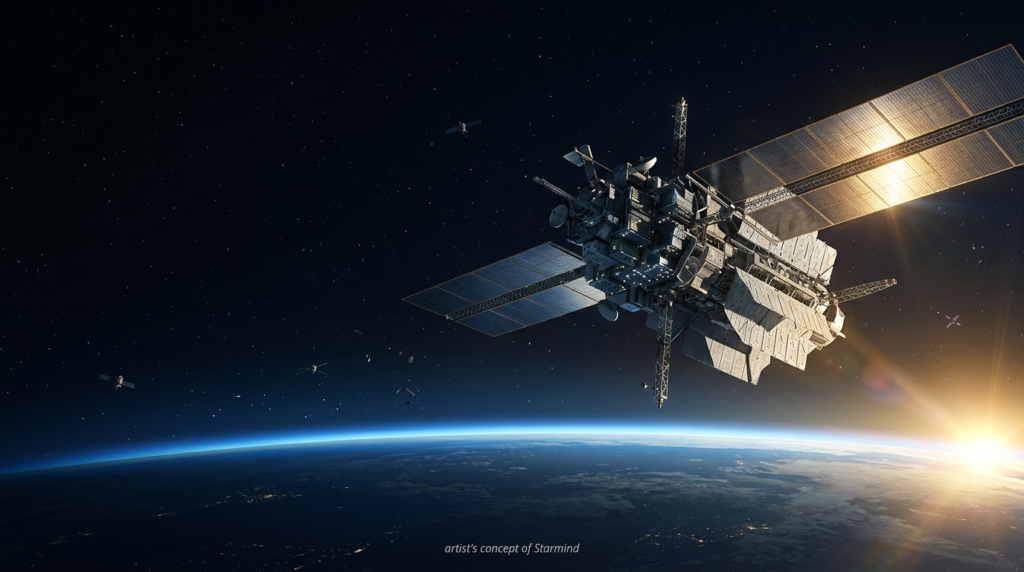
The U.S. Federal Communications Commission conditionally authorized SpaceX on November 25 to deploy Starmind, a constellation of up to one million satellites designed to run computing workloads in low Earth orbit.
The FCC called it the first U.S. authorization of its kind, giving SpaceX a regulatory path to test whether hardware in orbit can serve people and businesses on the ground.
One million is the ceiling in the authorization, and the first deadline calls for one satellite in its assigned orbit by November 2033.
That first spacecraft has a big job even before its successors arrive, because useful computing requires electricity, cooling, reliable hardware and a way to send results home.
Then comes the harder question of whether all of that works at a competitive price.
What an orbital data center would do
Picture a satellite carrying processors alongside the usual spacecraft equipment, using its onboard hardware to work through data and pass the results onward.
SpaceX proposes spreading that capability across a fleet, with the modules connected by optical links and able to communicate with other SpaceX satellites, including Starlink.
What customers could run would depend on the time it takes to move data to and from the hardware, as well as the computing capacity available on each spacecraft.
Work that can be split into independent jobs might fit a distributed fleet if each job can run locally and return a compact result.
A developer would care about how long a job takes from submission to delivery, even if the processor itself finishes its part quickly.
The dates behind the million
The FCC order gives SpaceX until November 25, 2033, to put its first authorized spacecraft into its assigned orbit and operate it under the license.
The next deadlines require 100,000 satellites by November 25, 2035, and 500,000 by November 25, 2038.
The order sets November 25, 2040, for completing the authorized constellation and says the authorization becomes void if SpaceX misses the milestones as written.
If the first satellite flies close to the initial deadline, the company would have roughly two years to reach the next milestone, which requires spacecraft to be operating in their assigned orbits.
SpaceX could start earlier, and the dates give outsiders clear points at which to compare the company’s public ambitions with the scale of what it has actually deployed.
Why sunlight is part of the pitch
SpaceX argues that access to near-continuous sunlight could make computing in orbit more energy efficient and less dependent on infrastructure on the ground.
The attraction is easy to see for anyone trying to secure enough grid capacity for a large computing facility.
How much electricity an orbital platform can supply depends on its orbit, how much sunlight its panels receive, and how much power the satellite uses to keep itself operating.
The processors share an electricity budget with equipment that keeps the spacecraft pointed correctly, talks to the network and helps move waste heat away from the chips.
The relevant figure for a customer is how much reliable computing the system delivers with the power it actually has available over time.
The vacuum makes cooling tricky
Open a window on a cool morning and fresh air carries heat out of the room, a trick that comes to an abrupt end in a vacuum.
Spacecraft can move heat from electronics toward external panels, but those panels ultimately have to emit the heat as infrared radiation.
NASA’s spacecraft engineering guidance describes how radiator area, surface properties and temperature affect the amount of heat a spacecraft can shed.
That matters because a computer designed for long, heavy workloads needs to keep removing heat for as long as those jobs run, even as its surroundings and exposure to sunlight change.
A useful test would show how many hours a prototype can sustain a representative workload before temperatures force its chips to slow down.
What orbit does to the chips
A processor has to survive the ride up before it can earn its keep, and prolonged exposure to radiation can create errors as it works.
In its separate Project Suncatcher research, Google described testing AI chips for exposure to radiation and subjecting hardware to vibration tests that mimic a rocket launch.
Those experiments illustrate the kind of evidence an orbital computing provider needs about how its own equipment behaves.
Keeping a fleet dependable would also involve spotting faulty hardware, recovering interrupted jobs and estimating how often satellites need to be replaced.
A first Starmind prototype could answer some of those questions by reporting how often jobs fail, how quickly the system recovers and what happens when the same equipment runs for months at a stretch.
How the data gets home
SpaceX plans to use optical links as the primary communications path, with satellites passing data between themselves using lasers.
The FCC also authorized limited radio communications for backup and emergencies, including links that let operators track and command spacecraft if the primary system runs into trouble.
NASA’s work on optical communications illustrates the precision laser links require and shows how clouds can interrupt optical signals between a spacecraft and Earth.
Actual performance would depend on the route a job’s data takes and the ground infrastructure the service uses to deliver it.
Even a brief interruption can matter if an application has to wait for several satellites to finish their parts before it can deliver a result.
A useful public demonstration would trace an entire job from a request on Earth through processing in orbit to a result on the ground, with timings for each stage.
Which AI jobs might make sense
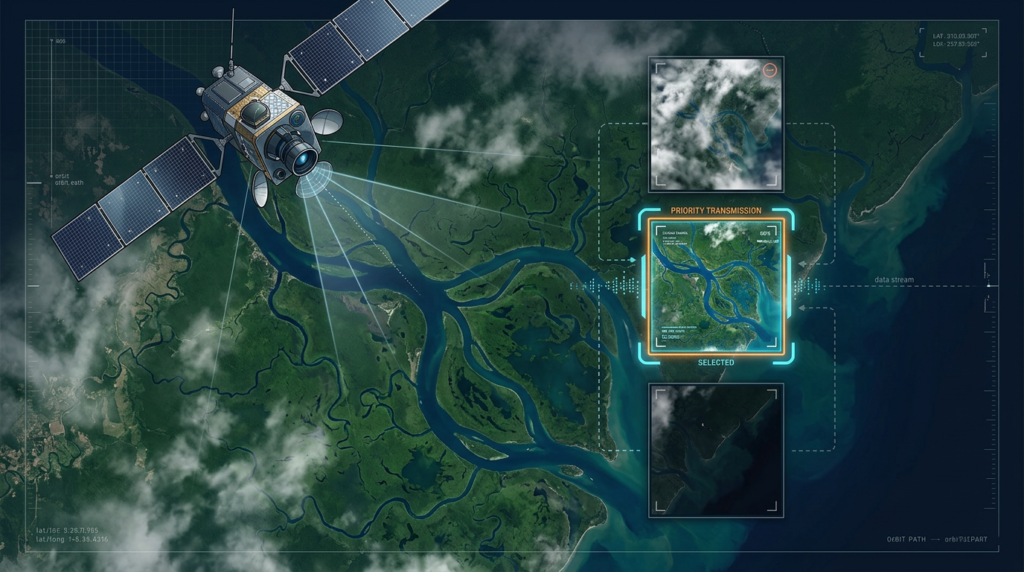
A natural candidate is work that starts in space, such as screening Earth observation imagery for scenes worth sending down.
If an onboard model can flag images that analysts asked for, operators could prioritize those files for transmission and decide what to keep for later.
A different candidate might be a batch of independent AI jobs that can wait for results and fit within the available communications capacity.
Training large models across multiple spacecraft would be a tougher demonstration if the chips need to exchange large volumes of data repeatedly while they work.
These examples describe workload characteristics that could favor or complicate orbital computing, and choosing between them would require measurements of cost, throughput and reliability on representative jobs.
The factory and the launchpad
Reuters reported that SpaceX’s plans lean heavily on lowering costs with Starship, its next-generation reusable rocket.
Launch economics matter because every additional panel, radiator and processor weighs something and has to fit within the rocket’s payload limits.
Factories would have to build and test satellites fast enough to keep up with deployment, while launch teams would have to deliver batches into orbits where they can begin working.
A design that’s quick to manufacture still has to hold up through launch and years of operation, because frequent replacements could consume the savings from building it cheaply.
A single successful mission would establish a starting point, and repeat launches would show whether the company can build and deploy hardware at the required pace.
What customers would pay for
Solar energy is one item on an orbital computing budget that would also include hardware, satellite manufacturing, launches, ground stations and fleet operations.
TechCrunch reported that financing the chips themselves is among the challenges SpaceX faces in bringing the project to market.
A customer comparing services would want a price for getting a job done, including the time and expense of moving data and rerunning work when something fails.
Usage matters too, because idle processors still occupy spacecraft that cost money to manufacture, launch and manage.
For prospective customers, a clearer signal than the size of the proposed fleet would be a price and a service commitment for a particular workload, backed by results they can reproduce with their own data.
Who watches for close approaches
The FCC’s order requires SpaceX to report every six months on matters including close approaches, resulting maneuvers or coordination, retirements, reentries and the number of spacecraft deployed.
When satellites are predicted to pass close to each other, operators can coordinate and, where appropriate, change a spacecraft’s course to reduce the chance of collision.
At fleet scale, the record of those encounters would help show how often operators have to intervene and whether the system can handle the workload as it expands.
A collision can also produce fragments that threaten spacecraft well beyond the two involved, a risk scientists raised in coverage by the Associated Press.
That gives operators of weather, communications and research satellites a direct interest in how Starmind performs.
What happens when satellites retire
The FCC found the debris mitigation plan for satellites operating below 600 kilometers compliant and required SpaceX to submit a final plan through a license modification application before deploying satellites that would operate above that altitude.
The agency deferred a separate request for flexibility to retire some higher-flying spacecraft into other orbits instead of bringing them back through the atmosphere.
SpaceX has to provide more information and seek a modification before deploying any satellite intended for disposal by a route other than atmospheric reentry.
This part of the order matters because a disposal plan has to account for equipment that may have degraded by the time the spacecraft reaches retirement.
At scale, even a small share of failed disposals could leave many spacecraft behind.
Astronomers raise a different concern
The American Astronomical Society opposed the application and warned that larger, brighter satellites could interfere with optical and infrared observations as well as change how the night sky looks.
Sunlight reflected by a satellite can leave a streak across a telescope exposure, and astronomers are concerned about the cumulative effect of adding many more objects.
The society acknowledged that SpaceX’s earlier design changes reduced the impact of Starlink satellites and said Starmind would raise a different challenge because of its proposed scale.
The FCC concluded that the potential effects on optical astronomy were outside the agency’s authority in this proceeding.
Measurements of early Starmind spacecraft across different viewing angles would give observatories something concrete to use when estimating the impact on their work.
The environmental trade takes measuring
SpaceX says orbital computing could ease some of the demand that big ground facilities put on electricity and cooling resources.
Scientists interviewed by AP raised concerns about launch and reentry pollution, alongside the risk of collisions in orbit.
The FCC declined to require further environmental review of the constellation under the National Environmental Policy Act and pointed to the Federal Aviation Administration’s role in reviewing the effects of rocket launches.
Evaluating the environmental case would require comparing systems that deliver an equivalent amount of useful computing, accounting for how they are built, powered, maintained and retired.
The results could vary with the pace of launches, the lifespan of the hardware and the source of electricity the same workload would have used on Earth.
What a first flight can prove
An early Starmind mission could put numbers on how much power a satellite produces, how long its chips can stay busy and how reliably it can complete a job from orbit.
A later demonstration involving several spacecraft could show how much computing capacity customers gain when each additional satellite joins the network.
There is also a practical question about how the system recovers when a communications link drops or a spacecraft leaves service.
Those results would help prospective users work out which jobs they could send to orbit while keeping delivery times predictable.
The FCC order sets deployment conditions, while evidence about the service itself will come from engineering disclosures, flight tests and, eventually, the experience of anyone paying to use it.
That would give buyers a baseline for comparison.
The first job matters most

The decision hands SpaceX an opening to build and test orbital AI infrastructure under a license with specific deadlines and operating conditions.
A modest fleet could be valuable if it handles a well-chosen job reliably, charges a price customers will pay and can be operated responsibly in shared orbit.
The size of the authorization tells us how far the FCC is prepared to let the project go under this grant.
The company will have to show how much usable computing a satellite can deliver and how readily the next one can add to it on a sustained commercial schedule.
For now, the result worth watching is a job sent from Earth, completed by Starmind and returned on time, along with enough data to tell what the trip cost.
Sources
- Federal Communications Commission — Starmind authorization order and license conditions
- Federal Communications Commission — Starmind authorization announcement
- Reuters — Deployment milestones, solar power proposal and Starship economics
- TechCrunch — Satellite communications and financing challenges
- Associated Press — Scientific concerns about orbital computing
- American Astronomical Society — Response to the Starmind authorization
- NASA — Spacecraft thermal control
- NASA — Optical communications
- Google — Project Suncatcher hardware testing