
“Le GPT Fat” is a memorable nickname for an OpenAI model rumor. As of November 3, 2026, no model identity, specifications or launch date have been confirmed for it. The interesting question is what “fat” might mean: a bigger model, more computation per answer, a more capable agent system, or some combination of the three.
The original X post could not be opened for this report. A public mirror reproduces the words under Tibo’s account, @thsottiaux. OpenAI’s Build Week page identifies Thibault Sottiaux as Head of Product & Platform.
The phrase could be a joke. Its possible interpretations nevertheless point to different ways a future OpenAI release could improve, each with distinct tradeoffs for users.
What is known so far
OpenAI’s model catalog lists GPT-6 Astra for complex reasoning and coding, alongside GPT-6.1 Sol, GPT-6.1 Terra, GPT-6 Luna and specialized models. The catalog reviewed for this article did not identify a model called Le GPT Fat. OpenAI’s release notes also describe GPT-6 Rosalind Research, a separate limited rollout for approved Research customers. Neither source connects those models to the nickname.
OpenAI’s November 3 engineering report adds a company-reported result for an unnamed internal model. OpenAI says it averaged 0.875 on BenchCAD 2.0, compared with 0.594 for GPT-6 Astra at Astra’s highest reasoning setting. The benchmark tests reconstruction of 3D parts and assemblies and identification of circuit-board connections. The report does not connect the internal model to Le GPT Fat.
These are provider-reported results; independent testing would be needed to establish how well the gains carry over to other work. The report also says Astra’s device prototype needed several rounds of manufacturing review and iteration because the model did not consistently account for production limits, tolerances and assembly details.
There are other rumors in circulation. Kingy has covered screenshots purportedly showing GPT-6.2 Astra and a separate Bel rumor. Those stories do not establish that either name refers to Le GPT Fat. A string in a screenshot, a social post, and a model listed by its provider are different levels of evidence.
A larger or better trained model
The obvious reading of “fat” is a larger model. Parameters are numerical values learned during training; they help determine how a model transforms an input into an output. A future release could have more of them, benefit from better training, or combine both changes.
More parameters can give a model more capacity, but a parameter count does not tell you how useful that capacity will be. Data quality, training methods, post-training, and how a model is evaluated all matter. A model could improve at writing or coding without being the largest one available; a larger model could also be disappointing on the tasks a particular user cares about.
Architecture complicates the comparison further. In a mixture-of-experts design, only some of the model’s components are activated for a given token. OpenAI describes this approach in its gpt-oss announcement. That is an example of why total parameters and computation used for each token are different measures.
If OpenAI announces a bigger model, the useful follow-up is not just “how many parameters?” Ask what it can do reliably, how quickly it responds, and what it costs to run. A model that produces a marginally better first answer but takes much longer or requires substantial checking may be a poor upgrade for an everyday workflow. A model that catches a consequential error or finishes a difficult coding task could be worth the wait.
More thinking per answer
“Bigger” could also describe the amount of work performed when answering a question. A model can spend more computation on a hard problem without its underlying parameter count changing. Depending on the system, that might involve more reasoning, considering alternatives, checking intermediate work, or some other process the provider chooses to expose.
OpenAI already documents controls that distinguish these ideas. Its reasoning guide describes reasoning effort as a way to guide how much thinking is used, with availability depending on the model. It also describes standard and pro reasoning modes separately from effort; pro performs more model work and carries greater latency and token usage.
The potential benefit is straightforward: hard tasks often reward a more careful answer. A coding assistant might use extra time to examine a failure, revise a patch, and check whether the fix introduces another problem. A research assistant might compare conflicting passages before writing a synthesis.
The tradeoff is equally real. More computation can make a system slower and more expensive without guaranteeing that it reaches the right answer. A long, confident explanation may still rest on a false premise. Users need to know whether extra work improves outcomes on their tasks, and whether they can choose a faster setting for routine requests.
The best version of this possibility would make that tradeoff legible: fast when a task is simple, more deliberate when it is difficult, and clear enough about the time and cost that users can decide when the extra work is worthwhile.
A stronger agent system
A future OpenAI product could feel much more capable because the system around its model improves. An agent may search, execute code, interact with software, manage context, and use results from one step to decide what to do next. The underlying model is one part of that system. Tools, permissions, memory and the way work is organized can change the result a user sees.
There is a concrete precedent in OpenAI’s GPT-6 Astra announcement. Alongside model training changes, OpenAI describes changes to software around Codex, including speed improvements and a way to preserve and retrieve notes across context windows. That history makes the surrounding software worth watching alongside any new model.
Imagine asking an agent to investigate a broken checkout. A stronger model might form better hypotheses. A better-equipped system could inspect logs, reproduce the error, read the relevant code, run a targeted test, and show the evidence behind a proposed fix. The outcome depends on both the reasoning and the tools. Give the same model poor access or unreliable feedback and the job can still fail.
Check an agent demonstration against the original request. Did the checkout work afterward? Did the proposed change break another path? Did the agent identify uncertainty and ask for permission when an action required it? How much time did a person spend correcting it?
OpenAI has already described a large coordinated research effort. In its September 8 account, the company says the group that produced its Navier–Stokes result involved approximately 10,000 concurrent agents powered by an internal model. It reports reaching that result about 88 hours after the first agents were launched. OpenAI says GPT-6 Astra then spent additional time on Lean formalization and verification. These are company-reported figures from an internal research effort.
Multiple agents are one possible way to organize work. Coordination can introduce its own costs: duplicated work, conflicting conclusions, slow handoffs, and errors that travel from one agent to another. More workers only help when the system can divide a task well and check what comes back.
A different product or research package
A release could also change who gets a capability and where they can use it. OpenAI’s catalog includes models with different roles, while its release notes describe research access separately from general chat access. A future announcement could be a general flagship, a model aimed at a narrower research workload, an update with stronger multimodal skills, or a change to routing and access.
Those distinctions matter because the same name in a product menu does not tell the whole story. A model available through an API may have different controls, limits, pricing, or tool access from a version offered inside a consumer application. Conversely, a product can gain a new workflow or routing policy without necessarily introducing newly trained model weights.
For a user, the practical questions would be: where can I use it, what can it access, what limits apply, and can I choose it? For a developer, the model identifier, supported inputs and outputs, rate limits, migration behavior, and pricing would matter as much as the launch name. Those details remain unknown for this rumor.
How to judge a meaningful improvement
I would judge a launch by how well it completes useful work. Consider a team asking an assistant to analyze a dataset and prepare a report. A useful result would use the correct file, handle missing values appropriately, show reproducible calculations, cite the relevant evidence, and flag conclusions the data cannot support. The team should be able to inspect the work without reconstructing it from scratch.
The same principle applies to coding. A model that writes a plausible patch is helpful; one that identifies the underlying bug, checks the fix, and explains any remaining risk saves more time. Yet those gains have to survive contact with real projects, imperfect instructions, and unfamiliar code. A cherry-picked demonstration cannot establish reliability across those conditions.
I would watch four measures together: successful task completion, elapsed time, total cost, and human rework. Any one can hide a weakness in the others. A system may finish more tasks by spending far more time and money, or look fast because a person quietly repairs its mistakes. For consequential work, failure handling matters too: an assistant should recognize missing information, surface uncertainty, and stop before taking an action outside its authority.
Benchmarks can help when they state the version, setup, tools, effort and scoring method. Independent tests matter because the provider chooses its own launch examples. Neither a leaderboard rank nor a single anecdote should stand in for the workflow a reader needs to run.
What to watch next
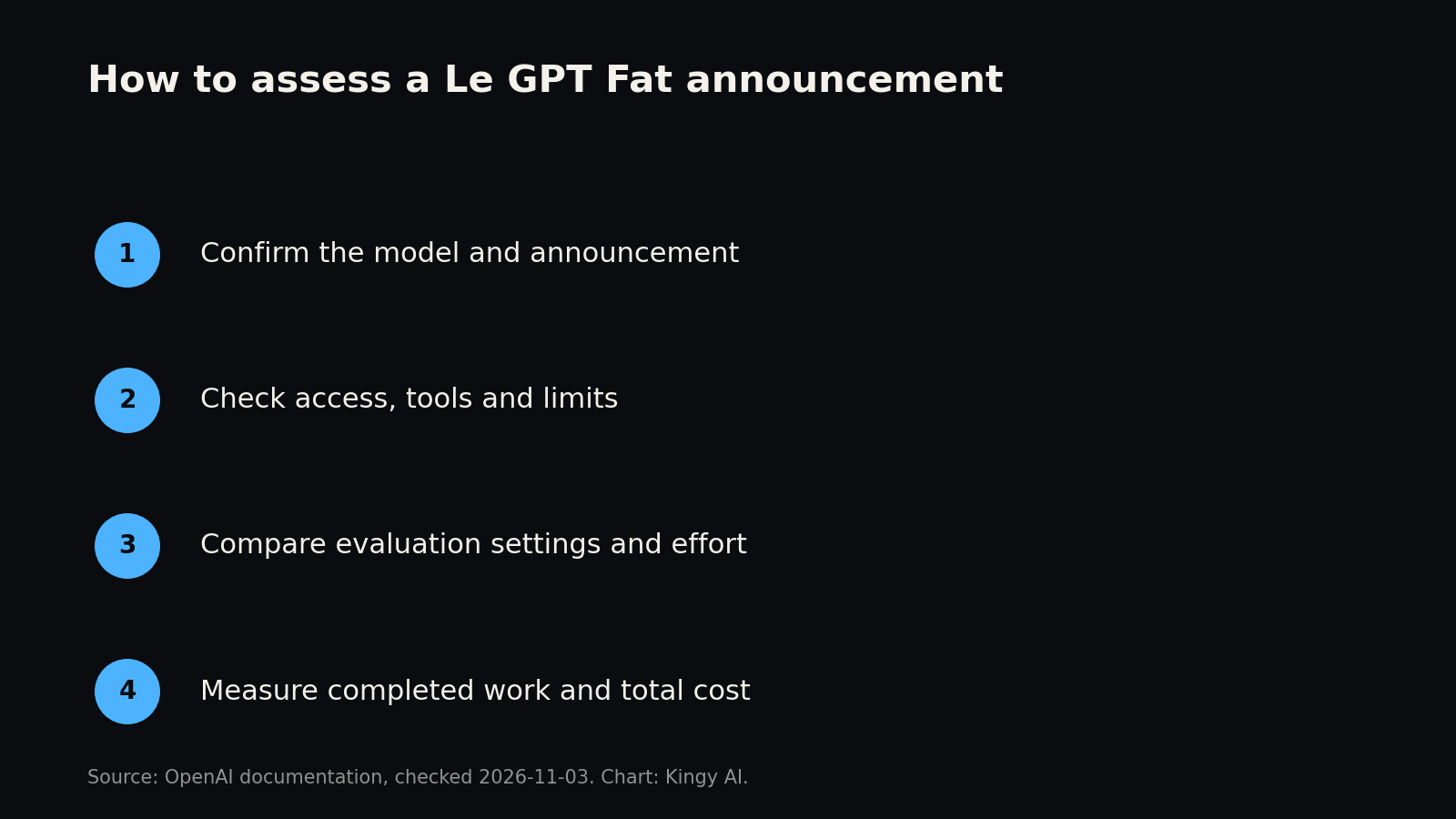
Kingy’s suggested evaluation steps, based on documented model controls and the questions above. Open the full-size diagram.
The first decisive evidence would be a dated OpenAI announcement that explicitly connects the nickname to a named model or product. After that, look for an API identifier or other verifiable access path, model-specific documentation, availability, pricing and usage limits. If evaluations are published, their settings and tool access should be clear enough to compare results fairly. Independent tests can then show whether the reported gains carry over to actual work.
A correction or clarification from the person who posted the phrase would matter too.
Sources
- Original X post
- Public mirror of Tibo’s posts
- OpenAI Build Week
- OpenAI model catalog
- OpenAI model release notes
- OpenAI’s November 3 engineering report
- Kingy’s Astra screenshot tracker
- Kingy’s Bel rumor coverage
- OpenAI gpt-oss architecture account
- OpenAI reasoning guide
- OpenAI Astra announcement
- OpenAI’s September research account
Revision log
November 3, 2026: Initial working analysis of the reproduced social post, current OpenAI documentation, and the main possibilities. No model identity or launch details were confirmed.
November 3, 2026 update: Added OpenAI’s BenchCAD 2.0 result for an unnamed internal model, alongside the report’s account of Astra’s manufacturing limitations. The report does not identify Le GPT Fat.
The Kingy Brief
Get the free AI price sheet.
25 AI plans and models on one page, from official pricing pages, updated every month. Free when you join The Kingy Brief: AI changes, original tests and one practical thing to try, Fridays at 09:00 Vancouver time.
Free · Double opt-in · Unsubscribe anytime
Sign up for The Kingy Brief on Beehiiv.
Signup help and newsletter schedule
Signup form provided by Beehiiv. After submitting, check your inbox for "Confirm your subscription to The Kingy Brief" and open its confirmation link. Your price sheet download is on the page that opens. Check Spam or Promotions if you cannot find it.
Fridays at 09:00 Vancouver time: source-checked AI changes, original tests and one practical thing to try. We skip a week when there is not enough verified material. Free. Unsubscribe anytime.