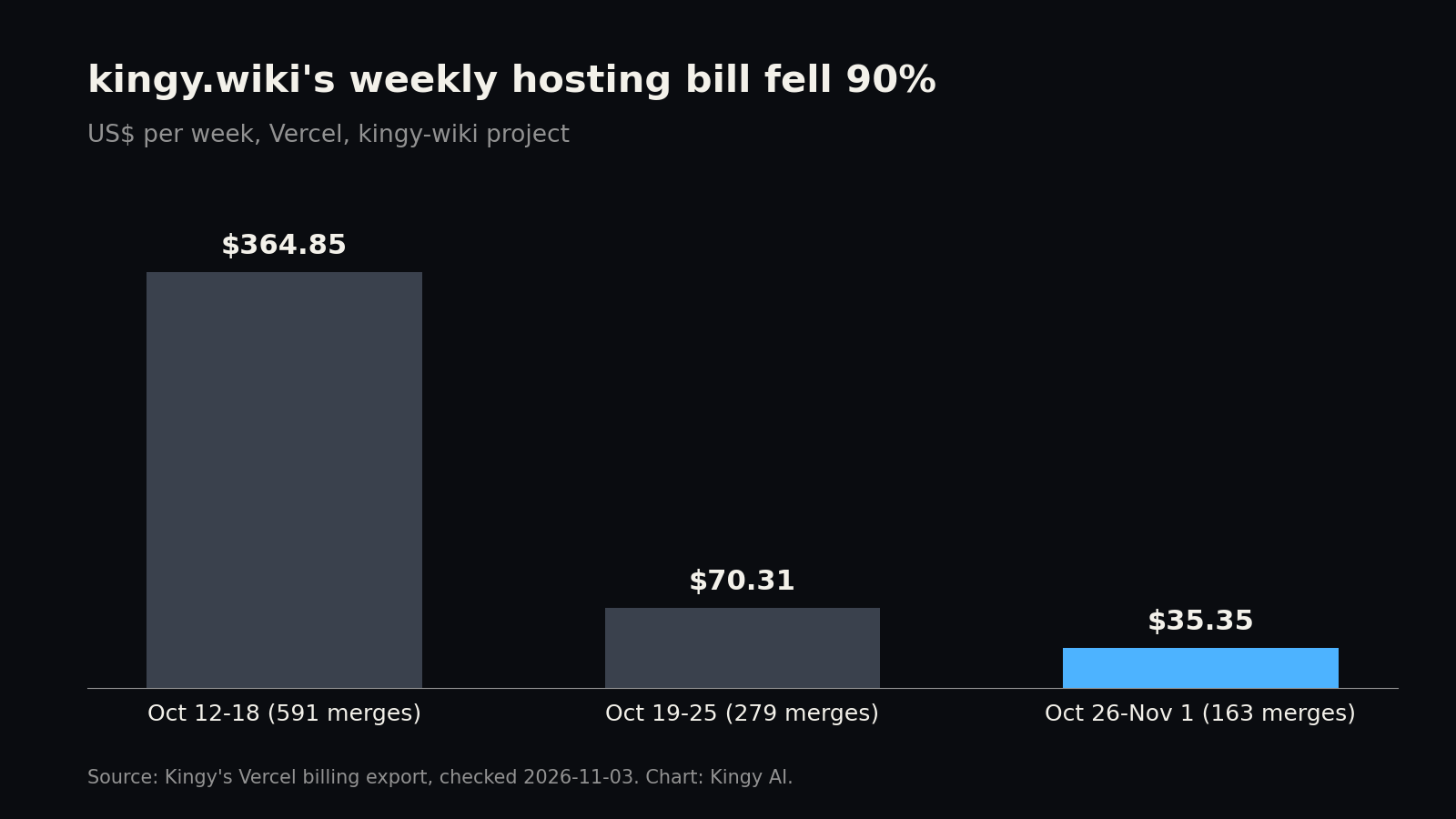
Short answer: AI coding agents merged 1,033 changes to our game guide site, kingy.wiki, in three weeks. The cost that caught us out wasn’t the AI. It was what each change set off: a full rebuild of the site. Our weekly hosting bill hit $364.85, and the budget cap took every site on the account offline for about 20 minutes. Once we batched the agents’ changes, the bill fell to $35.35 a week. These are our own records, not estimates.
Most writing about agent swarms is about what agents might do. This is what ours did. From Oct 12 to Nov 1, 2026, scheduled programs running Claude Code and Codex proposed, checked and merged changes to kingy.wiki. A person wrote the rules and approved the risky steps. The agents did the rest. This is the first Agent Receipts, a monthly report with the same table each time.
The receipts
| Week (2026) | Merged changes | Hosting bill for kingy.wiki | Cost per merge |
|---|---|---|---|
| Oct 12–18 | 591 | $364.85 | $0.62 |
| Oct 19–25 | 279 | $70.31 | $0.25 |
| Oct 26–Nov 1 | 163 | $35.35 | $0.22 |
Of the $470.51 total, $376.20 was build time: the computer time the host charges to rebuild the site after each change. This report covers hosting only. What we paid for the agents’ AI use is not in this table.
What went wrong, and the fix for each
1. The surprise bill came from side effects, not tokens
Every merged change rebuilt the whole site in production. On the 30-core build machine we used then, each rebuild cost about $0.70 to $0.76. At around 80 merges a day, the hosting budget ran out at 15:11 UTC on Oct 19. Our host’s spend control was set to pause production when the budget is reached, and that pause covers every project on the team, including sites that had nothing to do with the agents. They were back about 20 minutes later.
Fix: rebuild at most twice a day, use an 8-core machine, and make one change per game instead of one per video clip. In the eight days to Oct 19, 297 of 637 merges were a single video clip each.
2. Volume was the failure, not quality
No agent broke its rules. Each change was reasonable on its own, but there were 80 of them a day. Caps and batching fixed it. Smarter agents would not have.
3. Slow growth stays hidden until one day it breaks everything
On Oct 20, every rebuild ran out of memory: 14 failed builds and about 18 hours with no update going live. Nothing broke that day. Rebuilds had crept from 5 to 11 minutes over many merges, and one setting had quietly turned off a build helper that splits the work. No single change was to blame.
4. Agents copy text literally
The site has a “deploy now” phrase that forces an immediate rebuild. An agent quoted the phrase while describing a change. The merge copied that description into the record, and an unplanned paid rebuild started. The rule now: describe the marker, never write it.
5. Agents competing for one budget starve the job that matters most
Several programs drew on the same weekly AI usage limit. It ran out around Oct 27, and keeping pages up to date slipped, among other causes. A check on Oct 31 found 149 of 574 hub and guide pages with no readable date. The fix was a single “steward” program that gets first call on the budget for freshness work.
6. A second model as checker earns its keep, with boring catches
In a separate private trial (a changelog of AI apps), one model writes each entry and a different model checks it against the source. Of 34 drafts, the checker passed 26 and held 8. Its most common catch: a draft said everyone on a plan gets a feature when the company never said so. On its first pass it failed 20 of those 34, but that was our bug: the pipeline never gave the checker the source’s date.
What happened to Google traffic
Google visitors to kingy.wiki fell about 89% from around Oct 4, from 102.7 a day to 11.6, while visitors from other sources rose from 103 to 119 a day. The cause is unconfirmed. The timing overlaps a Google spam update. By then the site had grown to 82 game wikis, about 40 of them with 10 pages or fewer, many built from other players’ reports rather than our own play. Since then we have halved the weekly cap on new-game coverage.
What this shows, and what it doesn’t
- Shown by our records: the merge counts, the bills, the pause, the failed builds and the checker’s results above.
- Our reading, not proven: that batching caused most of the bill’s fall. Fewer merges, a smaller build machine and twice-daily rebuilds all arrived in the same days, so their effects can’t be separated.
- Unknown: why Google traffic fell, and how far these costs carry over to other hosts and setups.
- Not counted: the agents’ AI costs. This issue covers hosting only.
- Not a comparison of agents: Claude Code and Codex ran different programs here, so these numbers don’t rank them.
Timeline
| Date (2026) | What happened |
|---|---|
| Oct 12–18 | 591 merges, about 80 a day; every merge rebuilds the site. |
| Oct 19 | Budget reached at 15:11 UTC; every project on the account paused for about 20 minutes. Same evening: rebuilds limited and the build machine made smaller. |
| Oct 20 | Rebuilds moved to two daily windows. Every rebuild that day ran out of memory; fixed later that day. |
| About Oct 27 | The shared weekly AI usage limit ran out; freshness work slipped. |
| Nov 1 | A freshness steward program gets first call on the budget. |
What we’d tell anyone running agents
- Budget for what agents set off (builds, storage, deploys), not only their AI usage.
- Cap volume before you tune quality.
- Keep unrelated sites on a separate hosting team, so one runaway project can’t pause them.
- Give the most important job first call on shared limits.
- Use a second model as checker, and log what it catches.
- Write every fix down as a rule that all agents read. Ours live in the site’s code repository.
How we counted
Merges are pull requests merged into the site’s main branch, counted per UTC day with GitHub’s merged: search qualifier on our private repository. Bills come from our host’s billing export for the kingy.wiki project only. Its days start at 07:00 UTC, so the weeks line up within a few hours. Incident times come from the host’s activity log and build logs. Traffic figures come from our own site analytics. We read the merge counts and bills on Nov 3, 2026, and kept copies. Incident details come from logs recorded at the time.
Sources
- Vercel billing charges API, used for our billing export, read Nov 3, 2026
- GitHub: searching pull requests, used for our merge counts, read Nov 3, 2026
- Vercel spend management, for how a budget pause works, checked Nov 3, 2026
- kingy.wiki, the site the agents ran
- Kingy’s own logs and analytics, as described in How we counted
Revision log
- Nov 2, 2026: first published.
The Kingy Brief
Get the free AI price sheet.
25 AI plans and models on one page, from official pricing pages, updated every month. Free when you join The Kingy Brief: AI changes, original tests and one practical thing to try, Fridays at 09:00 Vancouver time.
Free · Double opt-in · Unsubscribe anytime
Sign up for The Kingy Brief on Beehiiv.
Signup help and newsletter schedule
Signup form provided by Beehiiv. After submitting, check your inbox for "Confirm your subscription to The Kingy Brief" and open its confirmation link. Your price sheet download is on the page that opens. Check Spam or Promotions if you cannot find it.
Fridays at 09:00 Vancouver time: source-checked AI changes, original tests and one practical thing to try. We skip a week when there is not enough verified material. Free. Unsubscribe anytime.