Imagine searching for a fix to a broken appliance. An AI answer gives you the part number and the steps. You never see the Reddit thread where a stranger identified the problem, another person corrected the instructions, and a third came back months later to say the fix worked.
That answer can save you time. It also depends on people having a reason to create and maintain the source in the first place.
On October 29, 2026, Reddit CEO Steve Huffman announced a move toward a primarily logged-in experience. Unauthorized scraping is one reason. Reddit also wants better personalization and participation, more useful advertising signals, and a way to address regulatory requirements. The company plans selected tests outside the United States in the fourth quarter of 2026, according to its shareholder letter.
The precise boundaries are still open. Huffman says he wants the front page and posts reached through search or shared links to remain accessible without an account. There is no announced global launch date. The proposal does not require real names.
The announcement lands as the bargain that supported much of the open web is changing. Websites publish information, search engines help people find it, and some visitors support the source by viewing ads, subscribing, donating or contributing. AI can deliver the information directly. When that answer satisfies the reader, the source may lose the visit and the opportunity that came with it.
Reddit has an unusually valuable supply of material for this new arrangement. Its users have spent years answering specific questions about software, games, repairs, health experiences and almost everything else. Some answers are wrong or out of date; others contain a detail unavailable in a conventional article. The usefulness often comes from the discussion itself: an answer gets challenged, qualified and updated by people with different experiences.
Reddit wants a say in who collects that material and on what terms. Huffman says most unauthorized access occurs while logged out. The company also intends to continue licensing data. In 2024, Google announced expanded access to Reddit’s Data API for uses including displaying and training on content. OpenAI announced a partnership to bring timely Reddit content into ChatGPT and other products.
Different automated visitors also do different jobs. Training crawlers gather material for datasets; retrieval bots fetch sources for current answers; personal agents browse on a user’s behalf; posting bots add content or manipulate interactions. A login can help a platform account for access, but an account does not prove its user is human.
There is a commercial reason to encourage accounts, too. In its shareholder letter, Reddit says logged-in and app users account for more than 80% of its monetization. It can learn more about what those users engage with and show them advertising across a continuing relationship, rather than relying on a brief anonymous visit.
This is a strong business responding to a shift in distribution. Reddit’s third-quarter results show $895 million in revenue, up 53% from a year earlier, and 130.3 million daily active uniques, up 12%.
In that same quarter, the company’s shareholder letter reported that search referrals declined meaningfully, with the decline accelerating later in the period. In October, search traffic fell by more than one million referrals per week on average. Referrals are visits, not unique people, and Reddit has not quantified how much of the decline came from particular AI interfaces.
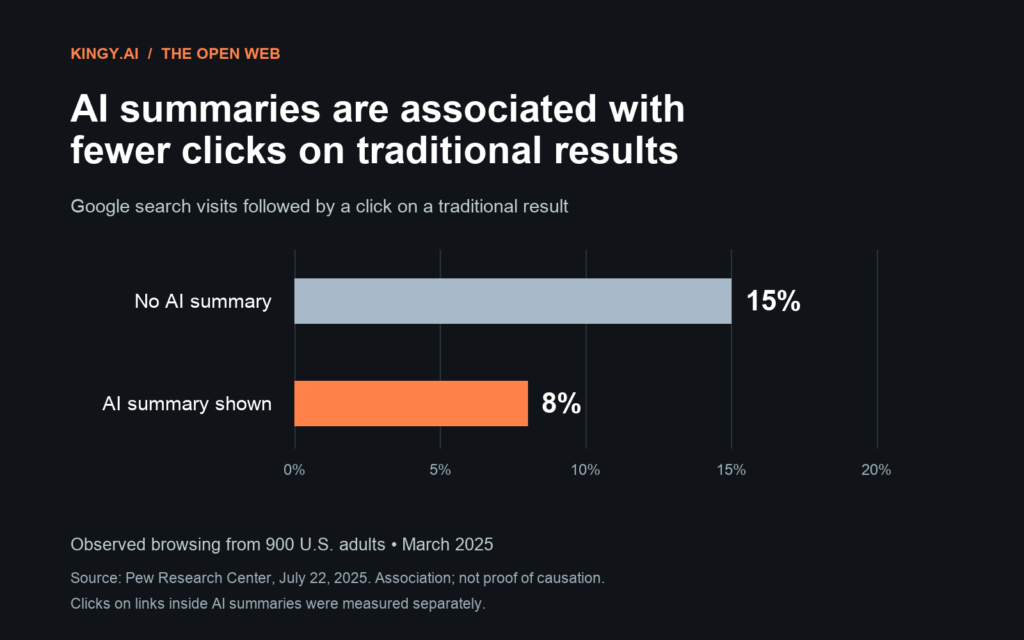
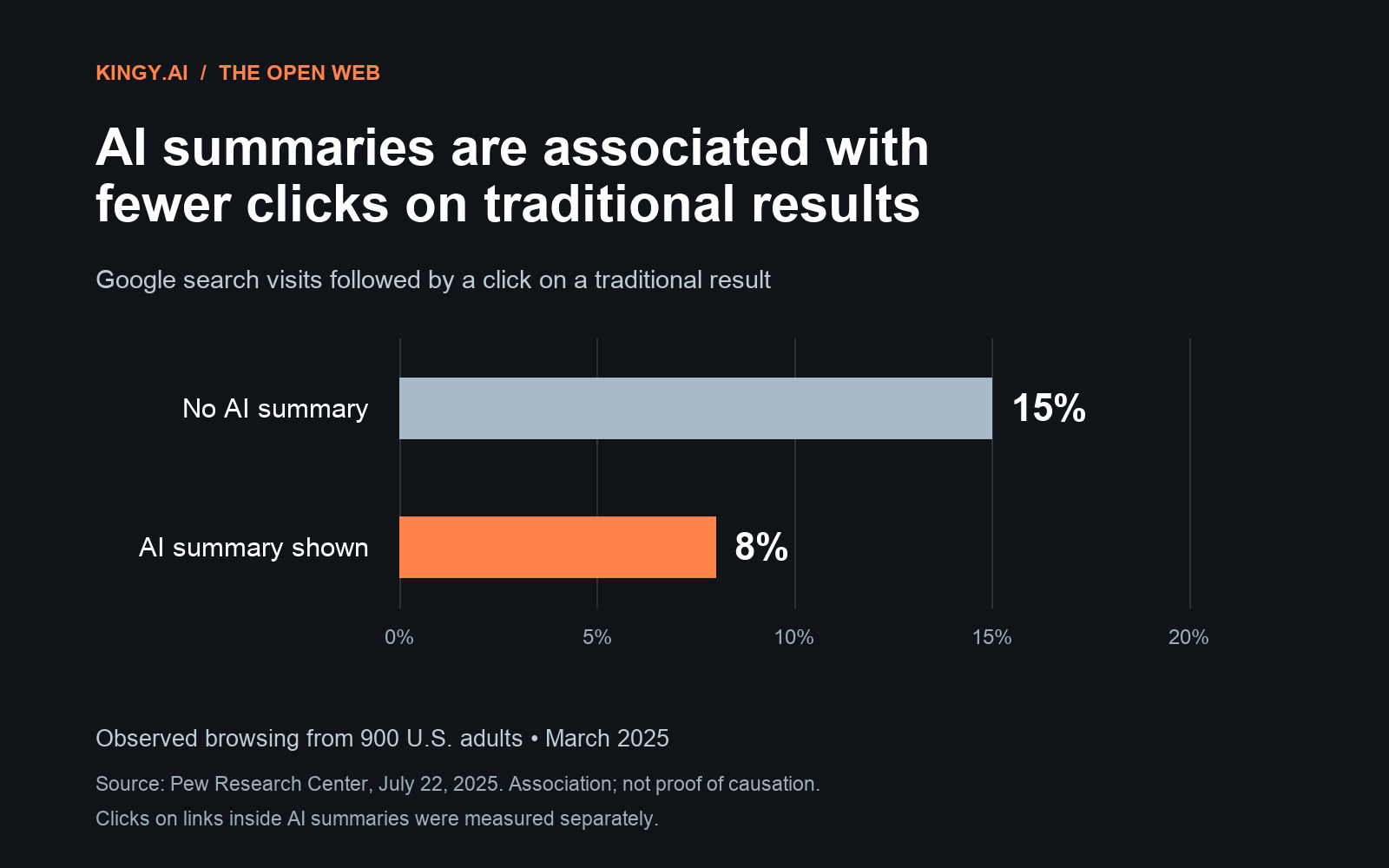
In a Pew Research Center study of US browsing in March 2025, traditional Google results received clicks on 8% of visits with an AI summary versus 15% without one. Summary links separately drew clicks on 1% of summary visits. Query differences and the observational design prevent a causal conclusion.
A citation can identify a source while the reader stays on the search page.
Google offers a different account. In August 2025, Google said aggregate organic outbound clicks from Search were relatively stable year over year, with some sites gaining and others losing. Google did not publish a full reproducible dataset for that claim.
Chartbeat measured a roughly 6% decline in average weekly pageviews across its network of news and media sites between 2024 and 2025, alongside a sharper decline in Google Search referrals over its December-to-December comparison. It cautioned that news cycles and other changes complicate attribution.
A stable aggregate can coexist with serious losses at individual sites. A falling referral count can have several causes, including search ranking changes, social and video platforms, and changing reader habits. AI answers add pressure to a system that was already shifting.
The question is what happens to the next useful source. A repair answer begins with someone spending an afternoon diagnosing the fault. A game guide needs an update after a patch changes the rules. A product review requires testing, and reporting requires someone to find documents, make calls and check what people say. The final answer can fit in a paragraph; producing it can take hours or weeks.
A reader who gets a good AI answer has received something valuable. But if fewer readers reach the original source, the writer may lose ad revenue, a prospective subscriber or the encouragement to keep an old guide current. A forum may lose the new member who would have spotted an error and supplied a better answer. A source can remain available for scraping long after the conditions that created it have weakened.
A 2024 peer-reviewed study of Stack Overflow estimated posting activity was 25% lower within six months of ChatGPT’s late-2022 launch relative to comparison programming sites and mathematics forums. The historical estimate depends on the researchers’ comparison design; it does not establish the same effect everywhere.
Reddit itself offers a counterweight to a simple collapse story. Its shareholder letter says users added another billion posts and comments during Q3 2026. That figure measures volume. It leaves quality, authenticity and the human share unresolved. The challenge is to keep useful contributions worth making as the routes by which readers encounter them change.
There are several possible responses. A publisher can charge readers directly, seek donations or build a newsletter relationship. A community can keep useful pages open while asking visitors to join and participate. A platform can license its archive, although a payment to the platform does not establish that each contributor receives a share. An AI company can send more readers to sources or pay for access. Each approach has trade-offs: subscriptions and logins can make information harder to reach, while licenses can favor organizations large enough to negotiate them.
An entirely AI-written internet remains speculation. A more divided web is plausible. So is a feedback loop in which fewer visits weaken the incentives to create firsthand material, leaving AI products with less fresh information to draw on. Neither outcome is a settled fact. People still share knowledge for many reasons, including curiosity, reputation, community and the satisfaction of helping someone else.
An AI answer can save someone an afternoon of searching. The next repair guide, software fix or product review still needs fresh evidence. An internet built around AI answers needs a way to support the people who go out and find it.
The Kingy Brief
Get The Kingy Brief.
AI changes, original tests and one practical thing to try. Fridays at 09:00 Vancouver time.
Free · Double opt-in · Unsubscribe anytime
Sign up for The Kingy Brief on Beehiiv.
Signup help and newsletter schedule
Signup form provided by Beehiiv. After submitting, check your inbox for "Confirm your subscription to The Kingy Brief" and open its confirmation link. Check Spam or Promotions if you cannot find it.
Fridays at 09:00 Vancouver time: source-checked AI changes, original tests and one practical thing to try. We skip a week when there is not enough verified material. Free. Unsubscribe anytime.