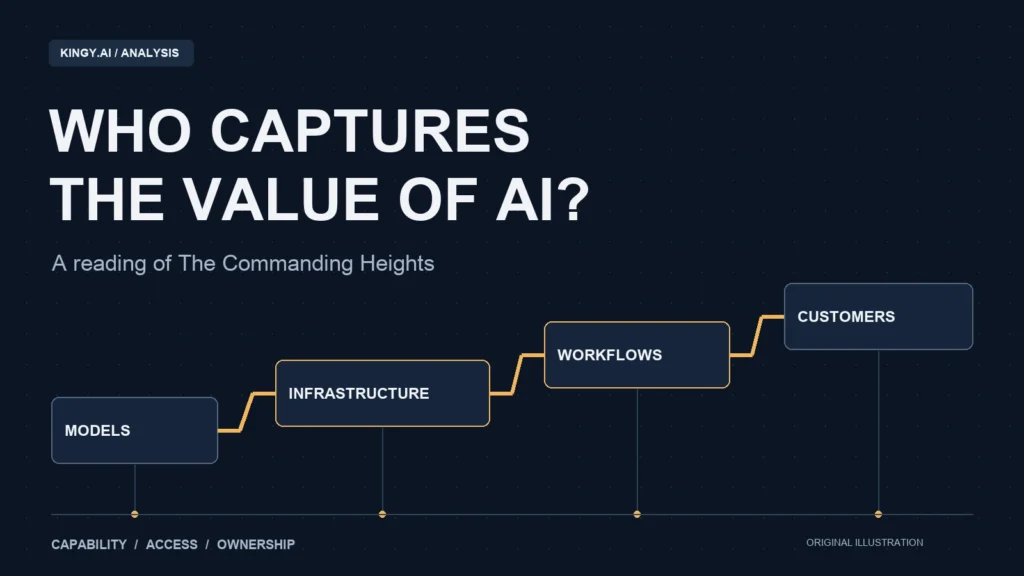
AI can become cheaper and more capable while the benefits remain uneven. A business can save money on a model and still lose control over its customer relationships. A worker can become more productive and still find fewer openings. A country can buy excellent AI services and still struggle to keep a public system running when a supplier changes its terms.
Those outcomes are not settled by a benchmark score. They depend on contracts, infrastructure, training, competition and decisions made inside organizations.
Will Manidis and Joe Roberts' The Commanding Heights, published October 29, 2026, offers a sweeping forecast of AI's economic and political consequences. It is an argument about the future, not a record of events that have already occurred. The short synopsis below captures its central conclusions; the rest of this article is our independent analysis, grounded in separate research. We have not tested the systems discussed or conducted a new survey.
What the authors conclude
Will Manidis and Joe Roberts expect AI’s enduring gains to accrue to owners of essential economic channels, distinguishing lasting control from temporary shortages. Model development faces escalating spending and price competition; they expect American policy to sustain the buildout despite financial losses.
They foresee abundant commercial models alongside restricted sovereign systems led by America and China. Their “Neo-Dollar” argument links AI-driven commerce, dollar stablecoins and US financial power.
They predict unequal outcomes: disruption to poorer countries’ service jobs and development paths, protection for some established professionals, and weaker entry routes for younger workers.
Firms would rely on small groups of operators directing models and sharing ownership-like rewards. Investors and fund managers would need to reconsider existing advantages, financing and governance as economic power moves.
These are forecasts, partly illustrated through fiction. The opening Ravi story is speculative.
The full essay contains the authors' complete case. The questions below use other evidence to examine mechanisms that matter for builders, employees, customers and public institutions.
Cheaper models do not guarantee an easy exit
The decline in the cost of reaching a given model performance level is substantial, although it needs careful interpretation. In a September 2026 analysis of five primary benchmarks since 2023, Epoch AI researchers Luke Emberson and David Roodman estimate that the cost of a given benchmark performance fell about 47% per quarter, or roughly 13-fold per year. That is a modeled frontier across tests, not the change in every customer's bill or a measure of every useful task. Benchmark selection, public-test optimization and a short observation period all matter. Source: Epoch AI
Lower prices can make experiments possible for a small team that previously could not afford them. They can also make it practical to run more checks, compare multiple candidate answers or keep a second model available as a fallback. None of those choices follows automatically from a price chart. A company has to build and pay for the surrounding workflow.
Consider a hypothetical retailer whose model charge per request falls by half. Its customer history, approval rules and checkout permissions remain inside one platform. The retailer receives a real saving, but moving to another provider may still require rebuilding integrations, testing permissions and transferring records. A competing model can be cheaper and technically capable while the move remains expensive or disruptive.
That is why an exit plan needs more than a promise that data is exportable. Can the business retrieve customer records in a usable format? Can it export the rules governing discounts and refunds? Are evaluation cases and audit logs portable? Does a replacement system support the same identities and permissions? How long would the business operate with reduced service during a migration? A contract can answer some of these questions, but a rehearsal reveals whether the answer works in practice.
The surrounding agreements deserve as much attention as the model. In a January 2025 study, US Federal Trade Commission staff described cloud and AI partnerships involving provisions such as exclusivity, cloud spending commitments and access to sensitive information. Staff raised possible concerns about switching costs and access to inputs. The study covered evidence through September 2024 and public material through January 2025; it did not establish that every such arrangement was unlawful or that its historical terms still apply today. Source: FTC
For a startup, a cloud credit or a tightly integrated development stack may be the sensible way to get a product into customers' hands. The cost of accepting it should still be visible. Map the contractual commitments against a credible revenue forecast, ask what happens when credits end, and retain copies of the data and tests needed to move. A founder choosing speed today can make that choice consciously without pretending migration will be free tomorrow.
Open weights expand options, with conditions
Open-weight models can improve a team's choices, particularly when it can adapt or run a suitable model within infrastructure it controls. An Epoch AI analysis covering January 1 through May 28, 2026 estimated an average four-month lag between the open-weight and closed-model frontiers on its ECI measure, using its stated statistical criterion. A stricter point-estimate comparison produced six months. That is a finding for that period and benchmark, not an October measurement or proof that all models are interchangeable. Source: Epoch AI
Weights alone do not provide a complete operating system. A team also needs a license that permits its intended use, serving infrastructure, security updates, evaluation data and people who can maintain the deployment. A model may be downloadable while the training data, training code or other components remain unavailable. “Open weights” is therefore a narrower description than a fully open system.
Privacy also depends on the actual deployment. Downloading weights does not itself send prompts to the model developer. Where inference runs, what the runtime transmits, whether telemetry is enabled, the hosting contract and any feedback pipeline determine data flows. Teams should inspect those arrangements rather than infer them from a label.
For researchers, the practical value of alternative models includes the ability to compare behavior and reproduce more of a workflow. Access to weights does not remove the need to document versions, settings, evaluation data and compute. For customers, an alternative matters most when the application has been designed to use it before an emergency makes switching urgent.
Count the cost of an accepted result
A model price is one input to an operational decision. A useful internal accounting framework adds model and tool charges, integration, human review, expected error and remediation, compliance, and switching overhead. These categories are a way to organize a business case, not a measured equation that assigns the same weight to every deployment.
A cheaper model can cost more per accepted result if it produces more retries, asks for more human review or causes errors that take time to fix. A more expensive model can cost less per accepted result if it reliably reduces those other costs. The reverse can also be true: a smaller model with a narrow job and a strong validation step may be the economical choice. The answer depends on the task and its consequences.
Imagine a hypothetical invoice-triage system. It labels incoming invoices, checks them against purchase records and sends uncertain cases to a person. A useful trial would record correct approvals, wrong approvals, escalations, time spent on each route and the time needed to recover from mistakes. It would also include invoices the system has not seen before, changing supplier formats and cases where the purchase record itself is wrong.
The distinction between a correct rejection and an unnecessary escalation matters. So does the difference between a reversible tagging mistake and an incorrect payment. A single average accuracy number can hide both. The company should decide in advance which errors require a stop, which can be repaired, and who has authority to make that decision.
This is also a useful lens for products sold to other companies. A demo can show how quickly a system produces a draft. A buyer needs to know how often the draft survives review, whether the system exposes the evidence behind it, and what happens when the workflow encounters an exception. Those answers require task-specific evidence. No experiment described in this article was conducted by Kingy.ai.
Productivity and employment are different measurements
There is credible evidence that assistance can improve performance in a particular workplace. In the final published version of Generative AI at Work, Erik Brynjolfsson, Danielle Li and Lindsey Raymond studied a staggered rollout to 5,172 customer-support agents. Issues resolved per hour rose 15% on average, with effects varying by worker experience and skill. The setting involved an assistant helping agents, and the study also examined learning. It does not tell us that every workplace will obtain the same gain or what will happen to total employment and wages. Source: Quarterly Journal of Economics
A firm can respond to a productivity improvement in several ways. It may lower prices, serve more customers, improve service, increase profits, reduce hours, hire fewer people, or combine those responses. Workers' bargaining power and the availability of competing employers can affect how the gains are divided. The productivity measure alone cannot identify which outcome occurred.
Adoption data needs the same care. A US Census Bureau working paper using a nationally representative business survey found that 18% of firms reported using AI in a business function in November 2025 through January 2026. The figure was 32% when weighted by employment. Among firms reporting task effects, 66% reported augmentation alone; about 2% of AI-using firms reported AI-related employment decreases. Those are self-reports for that reference period, not an October 2026 adoption rate or proof of the long-run employment effect. Source: US Census Bureau
Firm counts and employment-weighted counts answer different questions. If larger employers adopt more often, a relatively modest share of firms can still encompass a larger share of workers. Even then, “the firm uses AI” does not mean every employee uses it, every task is automated, or the organization has redesigned its whole operation.
A Danish working paper by Anders Humlum and Emilie Vestergaard examined roughly 25,000 workers at 7,000 workplaces across 11 exposed occupations, using records through December 2024. Its difference-in-differences estimates found no detectable earnings or hours effects at worker and workplace levels, ruling out effects larger than 2% two years after ChatGPT, while documenting changes in work. It is a working paper, and its country, occupations, early generation of tools and observation period limit what it can say about later outcomes elsewhere. Source: RFBerlin discussion paper
A different signal appears in a Stanford Digital Economy Lab analysis of ADP payroll data through June 2026. In the revised August 2026 study, employment for workers aged 22–25 in AI-exposed occupations was 19% below a counterfactual based on the trend for less-exposed peers, primarily through reduced hiring. The authors also found no evidence of widespread economy-wide displacement. Their indicators are descriptive, not causal estimates; patterns weaken with education controls, and some pretrends and sample differences complicate interpretation. The finding does not mean AI eliminated 19% of young workers' jobs. Source: Stanford Digital Economy Lab
Read together, these studies make a useful case for watching several outcomes separately. A tool can help an employed novice resolve cases faster while an employer hires fewer novices. Work can be reorganized before a measurable change appears in earnings or hours. A decline in hiring in an exposed occupation can have several causes, including changes unrelated to AI. No single statistic resolves all three questions.
The measurements that matter to a community include entry-level hiring, pay, hours, job transitions, business formation and the quality of services people receive. A rise in output or company revenue can coexist with weak hiring. Equally, a change in a particular occupation does not establish the direction of the whole labor market. The credible position is to follow the evidence as it arrives and avoid treating either early reassurance or early warning as a final verdict.
How people learn when routine work changes
Many professions teach judgment through repeated exposure to ordinary cases. A junior employee sees a draft, asks why a rule applies, checks an exception and gradually learns which details change the answer. If software handles the initial pass, that learning path can become less visible even when the senior employee has a useful new tool.
Organizations can design around this problem. Give trainees ownership of bounded cases with supervision, including cases the software marked as easy. Ask them to explain the evidence behind a recommendation before approving it. Rotate responsibility for investigating failures, and keep a record of corrections that shows why an output was wrong. These are proposals for training design, not results established by the studies above.
A human signature by itself is a weak control. The reviewer needs enough time, access to relevant evidence and the authority to reject a recommendation. If the system presents a confident answer without its supporting material, a busy reviewer may be unable to distinguish a well-founded result from a plausible mistake. In higher-stakes work, employers should define when the system must pause and when a qualified person must take over.
The design should also leave room for disagreement. An employee who sees an unusual case needs a way to challenge the model's output without being treated as an obstruction to an efficiency target. That can mean a documented escalation path and a record of how the disagreement was resolved. It can also mean tracking whether reviewers are routinely approving more cases than they could reasonably inspect.
This is not a claim that every routine task should be preserved forever. Some work is repetitive without teaching much. The practical question is which tasks create expertise, and whether a replacement process gives people enough experience to handle the cases that remain. A company that eliminates its training pipeline may discover the cost years later, when it needs people who can investigate an unfamiliar failure or take responsibility for a consequential decision.
For individuals, learning to use a model is valuable; learning to inspect its work is a separate skill. Domain knowledge, verification, communication and recovery from errors remain useful across tools. Workers cannot solve a shortage of openings through training alone, however. Employers and public institutions also shape access to experience and the demand for work.
Small teams still need governance
A capable tool can let a small team accomplish work that would otherwise require more employees. Whether it does so profitably depends on the work, the reliability required and the services the team buys from others. A company with five employees may rely on cloud providers, contractors, payment processors, support vendors and outsourced specialists. Its payroll is small; the total system supporting customers is larger.
This distinction matters when comparing new firms. A small software business may have unusually high output per employee because it has found a narrow, well-defined task and built good checks. Another may appear efficient because it has shifted expensive support or risk to customers. The headcount alone cannot distinguish the two.
Founders should map decisions before giving an agent access to tools. Who can authorize a payment or refund? Can a customer dispute an action? What happens if a model generates an instruction that conflicts with a customer's contract? Which actions can be reversed, and who can stop the system? Permissions should reflect the consequences of an action, not the convenience of a demonstration.
A hypothetical startup might let an agent draft a refund but require a person to approve it above a defined threshold. The threshold, evidence shown to the reviewer and exception process would need to reflect the startup's business and applicable rules. The team should also test what happens when the agent has incomplete customer information or when a payment provider is unavailable.
Small teams face key-person risk. If only one operator knows how the system is configured, a departure or illness can interrupt service. Document access, recovery procedures, supplier contacts and the reasoning behind important settings. Make sure a second authorized person can disable an integration and restore a previous working state. These are ordinary operating disciplines, and AI tools do not make them optional.
Equity or other ownership-linked rewards can give employees a stake in a company's success. They can also leave people exposed to concentration, uncertain valuation and decisions they do not control. The details of vesting, dilution, voting rights and liquidity matter more than a general promise of alignment. Founders and employees should understand those terms in their own circumstances; this article does not assess a particular investment.
For a startup customer, governance is part of product quality. Ask how the vendor handles incidents, how it separates customers' data, who can change permissions, and whether the customer can retrieve its records. If an AI feature performs a consequential action, ask for the audit trail and the correction path. A fast response is useful only if someone can take responsibility when it is wrong.
Sovereignty has several layers
National AI capability is often discussed as though the only meaningful question is whether a country can train the largest frontier model. That is one capability. Others include reliable inference, control over sensitive data and encryption keys, local-language evaluation, procurement expertise, security, research talent and the ability to move a public service to another supplier.
A country can lack a frontier training lab and still make consequential choices in those areas. It can also own infrastructure without having the skills or contracts required to operate it effectively. Control depends on the particular service and the institutions around it.
The European AI Gigafactories program illustrates one policy approach. In July 2026, EuroHPC announced a call under which the EU and participating states planned to procure compute time jointly as an anchor customer for up to seven facilities. The announcement expected selection in early 2027 and operation within 18 months afterward. Those are plans and expected dates, not completed capacity or evidence that a competitive gap has closed. Source: EuroHPC
Public procurement can create a market for infrastructure and services that researchers or smaller firms could not fund alone. It also creates obligations: a government needs to define access rules, evaluate results and account for delays or cost overruns. An anchor purchase does not by itself establish public ownership, nationalization or operational control of every system built under a program.
A practical assessment starts with a service. Could a hospital, tax office or public benefits agency continue its essential work if an upstream provider suffered an outage or changed access terms? Who controls its keys and records? Can the institution audit model updates? Is there a tested route to another supplier? Does the procurement contract let the institution retain useful data and evaluation cases?
Local-language capability deserves the same specificity. A system may perform well in a widely used language yet struggle with a regional language, local administrative forms or a community's terminology. A public institution can fund representative evaluations and involve intended users without claiming that local hosting alone fixes quality. It should measure whether the service improves access and whether people can challenge an incorrect result.
Research communities also need access that lasts beyond a launch announcement. Compute allocations, reproducible model versions, safe access to relevant datasets and predictable support can matter as much as a headline capacity figure. The right mix will differ across countries and projects. National agency is better assessed through these operational choices than through a single league table.
Compute is a physical and financial project
Software may be copied quickly, but the facilities supporting it need power, cooling, equipment, financing and connections. The International Energy Agency's April 2026 central projection puts electricity use by all data centres at 485 terawatt-hours in 2025, rising to 950 TWh in 2030, about 3% of global electricity demand. The IEA projects AI-focused data-centre demand to triple. These are projections, not guaranteed consumption, and the all-data-centre figure includes more than AI. Source: IEA
Global totals do not tell a local utility when a particular project can connect. A site may need transmission upgrades, a new substation, water arrangements or permits. Community acceptance, equipment availability and financing affect schedules too. The distinction between announced capacity, construction that is funded, a signed power agreement and capacity that is energized matters for anyone making an operational plan.
Efficiency gains complicate the demand picture. A model may need less computation for a given simple query, while a product asks models to reason for longer, inspect more material or generate video. A lower cost per operation can encourage more operations. Neither that possibility nor the efficiency gain tells us the final electricity demand by itself.
Businesses buying compute should understand how their capacity is contracted and what happens when demand spikes. A startup may prefer an adjustable service over a long commitment it cannot use, even if the longer contract has a lower nominal rate. A research group may need scheduled access and reproducibility more than immediate access to the largest machine. A local government negotiating a data-centre project needs to understand who pays for grid upgrades and how the costs appear on customer bills.
Scarcity at one date does not guarantee scarcity forever. Capacity can arrive late, demand can fall short of plans, or financing can become expensive. Conversely, a useful project can be delayed by a local connection constraint even while aggregate capacity grows elsewhere. Technical demand, contract commitments and actual delivery should be tracked separately. A forecast of demand is not a forecast of a particular project's return.
Stablecoins, dollar access and the missing causal link
An AI agent may need to initiate a purchase or pay a supplier. That does not settle which payment rail it should use. The decision depends on costs, access, settlement, fraud handling, reversibility and the rules applicable to the transaction. A conventional bank payment and a token transfer can each be useful in some circumstances; neither should be assumed to win every use case.
A 2026 Bank for International Settlements paper estimates that about 98% of stablecoin value is dollar-denominated. The authors examine different scenarios, including niche use and wider digital dollarisation, with different implications for monetary sovereignty. Their analysis does not establish that stablecoins dominate payments generally. The authors' views are not necessarily those of the BIS or its member central banks. Source: BIS Paper 170
A Federal Reserve staff conference synthesis describes ways stablecoins can extend access to dollar finance and connect demand for tokens with assets held in reserve. It also discusses the continued importance of existing drivers of dollar use and the relationship between payment innovation and banking. The staff authors' views are not Federal Reserve policy. Neither source proves that AI will cause stablecoin adoption or guarantee cheap government financing. Source: Federal Reserve FEDS Notes
Four separate questions help clarify the issue. What currency is the invoice quoted in? Which rail moves the payment? What assets, if any, back a token? Who bears the loss if an intermediary or issuer fails? A dollar invoice can be paid through a bank. A token can create issuer, redemption or operational risks even if it is convenient to transfer. A reserve asset's role does not remove those risks for the user.
An agent also needs permission to act. A business can set spending limits, restrict approved counterparties, require confirmation for unusual transactions and maintain records for reconciliation. Those controls are necessary whatever payment method the business selects. In a hypothetical procurement workflow, the agent might prepare an order from an approved catalogue while a person approves a new supplier. The business would need to check the applicable legal and payment requirements before implementation.
For customers in countries with unstable currencies or limited financial access, a dollar-denominated instrument may offer a useful option. It may also introduce dependence on an issuer, a foreign currency and access channels outside local control. The balance depends on the product, local rules and alternatives. Convenience is a reason to investigate, not evidence that a particular token or investment is suitable.
Benefits outside the largest AI markets
A cross-country analysis by the International Labour Organization examined 135 countries representing around two-thirds of world employment. It found lower aggregate automation exposure in developing economies, while warning that digital divides and differences in task content can produce disruption before benefits. Exposure is a measure of potential, not a count of people who have lost jobs. The authors also caution against assuming that a job title contains the same tasks in every country. Source: ILO Working Paper 166
Those distinctions matter for a connected export-service sector. A country may have relatively low aggregate exposure while a particular group of workers faces acute competition. At the same time, firms elsewhere in that country may lack reliable connectivity or devices needed to use assistance productively. A national average can conceal both conditions.
There are also possible gains. A local business might use a language tool to serve more customers, or a professional might get help finding information that was previously expensive to access. Those possibilities need testing with the people who would use the service. A tool that handles an international benchmark well may fail on local terminology, unreliable connections or records that mix languages.
For developers, price the whole route to access. Subscription fees are only one component; data charges, devices, support and the time required to correct errors can decide whether a product is useful. Test with representative users, document where performance is weak and make it possible to report errors. A local-language interface that produces confident but unreliable advice can increase risk rather than access.
Governments have several policy tools, including competition, skills, public procurement and social insurance. None guarantees a smooth transition. Retraining can help people qualify for opportunities, but training cannot by itself create enough suitable jobs. Public policy should measure wages, hours, new firms, service quality and access separately, and revise its approach when the evidence changes.
Three paths to watch from 2027 through 2030
The following scenarios are our editorial framework, not forecasts with calculated probabilities. They can coexist across industries and countries. The years identify a period to monitor, not a promised delivery schedule.
Broad diffusion with workable competition
This path becomes more plausible if organizations can move workflows between suppliers, the cost of accepted work continues to fall, and employees have access to meaningful training. Smaller firms would need practical access to models and infrastructure, while customers would need genuine alternatives when a supplier changes prices or terms.
Evidence to watch includes completed migrations, renewal prices, the breadth of small-firm adoption and task-level productivity alongside wages and entry hiring. A new supplier entering a market is encouraging, but customers also need a realistic way to use it. Teams can prepare by keeping portable records, maintaining independent evaluations and rehearsing a change of provider.
Concentrated adoption with limited employment gains
This path becomes more plausible if a small number of platforms control key execution channels or customer access, and users cannot move their data or operating rules without serious disruption. Businesses could still obtain productivity gains while hiring or wages respond weakly. That would need to be established through actual outcomes rather than inferred from a company's use of AI.
Watch switching costs, contract terms, hiring by experience level and the relationship between productivity and compensation. Builders can treat dependency as an engineering and commercial risk: identify critical suppliers, negotiate access and exit rights, and test an alternative before it is urgently needed. Workers and employers can track whether entry routes and supervised experience remain available.
Uneven or delayed transformation
A third path is that integration, trust, error recovery, energy constraints or financing slow adoption despite better benchmark results. One sector may automate a narrow process quickly while another finds that review, regulation or messy data make the business case harder. Better models can still be useful under this scenario; the rate of organizational change would vary.
Watch the cost of accepted cases, incident recovery, adoption beyond pilots, and energized capacity compared with announcements. Fund bounded deployments with clear stop conditions and keep a workable fallback. A pilot that reveals an expensive failure mode has produced useful information, even if the team decides not to deploy.
A practical standard for the next few years
The most persuasive evidence today concerns specific mechanisms: lower modeled benchmark costs, gains in a particular support deployment, uneven business adoption, a warning signal in young-worker hiring and constraints on physical infrastructure. Each has a defined scope. The further a claim moves from those observations toward a complete account of 2030, the more assumptions it needs.
For AI builders, the immediate work is concrete. Measure successful cases and consequential errors. Preserve the data, tests and permissions needed to move a workflow. Give people a route to learn and a way to challenge an output. Make the cost and responsibility of external services visible. For public institutions, examine continuity, procurement and access in the context of an actual service.
Those choices will not settle every economic outcome. They can make the systems people build easier to evaluate, contest and replace as the evidence develops.
The Kingy Brief
Get The Kingy Brief.
AI changes, original tests and one practical thing to try. Fridays at 09:00 Vancouver time.
Free · Double opt-in · Unsubscribe anytime
Sign up for The Kingy Brief on Beehiiv.
Signup help and newsletter schedule
Signup form provided by Beehiiv. After submitting, check your inbox for "Confirm your subscription to The Kingy Brief" and open its confirmation link. Check Spam or Promotions if you cannot find it.
Fridays at 09:00 Vancouver time: source-checked AI changes, original tests and one practical thing to try. We skip a week when there is not enough verified material. Free. Unsubscribe anytime.