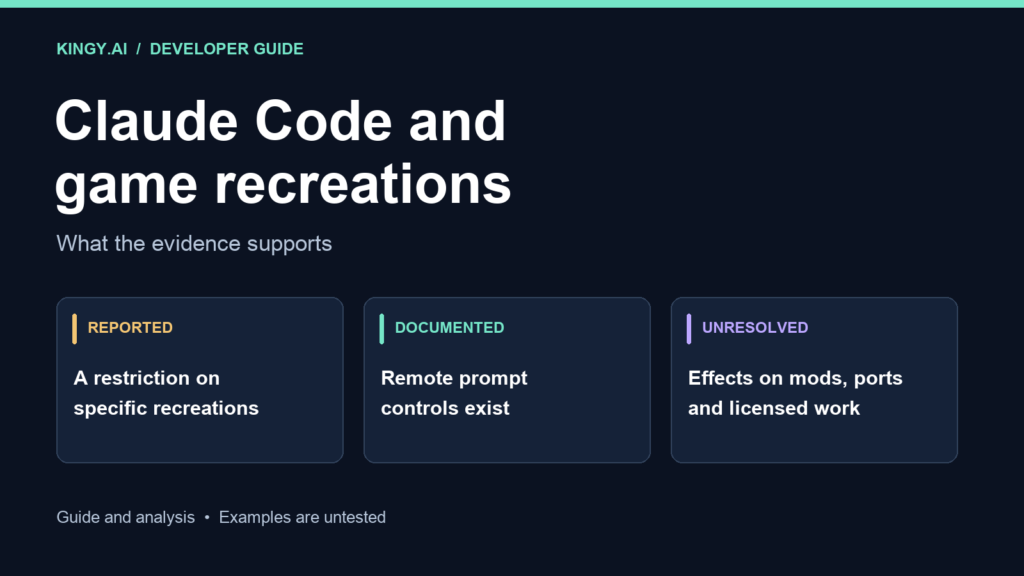
A reported instruction for Claude Code tells the coding assistant not to build a recreation of a specific existing game, even when the project is renamed. The report also describes room for original games, genre projects, and games based on a user’s own designs and assets. Anthropic has not, in the public sources available for this guide, confirmed the current game-specific instruction or explained how it applies to licensed work, ports, or mods.
That distinction matters if you use Claude Code to build games. One developer reports refusals affecting commissioned adaptations, with a crucial qualification: he says the work continued after the supposed rollout and stopped after a policy self-audit. The cause remains unresolved.
The safest practical response is to identify exactly what your project copies, what you have permission to use, and what task you want the assistant to perform. Then record any refusal carefully. A renamed recreation, a new game in the same genre, and an accessibility mod made with an official SDK raise different questions, even if the boundary of Claude Code’s reported instruction remains unclear.
Evidence status: The instruction text was supplied with a social-media link that returned HTTP 403 when we tried to open it. We could not authenticate its provenance or verify its rollout date. The developer’s account is unreplicated. The scenarios and prompts below are our interpretation and have not been tested against Claude Code.
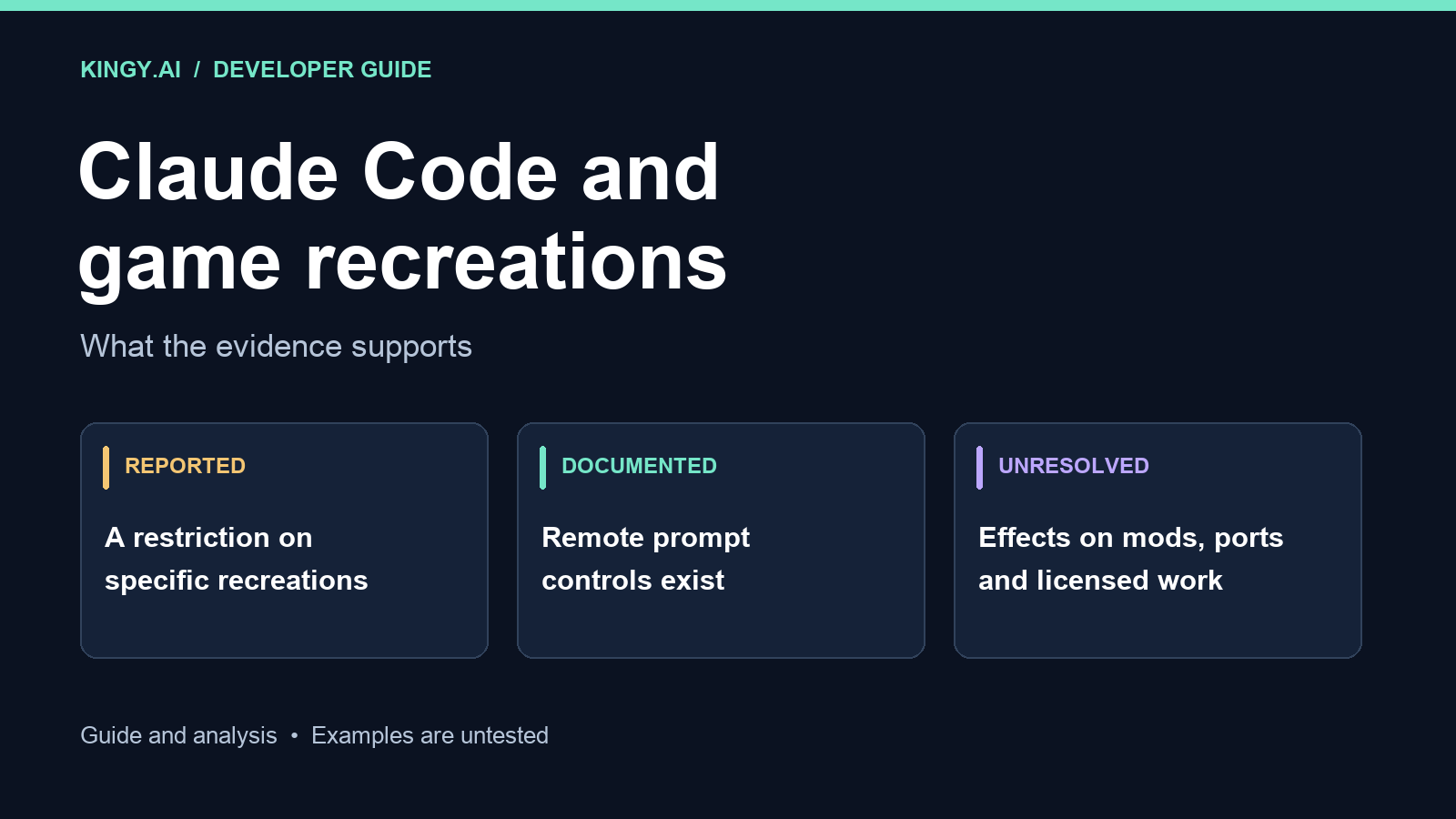
What the reported instruction says
The report describes an instruction that permits original games, games within a genre, and projects based on a user’s own designs and assets. Its reported restriction says: “Don’t build a recreation of a specific existing game, even if it is renamed or called original.”
The wording is significant because changing a title alone would not address the reported restriction. A prompt asking for a recognizable game’s same characters, levels, interface, and rules under a different name would still describe a recreation. By contrast, “make an original tactical game with a grid and turn-based movement” describes a genre and some mechanics without identifying a particular game to reproduce.
Those are interpretations of the reported text, not confirmed outcomes. We do not know the instruction’s current payload, how widely it was delivered, which models or Claude surfaces it affects, or how it handles authorized adaptations. Anthropic’s October 8 usage-policy announcement describes a separate policy update effective November 12, 2026; it does not announce this game-specific instruction. Its timing should not be treated as confirmation of the reported change.
The licensed developer report, and its limits
In an October 30 GitHub issue, a developer at Conflict Simulations LLC reports refusals in commissioned board-wargame adaptations using Opus 5.5, Max and Team accounts, and multiple Macs. He describes the work as licensed; contracts are not published.
His follow-up says work continued after the purported October 27 rollout. Refusals began after he asked Claude to assess the projects against the rule and persisted in sessions using the same repositories. Causality is unresolved.
There is no numeric CLI version or attached log establishing a controlled reproduction. The form’s Anthropic API label does not establish direct API behavior. Treat this as a report requiring investigation, not a demonstrated universal change.
A project-by-project guide
These categories are useful for describing a project to a coding assistant and to a lawyer or rights holder if needed. They do not predict a Claude response.
| Project | What to identify | What remains uncertain |
|---|---|---|
| Original game in a genre | Your own design, assets, and intended mechanics | Whether a particular prompt is sufficiently distinct in practice |
| Identifiable recreation | The existing game and the elements being reproduced | Whether the reported restriction applies to the requested task |
| Port of your own game | The source, assets, and rights you control | Whether Claude Code recognizes or accepts that authorization |
| Licensed remake or adaptation | The rights granted, material covered, and limits of the licence | Whether the tool makes an exception for the licensed work |
| Mod using an official SDK | The host game, SDK, allowed interfaces, and mod’s scope | Whether a particular mod task is accepted |
| Engine reimplementation or preservation | The code, assets, behavior, and distribution you plan to use | Both rights questions and the assistant’s handling of the request |
Original games and genre inspiration
A genre is a useful design starting point. You can ask for a deck-building roguelike, a physics platformer, or a turn-based tactics prototype while specifying your own setting, visual direction, level design, and progression. A useful brief explains the features you want rather than asking the assistant to reproduce the feel and details of one named game.
That does not mean every unnamed project is original. If a specification copies distinctive characters, art, maps, dialogue, audio, or presentation, removing the title does not change the underlying work. Conversely, a shared mechanic or genre label does not by itself establish that a project is a recreation. The exact facts matter.
Untested example: original prototype
Build a small original turn-based tactics prototype in Godot. Use a 7-by-7 grid, three original unit types, and a new science-fiction setting. Create placeholder shapes and original names. Implement movement, cover, and a basic enemy turn. Do not copy characters, maps, art, dialogue, or interface designs from a specific game. Explain how to run the prototype and list the files you create.
This is a proposed starting point, not a demonstrated acceptance test. A refusal or acceptance would still depend on the actual session and context.
Your own game, a licensed remake, or a commissioned port
If you own a game’s source and assets, a port can involve an existing game without being an unauthorized attempt to copy someone else’s work. Likewise, a studio might have a licence to adapt a publisher’s game or a commission to develop a digital version. The reported instruction does not tell us whether Claude Code distinguishes those situations reliably.
Describe the task and your authorization truthfully. A licence to use an asset may cover only that asset, a particular project, or a limited distribution channel. Owning a purchased copy of a game is not, by itself, proof of a right to reproduce and distribute it. Keep the actual licence handy for your own review; a prompt is not a substitute for checking its terms.
Untested example: port of a game you own
I created this game and control the source code and assets in this repository. Help me port the input and rendering layers from the existing desktop build to the new platform. Start by inspecting the interfaces, identify platform-specific dependencies, and propose a migration plan. Keep gameplay behavior unchanged and add tests for the input mapping. Ask before making assumptions about missing files.
Use that statement only if it is accurate. If your rights are limited, describe the limit instead. If the assistant refuses, record the response and ask support about the actual authorized project; do not invent an ownership claim or conceal the identity of the work.
Mods and official SDKs
Modding covers a broad range of work. An accessibility overlay using documented extension points is different from shipping a full game reconstruction. Valve’s Steam Workshop documentation describes tools and interfaces for creators to produce and distribute game content, including mods. It does not establish that Claude Code will accept a particular modding request, or that every game grants the same permissions.
For an SDK-based project, give the assistant the relevant documentation, the supported interface, and the boundaries of the change. Keep the request tied to a concrete task: for example, enlarging text through an exposed UI API, adding a configurable color palette, or fixing a bug in your own plugin. Check the game’s actual modding terms before distributing anything.
Untested example: accessibility mod
Using the supplied official SDK documentation, help me implement a mod that increases subtitle size and adds a high-contrast background through the documented UI extension points. The mod should read a local configuration file and leave game assets unchanged. Identify any SDK functions you cannot verify from the supplied documentation, and suggest a manual test for each setting.
This prompt describes a proposed SDK-based task; it establishes neither permission to distribute the mod nor Anthropic’s approval. If it fails, save the exact request and response rather than treating one refusal as proof of a blanket modding ban.
Engine reimplementation, decompilation, and preservation
An engine reimplementation may replace a game’s underlying code while relying on original data files. A preservation project may attempt to keep an old game playable on modern hardware. Decompilation or recompilation may involve transforming an existing program. These labels describe different technical approaches; none automatically answers the rights question or predicts the assistant’s response.
A clean-room process is also a method, not a universal legal exemption. The details can include who had access to original code, what specifications were written, what material is reused, and where the resulting work will be distributed. If you are planning a release, assess the relevant rights and licence terms for your circumstances. Do not assume that a preservation purpose or a free download settles them.
What copyright does and does not settle
Under US law, the US Copyright Office’s guidance on games distinguishes game ideas and methods of play from expressive material that can be protected. Its software guidance similarly distinguishes program expression from ideas, algorithms, systems, and methods.
Those distinctions are useful, but they are not a clearance certificate. Writing new code does not resolve whether a project reproduces protected artwork, characters, dialogue, music, or other expression, or whether other rights and contractual terms apply. Laws and results can differ by jurisdiction. For a significant commercial release or disputed project, get advice on the actual materials and permissions involved.
A provider can also set its own product rules. A task’s legal status and a coding assistant’s willingness to perform it are separate questions. A refusal does not prove infringement, and permission from a rights holder does not guarantee that an assistant will accept the work.
How to investigate a refusal without muddying the result
Start with a real coding task, not a request for the assistant to decide whether your entire project violates a rumored rule. Keep a policy discussion separate from the coding reproduction so readers can tell which context was present.
For a useful report, record:
- The date and time, including your time zone or UTC, and the Claude Code CLI version.
- The exact model identifier, product surface, provider, and account class, without sharing personal account details.
- The actual task and the complete relevant response, with private code and confidential material removed before sharing.
- Whether the session was new, which repository it used, and what project instructions,
CLAUDE.md, memory, or prior conversation were present. - Any settings you changed and the number of attempts, including successes as well as refusals.
A fresh scratch repository and a new session can help you separate task wording from accumulated context. Keep the model, version, and other settings matched when comparing attempts. Change one variable at a time, and record what changed. A few attempts can describe what happened to you; they cannot establish the behavior of every account or model.
Untested example: a narrow reproduction
In this sample repository, add a test for the supplied input-mapping function. The code and test fixture are mine to use. Run the existing test command if available, report the result, and show the diff.
Choose a sample that accurately reflects the problem without exposing client material. If the original refusal requires a named project or particular files to reproduce, note that limitation. Do not replace the real project with a materially different example and claim the same behavior has been established.
What about feature flags and environment variables?
Chasm identifies the delivery flag as tengu_heron_brook. The same name appears in the historical report below; its existence does not independently establish what instruction every current session receives. There is a reason developers are discussing remote configuration. In a historical Claude Code issue, a researcher described a mechanism for supplying strings through remote configuration to a system-prompt slot. An Anthropic-affiliated response discussed system-prompt experiments and traffic-related opt-outs. That history does not prove how the reported game instruction is delivered today, or even that it is an experiment.
Anthropic’s current environment-variable documentation says DISABLE_GROWTHBOOK=1 or true stops fetching feature flags and uses each flag’s code default. It leaves telemetry event logging on unless separately disabled. CLAUDE_CODE_DISABLE_NONESSENTIAL_TRAFFIC=1 also stops flag fetching, alongside auto-updates, telemetry, error reporting, feedback and other traffic. Remote Control and other features dependent on flag fetching become unavailable with either setting.
The settings have different value semantics: DISABLE_GROWTHBOOK=0 or false leaves fetching enabled, while any non-empty value for CLAUDE_CODE_DISABLE_NONESSENTIAL_TRAFFIC, including 0 or false, still disables the traffic. Unset that second variable to allow it again. These documented differences matter if you compare sessions.
Neither setting is a verified fix for a game-related refusal. Disabling a fetch does not tell us what defaults, cached values, or model behavior apply to your session. We found no documented game-specific switch. Do not delete caches or patch binaries on the assumption that doing so will resolve this issue. If you change a documented setting for your own investigation, record it and its side effects so your comparison remains interpretable.
When to escalate
If a refusal blocks authorized work, collect a minimal example and use the provider’s support or issue-reporting channel you normally trust. Describe the task, your relevant authorization, and the exact response. You can offer to provide contracts privately if requested; do not post client source code or confidential agreements in a public issue.
For work that can continue, split the project into honest, concrete tasks and keep a record of which ones work. You might be able to improve your test suite, document a platform interface, or work on independently authored tooling while you seek clarification. That is a project-management choice, not a promised bypass. If the result still blocks a licensed port or preservation project, preserve the reproduction and ask Anthropic how its current instruction applies to that specific authorized work.
The Kingy Brief
Get The Kingy Brief.
AI changes, original tests and one practical thing to try. Fridays at 09:00 Vancouver time.
Free · Double opt-in · Unsubscribe anytime
Sign up for The Kingy Brief on Beehiiv.
Signup help and newsletter schedule
Signup form provided by Beehiiv. After submitting, check your inbox for "Confirm your subscription to The Kingy Brief" and open its confirmation link. Check Spam or Promotions if you cannot find it.
Fridays at 09:00 Vancouver time: source-checked AI changes, original tests and one practical thing to try. We skip a week when there is not enough verified material. Free. Unsubscribe anytime.