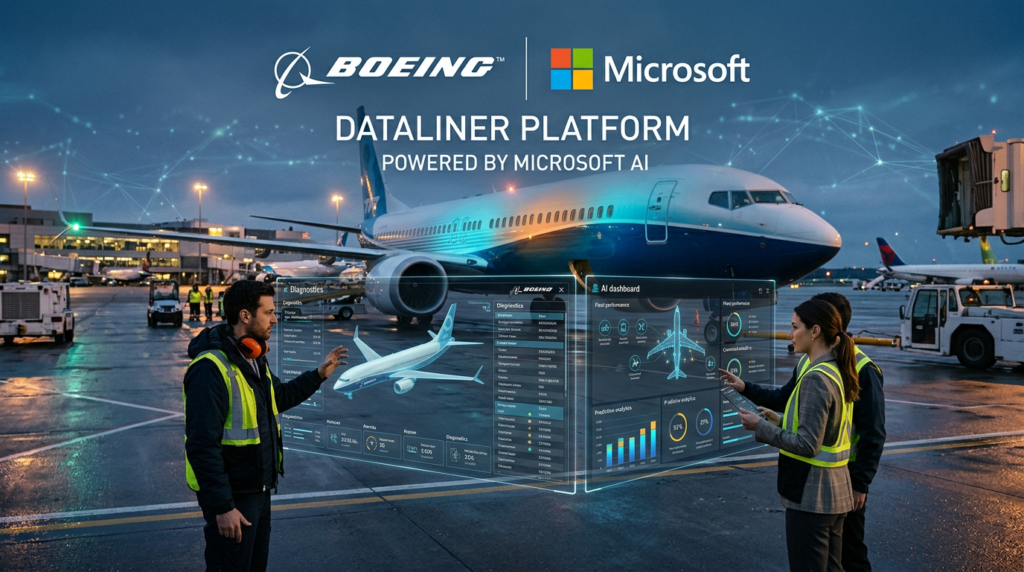
Boeing is bringing artificial intelligence deeper into commercial aviation through Dataliner, a new aircraft data intelligence platform developed using Microsoft technology. Designed to connect fragmented aircraft information, the platform aims to help airlines improve maintenance planning, streamline fleet management, and make smarter operational decisions.
Boeing Introduces a New Era of Aircraft Data Intelligence
Commercial aviation generates enormous amounts of information every day. From aircraft maintenance records to flight operations and fleet planning, airlines depend on data to keep their businesses running efficiently.
Unfortunately, having plenty of information does not always mean using it effectively.
On October 20, 2026, American aerospace manufacturer Boeing announced Dataliner, a new aircraft data intelligence platform developed with technology from Microsoft.
The platform is designed to help airlines connect information that traditionally exists across separate systems.
By combining aircraft data, advanced analytics, and artificial intelligence, Dataliner aims to give aviation professionals a clearer understanding of their operations.
Microsoft’s Azure AI Foundry is among the technologies supporting the platform.
The announcement represents another example of AI moving beyond chatbots and digital assistants into industries where operational reliability matters enormously.
For airlines, the potential advantages are substantial.
Better access to aircraft information could help maintenance teams identify issues, support more informed fleet planning, and reduce time spent searching through disconnected records.
However, Dataliner is a newly introduced platform.
Its long-term impact will depend on adoption, implementation, and measurable improvements in airline operations.
Why Airlines Have a Complicated Relationship With Data
Modern aircraft are sophisticated machines supported by extensive technical documentation and operational information.
Airlines must track maintenance activities, component histories, aircraft configurations, inspection schedules, and regulatory requirements.
They also manage information involving flight schedules, aircraft availability, and fleet utilization.
These records frequently originate from different software systems.
Some information comes from aircraft manufacturers.
Other records are maintained by airlines, maintenance providers, or specialized technology vendors.
Unfortunately, those systems do not always communicate efficiently.
A maintenance engineer might need to consult several applications before understanding the history of a particular aircraft component.
Fleet managers may face similar difficulties when comparing operational information across aircraft.
The problem becomes more complicated as airlines expand.
A carrier operating hundreds of aircraft can accumulate enormous volumes of technical and operational records.
Simply collecting more information does not solve the challenge.
Airlines need ways to organize that information and turn it into useful insights.
Dataliner is Boeing’s attempt to address this problem.
Rather than treating aircraft information as isolated records, the platform aims to create a more connected environment for analyzing aviation data.
What Exactly Is Boeing Dataliner?
Dataliner is an aircraft data intelligence platform intended to connect information across airline operations.
Its central purpose is to help aviation organizations access, organize, and interpret data more effectively.
Boeing describes the platform as a way to connect fragmented aircraft information and support more informed operational decisions.
This approach differs from traditional software that concentrates on a single aviation function.
For example, one system might manage maintenance documentation.
Another might track fleet availability.
A separate application could handle operational analytics.
Dataliner aims to make relevant information easier to use across these different activities.
Artificial intelligence plays an important role in that vision.
AI-supported capabilities could help users explore connected datasets, identify relationships, and obtain useful operational insights.
However, the platform should not be confused with an autonomous aircraft management system.
It does not mean that AI independently decides whether an aircraft is safe to fly.
Qualified aviation professionals remain responsible for operational decisions and compliance with applicable requirements.
Dataliner is better understood as a data intelligence environment designed to support human expertise.
Its success will depend on how effectively it helps aviation teams solve real operational problems.
Microsoft’s Azure AI Foundry Enters the Aviation Picture
Microsoft provides important technological capabilities supporting Boeing’s new platform.
Among them is Azure AI Foundry, Microsoft’s environment for developing, deploying, and managing AI applications.
The technology gives organizations tools for building AI-powered systems using cloud infrastructure and connected enterprise data.
For Boeing, these capabilities offer a foundation for developing sophisticated aviation analytics.
Dataliner can potentially use AI-supported processing to help users work with complex information.
Imagine a maintenance specialist investigating a recurring aircraft issue.
Instead of manually searching through numerous disconnected records, the specialist could potentially use an integrated interface to locate relevant information more efficiently.
Similarly, fleet planners might benefit from easier access to operational patterns across aircraft.
These examples illustrate the kinds of workflows that connected data and AI could support.
They should not be interpreted as independently verified demonstrations of every Dataliner feature.
Microsoft’s involvement also reflects a broader trend.
Major technology companies increasingly supply AI infrastructure for specialized industrial applications.
Rather than building every underlying capability independently, industry leaders can combine their domain expertise with established AI development platforms.
In this case, Boeing contributes aviation knowledge while Microsoft provides supporting technology.
Aircraft Maintenance Could Become More Data-Driven
Aircraft maintenance is among the most demanding responsibilities in commercial aviation.
Airlines must follow strict inspection requirements and ensure that maintenance activities are properly documented.
Unexpected technical problems can disrupt schedules and create additional expenses.
Accurate information is therefore essential.
Dataliner aims to support maintenance-related decisions by making aircraft information more accessible and connected.
Consider an airline investigating repeated maintenance reports involving a particular aircraft system.
Relevant information might exist in inspection records, component histories, and operational documentation.
A connected data platform could help engineers examine those records together.
That might make it easier to recognize patterns or identify areas requiring further investigation.
However, finding a pattern does not establish the cause of a technical problem.
Maintenance engineers must still inspect equipment, evaluate evidence, and follow approved procedures.
AI-generated insights should complement those responsibilities.
If Dataliner reduces the time required to locate and interpret relevant information, it could improve maintenance workflows.
Whether it reduces aircraft downtime or maintenance costs will require evidence from actual airline deployments.
Predictive Maintenance Is an Important Opportunity
One of aviation’s most promising technological developments involves predictive maintenance.
Traditional maintenance programs rely on established inspection intervals, operational requirements, and responses to identified problems.
Predictive approaches use available information to estimate when certain components may require attention.
AI and advanced analytics can potentially strengthen these capabilities.
For example, a system might examine historical maintenance records and operational measurements to identify unusual patterns.
Engineers could then investigate whether those patterns indicate a developing issue.
This approach may help airlines prepare for certain maintenance needs before they cause operational disruptions.
Dataliner’s broader data integration capabilities could support such applications.
Nevertheless, Boeing has not established that every predictive maintenance capability described in this discussion is available within the newly announced platform.
Predictive maintenance also has limitations.
Algorithms can generate false alarms.
They may overlook problems that differ from previously observed patterns.
Their performance depends heavily on data quality and appropriate validation.
Aviation safety requirements cannot be replaced by statistical predictions.
The most useful applications will combine advanced analytics with established engineering procedures and professional judgment.
Better Fleet Planning Could Help Airlines Operate Efficiently
Airline fleet management involves balancing numerous competing priorities.
Carriers must decide which aircraft to assign to routes, when to schedule maintenance, and how to manage available capacity.
Those decisions influence operational efficiency and customer experience.
A disruption affecting one aircraft can create consequences across several flights.
Fleet planners therefore benefit from accurate, timely information.
Dataliner is designed to support fleet-related decisions by connecting relevant aircraft and operational data.
An airline could potentially use improved analytics to understand patterns involving aircraft availability and maintenance requirements.
Such insights might help managers evaluate operational options.
For example, planners could compare available aircraft against upcoming maintenance commitments.
They could also investigate whether certain operational patterns deserve closer attention.
However, Dataliner should not be portrayed as automatically optimizing every airline schedule.
Its actual capabilities and performance will depend on the information connected to the platform and the applications deployed.
The potential advantage is better-informed decision-making.
For airlines managing complicated fleets, that could be valuable even without fully automated planning.
Airlines Will Retain Control Over Their Information

One important element of Boeing’s announcement concerns data ownership and control.
The company says airlines will retain control over the information they choose to share through Dataliner.
This commitment addresses a significant concern in enterprise technology.
Aircraft information can contain commercially sensitive operational details.
Maintenance histories, fleet performance records, and internal planning information may influence competitive decisions.
Airlines therefore have legitimate reasons to carefully manage how their information is accessed and used.
A platform requiring unrestricted sharing of sensitive data could encounter resistance.
Boeing’s stated approach aims to give customers greater control.
However, data control involves more than a general commitment.
Airlines will need to evaluate contractual arrangements, access permissions, cybersecurity protections, and data governance procedures.
They should also understand how information is processed and which organizations can access particular datasets.
These considerations become especially important when cloud computing and AI services are involved.
The platform’s ability to earn customer trust could influence its adoption.
For aviation organizations, useful analytics must come with dependable information governance.
Why Data Security Matters in Commercial Aviation
Commercial aviation depends on highly reliable digital systems.
Airlines use software to support maintenance, scheduling, logistics, customer operations, and numerous other activities.
Connecting more information can improve efficiency.
However, it can also create additional cybersecurity considerations.
Dataliner’s proposed integration of aircraft information makes security an important implementation requirement.
Organizations must ensure that authorized personnel can access the information they need without exposing sensitive systems unnecessarily.
Strong authentication, appropriate access controls, monitoring, and secure system integration are essential considerations.
AI introduces further challenges.
A system interpreting operational information must produce outputs that users can evaluate and verify.
Incorrect or misleading information could create confusion.
Organizations should therefore establish procedures for checking important results before acting on them.
Another consideration involves maintaining reliable records.
Aviation organizations must preserve documentation needed for maintenance oversight and regulatory compliance.
AI-generated summaries cannot substitute for required technical records.
Dataliner’s practical value will depend partly on how well it supports these existing responsibilities.
In aviation, technological convenience must never come at the expense of safety or accountability.
Could Dataliner Reduce Airline Operating Costs?
Operating an airline involves substantial expenses.
Aircraft maintenance, staffing, fuel, airport services, and fleet management all contribute to financial performance.
Unexpected disruptions can create additional costs.
A technical problem may require replacement aircraft, revised schedules, or additional maintenance resources.
Consequently, airlines have strong incentives to improve operational efficiency.
Dataliner could potentially help by making information easier to access and analyze.
Maintenance teams might spend less time searching for relevant records.
Fleet managers could gain clearer visibility into aircraft availability.
Operational teams might identify certain issues earlier.
These improvements could translate into financial benefits.
However, Boeing has not provided independently verified figures establishing how much money Dataliner will save airline customers.
Implementation also involves costs.
Airlines may need to connect existing systems, train employees, and maintain appropriate cybersecurity controls.
The economic benefits will therefore depend on actual performance.
A useful evaluation would compare implementation expenses against measurable improvements in productivity, operational reliability, and decision-making.
For airline executives, those results will matter more than broad promises about AI efficiency.
Boeing Is Expanding Its Digital Aviation Business
Boeing is best known for manufacturing commercial aircraft.
However, the company also provides aviation services, maintenance support, training solutions, and digital technologies.
Dataliner fits within that broader business.
Instead of concentrating exclusively on aircraft hardware, Boeing is developing tools intended to help customers manage information throughout aircraft operations.
This approach reflects the increasing importance of software in aviation.
Modern airlines depend on digital systems for numerous operational responsibilities.
Aircraft manufacturers also possess extensive technical knowledge that can support specialized applications.
Boeing can potentially combine its understanding of aircraft systems with Microsoft’s cloud and AI technologies.
That combination could help the company develop services that remain relevant throughout an aircraft’s operational life.
The opportunity extends beyond selling new aircraft.
Digital services can support long-term customer relationships.
Nevertheless, airlines will evaluate such products according to their usefulness, reliability, and integration requirements.
Boeing must demonstrate that Dataliner delivers practical value in environments where established software systems already exist.
Microsoft Continues Expanding Industrial AI Applications
Microsoft’s participation in Dataliner reflects its wider efforts to bring AI into enterprise and industrial environments.
The company provides cloud infrastructure, analytics services, and AI development technologies used across multiple industries.
Manufacturing, transportation, healthcare, and financial services all present opportunities for specialized AI applications.
Commercial aviation is particularly demanding because of its technical complexity and regulatory requirements.
For Microsoft, working with Boeing offers an opportunity to support AI applications grounded in extensive industry expertise.
Azure AI Foundry provides tools that developers can use to build and manage AI systems.
Boeing contributes knowledge of aircraft operations and the needs of aviation customers.
Together, these capabilities could support applications that would be difficult to develop using general-purpose AI tools alone.
The partnership also illustrates how industrial AI differs from consumer-facing chatbots.
Users need dependable access to relevant information.
They also require integration with established systems and clear procedures for reviewing important outputs.
The success of Dataliner will depend on these practical considerations.
The Challenges of Connecting Fragmented Aviation Systems
Combining information from different airline systems sounds straightforward.
In practice, it can be extremely complicated.
Airlines operate software developed by different vendors over many years.
Some applications use modern interfaces.
Others depend on older databases and specialized technical formats.
Information may also be recorded differently across departments.
A maintenance system might identify an aircraft component using one convention.
Another application could use a different structure.
Connecting those records requires careful data mapping and validation.
Incomplete or inconsistent information creates further difficulties.
AI cannot automatically correct every problem involving inaccurate source data.
Organizations must establish dependable processes for identifying errors and maintaining information quality.
Integration also requires cooperation between technology teams and aviation specialists.
A system that works well technically may still be difficult to use if it does not fit established workflows.
Dataliner’s ability to handle these challenges will influence its effectiveness.
Successful deployment may require substantial preparation before customers experience the full benefits of connected analytics.
Human Expertise Remains Essential to Aviation Safety
Artificial intelligence can process information rapidly.
It can identify patterns, organize records, and help users investigate complicated questions.
However, commercial aviation depends on professional judgment and established safety procedures.
Pilots, maintenance engineers, dispatchers, and other qualified personnel carry responsibilities that cannot simply be transferred to AI software.
Dataliner is intended to support operational decision-making.
It should not be interpreted as replacing the people responsible for aircraft safety.
For example, an AI system might highlight maintenance information that deserves attention.
A licensed professional must still determine the appropriate inspection or corrective action.
Similarly, fleet planning insights must be evaluated alongside operational requirements.
Human oversight also helps address AI limitations.
Models may misunderstand information, overlook relevant details, or generate inaccurate conclusions.
Those risks become especially important when software is used in safety-sensitive environments.
Organizations adopting Dataliner will need appropriate training and review procedures.
The most effective implementation would give aviation professionals better information while preserving clear accountability.
Dataliner Could Influence the Future of Airline Operations
Boeing’s introduction of Dataliner highlights an important direction in aviation technology.
Airlines already generate extensive operational information.
The next challenge involves connecting that information and making it more useful.
Dataliner aims to address this opportunity through a combination of aircraft expertise, data integration, and AI technology.
Microsoft’s involvement provides supporting cloud and AI development capabilities.
Potential applications include maintenance analysis, fleet planning, and operational decision support.
However, the platform’s long-term impact remains uncertain.
Boeing will need to demonstrate that Dataliner integrates effectively with existing airline systems.
Customers will need evidence that it improves workflows without introducing unacceptable risks.
Security, information governance, and regulatory compliance will remain important considerations.
If the platform delivers measurable benefits, it could strengthen the role of connected analytics in commercial aviation.
That would represent meaningful progress toward more data-driven airline operations.
A Smarter Aviation Industry Begins With Better Information

Artificial intelligence is often associated with dramatic technological breakthroughs.
In commercial aviation, some of its most useful applications may be considerably less flashy.
Helping engineers locate relevant maintenance records faster could improve productivity.
Giving fleet managers a clearer picture of aircraft availability could support better planning.
Connecting fragmented information could reduce unnecessary administrative work.
These improvements may not generate spectacular headlines.
However, they address practical challenges that aviation professionals encounter regularly.
Boeing’s Dataliner represents an attempt to bring these capabilities together within a dedicated aircraft data intelligence platform.
Microsoft contributes technologies intended to support the underlying AI applications.
Boeing provides aviation expertise and an understanding of customer requirements.
The result is a platform designed to help airlines make better use of information they already possess.
Whether Dataliner becomes a major aviation technology success will depend on its performance in real operating environments.
For now, the announcement demonstrates how AI is expanding into specialized industrial applications.
The future of aviation may involve increasingly sophisticated aircraft.
But it will also depend on something less visible and equally important: helping the people responsible for those aircraft make better-informed decisions.
Sources
- Boeing — Boeing Introduces Dataliner, a New Aircraft Data Intelligence Platform
- Aviation Week — Boeing Launches AI-Powered Data Platform for Digital Services
- Cinco Días — Boeing Impulsa la Inteligencia de Datos de las Aerolíneas con una Plataforma de IA Junto a Microsoft
- Investor’s Business Daily — Boeing Dataliner and Microsoft AI Coverage
The Kingy Brief
Get The Kingy Brief.
AI changes, original tests and one practical thing to try. Fridays at 09:00 Vancouver time.
Free · Double opt-in · Unsubscribe anytime
Sign up for The Kingy Brief on Beehiiv.
Signup help and newsletter schedule
Signup form provided by Beehiiv. After submitting, check your inbox for "Confirm your subscription to The Kingy Brief" and open its confirmation link. Check Spam or Promotions if you cannot find it.
Fridays at 09:00 Vancouver time: source-checked AI changes, original tests and one practical thing to try. We skip a week when there is not enough verified material. Free. Unsubscribe anytime.