Published October 19, 2026. Legal and legislative status checked on that date. The Federal Register notice is scheduled for October 20 publication. Forecasts below are Kingy.ai’s analysis.
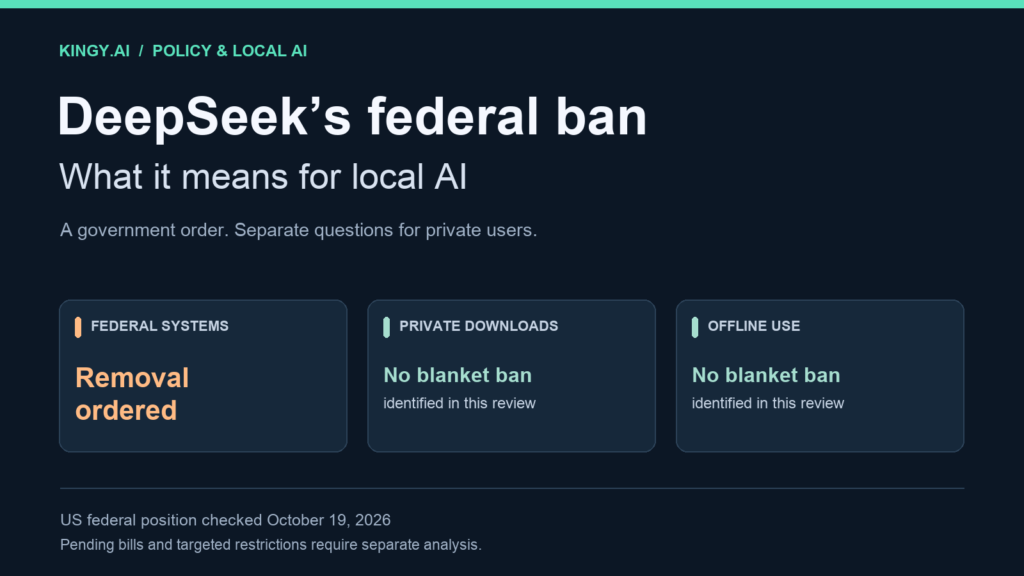
The US Department of Homeland Security has ordered DeepSeek out of federal civilian agency IT and procurement. Its language reaches third-party products built using DeepSeek implementations, raising a practical question for anyone who runs downloadable AI models: how far can a restriction follow the technology?
For private users, the immediate answer is reassuring but limited. Kingy.ai found no enacted federal blanket prohibition on an ordinary individual downloading Chinese model weights or running them offline. Government systems, federal contracts, imports, commercial hosting and private possession are different legal categories. A restriction in one category does not automatically extend to the others.
There are nevertheless concrete reasons to pay attention. A pending Senate bill would prohibit importing Chinese AI technology. Other proposals would sanction particular developers. Existing Commerce Department powers can reach private-sector technology transactions. Each route could change access before any government attempts to prohibit inference on a home computer.
This article examines those routes, the security case, the competition concerns and the evidence that still points toward continued support for open models.
What the DHS order does
The official six-page document was filed for public inspection on October 19. Its signed appendix carries an original release date of July 24, 2026. The filing therefore publicizes an existing order; it is not a consultation proposing a new consumer ban.
Under the Federal Acquisition Supply Chain Security Act, DHS directs affected civilian agencies to exclude DeepSeek and affiliate products from procurement and remove them from IT, including “third-party products and services developed using DeepSeek implementations.” The appendix calls for action immediately after issuance, or an exception request. Its 60-day provision concerns submitting exception requests, rather than a general 60-day removal allowance.
The breadth of that third-party language matters. Self-hosting is not expressly exempted. Our reading is that local deployment on an affected agency system would remain covered. Treatment of particular fine-tunes, distillations and more remote derivatives needs clarification. The document does not establish a prohibition on private household possession.
The same model can face different rules in different settings
| Setting | Practical position on October 19 |
|---|---|
| Affected federal civilian agency | The DHS removal and procurement order applies, subject to exceptions. |
| Federal contractor or subcontractor | Check the applicable order, contract clauses, modifications and work performed. Obligations can extend through the supply chain. |
| Private company doing unrelated commercial work | The DHS order does not automatically prohibit all of its DeepSeek use. |
| Individual running a model on a personal computer | No general federal Chinese-model download or offline-use ban was identified in this review. |
| Public employee, student or researcher | Institutional devices, networks, contracts and research rules can impose additional limits. |
There is already an enacted intelligence-community measure. Public Law 119-60, section 6604, requires standards removing covered DeepSeek applications from intelligence-community national-security systems, including contractor-operated systems. It includes national-security and research exceptions. That scope should not be confused with every privately owned machine.
State restrictions also require careful reading. Tennessee’s published action, for example, concerns its state network and government technology. A campus or employer can restrict a model on its infrastructure even when personal offline use is outside a federal prohibition. We have not conducted a complete 50-state survey.
The security case deserves a deployment-specific answer
DHS’s stated rationale includes exposure of sensitive information through Chinese-hosted services, foreign-government access and software security concerns. Those are serious considerations for an agency handling personnel records, investigations or operational information. The signed order is evidence of the government’s risk determination, not a published forensic demonstration that every offline copy contains a backdoor.
There is concrete historical research behind some app-level concerns. In February 2025, NowSecure documented flaws in the DeepSeek iOS app, including unencrypted transmission of some registration and device information, weak encryption practices and insecure local storage. Those findings concern the app and version examined then. They do not establish the security condition of every current release or a separately downloaded model.
NowSecure’s own recommendations included considering alternative hosting or self-hosting. That distinction helps explain the disagreement: the risk of submitting documents to a remote service differs from the risk of executing a model through a locally controlled runtime.
A genuinely disconnected deployment cannot send prompts to a remote API while it remains disconnected. But the complete installation still matters: the model-file format, loader, dependencies, update process, plugins and tools. Hugging Face’s security documentation explains why some serialized model files can execute code during loading. Downloadable weights are not a substitute for inspecting the software that loads them.
Tool access adds another distinction. A local assistant given a shell, a browser or document-write permission can act through those tools. Keeping inference on your machine does not make every action it proposes safe. Conversely, an app’s telemetry finding should not be presented as proof that an inert weights file independently phones home.
A proportionate security assessment should identify the failure being controlled. Network isolation addresses outbound data flows. Restricted tools address actions. File provenance and dependency review address parts of the software supply chain. Evaluations address behavior. Some government procurement decisions also weigh foreign jurisdiction and supplier trust, which a technical mitigation may not resolve.
Federal contracts can move the boundary into private businesses
The near-term commercial effect could be larger than the number of government employees using DeepSeek.
FAR 52.204-30 prohibits contractors from providing or using covered products as part of contract performance when an applicable FASCSA order prohibits them. It also contains reporting requirements and subcontract flow-down provisions. Orders issued after solicitation have specified incorporation rules; a new order does not silently rewrite every existing contract. FAR 4.2304 describes the contracting procedures.
Consider a hypothetical software vendor serving both a civilian agency and local retailers. It might maintain different model configurations, or decide that removing the restricted model across its product is cheaper than operating separate versions. Its commercial customers could lose an option because of that business decision even though the order does not directly prohibit their use.
This is one plausible way restrictions spread. Procurement questionnaires, supplier assurances and internal policies can influence model selection beyond the legal minimum. It remains a forecast, not evidence that every cloud provider or enterprise has already adopted the same policy.
S.321 could reach private downloads, but remains a bill
Senator Josh Hawley’s S.321, the Decoupling America’s Artificial Intelligence Capabilities from China Act, is the clearest direct proposal identified in this review. Section 3 would prohibit importing Chinese-developed AI technology or intellectual property beginning 180 days after enactment. Its broad definitions provide no explicit free-model or personal-research exemption.
Downloading weights into the US could fall within that language. That is our interpretation, subject to regulations and legal review. Switching off the network afterward would not reverse a prohibited import. The text does not expressly prohibit merely retaining an existing copy or ordinary offline inference, although it separately restricts specified research collaborations and research transfers involving China.
S.321 has not become law. The current GPO status record still lists its latest action as referral to the Senate Judiciary Committee on January 29, 2025. Introduction demonstrates a legislative proposal exists; it does not establish congressional support sufficient for passage.
Other bills target agencies, developers or transactions
The China FIREWALL Act, H.R.10670, introduced October 1, would require executive agencies to remove covered applications and prohibit procurement, including software using covered foundation models. It remains referred to committee. Its broad model coverage concerns government IT and purchasing, without establishing a general private-device prohibition.
The pending H.R.1121 and S.765, titled the No DeepSeek on Government Devices Act, also concern government systems. The No Adversarial AI Act, H.R.4142, would establish a foreign-adversary AI list and an agency exclusion-and-removal review process. None of these texts creates an ordinary household possession ban.
Sanctions proposals could affect private access through a different mechanism. The BLADE Act, S.5252, would require blocking sanctions and Entity List additions for identified foreign actors involved in covered model-extraction attacks. Its status record shows referral to the Senate Banking Committee on August 5, 2026.
H.R.8283, the Deterring American AI Model Theft Act, proposes discretionary blocking sanctions. It was ordered reported, as amended, on April 22; it is not enacted. A sanctions regime could restrict payments, services or other dealings with designated entities. Its effect would depend on the eventual law, designations, licenses and exceptions. Neither proposal expressly establishes a blanket ban on private offline inference.
Distillation itself also needs precise language. The September 8 NSA, FBI and CISA advisory describes alleged industrial-scale extraction campaigns and recognizes distillation as a legitimate research technique. Training on another model’s outputs, unauthorized account use and unlawful acquisition of protected information are not interchangeable claims.
Further restrictions would not necessarily require a new act of Congress
Commerce already has a process for reviewing certain foreign-adversary information and communications technology transactions. 15 CFR 791.1 covers determinations involving acquisition, importation, installation, dealing in and use; 791.3 explicitly includes artificial intelligence among the technology categories.
This is existing authority for further action, not a current blanket prohibition on Chinese models. Any attempt to apply it to a particular model or class of transactions would need its own legal basis, scope and process. Standalone offline weights would raise questions that cannot be answered by citing the existence of the regulation alone.
It is also important to distinguish Commerce’s Entity List from Treasury blocking sanctions. The Entity List generally controls exports, reexports and transfers of items subject to US export rules to listed parties. A listing alone should not be described as a universal ban on Americans buying or downloading everything that party produces. BIS’s explanation of its jurisdiction separately identifies Treasury’s controls over imports and financial dealings.
US policy also contains substantial support for open models
The policy picture includes measures that pull in another direction. The White House’s July 2025 AI Action Plan supports open-source and open-weight models, citing research, competition and sensitive-data deployments. Its emphasis on American leadership leaves room for support for domestic openness alongside restrictions on particular foreign suppliers.
The June 2, 2026 executive order establishes a voluntary frontier-model review framework. Section 3(c) expressly says that section does not authorize mandatory government licensing, preclearance or permitting for new AI model development or release. This provision is meaningful, although it does not abolish other legal authorities or guarantee future policy.
Congress has a counterproposal too. H.R.10152, the Open-Source AI Leadership Act, promotes qualified American open models and assessments of foreign-adversary models. Section 4 expressly denies authority under the bill to ban, restrict or make an open model unavailable in interstate or foreign commerce. It was ordered reported on September 16 and remains pending.
The commercial arguments deserve scrutiny on both sides. Restricting inexpensive or customizable alternatives could increase dependence on a smaller supplier pool. Domestic open-model developers could also benefit, so a foreign-model restriction does not necessarily mean a move to closed APIs. The result would depend on which alternatives remain available and how buyers respond.
Companies defending open weights have commercial interests as well. Chip vendors, hosting firms and application developers can benefit when customers run their own inference. That does not invalidate the case for openness; it means policy arguments should be assessed on evidence rather than assumed altruism.
The July 24 industry letter hosted by NVIDIA argues that open weights support competition, customer control and security research, while acknowledging that released weights are hard to recall. It advocates targeted responses to unlawful extraction. This is an industry position, not an independent finding that every open model is safe.
China can also influence what becomes available overseas
Access depends partly on the exporting country. On October 16, China’s commerce and science ministries announced proposed technology-export catalogue revisions and temporary pre-export registration measures. The Commerce Ministry’s accompanying Q&A says the proposed additions include 23 AI-related technologies.
The same explanation describes easier licensing for open-source releases, proposes excluding relevant technology already in the public domain, and distinguishes overseas deployment of restricted technology from several API, app, SaaS and lightweight endpoint delivery arrangements. These are translations and paraphrases of the ministry’s Chinese-language explanation.
The proposal should therefore not be summarized as China banning all open-weight exports. Nor should its draft status obscure the temporary registration measures announced alongside it. Final rules, thresholds and implementation will matter.
For developers, the broader implication is uncertainty at both ends of a release. US restrictions could constrain imports or transactions; Chinese rules could influence future transfers or release arrangements. Neither fact proves that weights already held by a private user are about to be confiscated or remotely disabled.
Four plausible paths from here
The following are scenarios, not announced policy or numerical predictions.
1. Restrictions remain concentrated in government and sensitive work
Agencies implement the order, contractors review their obligations, and private users retain access. Buyers outside government may still adopt more cautious policies. This path requires no household ban and is consistent with the limited scope of the measures already discussed.
2. Supplier and model-origin checks become routine
Software buyers could increasingly ask which base models, fine-tunes, hosting providers and dependencies sit behind an AI feature. A supplier might need separate configurations for different customers or countries. The cost would include migration, evaluation and documentation, not only replacement inference charges.
Definitions would become consequential. A rule covering model weights, a hosted service and an application that merely consumed generated text can produce very different obligations. The phrase “developed using” leaves questions that vendors should seek to resolve rather than confidently guess.
3. Targeted restrictions reduce commercial access
Sanctions or technology-transaction determinations could make a developer harder to pay, host or support. Platforms might remove an offering to reduce uncertainty. An individual could experience a smaller model catalogue even if possessing an old download remained outside the restriction.
Commercial enforcement has identifiable intermediaries: payment providers, hosts, marketplaces and enterprise suppliers. That makes access restrictions a plausible policy route without establishing that every such route would be legally justified.
4. Lawmakers attempt broader import or private-use controls
S.321 shows that a broad import prohibition has already been proposed. A prohibition on continued private offline use would be a further step, requiring attention to its exact text, scope and enforcement basis. A downloadable model can be copied, modified and disconnected; practical difficulty enforcing a rule would not itself make the prohibited conduct lawful.
The political and legal costs could also be greater. Researchers, small businesses and users would have reasons to challenge restrictions that prevent legitimate work or favor particular suppliers. The current evidence does not establish that this scenario is inevitable, imminent or supported by a congressional majority.
What users and builders can do now
Private hobbyists should distinguish a proposal from an effective prohibition. This review gives no basis for telling ordinary users to delete every Chinese model, and no basis for promising permanent immunity from future rules.
For anyone relying on local AI, useful records include the exact model name and version, source repository, license, file hashes, runtime and installed tools. Those records help with security review, reproducibility and future migration. They are not a legal exemption.
Federal suppliers should identify where covered technology is provided or used in contract performance and review the relevant clauses with the contracting office. A commercial product’s branding may reveal less than its underlying model configuration. Unrelated private work should be assessed under the rules that actually apply to it.
Product teams can reduce disruption by keeping application data and evaluation tasks portable. Switching the model name in a configuration file may change output quality, tool behavior, context handling and operating costs. A tested alternative is more useful than a list of interchangeable-looking model IDs.
For more context, see Kingy.ai’s earlier analysis of possible open-model restrictions and our DeepSeek local-hardware guide. Hardware feasibility and permission to use a model are separate questions.
The next evidence to watch
Watch for an enacted bill, a final Commerce determination, an actual sanctions designation, a contract modification or published implementation guidance. Each can change obligations. A hearing, an official’s criticism or a headline predicting a ban establishes much less.
For local AI, the decisive language will identify the regulated activity: obtaining new weights, distributing copies, selling hosted access, performing government work, retaining a copy or running inference. Any future report should say which activity the rule reaches, who is bound, when it takes effect and what exceptions apply.
Research note: Kingy.ai reviewed the DHS notice and signed appendix, cited statutes and regulations, congressional bill texts and GPO status records, original security research, US policy documents and China’s official October 16 explanation. We distinguish agency findings, historical technical results, legal interpretation and forecasts. This is explanatory reporting, not an individualized legal opinion. We did not perform a new model-security audit or a complete 50-state legal survey.
The Kingy Brief
Get The Kingy Brief.
AI changes, original tests and one practical thing to try. Fridays at 09:00 Vancouver time.
Free · Double opt-in · Unsubscribe anytime
Sign up for The Kingy Brief on Beehiiv.
Signup help and newsletter schedule
Signup form provided by Beehiiv. After submitting, check your inbox for "Confirm your subscription to The Kingy Brief" and open its confirmation link. Check Spam or Promotions if you cannot find it.
Fridays at 09:00 Vancouver time: source-checked AI changes, original tests and one practical thing to try. We skip a week when there is not enough verified material. Free. Unsubscribe anytime.