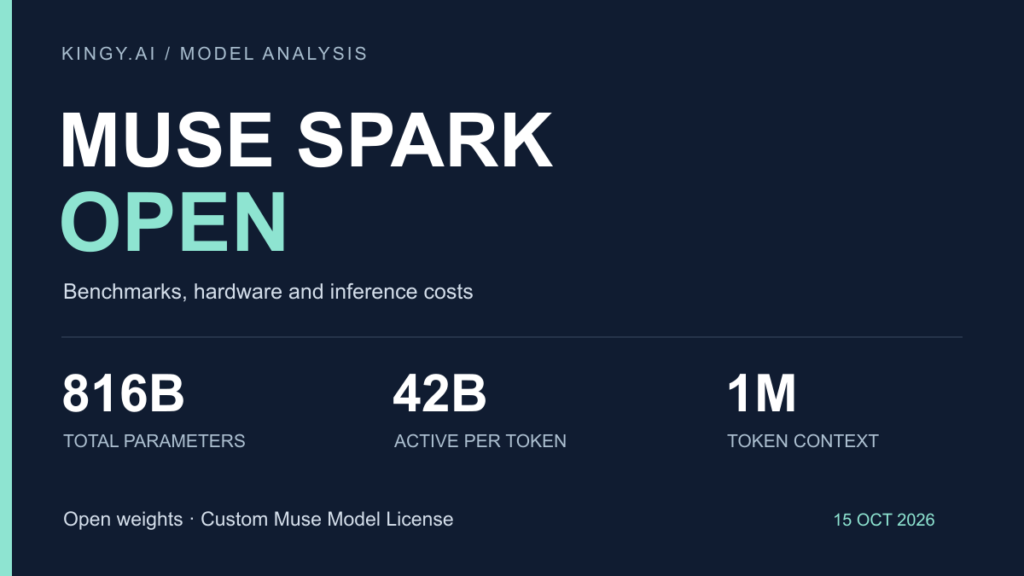
Meta released Muse Spark Open on October 15, 2026, giving developers downloadable weights for an 816-billion-parameter multimodal model built for coding and agents. It activates 42 billion parameters per token and supports a context window of 1,048,576 tokens. The launch puts a substantial new option on the table for organizations that want to operate their own AI. Meta announcement, developer overview.
The buying decision takes more work than the launch headline suggests. Spark Open has competitive agent results, a large memory footprint, meaningful license conditions, and published Mac performance that deserves a close reading. Its place in the market also depends on whether you care most about raw capability, local control, inexpensive inference, or reproducible research.
Our assessment is that Spark Open deserves evaluation for private multimodal agents and self-hosted coding systems. The evidence does not establish it as the best model across workloads. A hosted trial is the sensible first step for most buyers; a workstation purchase should follow a measured workload advantage.
Evidence checked October 15, 2026. This is a source-based launch analysis. Benchmarks below come from the identified evaluators and model developers; Kingy has not run a new hands-on Spark Open test. Prices are in US dollars unless stated otherwise.
What Meta released and how it differs from Spark 1.3
The exact release name is Muse Spark Open. Its full-precision repository is meta-models/Muse-Spark-Open-816B-A42B, with a separate NVFP4 checkpoint. Meta describes the model as derived from the Spark model released in August, with additional safety post-training for standalone deployment. That description does not establish that these are identical weights to September's hosted Muse Spark 1.3. Meta model page.
Muse Wonder and Muse Wonder Full are separate models. Their product features, performance, subscriptions, memory systems, and benchmarks should stay attached to their own versions. Earlier Kingy tests of Spark 1.3 remain evidence about that hosted model and those dated trials. They do not become tests of Spark Open because the names share a family.
Meta distributes the weights through several cloud and model platforms and names multiple hosted inference partners. Access to weights and access to an API are different routes: the former gives you responsibility for operating the model; the latter gives you a provider's particular implementation and commercial terms. Meta release and distribution links.
Specifications and architecture
The following architecture figures are Meta's model-card disclosures, rather than measurements obtained by inspecting the weight tensors.
| Specification | Muse Spark Open |
|---|---|
| Total parameters | 816 billion |
| Active parameters per token | 42 billion |
| Architecture | Sparse mixture-of-experts Transformer |
| Transformer layers | 62 |
| Hidden width | 8,192 |
| Experts | 256, with eight selected per token |
| Attention | 128 query heads, 16 key/value heads, head dimension 64 |
| Vocabulary | 202,048 tokens |
| Perception encoder | 1.8 billion parameters, 50 layers |
| Maximum model context | 1,048,576 tokens |
| Native inputs | Text, images, audio, video |
| Native output | Text |
| Official weight formats | BF16 and NVFP4 |
Sources: Meta's model overview for model size, context, modalities and checkpoint formats; official model card for layer, attention, vocabulary and perception-encoder details.
Multimodal input allows workflows involving screenshots, recordings, documents, and visual feedback. It does not mean the model generates images, video, or speech. An application that produces those assets would need additional components. Meta developer overview.
A practical architectural distinction is the split between parameter storage and computation. In a mixture-of-experts model, routing selects part of the network for each token. Different tokens can select different experts, so the server still needs access to the entire expert pool. The approximately 5.1% active-to-total ratio is useful context for computational sparsity; it is not a prediction that the system will cost 5.1% as much as a dense model or require 5.1% of the memory.
Memory bandwidth, attention, routing, communication between devices, batching, and the implementation all affect performance. Comparing models by active parameters alone misses those costs. Comparing them by total parameters alone misses sparsity. The useful measurement is how quickly and reliably a complete deployment finishes your work.
Independent results against open and frontier models
Artificial Analysis provides a useful common reference because its index includes both downloadable and closed models. The following figures come from one October 15 snapshot, retrieved at approximately 20:35 UTC, or 1:35 p.m. Pacific. Scores are rounded to one decimal; effort settings and fallback labels matter.
| Model and evaluated setting | AA Intelligence Index |
|---|---|
| Claude Opus 5.5, max, default fallback | 57.6 |
| Claude Sonnet 5.5, max, default fallback | 56.0 |
| Muse Wonder Full, max | 55.8 |
| GPT-6 Astra, max | 52.7 |
| Gemini 4 Argon, high | 52.6 |
| GPT-6.1 Sol, max | 51.8 |
| MiMo-V2.6-Pro | 46.3 |
| GLM-5.3, max | 44.8 |
| Kimi K3, max | 43.6 |
| Qwen3.8 2.4T A95B | 39.9 |
| DeepSeek V4.1 Flash, max | 39.5 |
| Muse Spark Open, xhigh | 38.9 |
Source: Artificial Analysis model comparison, index v4.3.2, October 15 snapshot. The Spark Open score is marked as measured rather than estimated in the evaluator's published data.
This index places Spark Open near several capable open alternatives, with a substantial gap to the leading closed models in this selection. An index point is not a percentage of intelligence, task success, or business value. Similar totals can conceal different strengths, and the table does not represent every model or every configuration.
One component deserves attention: the current index includes Terminal-Bench 4.0. The same October 15 Artificial Analysis snapshot gives the following results:
| Evaluated model and setting | Terminal-Bench 4.0 % |
|---|---|
| Claude Sonnet 5.5, max, default fallback | 63.6 |
| Claude Opus 5.5, max, default fallback | 59.6 |
| GPT-6 Astra, max | 59.1 |
| Gemini 4 Argon, high | 57.1 |
| GPT-6.1 Sol, max | 56.1 |
| GLM-5.3, max | 41.9 |
| Kimi K3, max | 12.6 |
| Muse Spark Open, xhigh | 8.1 |
Source: Artificial Analysis's coding-agent results. These results expose a weakness obscured by Spark Open's headline 76.4 on Terminal-Bench 2.1. Version 4.0 uses a different task set; 8.1 and 76.4 do not measure success on the same problems. Neither their difference nor their ratio measures a change in the model's ability. The evaluator identifies 66 tasks for 4.0; Meta's methodology identifies 89 for 2.1.
The broader profile is mixed too. In that same snapshot, Spark Open scores 43.9% on HLE without tools, versus 61.4% for Opus 5.5, 57.1% for Argon, and 52.9% for Sol 6.1. Spark Open's 58.4% SciCode result exceeds Astra's 56.5% and Sol's 54.2%, while trailing Opus's 66.9%. A model can be useful in scientific coding without matching frontier performance across the whole suite. Artificial Analysis.
Meta's release table uses an earlier Artificial Analysis v4.3 snapshot dated October 7. Its rounded Spark Open score of 39 is consistent with the current 38.9, but other entries can move. Its GDPval-AA comparisons also use the earlier snapshot. Keep dates attached to those results instead of combining the tables into a supposedly synchronized launch-day leaderboard. Meta evaluation methodology.
Meta's claim to US open-weight leadership should also retain its attribution. It is narrower than worldwide model leadership, and a selected benchmark suite cannot settle every interpretation of “most capable.” Country of development can matter for procurement; it does not substitute for workload evidence.
Meta's agent reasoning and coding results
Meta's published comparison shows a more uneven and useful picture than a single winner label. These are numbers reproduced from its model page and release materials, not new Kingy measurements.
| Benchmark | Spark Open xhigh | Qwen3.8 2.4T xhigh | GLM 5.3 max | Kimi K3 max |
|---|---|---|---|---|
| JobBench | 61.8 | 52.7 | 61.4 | 54.3 |
| MCP-Atlas | 89.2 | 84.5 | 84.2 | 82.3 |
| GDPval-AA v2 rating | 1401 | 1613 | 1653 | 1537 |
| HLE-Diamond, no tools | 26.1 | 17.3 | 16.4 | 22.2 |
| SciCode | 58.5 | 54.1 | 59.0 | 59.5 |
| AA Omniscience | 25 | 4 | 14 | 20 |
| Terminal-Bench 2.1, Terminus 2 | 76.4 | 82.0 | 83.9 | 85.0 |
| DeepSWE 1.1, preferred harness | 60 | 57 | 67 | 68 |
Source: Meta's benchmark comparison. Most entries are percentage-like task metrics; GDPval is a rating and Omniscience has its own scoring scale. These columns should be compared within a row, never averaged together.
Meta credits Scale for MCP-Atlas and HLE-Diamond and the official JobBench leaderboard for JobBench. The public evaluator pages checked for this article did not yet list Spark Open. Its figures above therefore remain Meta-published results with the stated evaluator attribution, rather than verified public leaderboard positions. Meta methodology.
The tasks also differ substantially. MCP-Atlas tests tool discovery and multi-step work across 36 servers and 220 tools. A task passes when an LLM judge finds at least 75% coverage of its required claims; 89.2 does not mean every individual tool call is correct. JobBench focuses on professional work that workers want delegated, including reconciling contradictory records. Its current leaderboard specifies OpenCode v1.14.18 and a Grok 4.3 rubric judge, so the agent and judging setup belong beside the score.
Artificial Analysis's Omniscience index rewards correct answers, penalizes wrong ones, and leaves abstention unpenalized, on a scale from -100 to +100. Spark Open's 24.65 in the current snapshot measures knowledge reliability under that scoring rule; it is not 24.65% accuracy or a hallucination percentage. Its separately reported accuracy is 39.3%. This distinction matters when an application benefits from admitting uncertainty instead of supplying a confident guess. Artificial Analysis definitions and results.
The agent results give a reason to try Spark Open. Its MCP-Atlas result is particularly relevant to applications that choose and operate tools. The JobBench point estimate is also competitive, although a 61.8 versus 61.4 difference should not be promoted into a decisive advantage without uncertainty estimates.
The coding rows support a more qualified conclusion. Spark Open trails the listed Qwen, GLM, and Kimi configurations on Terminal-Bench 2.1. DeepSWE puts it ahead of the listed Qwen result and behind GLM and Kimi. Those results argue for testing the kind of engineering you actually do: repository navigation, debugging, terminal operations, implementation, and verification can reward different systems.
DeepSWE also illustrates why the surrounding agent matters. Meta identifies different preferred harnesses: Muse Code for Spark Open, Claude Code for Qwen, mini-swe-agent for GLM, and Kimi Code for Kimi. Tool definitions, context management, timeouts, retry behavior, and access to the environment contribute to the result. The comparison describes complete evaluated systems rather than an experiment that holds every component fixed. Evaluation methodology.
For a coding buyer, that distinction cuts both ways. A strong model in an unsuitable agent can waste time; a well-integrated agent can make a model much more useful. Run both a common-agent comparison and the native setup you would deploy before making a large infrastructure commitment.
Multimodal evaluations and the limits of the scores
Meta reports the following additional results. Missing comparison values are omitted here rather than treated as failures.
| Evaluation | Spark Open | Kimi K3 |
|---|---|---|
| OSWorld Verified | 80.4 | 84.8 |
| Toolathlon Verified | 72.8 | 76.5 |
| HLE with tools | 61.0 | 56.0 |
| GPQA Diamond | 89.0 | 93.5 |
| ZeroBench with tools | 50.0 | 41.0 |
| BabyVision with tools | 80.2 | 85.7 |
| SimpleVQA with tools | 73.6 | 71.9 |
| WorldVQA with tools | 49.4 | 51.0 |
| IntPhys2 | 68.3 | 60.3 |
| VideoMME v2 | 61.5 | 65.4 |
Source: official model-card evaluation table.
There are three essential reading rules. ZeroBench's 50.0 is pass@5, meaning success across up to five samples, rather than single-answer accuracy. Tool-assisted visual tasks may involve operations beyond the model's first response. VideoMME v2 in this evaluation uses subtitles without audio, so that score does not measure audio comprehension. Meta methodology.
HLE-Diamond, full HLE without tools, and HLE with tools are also different tests or settings. A 26.1 in one column and a much larger HLE figure elsewhere can both be correct. They should not become competing headlines about the same task. Likewise, Terminal-Bench 2.1 and later benchmark versions cannot be combined into a single ordered table.
The practical implication is to evaluate the actual media pipeline. For video, specify whether the application sees sampled frames, subtitles, an audio track, or all three. For documents, check whether text is extracted before inference and whether page images are preserved. For desktop work, measure whether the agent reaches the right final state, including recovery from a bad click or an incorrect assumption.
Open weights open source and the alternatives
Spark Open uses a custom license. It belongs in a comparison with open-weight models, but its release should not be described as an unrestricted Apache or MIT offering. Open-source software licensing and an open AI development process are also separate questions. OSI's definition includes freedoms to use, study, modify, and share, together with the preferred form needed for modification. Open Source AI Definition.
These alternatives serve different priorities:
| Alternative | Why compare it with Spark Open | Material distinction |
|---|---|---|
| GLM-5.3 | Strong coding and agent results | Open weights under its own GLM-5.3 license |
| Kimi K3 | Multimodal agents and long engineering tasks | 2.8T total, 104B active; custom Kimi K3 license |
| Qwen3.8 2.4T A95B | Large open-weight reasoning and coding | 2.4T total, 95B active; this checkpoint is text-only |
| DeepSeek V4.1 Flash | Low hosted cost and downloadable weights | MIT-licensed repository and weights |
| Qwen3.8-27B | Much smaller local deployment | Apache-2.0 weights; different capability and memory class |
| Muse Glimmer 30B | Consumer-scale local Meta alternative | Apache-2.0 release with four-bit artifacts |
| Olmo 3.1 32B | Research transparency and inspectable training | Ai2 publishes training data references, code, checkpoints, and training details |
| Mistral Large 4 Preview | Nearby capability comparison | October 6 announcement promised weights at month end; preview API availability is not an October 15 weight release |
Sources: GLM, Kimi, large Qwen, DeepSeek, Qwen 27B, Glimmer, Olmo, Mistral announcement.
The distinction inside Qwen's lineup is particularly easy to miss. The downloaded 2.4T model is text-only and requires thinking mode; Qwen's hosted Max product exposes additional capabilities. A family name does not guarantee identical modalities or operating behavior. Qwen model card.
Olmo belongs in the discussion because some readers mean reproducible model development when they ask for open source. Spark Open offers inspectable weights and deployment options, while its published training-data description remains broad. That makes Olmo relevant to a research decision without implying that a 32B model matches an 816B model on every task.
For readers choosing between local and closed frontier systems, the index above supplies one capability reference. Hosted GPT, Claude, Gemini, and Wonder systems also remove the need to buy hardware and maintain inference infrastructure. Their private deployment, retention, regional, and tool terms require their own examination. The right comparison includes the application and its operating conditions.
Hardware requirements start with the actual checkpoint
Meta's download documentation lists approximately 1.65 TB for BF16 and 537 GB for NVFP4. NVFP4 is a mixed-precision release with some components retained at higher precision. Calculating 816 billion times four bits gives 408 GB, which understates the actual published artifact. Getting the model.
| Weight representation | Calculated raw payload | How to use the figure |
|---|---|---|
| Uniform BF16, two bytes per parameter | 1,632 GB | Arithmetic baseline, before actual layout and runtime |
| Uniform eight-bit | 816 GB | Hypothetical baseline, not a promised official artifact |
| Uniform four-bit | 408 GB | Lower than the published NVFP4 checkpoint |
| Official NVFP4 download | About 537 GB | Documented artifact size; memory overhead still remains |
The first three rows are calculations from the advertised parameter count using decimal GB. They are not measured file sizes or recommended machine capacities. A machine also needs room for activations, caches, the runtime, the operating system, and temporary loading or conversion work.
Meta's general guidance calls for at least 700 GB aggregate GPU memory for NVFP4 and 2 TB for BF16. Actual recipes depend on precision, engine, context, and parallelism. Model card deployment guidance.
A single consumer GPU with 24 or 32 GB cannot hold the official checkpoint. Apple's MLX implementation reports about 493 GB for the NVFP4 weights, then requires additional memory for inference, which prevents the model fitting on one 512 GB Mac. That reported memory footprint differs from the 537 GB checkpoint download; neither figure is the complete serving budget. Apple's MLX research.
Hybrid attention reduces context memory
A million-token context window is a model capability, not a promise that every machine can serve it cheaply.
Spark Open uses 16 full-attention layers and 46 sliding-window layers with a 2,048-token window. A runtime that bounds the sliding caches can retain substantially less state than one that stores every token in all 62 layers. NVIDIA architecture documentation.
For one sequence with BF16 keys and values, the idealized logical cache payload is:
2 × 16 KV heads × 64 dimensions × 2 bytes × [16 × context + 46 × min(context, 2048)]
| Retained tokens | BF16 logical KV cache | Eight-bit logical KV cache |
|---|---|---|
| 65,536 | 4.36 GiB | 2.18 GiB |
| 131,072 | 8.36 GiB | 4.18 GiB |
| 262,144 | 16.36 GiB | 8.18 GiB |
| 1,048,576 | 64.36 GiB | 32.18 GiB |
These are calculations in binary GiB, assuming the sliding cache is recycled. They exclude scales, allocator overhead, activations, padding, replication, and implementation-specific behavior. A runtime that stores the full history in every layer uses more memory. The table is a planning illustration rather than measured runtime allocation.
Even the simplified eight-bit million-token example adds approximately 32 GiB to the weights. Multiple concurrent long sessions can increase memory requirements further. Prefix sharing may help when requests share material, but it does not justify assuming that every user's unique context is free.
This is why a deployment specification should state context length and concurrency alongside the model name. “Runs Spark Open” tells a buyer much less than “serves two simultaneous 128K sessions at a measured latency and error rate.”
What Apple's two Mac Studio demonstration proves
Meta's MLX recipe specifies two M5 Ultra Mac Studios with 512 GB each, or four with 256 GB each. It requires RDMA over Thunderbolt 5, macOS 26.2 or later, and direct links between every pair. Meta hardware matrix.
Apple publishes these NVFP4 measurements for distributed inference using MLX:
| Apple test configuration | Input context | Decode tokens per second | Time to first token |
|---|---|---|---|
| Two M5 Ultra machines, tensor parallel | 8,192 | 24.99 | 8.2 seconds |
| Two M5 Ultra machines, pipeline parallel | 8,192 | 15.74 | 8.4 seconds |
| Four M5 Ultra machines, tensor parallel | 8,192 | 36.73 | 4.8 seconds |
| Two M5 Ultra machines, tensor parallel | 65,536 | 23.84 | 70.3 seconds |
| Two M5 Ultra machines, pipeline parallel | 65,536 | 14.37 | 47.6 seconds |
| Four M5 Ultra machines, tensor parallel | 65,536 | 34.66 | 40.6 seconds |
These are Apple's batch-one measurements over 128 generated tokens, using two Thunderbolt cables per machine pair. They do not validate million-token prompts or many concurrent users. Source: Apple's MLX distributed inference research.
At roughly 24 tokens per second, a 10,000-token generation alone takes about seven minutes, before prompt processing and tool execution. That calculation helps translate an interactive-looking token rate into the duration of a long coding turn. Reasoning and repeated agent turns can extend the wall time considerably.
The hardware's availability needs a date. Apple's announcement says the 512 GB M5 Ultra memory option will be available in late October. As of this October 15 analysis, the demonstrated high-memory configuration should not be presented as an immediately purchasable setup for every reader. The base Mac Studio price also does not establish the price of two fully configured 512 GB machines. Apple hardware announcement.
A purchase decision should include the configured machines, storage, the required connection between them, power, and support. Obtain an actual configuration quote. The amount spent on two base systems would be a misleading price for a one-terabyte memory deployment.
For existing Mac owners, generation speed is only part of the test. Measure long-prompt ingestion, memory pressure, sustained operation, and agent completion time while the tools are also running. A model that occupies nearly all usable memory can interfere with the development environment it is meant to operate.
GPU servers supported runtimes and rented capacity
Meta lists deployment recipes across NVIDIA and AMD hardware, including four-B300 NVFP4 and eight-B300 BF16 arrangements. The exact engine and parallelism settings belong with the recipe; a card count by itself is insufficient. Meta hardware platform matrix.
The launch names SGLang, vLLM, TensorRT-LLM, Transformers, MLX, llama.cpp, and Unsloth. Support is version-sensitive. Use the model-specific recipe and its parser, processor, precision, and dependency requirements instead of assuming an older installed engine supports a new model. Inference deployment documentation.
For a concrete rental reference, Hugging Face lists an NVFP4 inference endpoint recipe using eight RTX PRO 6000 Blackwell GPUs, with 768 GB combined GPU memory, at $22 per running replica-hour. Its configured context is 131,072 tokens. An eight-H200 recipe is listed at $40 per hour. Those are specific catalog offerings, subject to provider availability and configuration. Hugging Face endpoint catalog.
At $22 per hour, 730 running hours would cost $16,060. At $40, the same assumed month would cost $29,200. These calculations exclude any separately billed storage, transfer, or supporting services. Shutting down idle capacity can change the economics significantly, but startup time and model-loading delays must then be measured.
A private service with steady demand can use batching to spread that cost across many requests. An individual making occasional coding requests may leave expensive capacity idle. Neither case can be judged from the absence of a per-token license charge.
Can a single Mac or smaller workstation run a quantized version
Third-party GGUF quantizations open smaller deployment possibilities than the official NVFP4 recipe. Unsloth's current guide advertises configurations ranging from roughly 180–212 GB for its one-bit tier through 250–316 GB for its two-bit tier, with larger footprints at higher precision. It also describes an IQ2_XXS option that fits 256 GB. Unsloth deployment guide.
The quality qualification belongs beside those capacities. Unsloth warns that quantizations below UD-IQ2_S degrade general tasks and recommends UD-IQ2_S as a minimum for agentic work. A smaller checkpoint's ability to load does not carry over the release model's benchmark results. Engine availability also changes quickly: the guide identifies a pending llama.cpp integration and provides its own builds. Check that status before following a command from launch-day coverage. Unsloth guide and compatibility notes.
For a 256 GB machine, aggressive quantization may be technically interesting, but the appropriate claim is that a third-party configuration is described as fitting. Useful speed, context headroom, tool reliability, and similarity to the released model remain separate questions.
A 512 GB system has more room to explore lower-bit variants, but fitting a nominal file size into advertised memory still leaves overhead. Do not assume all memory is available to the GPU or that a file-size estimate includes a long conversation.
Readers with ordinary consumer hardware should also consider smaller models. Meta publishes Muse Glimmer 30B four-bit artifacts intended for 24/32 GB systems, while Qwen3.8-27B offers another much smaller local option. Test those models against the actual task before deciding that only an 816B model can provide value. Glimmer artifacts, Qwen 27B.
API pricing against closed frontier models
Hosted Spark Open avoids the initial hardware purchase. Several providers list a common launch rate of $1.25 per million uncached input tokens, $0.15 per million cached input tokens, and $4.25 per million output tokens. The table gives specific routes, rather than implying that Meta imposes a universal API price.
| Model and route | Input per million | Cached input per million | Output per million |
|---|---|---|---|
| Spark Open, Modal | $1.25 | $0.15 | $4.25 |
| Spark Open, Fireworks | $1.25 | $0.15 | $4.25 |
| GPT-6.1 Sol, standard, up to 272K input | $2.00 | $0.10 | $10.00 |
| Claude Sonnet 5.5, standard | $2.00 | $0.10 | $10.00 |
| Claude Opus 5.5, standard | $4.00 | $0.20 | $20.00 |
| Gemini 4 Argon, introductory through November 30 | $2.00 | $0.10 | $10.00 |
| DeepSeek V4.1 Flash, off-peak | $0.15 | $0.003 | $0.60 |
| DeepSeek V4.1 Flash, peak | $0.30 | $0.006 | $1.20 |
Sources: Modal, Fireworks, OpenAI, Anthropic, Google, DeepSeek. Snapshot checked October 15. Provider-specific tool fees, cache writes, regional premiums, batch discounts, and special speed tiers are excluded.
For GPT-6.1 Sol, requests above 272K input tokens have different full-request multipliers: twice the input and cache rates, and 1.5 times the output rate. Gemini's introductory Argon rates increase on December 1 to $4 input, $0.20 cached input, and $20 output. Anthropic separately charges cache writes; the source table lists $2.50 for Sonnet and $5 for Opus. OpenAI rate details, Google's dated pricing, Anthropic rate table.
DeepSeek's off-peak pricing is time-dependent. Its published weekday peak periods are 01:00–04:00 and 06:00–10:00 UTC; check the current schedule and selected model before forecasting a bill. DeepSeek pricing.
A concrete workload calculation
Assume one job consumes 100,000 uncached input tokens and 10,000 billed output tokens, including any billed reasoning. It uses no separately charged tools and has no retries.
| Route | Calculated token charge for that job |
|---|---|
| Spark Open at $1.25/$4.25 | $0.1675 |
| Sol or Sonnet at $2/$10 | $0.30 |
| Argon at the current introductory $2/$10 | $0.30 |
| Opus at $4/$20 | $0.60 |
| DeepSeek V4.1 Flash off-peak | $0.021 |
| DeepSeek V4.1 Flash peak | $0.042 |
These are arithmetic examples using the rates above, not measured task bills. Different tokenizers, reasoning lengths, repeated tool turns, caching behavior, and failures change usage. A result that takes three attempts can cost more than a higher-priced model that succeeds on the first.
For an input-heavy cached request, Spark Open's price advantage can also shrink: the listed $0.15 cache-read rate is above the $0.10 rate of several closed alternatives. Compare the actual mix of fresh input, cache reads, cache writes, and generated tokens instead of ranking services by one rate.
The business metric should be cost per accepted result. Include human review and correction time when they matter. A cheap answer that needs manual repair and a more expensive answer that can be used immediately are different products.
Local ownership and break-even
As a hypothetical calculation, assume $20,000 in hardware acquired specifically for inference. At the example Spark Open API bill of $0.1675 per job, dividing the capital expense by the avoided API bill gives roughly 119,403 jobs. That ignores electricity, maintenance, financing, residual value, utilization, and any differences in throughput or output quality. The $20,000 is an assumed budget, not a quote for the Apple configuration.
Local operation can still be justified by control, data handling, customization, or predictable demand. Those benefits deserve their own business case. They should not be converted into a claim that local inference is automatically cheaper.
Endpoint limits can matter more than the model specification
A one-million-token model can be exposed through a much smaller service window. Groq's Spark Open documentation describes an enterprise limited preview with a 131,072-token context, text and image input, and a five-image limit. Its advertised 350-plus tokens per second is a provider claim, not an interchangeable comparison with Apple's batch-one local measurements. Groq model documentation.
Modal's listing advertises text, image, and video. Other routes can expose different subsets. Audio support in the underlying model does not establish audio support on a particular API. Modal model page.
Before choosing a provider, verify context and output limits, accepted media formats, tool calling, structured output, cache behavior, rate limits, and retention terms. Pin the route during a comparison when possible. Changing providers mid-test can change performance or functionality even when the public model name stays the same.
Reasoning settings deployment and adaptation
Meta supports low, medium, high, and xhigh reasoning effort, with xhigh as the default. Its recommended sampling is temperature 1.0, top-p 1.0, and top-k disabled. Reasoning remains enabled; the effort controls are not fixed output-token budgets. Recommended settings.
A low-effort deployment should not be expected to reproduce xhigh benchmark figures. Conversely, using the maximum setting for every extraction or formatting task can waste generation time. Evaluate a small effort matrix on representative work and select the least expensive setting that meets the acceptance standard.
The runtime must also understand Muse's message format, reasoning messages, and tool calls. A server that produces fluent text can still mishandle an agent conversation if the parser or stopping behavior is wrong. Use the current model-specific prompting and serving instructions. Prompting guide, deployment guide.
Downloaded weights do not automatically provide a browser, shell, durable memory, or access to local files. The application supplies those tools and the logic for using their outputs. That surrounding system also determines whether model activity stays on the local machine or reaches external services.
Meta documents downstream adaptation through frameworks including Miles, NeMo, Megatron Bridge, and TRL. Fine-tuning feasibility has its own memory and infrastructure requirements; the memory needed to run inference does not establish the cost of training. LoRA, full fine-tuning, and reinforcement learning require separate plans. Post-training documentation.
The Muse Model License and commercial use
The custom Muse Model License permits use, modification, fine-tuning, distillation, merging, and distribution subject to its conditions. It requires the attribution “Built with Muse Spark Open” in a product interface or accompanying documentation, website, or settings. Its derivative definition includes models improved using outputs.
Section 3 requires notifying Meta and obtaining a separate written agreement before offering the model in a Model as a Service business when aggregate licensee-and-affiliate gross revenue exceeds $20 million in any consecutive twelve months. It explicitly exempts internal use, research, non-MaaS commercial activity, and qualifying product-feature use. This is not a blanket $20 million ceiling on every company's commercial use. The text does not specify a negotiated agreement's price.
The incorporated Usage Policy restricts harmful uses and safety-measure circumvention, and says the model is not intended for under-18s. The release is best described as open weight under a custom license. Source: Muse Model License and Usage Policy.
For procurement, classify the actual product and distribution arrangement against the current text. A private internal assistant, an application feature, an inference API, and a distilled model can raise different questions. Avoid transferring terms from older Meta licenses or from Muse Glimmer's Apache release onto Spark Open.
Safety evaluations show a helpfulness tradeoff
Meta reports a FORTRESS adversarial risk score of 5.8, benign over-refusal of 17.4%, and StrongREJECT v2 attack success of 0.5%. All are lower-is-better measures of the tested checkpoint. Model-card safety results.
The methodology identifies StrongREJECT v2 as an internal 202-behavior adaptation. FORTRESS also measures refusals on benign requests, so the strong adversarial result comes with a measurable helpfulness cost in that test. Selected safety scores do not support an unqualified “safest model” verdict. Safety evaluation methods.
For a coding deployment, over-refusal can mean a legitimate security or debugging task stalls. Insufficient safeguards can mean a tool-enabled agent takes an unwanted action. Measure both kinds of failure on the intended workload, and re-evaluate after quantization, fine-tuning, parser changes, or changes to system instructions.
Model safeguards also do not replace application permissions. A private agent should receive the files and tools its task requires, with review appropriate to the consequences of an action. This matters even when inference runs locally: external tools, telemetry, and the software supply chain can still affect privacy and security.
What is disclosed and what remains uncertain
Meta describes public, web, third-party, Meta-service and synthetic training data; it does not disclose a reproducible corpus, total pretraining tokens or training cost. Model-card training disclosure. Training on more than 100 languages does not establish equal capability across them. Meta's language disclosure.
The release includes runnable deployment paths and an evaluation-methodology document. Those improve inspectability and evaluation reproduction, while leaving original training reproduction as a different question.
For buyers, several uncertainties deserve direct testing: whether a chosen quantization preserves performance, whether a provider exposes the modalities you need, whether long context remains accurate on your documents, and whether task completion is reliable at the effort setting you can afford. The configured price and delivery date of the high-memory Mac setup also need a current quote.
Who should evaluate Spark Open now
| Reader or workload | Practical next step |
|---|---|
| Team building private multimodal agents | Trial Spark Open alongside open alternatives on representative tools and media |
| Developer with a 24/32 GB GPU | Start with smaller models such as Glimmer 30B or Qwen 27B |
| Owner of a 256/512 GB workstation | Treat lower-bit Spark experiments as distinct deployments and measure quality as well as fit |
| Organization buying a dedicated server | Establish accepted-task volume, concurrency, latency, and operating cost before purchase |
| Buyer prioritizing maximum capability | Include current GPT, Claude, Gemini, and Wonder configurations in the same task evaluation |
| Researcher prioritizing training transparency | Compare the released artifacts and reproducibility of systems such as Olmo |
| High-volume inference business | Review the Muse license's MaaS condition before committing to distribution |
Spark Open's strongest practical opportunity is a capable multimodal agent that an organization can operate and adapt itself. Whether that opportunity outweighs its memory demands depends on the work, the deployment, and the available alternatives.
The test that would justify a purchase
A useful follow-up evaluation should use private or newly created tasks with explicit acceptance criteria. Include repository changes that must build and pass relevant checks, document questions with verifiable answers, visual tasks with known targets, and tool workflows that require correct final state and recovery from errors.
Compare the official hosted route, the intended local quantization, a strong open alternative, and a closed frontier model. Record the exact model revision, provider, runtime, effort, context, tool access, time budget, and retry policy. Use a shared agent to examine model differences and a native-agent run to examine the product you would actually adopt.
Report accepted results, critical mistakes, human intervention, total billed usage, prompt-processing time, generation time, and full task duration. Include failed runs in the economics. Repeat enough cases to avoid basing a workstation purchase on one successful demo.
For most readers, the first useful expenditure is a bounded hosted trial. A hardware purchase becomes defensible when the intended local configuration meets the required quality and latency at the expected workload, with a documented reason to own the deployment.
The Kingy Brief
Get The Kingy Brief.
AI changes, original tests and one practical thing to try. Fridays at 09:00 Vancouver time.
Free · Double opt-in · Unsubscribe anytime
Sign up for The Kingy Brief on Beehiiv.
Signup help and newsletter schedule
Signup form provided by Beehiiv. After submitting, check your inbox for "Confirm your subscription to The Kingy Brief" and open its confirmation link. Check Spam or Promotions if you cannot find it.
Fridays at 09:00 Vancouver time: source-checked AI changes, original tests and one practical thing to try. We skip a week when there is not enough verified material. Free. Unsubscribe anytime.