Microsoft Wants More AI From the Same Power
Microsoft has introduced Maia 300, its third-generation AI accelerator, with production deployments scheduled to begin in 2027.
The company plans to expand its Maia infrastructure to multiple gigawatts and make the family its primary inference system for Microsoft products and services.
That puts a custom silicon program near the center of Microsoft’s AI strategy.
The headline projection is striking: 40% more tokens per megawatt than leading GPU-based systems.
Microsoft supplies that comparison; independent testing has not established it.
The announcement offers a useful glimpse of the company’s priorities.
It wants infrastructure suited to sustained AI work, rather than merely larger collections of processors.
For everyday users, the interesting question is what those investments eventually deliver: dependable assistance, responsive applications, and capacity that keeps pace with demand.
Inference Is Where the Everyday Work Happens
Inference is the process through which a trained model produces an answer.
When you ask an assistant to explain a document or suggest a sentence, the model must process your input and generate output.
Microsoft’s educational documentation describes text generation as an iterative process that produces tokens, the units used to represent text.
The model’s context includes the prompt, relevant conversation history, and other supplied information.
A product serving repeated requests needs to keep doing this work efficiently.
Training a model and operating a busy service present different demands.
Think of the distinction as preparing a kitchen and then handling dinner orders.
The recipes matter, but the restaurant also needs a system that can keep meals moving when every table is occupied.
Long Context Changes the Workload
A quick question and a request involving extensive background place different demands on an inference service.
Microsoft positions Maia 300 for long-context reasoning, conversational experiences, and sustained tasks involving AI agents.
The underlying challenge is that useful background has to fit within the system’s working resources.
Microsoft’s LLM documentation explains that modern inference engines use a key-value cache to reuse intermediate computations.
That cache helps avoid processing the entire existing sequence from scratch for every new token.
The practical lesson is that remembering context has an infrastructure cost.
An assistant handling a large document needs more than permission to accept a lengthy prompt.
It needs a serving system that can manage the resulting workload.
The chip announcement addresses that machinery; it does not establish that models will understand every document correctly.
Faster Answers Have More Than One Meaning
Speed sounds simple until people start measuring it.
Azure Databricks documentation distinguishes the time before the first output token appears from the time required to generate subsequent tokens.
It also distinguishes individual response latency from overall throughput across concurrent requests.
A service might handle more simultaneous work without making every individual answer arrive proportionally faster.
Alternatively, an improvement could reduce the initial wait while leaving lengthy output generation less changed.
For users, responsiveness involves the whole interaction.
A coding assistant that begins promptly but stalls during a suggestion can still feel slow.
Any future performance comparison should therefore identify what improved.
“Faster AI” is a good headline, but it needs measurements underneath before anyone can attach a stopwatch to the promise.
Memory Bandwidth Deserves the Spotlight
Microsoft’s technical overview specifies eight HBM4 memory stacks per Maia 300 accelerator.
Together, they provide 288 gigabytes of capacity and peak bandwidth of 18 terabytes per second.
Capacity describes how much information the memory can hold, while bandwidth describes how quickly information can move.
Both matter.
NVIDIA’s technical explanation of inference describes how token generation repeatedly accesses cached information, putting pressure on memory bandwidth.
That helps explain why an inference announcement spends so much attention on memory.
A processor can have arithmetic capability and still wait for the information it needs.
The useful analogy is a skilled chef waiting for ingredients to arrive.
Adding another chef will not solve a blocked delivery door.
Microsoft’s design aims to keep computation supplied, although peak specifications alone cannot establish application performance.
Chiplets Give Different Functions Different Homes
Maia 300 uses a multi-chiplet design that separates computing, memory-controller, and input-output functions.
Microsoft says its compute chiplets use TSMC’s N2P process.
The interesting implication is flexibility.
Engineers can choose how to distribute resources around the tasks a system must perform.
However, separate pieces must still work together efficiently.
That makes communication within the package part of the design problem.
The architecture is therefore worth understanding as a set of tradeoffs.
It is not a shortcut to assuming superiority over every competing accelerator.
The eventual test is whether the complete platform delivers useful work reliably and economically.
A clever floor plan matters most when the building actually functions.
Moving Less Data Can Be Valuable
Microsoft also emphasizes software-directed placement and movement of data.
Its technical overview describes putting information near the computing resources that use it, reducing unnecessary travel across the system.
That focus suggests a broader lesson about AI hardware.
Performance depends on coordination as well as calculation.
If different parts of a system repeatedly wait on one another, impressive individual specifications may not translate into equally impressive service.
A hypothetical improvement that removes those delays could be valuable without changing the model itself.
This is where hardware and software need to cooperate.
A well-designed accelerator still requires software that schedules work appropriately.
For readers, that is a reason to look beyond chip specifications.
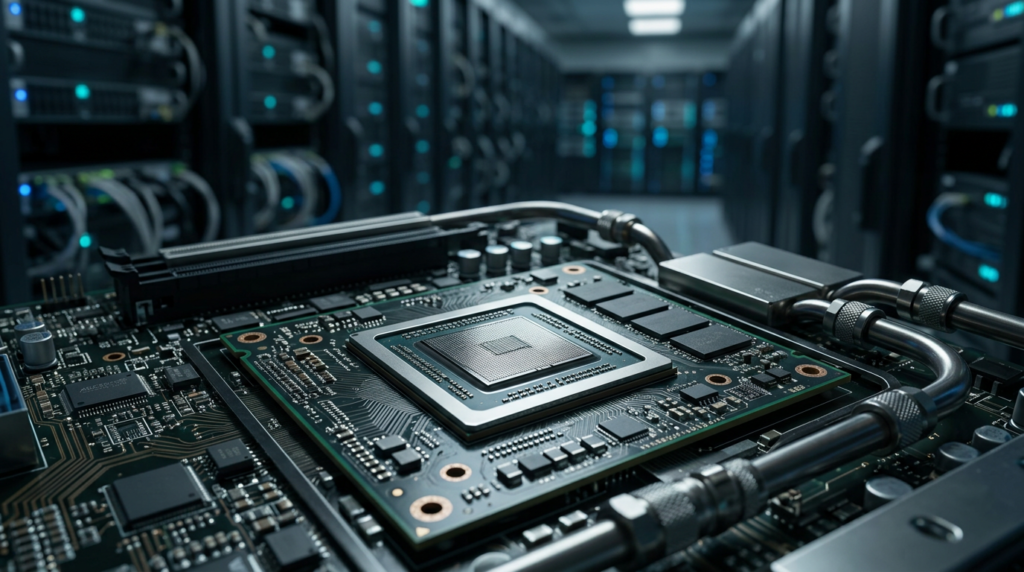
The relevant product is the working platform, including its software, rather than a photograph of the processor under dramatic blue lighting.
Smaller Number Formats Bring Tradeoffs

The Maia architecture includes enhanced MXFP4 and other narrow storage formats intended to reduce memory requirements and data movement.
These formats represent information using fewer bits.
NVIDIA’s own technical discussion of cache compression explains why smaller representations can relieve pressure on memory capacity and bandwidth.
That establishes the engineering motivation, rather than validating Microsoft’s particular implementation.
The practical question is how efficiency interacts with output quality.
Different models and tasks need evaluation under the formats actually used.
A useful comparison should show whether the resulting answers remain suitable for their intended purpose.
For example, a coding workload deserves testing on code quality as well as serving speed.
Infrastructure savings lose their appeal if users spend the recovered time correcting mistakes.
The goal should be efficient, dependable results.
The Rack Is Part of the Product
Maia 300’s planned rack configuration contains 96 accelerators within a 167-kilowatt power envelope.
Microsoft describes liquid cooling that removes more than 80% of the rack’s thermal load, with air cooling supporting other components.
These specifications show why the announcement concerns more than a chip.
Power delivery, cooling, and equipment layout all influence what can be deployed.
For a cloud operator, theoretical processor capability matters only if the facility can support it consistently.
The practical implication is that scaling requires coordination between computing equipment and the surrounding building.
A denser rack can create opportunities while also imposing demanding operational requirements.
Readers should therefore resist treating processor counts as the whole story.
The rack has to function as infrastructure, with the electrical and thermal support needed to sustain its workload.
Forty Percent Needs a Clear Comparison
Microsoft’s expected 40% advantage concerns tokens per megawatt.
That is an efficiency measure, rather than a statement that every answer will arrive 40% sooner.
Reuters reports that Microsoft did not name the GPU systems used for the comparison.
A stronger public comparison would specify models, input lengths, output lengths, concurrency, precision, and acceptable latency.
Azure Databricks’ benchmarking guidance reinforces the need to evaluate throughput within an application’s latency budget.
Quality also belongs in the comparison.
Two systems generating different amounts of useful output are harder to assess through raw token counts alone.
The headline figure is worth reporting once, with its limits clearly attached.
What matters next is reproducible evidence showing where the proposed advantage holds.
That would turn an encouraging projection into a result customers can evaluate.
Why Microsoft Wants Its Own Silicon
The business logic is understandable: a company operating AI services at scale can benefit from infrastructure designed around its own needs.
That is an interpretation of Microsoft’s strategy, not proof of a particular financial outcome.
Custom hardware could give the company more influence over design priorities, deployment choices, and operating economics.
It also brings responsibilities.
Designing the system is only one stage.
Manufacturing, software readiness, installation, and reliable operation must follow.
Success would depend on delivering a platform that works well for the workloads Microsoft actually serves.
The announcement signals confidence in that approach.
It does not eliminate the challenge of keeping a custom platform useful as models and customer requirements evolve.
Specialization pays when it matches the work.
What Copilot Users Could Notice
Microsoft identifies Copilot, GitHub Copilot, and Microsoft Foundry among the services its Maia program is intended to support.
For users, those names provide a connection between infrastructure spending and familiar applications.
However, a new accelerator does not automatically produce better suggestions or cheaper subscriptions.
Those outcomes also depend on models, software, product decisions, and pricing.
The potential benefit is more room to serve demanding workloads efficiently.
A hypothetical coding session could involve substantial project context and repeated requests.
A capable serving platform could help sustain that interaction.
Whether users actually notice an improvement requires product-level evidence.
The most meaningful questions concern reliability, waiting time, and successful completion of useful work.
Nobody opens a coding assistant hoping to admire its underlying memory architecture.
They want the code to work.
Agents Make Infrastructure Choices More Important
An agent can involve a sequence of model calls, tool interactions, and updates to its working context.
That makes an entire task a better unit of evaluation than a single response.
Consider a hypothetical assistant researching an issue, comparing findings, and preparing a draft.
Even when each model call is responsive, the overall workflow can remain slow if other steps introduce delays.
Hardware efficiency addresses one part of that chain.
It cannot settle questions about tool reliability, permissions, or whether the agent followed the right objective.
The implication for Maia 300 is straightforward.
Useful infrastructure should support sustained work without becoming a reason to overlook application quality.
A productive agent needs a sound workflow as well as adequate computing resources.
Otherwise, the system simply reaches the wrong destination more energetically.
Efficiency Does Not Guarantee Lower Total Consumption
Producing more output from a given amount of power can improve resource efficiency.
It does not necessarily reduce the total power consumed by an expanding service.
Microsoft’s planned multi-gigawatt deployment makes that distinction relevant.
If demand and installed capacity grow substantially, total consumption could rise even while each unit of useful work becomes more efficient.
That is an implication of expansion, not a forecast of Microsoft’s eventual electricity use.
The environmental assessment also extends beyond operating power.
Microsoft’s infrastructure lifecycle discussion describes reuse, refurbishment, and recycling through its Circular Centers.
A complete assessment would examine useful output, total energy, facility resources, and the handling of hardware over time.
Efficiency is valuable, but one favorable ratio cannot answer every question about scale.
The Road to 2027 Is an Execution Story
The production schedule places Maia 300’s main deployment story ahead of the announcement.
Readers should distinguish the disclosed design from hardware operating at the proposed scale.
Several practical questions remain worth following.
Will deployments begin on schedule?
Which services will receive capacity first?
How will performance look under ordinary production demand?
What information will Microsoft publish about comparable workloads?
These questions identify milestones, rather than suggest that a delay or failure has already occurred.
The most useful future reporting will connect planned capability to actual operation.
Announcements explain what a company intends to build.
Production results show how well that intention survived contact with manufacturing, installation, software, and customers.
For Maia 300, the next chapter belongs as much to operational execution as to silicon engineering.
The Useful AI Test Comes Last

Microsoft’s Maia 300 announcement reflects a clear priority: making demanding AI services easier to sustain through coordinated infrastructure design.
That is a significant direction, even before the projected efficiency advantage receives independent validation.
The strongest reason to watch the program is its connection to everyday work.
If deployment succeeds, better infrastructure could help support responsive applications and more sustained assistance.
But the hardware should ultimately disappear into the experience.
People should notice useful answers, dependable service, and tasks completed with less friction.
They should not need to understand chiplets to benefit.
The real achievement would be turning engineering improvements into practical value at scale.
Maia 300 now has a detailed design and an ambitious destination.
The remaining question is how convincingly Microsoft can deliver the journey.
SOURCES
- Microsoft to expand Azure Maia system to multi-gigawatt deployments — Official Microsoft Blog
- Deep dive into Azure Maia 300 architecture — Microsoft Azure Blog
- Microsoft plans huge deployment of its own AI chips, with an eye on saving costs — Reuters
- LLM fundamentals — Microsoft Learn
- Conduct your own LLM endpoint benchmarking — Microsoft Learn
- Optimizing inference for long context and large batch sizes with NVFP4 KV cache — NVIDIA Technical Blog
- Responsible infrastructure at hyperscale: Managing the full lifecycle of Azure hardware — Microsoft Azure Blog
The Kingy Brief
Get The Kingy Brief.
AI changes, original tests and one practical thing to try. Fridays at 09:00 Vancouver time.
Free · Double opt-in · Unsubscribe anytime
Sign up for The Kingy Brief on Beehiiv.
Signup help and newsletter schedule
Signup form provided by Beehiiv. After submitting, check your inbox for "Confirm your subscription to The Kingy Brief" and open its confirmation link. Check Spam or Promotions if you cannot find it.
Fridays at 09:00 Vancouver time: source-checked AI changes, original tests and one practical thing to try. The weekly restart begins October 9, 2026. We skip a week when there is not enough verified material. Free. Unsubscribe anytime.