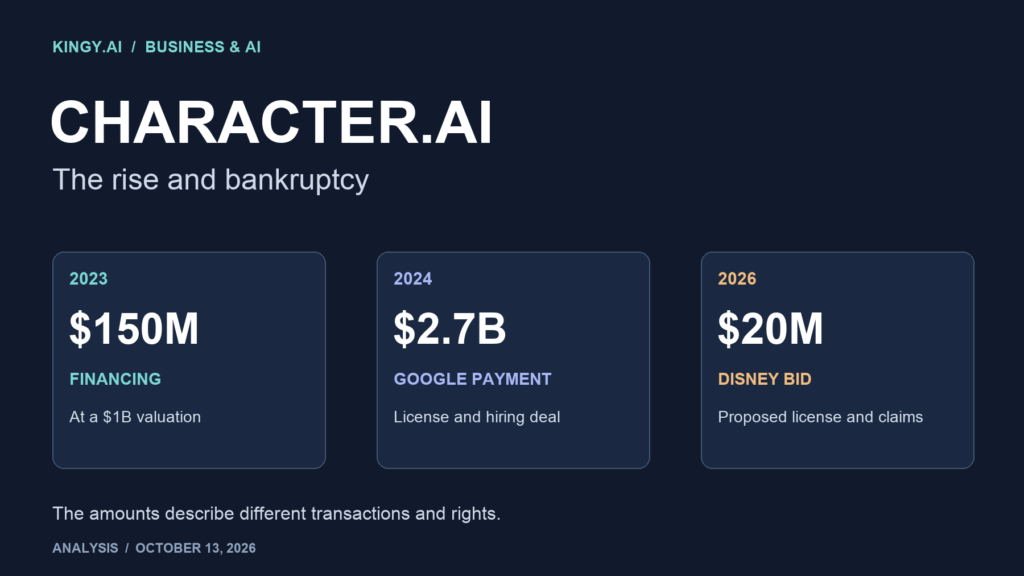
Google paid billions for technology and talent. Disney is bidding for a license and certain claims. The future of the chatbot that users built relationships with remains unresolved.
Character.AI has filed for bankruptcy, but its chatbots have not disappeared. That uncomfortable combination is the starting point for understanding what happened to one of the most recognizable businesses in consumer AI.
On October 12, 2026, Character Technologies, the company behind Character.AI, filed a voluntary Chapter 11 petition in Delaware. Its service remains online while the company pursues a court-supervised sale. A Disney affiliate has agreed to act as the opening bidder for specified rights, offering $20 million and transition services. The transaction is proposed, not completed, and it does not amount to a promise that Disney will keep the Character.AI app running. Reuters reported the proposed deal; the filing is recorded in the public bankruptcy case.
There is another detail that complicates an easy collapse story: the company reported approximately $57.4 million in unrestricted cash when it filed. Bankruptcy arrived with money still in the accounts, valuable technology, potential legal liabilities and most of a recent workforce accepting jobs elsewhere.
The questions are bigger than whether a controversial app finally ran out of luck. Why did technology companies value its people and intellectual property while the consumer business became unsustainable? What happened to the investors who financed the original promise? What obligations remain to users who treated a commercial service as a place for creativity, companionship or emotional support?
And does this bankruptcy tell us that the AI bubble is bursting, or that some of the most valuable parts of independent AI companies are being absorbed by larger businesses?
The evidence points most strongly toward a combination of operating-business failure, unresolved safety and rights costs, and consolidation. It leaves important parts of the money trail open. Those gaps matter, particularly when comparing a billion-dollar financing valuation, Google’s multibillion-dollar transaction and Disney’s much smaller bid.
Reporting checked October 13, 2026. Dollar amounts are US dollars. The sale process remains in progress; descriptions of earlier lawsuits are dated to the cited records.
What Disney has agreed to buy
The words “Disney bought Character.AI” compress several different events into one misleading conclusion.
The proposed counterparty is Disney Worldwide Services. According to Character.AI’s transaction announcement, the agreement covers a non-exclusive, perpetual license to certain intellectual property and certain company claims. Disney would also provide transition services using former Character.AI employees it has hired.
A non-exclusive license gives a licensee specified rights without necessarily making it the sole owner or sole permitted user. The actual agreement determines the scope. “Certain claims” is also consequential language: the public announcement does not explain everything covered by it. It would be premature to invent a list of legal rights or releases from that phrase.
Disney is acting as a stalking-horse bidder, establishing an initial offer against which competing proposals can be considered. Character.AI expects the sale process to close in late November or early December, but that is an expected timetable, not an accomplished result. Court approval and competing offers can affect the outcome.
The company says the platform will be wound down if the process does not produce a purchase that provides for continued operation. A buyer of useful technology can have different intentions from a buyer of the entire consumer service. That distinction is the central practical issue for anyone hoping their chats and characters will survive. Character.AI’s community update describes the conditional future of the platform.
Why people used Character.AI in the first place
Character.AI made an abstract technology personal. A general-purpose chatbot asks what task you want completed. A character-based service can offer a fictional person, a recurring relationship, a scene or a world that you want to return to.
The company was founded in 2021 by former Google researchers Noam Shazeer and Daniel De Freitas. Its public beta arrived in September 2022, according to its subsequent funding announcement. Users could create characters and have conversations with personalities built by others. The underlying appeal ranged from improvised storytelling and fan fiction to simulated advice and companionship.
That range is important. Calling every interaction a substitute for a human relationship misrepresents people using the service as a writing tool or a game. Treating every interaction as harmless fiction misses the people who took the responses seriously or became emotionally attached.
The same interface can support both experiences. A character that remembers the apparent history of a conversation, responds with warmth and remains available whenever someone opens an app can feel very different from a search box. A user does not need to believe the system is literally human for a conversation to become emotionally significant.
This was part of the commercial promise, not an accidental interpretation discovered only after controversy. In her March 2023 investment essay, Andreessen Horowitz partner Sarah Wang described personally meaningful interactions and discussed companionship, coaching, mental health and entertainment as possible applications. The thesis placed sustained engagement and personal connection near the centre of the opportunity.
That helps explain why the product attracted investors. It also explains why evaluating it solely as software that generates plausible sentences is inadequate. The business was selling access to experiences that users could understand as relationships, even though the relationship existed inside a product controlled by a company.
The investors’ bet and the money that came later
In March 2023, Character.AI announced a $150 million Series A at a $1 billion valuation. Andreessen Horowitz led the round. Named participants included previous investors Nat Friedman, Elad Gil, SV Angel and A Capital. The announcement also said Wang would join the board.
Those facts establish the financing and a historical governance role. They do not mean a16z supplied the entire $150 million, that every named investor held the same stake, or that the same board arrangement persisted through bankruptcy.
The investment case was understandable: a technically credible founding team, a new consumer interface and an opportunity to make AI part of everyday life. The harder questions concerned how that popularity would turn into revenue, how expensive the service would be to operate, and what safeguards a product built around personal connection would require.
The later Google transaction makes the investors’ outcome especially important. A company can fail after some of its original shareholders have already received a return. The operating company’s bankruptcy and the success or failure of an earlier investment are separate questions.
The Information reported a buyout above the previous financing’s share price. That contemporaneous reporting is a reason to investigate distributions, rather than assume all early backing was wiped out. It is not a complete public account of each investor’s realized return.
For an investor, a sale or redemption can bring a financial story to an end. For an employee who stays, a supplier that continues providing infrastructure, or a user who builds years of conversations, the story continues. Character.AI’s history therefore raises a question about whose definition of success counts.
That separation between liquidity for shareholders and durability for customers deserves close attention. In AI companionship, it becomes unusually personal because users can experience the product as more than a tool.
Google’s $2.7 billion deal was not an ordinary acquisition
Alphabet’s 2024 Form 10-K provides a firmer basis than the shorthand that Google “bought Character.AI.” In Note 8, Alphabet says it paid Character.AI $2.7 billion in cash, cancelled convertible instruments, obtained a non-exclusive license to its then-current large language model technology, and hired employees.
Reuters’s August 2024 report identified the returning founders as Shazeer and De Freitas. The consumer platform continued separately.
The economic value of an AI company can be spread across several things: its researchers, accumulated technical knowledge, model technology, customer relationships and product. A buyer can be highly interested in some of those assets without wanting responsibility for the whole business.
That structure changes what an apparently spectacular deal proves. It shows that a large company was willing to pay heavily for specified technology and access to people. It does not establish that subscriptions to the original app could finance its operations indefinitely.
It also makes careless arithmetic tempting. The $2.7 billion payment is not evidence that Character.AI subsequently burned $2.7 billion running chatbots. To reach that conclusion, we would need to know how the proceeds were distributed, what remained in the business, and what the company spent afterward. Public reporting on shareholder exits makes that distinction essential.
The same caution applies to a comparison with Disney’s offer:
| Event | Amount | What the figure describes |
|---|---|---|
| March 2023 financing | $150 million raised at a $1 billion valuation | A financing round and the valuation attached to it |
| August 2024 Google arrangement | $2.7 billion cash, plus cancellation of convertible instruments | A technology-license and employee-hiring transaction |
| October 2026 Disney proposal | $20 million plus transition services | A proposed license to specified intellectual property and certain claims |
These are three different transactions. Presenting them as a single price chart falling from $1 billion to $20 million would create a clean visual at the expense of an accurate explanation.
Bankruptcy with $57.4 million still in cash
The cash-management motion says the company held approximately $57.414 million in unrestricted cash at the petition date. It separately identifies a $2 million refundable deposit connected with the proposed sale process, bringing reported cash and cash equivalents to about $59.414 million.
The petition places both estimated assets and estimated liabilities in the $50,000,001–$100 million range. Those broad categories do not supply a precise balance sheet or establish the ultimate cost of contingent litigation.
This matters because “bankrupt” is often understood as “the account is empty.” The filing does not support that description here. A business can have cash and still face an operating model, obligations or prospective exposure that make a restructuring or sale preferable to continuing on the existing course.
The company’s critical-vendor motion attributes its inability to generate sufficient cash flow to development costs, potential litigation liabilities and regulatory engagement. It describes late payments to important suppliers and the difficulty of replacing providers of computing, storage and safety services. That is management’s account of the pressures, not an independent allocation of responsibility among them.
The creditor list makes some of those dependencies concrete. Google is listed with an unsecured trade claim of about $4.149 million; DigitalOcean with approximately $1.953 million. Hogan Lovells is listed with a professional-services claim of about $2.125 million. Fireworks.AI’s $813,900 trade claim is marked disputed. These are listed claims, not findings that every amount is finally payable. Nor does the list establish that every technology supplier’s bill was exclusively for inference.
Google’s appearance is particularly revealing about the structure of the business. The company that paid for technology in one transaction could also be a creditor of the continuing operation. An earlier strategic deal did not erase later commercial obligations.
The filings leave us with a more useful question than where the last dollar went: what combination of future operating losses, contractual commitments, litigation risk and available sale options persuaded the board that continuing independently was no longer the best course?
The petition records that the board created a restructuring committee on October 8, four days before filing, to consider strategic and financial alternatives. Further transaction documents and financial disclosures are needed to assess those alternatives in detail. The existence of cash makes the question more important; it does not answer it.
Why engagement is not the same as a sustainable business
For consumer software, time spent can be a powerful measure of interest. In a generative-AI service, it can also represent a continuing cost.
Long conversations require repeated model responses. Maintaining context, storing material, operating the application and reviewing unsafe activity all consume resources. A service that encourages people to keep talking has to finance the extra interaction as well as attract it.
Character.AI’s public subscription terms provide one part of that equation. Its 2026 promotional terms identify a standard renewal price of $9.99 per month or $94.99 annually, while noting regional differences and discounted introductory periods. The cash-management filing also describes advertising receipts.
Neither source gives us a complete income statement. We do not have a verified current paying-user conversion rate, a complete cost per conversation, or an audited margin for the service. Revenue figures copied among startup statistics websites should not fill those gaps without their original methodology.
A simple hypothetical shows why the missing variables matter:
| Paying share of one million hypothetical monthly users | Paying users | Gross monthly subscriptions at $9.99 |
|---|---|---|
| 1% | 10,000 | $99,900 |
| 3% | 30,000 | $299,700 |
| 5% | 50,000 | $499,500 |
This is an illustration, not Character.AI’s actual conversion or revenue. It excludes discounts, annual subscriptions, taxes, platform fees, refunds, advertising income and every operating expense. Its purpose is to show how strongly the result depends on the portion of users who pay and the cost of serving everybody else.
The financial problem is not solved merely by saying that the models will become cheaper. Lower serving costs can help, but users may demand more capable models, longer memory, voice and richer media. Safety work, support and rights management can remain substantial even if the cost of generating a particular response declines.
Advertising offers another source of revenue, with another set of trade-offs. Ads can support free access while interrupting the experience that attracted people. A companion product also raises questions about what information advertisers can use and whether users understand the distinction between a private-feeling conversation and a commercial platform.
None of that proves advertising or subscriptions could never work. It explains why impressive engagement, by itself, is not enough to demonstrate that they do.
The business practices deserve scrutiny beyond the headlines
Character.AI’s controversy encompasses different complaints that should not be collapsed into one angry consensus.
Some users objected to filters, changes in responses, removed characters and restrictions on roleplay. The company’s public discussion of character removals acknowledged both users’ investment in their creations and the possibility of mistaken removals. Parents and safety campaigners raised almost the opposite concern: that the product allowed interactions that were too intimate, too persuasive or insufficiently constrained. A policy change can disappoint one group while responding to another group’s legitimate concern. These public reactions illustrate experiences; they are not a representative survey of users.
The productive question is how the company designed, explained and governed the experience. Did users receive clear information about the limits of the system? Were safeguards appropriate for the audience? How did the company weigh engagement against the possibility that a user was becoming dependent? What happened when the business needed to change features people had built routines around?
Its Terms of Service, last updated August 27, 2025, illustrate the asymmetry. Users retain their existing rights, and the terms allocate ownership of generated characters and content to users as between themselves and Character.AI. The company also receives broad, continuing and transferable licenses. The terms permit service changes and termination, describe recurring billing, and include individual arbitration with an opt-out.
Those clauses do not tell us that every possible use of content has occurred or that every provision is enforceable everywhere. They show why users should distinguish ownership language from practical control over a hosted service. A person can have rights in a creation while depending on another company to store it, display it or keep the character responsive.
In a productivity tool, losing a familiar interface can be disruptive. In a companion product, changing a model or removing a character may also feel like losing a familiar personality. The underlying company can regard the change as routine product management while the user experiences it as something more personal.
That mismatch is a governance problem for the entire category. Building attachment can increase the value of a product while making ordinary business decisions more consequential for the people using it.
The harm allegations cannot be reduced to bad publicity
The most serious controversies concern alleged harm to children and vulnerable users. They require more care than either a corporate reassurance or a collection of shocking chatbot screenshots can provide.
Megan Garcia’s Florida lawsuit alleged that Character.AI contributed to the death of her 14-year-old son, Sewell Setzer III, following an emotionally harmful relationship with a chatbot. In January 2026, AP reported agreements to settle that case and other family cases in several states. That report did not disclose settlement terms and said judicial approval remained outstanding. It should not be turned into a claim that a court found the product responsible for every alleged injury.
An allegation identifies what a plaintiff says happened. A settlement resolves claims on agreed terms. A ruling decides a particular legal question. None is interchangeable with the others. Keeping those distinctions does not diminish the seriousness of a family’s experience; it keeps the account honest.
Government action widened the scrutiny. Kentucky’s attorney general filed a consumer-protection complaint in January 2026. Pennsylvania announced a lawsuit over chatbots allegedly presenting themselves as licensed medical professionals in May. The bankruptcy creditor list includes both states and a redacted minor plaintiff with litigation claims whose amounts are listed as unknown.
The medical-identity issue exposes a basic weakness in an interface built around convincing characterization. Being persuasive as a fictional professional is not the same as being qualified to provide professional care. A disclaimer elsewhere in the product has to compete with the language and apparent authority of the interaction itself.
The FTC’s September 2025 inquiry included Character Technologies and other companies offering companion-like chatbots. It sought information about safety, monetization, age restrictions and data handling. That was a compulsory study under the agency’s information-gathering authority, not a finding that each recipient had broken the law.
The issues nevertheless belong in the business analysis. Safety and legal exposure are not external distractions from a companion platform’s real economics. They arise from what the product does and whom it serves. A model of profitability that leaves them out may be measuring a business that cannot responsibly exist on those terms.
The public record does not let us calculate precisely how much each controversy contributed to bankruptcy. The company identifies potential litigation liabilities and regulatory engagement among its pressures. Assigning the entire failure to lawsuits would go beyond that evidence.
What Character.AI changed, and what the research can tell us
The company did make significant changes. On October 29, 2025, it announced that users under 18 would lose access to open-ended AI chat, initially setting a deadline of November 25. Its November 21 rollout update said removal would begin on November 24 in the United States, with other markets following.
The original announcement also described age assurance, temporary time limits and plans for an AI Safety Lab. Its September 2026 safety update discusses safeguards that take surrounding conversation into account and attempts to guide struggling users toward real-world support.
Those are material responses. They also raise hard retrospective questions about the earlier audience and product. Restricting access to a central feature is a much bigger intervention than adding a warning. It can protect users while changing the commercial proposition.
The existence of safeguards does not establish their effectiveness. Nor does a failure found in an earlier product version prove every later safeguard failed. Good scrutiny follows the dates, the actual behavior and independent evidence.
Research on AI companionship offers a similarly mixed picture. HBS research discusses temporary reductions in reported loneliness, alongside concern about dependence. The researcher discussion supports taking users’ perceived benefits seriously. Temporary relief does not establish clinical treatment or long-term safety for children.
The revised MIT/OpenAI longitudinal study followed 981 participants for four weeks. Its latest abstract reports no significant effects between assigned experimental conditions, while heavier voluntary use and stronger attraction to the chatbot were associated with worse outcomes. That association is not randomized proof that additional usage caused those outcomes, and the study is not a Character.AI-specific clinical verdict.
The reasonable conclusion is narrower than either “AI friends cure loneliness” or “AI friends harm everyone.” Some people experience meaningful short-term benefit; some patterns of use warrant concern; and age, design, expectations and duration matter. A commercial product needs to operate amid that uncertainty, not wait for perfect evidence while treating emotional engagement as an unqualified good.
Disney hired the people before the sale was complete
On September 18, 2026, Disney announced that Character.AI CEO Karandeep Anand would become its chief technology officer, effective October 2. It also expected members of the technical team to join. Disney’s announcement framed the appointment around its technology strategy and service to fans.
The bankruptcy’s wage motion supplies more detail about the transition. Character.AI says it employed approximately 86 full-time staff on September 30. Before bankruptcy, 66 had been offered and accepted employment with Disney; 56 of those had formally resigned. Ten transfers remained pending while immigration arrangements were updated.
The motion says 18 active full-time employees remained at the petition date, with eight expected to stay through key parts of the case. These figures describe different dates and statuses, so they should not be subtracted from each other to invent a precise account of every departure.
The disclosure shows how much the operating environment had changed before the proposed license transaction closed. The public app remained dependent on continuity arrangements while a large group of employees had committed to another employer. The company’s bankruptcy announcement names Colin Adams as its CEO.
There are legitimate reasons for a buyer and seller to arrange an orderly transfer of staff and services. Such an arrangement can preserve value and reduce disruption. The chronology, alone, does not prove improper conduct.
It does make governance a central issue. Who approved the transactions? What alternatives were available? How were the interests of the remaining company, its creditors, employees and users represented? The answers belong in the documents and court process, rather than in a confident story about motives that have not been established.
Disney’s copyright position makes the deal more interesting
The relationship has an earlier chapter. Axios reported in September 2025 that Disney demanded an end to unauthorized uses of its characters. A year later, Disney was recruiting leadership and technical staff; now its affiliate is the proposed opening bidder for a license and certain claims.
The sequence creates an obvious business question without establishing an answer: does technology that is difficult to monetize as an independent, open-ended character platform become more useful inside a company that owns famous characters and controls major routes to an audience?
That is plausible. An entertainment owner can combine technology with licensed properties, established distribution and rules about how characters behave. It may not need the same subscription model or the same unrestricted range of user-created experiences.
But plausible is not documented intent. Disney has not, in the materials examined for this article, committed to a particular consumer product using these rights. Its interest does not prove that an official Disney chatbot service is coming, that it will resemble Character.AI, or that it will take over existing users’ relationships with characters.
The copyright issues also need separating. Rights in fictional characters, celebrity likenesses, uploaded voices, generated outputs and model-training material can raise different questions. A cease-and-desist demand is evidence of a dispute, not a court judgment establishing every alleged infringement.
The broader commercial lesson is that intellectual-property access and distribution may matter as much as model capability. A startup can build a compelling interface and still face constraints that an established rights owner approaches from a different position.
What happens to users’ chats and creations
The privacy question becomes sharper when a product’s future is being negotiated.
Character.AI’s privacy policy, effective July 1, 2026, describes collecting submitted content, including chats and voice recordings; using information for service improvement and other purposes; and possible disclosures connected with business transfers. It also reserves the possibility of keeping popular public characters active after a creator deletes an account.
The policy is not proof that Disney has purchased private conversations. A general business-transfer clause does not tell us which data is included in this particular transaction, which legal conditions apply, or what any eventual buyer will do. Those questions require the actual agreement and applicable protections.
There is a separate trap in the company’s training disclosure. Its July 2026 explanation says it no longer carries out the particular processing associated with the initial development of its proprietary models. That should not be broadened into a promise that no information is used for any model improvement or training. The wording and scope matter.
For users, the immediate concerns are more concrete: whether they can obtain copies of their data, what an export includes, how subscriptions will be handled and what happens if the service closes. The company’s bankruptcy FAQ says export and account deletion remain available. We have not tested whether an export preserves every character setting, conversation feature or aspect of a continuing interaction.
A stored transcript and a responsive character are different forms of continuity. Even a complete copy of the words does not recreate the model, memory, product settings and hosting behind the conversation. That is why “download your data” can be useful without fully answering what a user stands to lose.
Creators face a related issue. Their work may have value as writing, characterization or community participation, while its discoverability and interactive behavior depend on infrastructure they do not control. Bankruptcy turns that dependence from an abstract contractual risk into a practical question.
Is this the AI bubble popping?
Character.AI is a warning about parts of the AI business. It is not sufficient evidence that the whole industry has reached a single turning point.
The strongest warning concerns the gap between demand and durable economics. People can want a service intensely without paying enough, in aggregate, to cover the full cost of providing it. A company can also create useful technology without building a lasting independent business around its original product.
There is a second warning about where value goes. Large companies can buy rights and hire teams without preserving the startup’s product in its original form. That can reward researchers and shareholders while leaving another set of questions for users, suppliers and the people who remain.
We have seen related structures elsewhere. Microsoft announced in March 2024 that Inflection cofounders Mustafa Suleyman and Karén Simonyan, together with team members, were joining its AI organization. Adept said in June 2024 that its cofounders and some staff were moving to Amazon, which was also licensing its technology. Those examples establish a pattern of talent and technology moving. They do not establish that all those operating companies shared Character.AI’s eventual outcome.
The consolidation interpretation therefore has stronger direct support than a sweeping bubble verdict. Google valued part of Character.AI’s technology and workforce in 2024. Disney values specified rights and people in 2026. The independent consumer business is the part in bankruptcy.
That does not make the bubble concern foolish. If many AI companies can finance their promises only through new investment or a strategic buyer, the durability of the market deserves scrutiny. But demonstrating a broad correction requires comparable evidence across companies: recognized revenue, margins, cash losses, financing terms, customer demand and actual exits. One dramatic case cannot supply all of it.
It is also important to keep the segments apart. The economics of companion chat are not automatically the economics of business software, coding tools, model licensing or infrastructure. They can share dependencies while facing different customers, pricing power and risks.
The most defensible judgment today is that Character.AI exposes a vulnerability in consumer AI built around sustained personal interaction. Its users’ attention, its technology’s value and its ability to remain a viable standalone company were never guaranteed to move together.
A business failure with uneven consequences
The rise and bankruptcy of Character.AI should resist an easy moral ending.
The consequences do not fall evenly. Users can lose access to an experience they value; families may still be pursuing answers and remedies; creditors face an uncertain recovery. Shareholders who exited earlier occupy a different position from people whose stake is tied to what the service does next.
What the record shows is a company that attracted major financing, participated in a substantial technology-and-talent transaction, continued operating a controversial consumer service, transferred much of its recent workforce toward another large company, and entered court-supervised restructuring while still holding significant cash.
Several decisive questions remain open: the full distribution of the Google proceeds, the company’s recent operating losses and commitments, the scope of Disney’s proposed rights, and whether any buyer will preserve the service. Those answers can change how responsibility and outcomes are assessed.
For now, users and creditors need a successful sale process more than another confident prediction about the future of AI. The next meaningful milestones are the transaction documents, the court’s decisions and an identified buyer willing to operate the platform. Until those arrive, the app’s continued availability is a temporary fact, not a guarantee about its future.
Research and drafting used AI assistance. This analysis draws on public court filings, company and regulator statements, and published reporting. It does not include an independent audit of Character.AI’s books, private interviews or clinical testing of the product. Allegations, reported outcomes and analytical conclusions are identified separately.
Trending on Kingy
Keep reading with the stories getting the most attention now.
The Kingy Brief
Get The Kingy Brief.
AI changes, original tests and one practical thing to try. Fridays at 09:00 Vancouver time.
Free · Double opt-in · Unsubscribe anytime
Signup help and newsletter schedule
Signup form provided by Beehiiv. After submitting, check your inbox for "Confirm your subscription to The Kingy Brief" and open its confirmation link. Check Spam or Promotions if you cannot find it.
Fridays at 09:00 Vancouver time: source-checked AI changes, original tests and one practical thing to try. The weekly restart begins October 9, 2026. We skip a week when there is not enough verified material. Free. Unsubscribe anytime.