Claude’s new design tools could change the economics of the everyday explainer: the animated chart for a board meeting, the product walkthrough that keeps slipping down the backlog, the short presentation that needs another round of revisions. The strongest idea in this release is giving people an inspectable, editable first version of that work inside the conversation where they already developed it.
On October 8, 2026, Anthropic launched Claude Dashboards and Claude Motion in beta. Dashboards brings connected business data into a visual workspace. Motion turns supplied content into short animations. Claude Docs, Slides and Design also leave beta and become available on every plan, including Free. Anthropic’s launch announcement establishes the release date and product names.
The immediate opportunity is practical. A team can investigate a number, decide what it means, and turn that explanation into something people can watch. For motion designers, the pressure will likely arrive first in routine business graphics and repeated revisions. For 3D artists and character animators, the announcement establishes much less.
Reporting note: This article is based on Anthropic’s announcement, help documentation, current web pricing and Sigma’s launch-partner documentation, checked October 8, 2026. We have not run hands-on Dashboards or Motion tests. Design-industry implications, example briefs and the evaluation plan below are Kingy.ai analysis, not measured results. Screenshots are Anthropic’s official launch images.
Claude Dashboards and Motion at a glance
| Feature | Release status | Who gets it | Main purpose |
|---|---|---|---|
| Claude Dashboards | Beta | Pro, Max, Team, Enterprise | Explore connected company data through charts |
| Claude Motion | Beta | Team, Enterprise | Build short, editable animations from supplied content |
| Claude Docs, Slides, Design | Out of beta | Free, Pro, Max, Team, Enterprise | Documents, presentations and visual work |
Motion is enabled by default on Team. Enterprise owners must enable Dashboards and Motion in Organization settings > Artifacts. Docs, Slides and Design become enabled by default for Enterprise on October 15; owners can enable them earlier. Artifacts also require Cloud code execution and file creation to be enabled. See the Artifacts feature matrix and prerequisites.
A solo creator paying for Max should pay attention to that table. A larger individual allowance does not unlock Motion in this launch. The eligibility boundary is the plan type.
What Claude Dashboards does
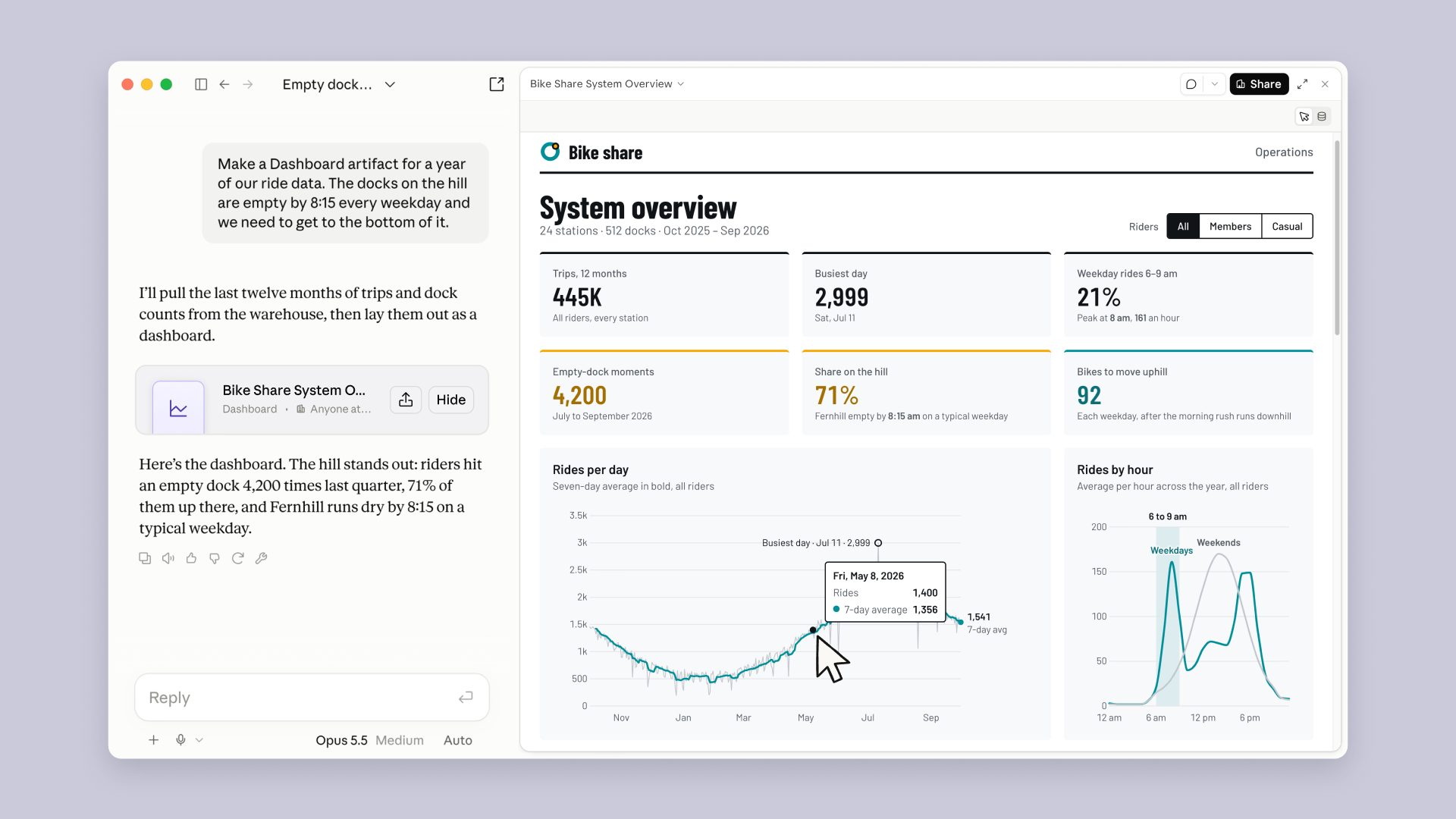
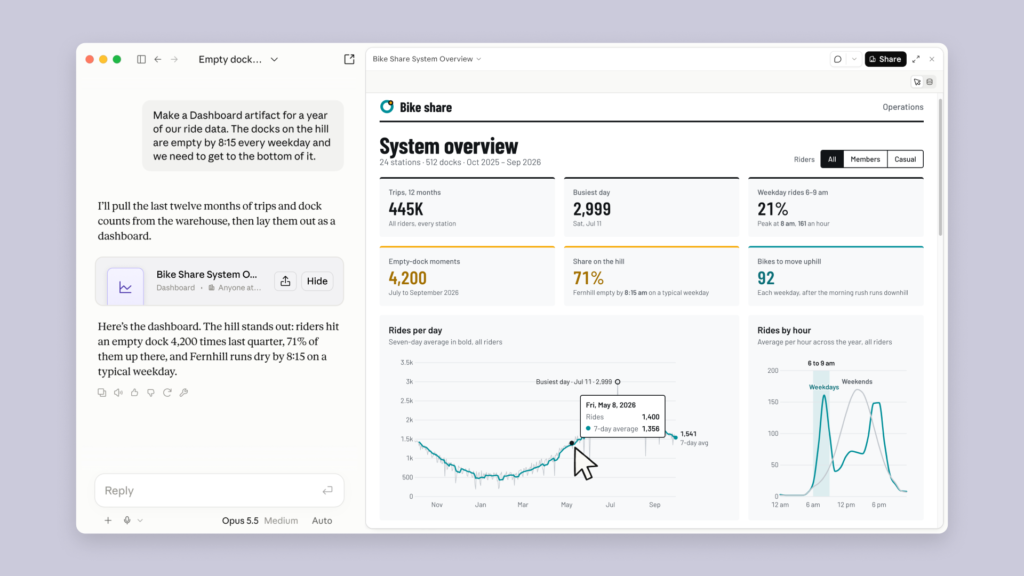
Dashboards is an artifact template. Claude writes a SQL query for each chart, runs it against the connected source, and shows the query and last-refresh information. The documented sources include Amazon Redshift, BigQuery, ClickHouse, Databricks and Snowflake, plus connected apps such as Salesforce. The feature is aimed at quick exploration. Dashboards start private, support conversational refinements such as filters or weekly views, and consume the plan’s usage allowance. These details come from the Dashboards getting-started guide.
For an analyst, the query is the most consequential part of the interface. A polished chart can hide a poor definition. Revenue might mean booked revenue, collected cash or recurring revenue. A signup count might include test accounts. A customer join might duplicate orders. Seeing the query gives the team something concrete to inspect before it presents the answer.
That does not make every answer correct. It makes some errors easier to locate. A designer can improve visual hierarchy, but an analyst still needs to confirm the denominator, date window, join behavior and business definition.
“Live” also deserves care. The announcement describes dashboards that stay current as data changes; it does not publish a universal refresh interval or latency guarantee. A refresh timestamp is useful evidence of freshness. It should not be mistaken for a promise that every chart updates instantly.
Anthropic lists handoffs to Amplitude, Grafana, Hex, Mixpanel, Omni, Perplexity, PostHog and Sigma, with Looker, monday.com and Tableau coming soon. Those are launch-day statuses, not guarantees that every destination supports the same workflow. Source: launch announcement.
Sigma provides a concrete example. Its launch documentation says Send to Sigma turns a Claude dashboard draft into a Sigma workbook or app through its MCP server. It requires a Claude paid subscription, a Sigma Build license and the Use Sigma MCP with OAuth permission. In Sigma, existing permissions apply, including row- and column-level security. That is evidence for Sigma’s specific handoff, not a blanket claim about permissions in every Claude connector. Source: Sigma’s launch guide.
Claude Motion’s key specification is editable code
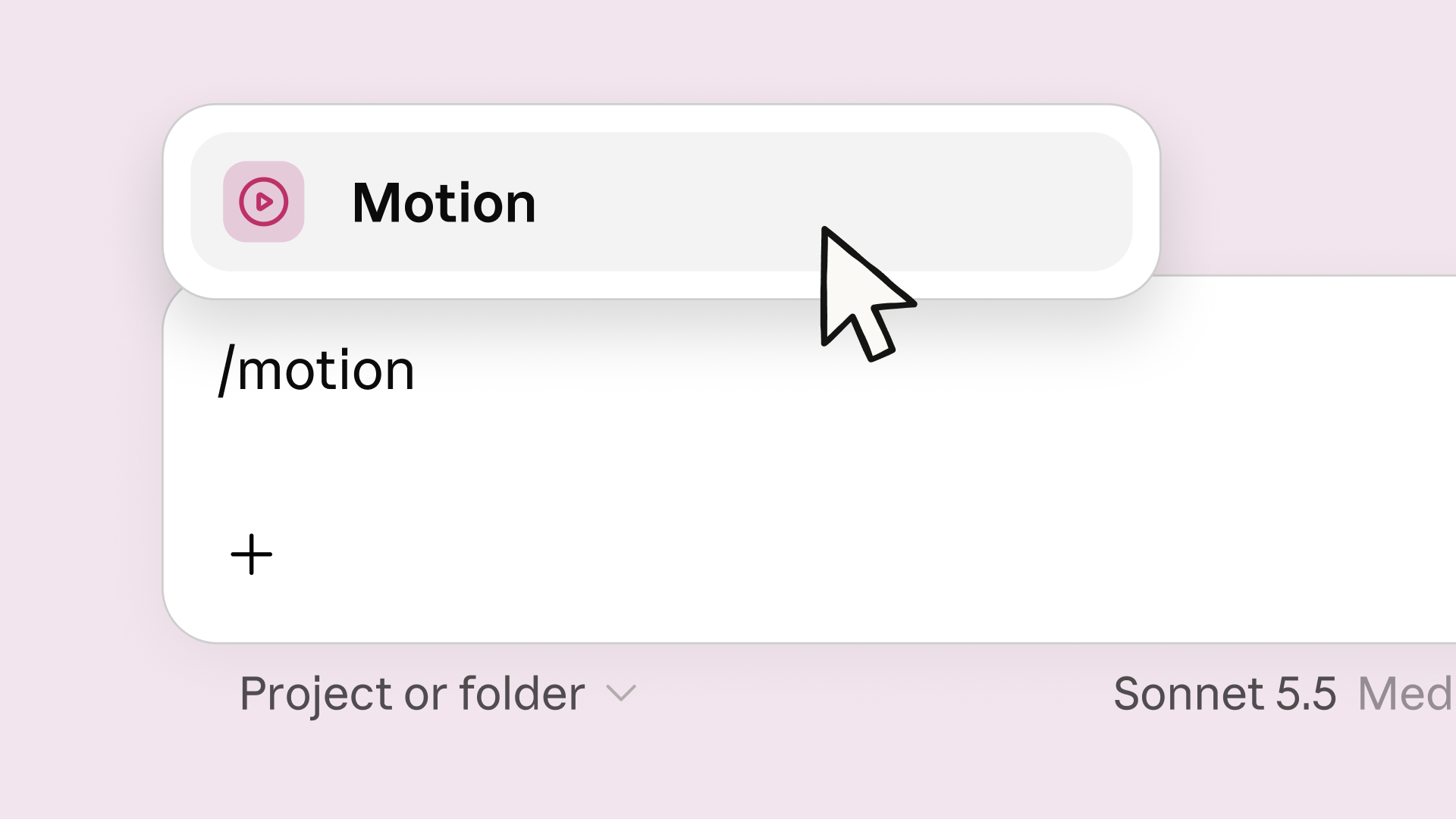
Motion builds code that animates your text, charts, shapes and images. You can request changes in chat or edit directly, then export MP4. It does not use a video-generation model to synthesize realistic footage or people. Anthropic says a word, number or timing can be changed while the rest stays as it was. Longer or more complex animations consume more allowance than a typical message. See the Motion guide.
That editability claim is where a working designer should focus. Suppose an explainer is approved except for a price. If a targeted revision preserves the composition, timing and other text, the production process becomes easier to manage. If the tool quietly rearranges unrelated scenes, the time saved on the first draft can disappear during review.
Anthropic’s launch materials list ways to continue Motion work in Adobe, Descript, HeyGen, Higgsfield, invideo, Luma AI and Runway. Canva and Captions are coming soon. An integration listing does not establish a native After Effects project export with editable layers, expressions and keyframes. Buyers should verify the actual handoff format for their destination. Source: launch announcement.
| Specification | What the checked launch documentation establishes |
|---|---|
| Output | MP4 download; animation remains editable within Claude |
| Content and construction | Code animating text, charts, shapes and images |
| Editing | Conversational changes and direct editor adjustments |
| Resolution, frame rate, maximum duration | No fixed specification stated in the checked announcement or Motion guide |
| Audio, captions and transparent exports | The checked launch documents do not establish a complete feature specification |
| Native 3D assets or scene interchange | No mesh, rig, material or scene-export specification established |
| Underlying implementation | No named animation framework or single required model established in those documents |
The announcement is a product-feature release. Parameter counts, model context windows and general coding benchmark scores would tell us little about whether a particular MP4 meets a client brief. The missing production specifications matter more to this audience.
Price and availability: what it costs to get access
The following are the published US web prices checked on October 8, excluding applicable taxes. They are subscription prices, not quoted prices per dashboard or finished video. Source: Claude pricing; Max tier prices.
| Plan | Published price | Dashboards | Motion |
|---|---|---|---|
| Free | $0 | No | No |
| Pro | $20 monthly; $200 billed annually (advertised as about $17/month) | Yes | No |
| Max 5x / 20x | $100 / $200 monthly | Yes | No |
| Team Standard | $25/seat/month monthly; $20/seat/month annually | Yes | Yes |
| Team Premium | $125/seat/month monthly; $100/seat/month annually | Yes | Yes |
| Enterprise | $20/seat/month annually, plus usage at API rates | Yes, owner enables | Yes, owner enables |
Team is advertised for 2–150 people. At two Standard seats, the arithmetic is $50/month on monthly billing, or a $40/month equivalent on annual billing: $480 per year. This is a calculation from listed seat prices, not a Motion-only offer. It matters for an individual freelancer considering a team plan solely to try Motion.
Buying more allowance and buying access are different decisions. Max can provide more individual capacity without adding Motion eligibility. Team Standard already lists both betas; Premium buys more capacity, not a separate Motion feature tier.
The real production cost goes beyond the seat price
A studio should budget for the accepted deliverable, including review. The useful equation is:
Total production cost = Claude subscription or usage charges + connected platform costs + finishing tools + human preparation, review and revision time.
Claude usage depends on the task, model, conversation and features used. There is no fixed message count that translates into a guaranteed number of animations. Extra usage can add charges where enabled; Enterprise’s pricing explicitly includes metered usage. See Anthropic’s usage-limit explanation and the pricing page.
Connected data also has its own economics. A warehouse query may incur charges under the warehouse’s contract. A BI handoff may require an existing license, as Sigma’s Build requirement illustrates. Finishing an animation in another application may add a subscription or paid processing cost. The Claude seat price is not an all-inclusive production budget.
Here is an illustrative break-even calculation, not a measured result. If an additional tool cost is $50/month and a producer values working time at $50/hour, saving one accepted hour per month covers that incremental subscription cost. But a first draft that saves 20 minutes and creates 40 minutes of repair work has made the job more expensive. Track both generation and cleanup.
This makes revision reliability commercially significant. A tool that can produce ten plausible drafts may still be less useful than one that makes a single approved draft easy to update every month.
Evals: what has been demonstrated, and what still needs testing
The announcement and getting-started pages checked for this article do not provide a reproducible, scored Dashboards or Motion benchmark. They do not establish a measured time-saving percentage, a designer-preference win rate or a native-project compatibility score. The launch demo is vendor evidence of a workflow; it does not establish how often the workflow succeeds across unseen briefs.
We would evaluate the betas against a small set of real production tasks, with the same inputs and acceptance criteria for each tool. For Motion, a fair comparison would use the same report, brand assets and required revisions in Claude and the studio’s existing animation workflow. For Dashboards, the reference should include verified queries and known answers, not merely another attractive chart.
| Test | What to measure | Why it matters |
|---|---|---|
| Data correctness | Every displayed value against verified source queries, including totals, date boundaries and duplicates | A wrong metric stays wrong when animated |
| Targeted revision | Change one price, one label and one scene duration; inspect all unrelated content afterward | Tests Anthropic’s edit-preservation claim |
| Brand and readability | Typography, spacing, color, contrast and legibility at the intended viewing size | Business explainers need to be readable, not merely visually busy |
| Export and handoff | MP4 dimensions, timing, playback and the actual editable content retained by the receiving tool | A playable video and an editable production project are different deliverables |
| Refresh and permissions | Source changes, displayed refresh time and behavior for users with different authorized access | Tests whether a shared dashboard remains useful and appropriately scoped |
| Cost per accepted output | Usage, attempts, elapsed time and human repair time through final approval | Measures the economic result a studio can act on |
These are proposed tests, not results. A useful published evaluation would retain prompts, input files, exported outputs, revision instructions and failures. It would also distinguish what Claude made from what a human fixed before the output was judged.
Impact on motion design: routine explainers face the first pressure
Our expectation is that Motion will have its earliest effect on work with structured content and repeatable layouts: a pricing comparison, a chart reveal, a product setup sequence or a monthly performance recap. These jobs often have a clear information order. They also attract small, recurring changes that can cost more attention than the initial composition.
Consider a sales team that needs the same 30-second pricing explainer for three regions. The expensive part may be ensuring that each price, currency label and qualifier stays correct across versions. If Motion preserves a layout while making those changes, it could reduce the time spent rebuilding routine variations. That outcome still needs testing.
Designers retain a demanding role. They decide what the audience needs to understand, which detail deserves emphasis, how long a chart needs on screen and when movement becomes a distraction. Fast generation can multiply weak communication as easily as it can produce useful drafts.
The commercial response for a motion studio is to separate routine assembly from direction and approval. A client may become less willing to pay for a simple first pass it can request internally. It may become more willing to pay for a distinctive visual language, careful pacing and reliable delivery across formats. We expect pressure on some production tasks; the evidence does not support a numerical job-loss forecast.
Impact on graphic design: more people can produce the first layout
The wider graphic-design change includes Claude Design’s availability on Free. Its documented workflow includes a canvas, direct editing, design-system context and exports such as ZIP, PDF, PPTX and standalone HTML. Design systems can supply colors, typography and component patterns. Those are capabilities of Claude Design; the launch does not establish identical design-system behavior for every Motion output. Source: Claude Design guide.
That wider access could increase the volume of one-pagers, internal proposals and product mockups made by people outside design departments. A designer might receive a concrete starting point instead of a loose brief. That can help: it exposes the content and the requester’s assumptions earlier.
It can also create more review work. A plausible first layout may have poor hierarchy, excessive copy or inconsistent brand treatment. Organizations will need someone to distinguish a usable draft from an approved asset. The ability to generate a canvas does not settle that judgment.
Dashboards adds a related challenge. Visual polish should follow the meaning of the data. A designer working on analytics needs to ask whether two numbers are comparable before giving them equal prominence. An animated percentage can attract attention while concealing an unsuitable denominator.
Impact on 2D animation: strong fit for graphics, unproven for character work
The documented Motion building blocks fit many kinds of 2D communication: type, charts, shapes, diagrams and supplied images. Our assessment is that simple explanatory sequences are a closer match to the beta than complex character performances.
A diagram of an onboarding process has explicit states and a clear order. A character scene requires acting choices, appealing poses, continuity and expressive timing. Both involve animation, but they demand different forms of control. The checked launch documentation does not establish a rigging system, lip-sync workflow, frame-by-frame drawing environment or animation interchange format.
Studios should therefore scope a trial around tasks the product describes. Test an animated diagram or a chart sequence first. A successful explainer should not be used as evidence that the tool can handle an episodic character-production pipeline.
Motion may still help earlier in that pipeline through presentation and planning. A producer could use a short explanatory animation to communicate a concept or sequence to stakeholders. That is a possible workflow benefit, not a confirmed character-animation capability.
Impact on 3D: the current evidence supports an indirect effect
The announcement does not establish native modeling, rigging, physically based materials, simulation, scene interchange or 3D render controls. It would be premature to describe this beta as a replacement for a 3D production suite.
The likely near-term value for 3D teams is around the work surrounding a shot: explaining a concept, assembling a presentation from existing images, communicating a sequence or preparing an internal review. Those are our proposed uses. They do not imply that Motion exports an editable 3D scene.
Even if code can create a convincing impression of depth, a rendered rotation is not evidence of a usable mesh, a controllable rig or a material system. A production artist needs those assets to make subsequent changes. Until the feature’s documentation and hands-on exports establish them, budget for specialist 3D tools and artists.
Why this release matters beyond a good demo
The important possibility is reducing the distance between analysis and explanation. A team may discover a useful result in a dashboard and then need to communicate it to people who will never open the dashboard. Motion gives that second step a dedicated place in Claude.
That does not establish a continuously linked pipeline where every MP4 automatically updates when a database changes. An exported video is a deliverable that needs its own accuracy check. Teams should record which data snapshot supplied the numbers and regenerate or revise the video when those numbers change.
The release also brings the work closer to its source context. The brief, source report and requested edits can sit in one conversation. When a tool retains that context well, a producer spends less effort explaining the same project again. When it retains an incorrect assumption, the error can travel into several outputs. Review at the source matters.
Finally, the handoff strategy gives the betas a route into existing workflows. A studio can judge Claude on whether it delivers a useful draft and a clean continuation into its finishing tools. It does not have to decide whether one application can handle every stage of production.
Claude Design users have a December migration deadline
The standalone site at claude.ai/design closes on December 14, 2026. Design systems can be migrated from the Artifacts page; a migration covers the organization’s eligible systems and leaves originals unchanged until closure. Projects keep working in the standalone version for now, and further moving instructions are pending. Chats and comments do not carry over, and standalone project public links stop working after closure. Save the discussion and download any project archives you need before then. Source: migration guide.
For a design team, that is a concrete planning task alongside evaluating the new betas. A successful design-system migration should not be assumed to preserve the comments, decisions and shared links around the old projects.
A useful first trial for a design team
Choose a small, real brief with known answers and a reviewer who can accept or reject the output. For Dashboards, use a data source whose totals you can verify. For Motion, use a report with approved figures and a short sequence that will be watched in a known setting.
Example Motion brief: Create a 30-second explainer from this approved report for our internal sales meeting. Use the supplied images and brand references. Keep every number and qualifier exactly as provided. Give viewers enough time to read each chart. Then change the second scene’s price and compare the revised version with the original.
This is an evaluation brief, not a promise that Motion supports every requested production control. Record what works, what needs correction and what cannot be specified. Export the MP4, open it in the intended finishing workflow and check the actual delivery format before committing a client deadline.
For agencies and in-house teams, the first decision should be whether Claude reduces the time to an approved, repeatable output. A month of attractive drafts is less useful than one reliable workflow for a report the team has to deliver every week.
Sources and related reading
- Anthropic: Build live dashboards and animate explainers with Claude, October 8, 2026
- Claude Dashboards getting-started guide
- Claude Motion getting-started guide
- Current Claude web pricing and Max pricing
- Artifacts availability and requirements
- Usage and length limits
- Claude Design guide and standalone Design migration guide
- Sigma: Claude Dashboards and Send to Sigma
- Related Kingy.ai reading: How to Create AI Explainer Videos and Movavi Video Editor 2027 review for YouTubers
Trending on Kingy
Keep reading with the stories getting the most attention now.
The Kingy Brief
Get The Kingy Brief.
AI changes, original tests and one practical thing to try. Fridays at 09:00 Vancouver time.
Free · Double opt-in · Unsubscribe anytime
Signup help and newsletter schedule
Signup form provided by Beehiiv. After submitting, check your inbox for "Confirm your subscription to The Kingy Brief" and open its confirmation link. Check Spam or Promotions if you cannot find it.
Fridays at 09:00 Vancouver time: source-checked AI changes, original tests and one practical thing to try. The weekly restart begins October 9, 2026. We skip a week when there is not enough verified material. Free. Unsubscribe anytime.