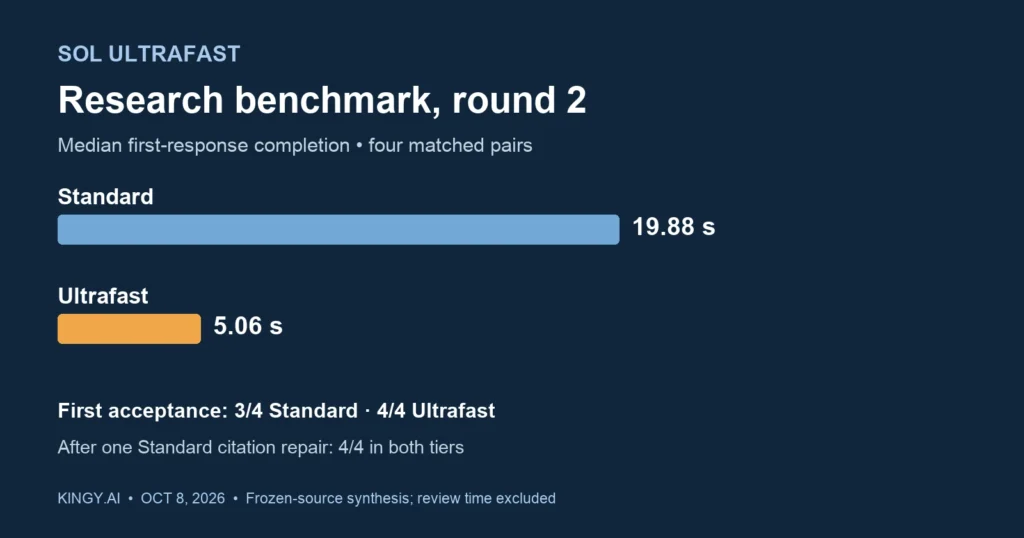
GPT-6.1 Sol Ultrafast cut waiting substantially in Kingy’s small matched trials. Coding median completion fell from 9.61 to 2.61 seconds with every answer passing all 30 checks. A second research test, with every acceptance requirement explicit, completed first responses in 19.88 seconds on Standard versus 5.06 on Ultrafast. Both tiers ultimately delivered four accepted briefs; Standard needed one citation-placement repair. The premium makes sense when useful time recovered pays for the extra cost and the output passes the same quality checks.
On October 8, 2026, OpenAI added Ultrafast to GPT-6.1 Sol in the Responses API. The official changelog confirms access for all API users, subject to rate limits, with global processing and US and EU data residency. Kingy’s AI Stack Change Radar caught the update. This article examines the purchase decision behind it.
The same gpt-6.1-sol model now has another service tier. Short-context Ultrafast costs $12 per million input tokens and $60 per million output tokens, compared with Standard’s $2 and $10. Whether the premium pays off depends on the whole task: reasoning, tools, retries, checking the answer and the amount of useful time recovered.
Evidence and scope, updated October 8, 2026. Official documentation and calculated examples sit alongside two completed Kingy benchmark rounds: the original coding/research pilot and a second research test with fully disclosed requirements. Across both rounds, 33 paid calls cost an estimated $1.2143152 from reported token usage. The samples are small, the research used frozen source summaries, and the second run does not establish a broad quality advantage. All prices are USD; larger worked examples remain illustrations.
What GPT-6.1 Sol Ultrafast changes
The API model identifier stays gpt-6.1-sol. Developers select the speed tier with service_tier: "ultrafast". The October 8 announcement concerns the Responses API; support for another endpoint on the underlying model does not establish Ultrafast support on that endpoint.
That makes this a deployment and pricing choice rather than a new model migration. OpenAI has not announced a separate Sol Ultrafast intelligence score in the sources reviewed here. Existing Sol benchmark scores should therefore be treated as model context, not as evidence that this tier produces better code or more reliable research.
For the underlying specifications and comparisons, see our GPT-6.1 Sol guide and Astra-versus-Sol analysis. The current model documentation lists a 1,050,000-token context window, a 922,000-token maximum input and a 128,000-token maximum output. It accepts text and images and produces text.
Sol’s API reasoning settings are low, medium, high, xhigh and max; medium is the default. none and minimal are unsupported. Speed tier and reasoning effort are different controls, and changing both during a comparison would obscure which one caused a time or quality difference.
How fast is Sol Ultrafast?
OpenAI describes the change as reducing the time between generated output tokens. Its current Ultrafast guide calls it the fastest API service tier and recommends persistent WebSocket connections for agents that make frequent tool calls. It does not give a numerical Sol tokens-per-second rate, guaranteed first-token latency or guaranteed task completion speedup.
A separate Work and Codex speed page says GPT-6 Astra Ultrafast generates tokens up to eight times faster than Astra Standard in Codex. That statement names Astra and token generation. It cannot be used as an eight-times-faster Sol result or an eight-times-faster coding-task result.
Three measurements answer different questions. Time to first visible output captures how quickly the interface responds. Generation throughput captures how quickly text arrives once generation starts. End-to-end completion time captures how long it takes to obtain an acceptable finished artifact. A tier can improve one substantially while improving another modestly.
A coding agent may spend time reading files, generating a patch, invoking a shell, waiting for tests, examining failures and revising. A research agent may spend time fetching websites, retrieving documents and checking citations. Faster generation can shorten the model portions; external tools and networks still contribute their own delays.
A faster generator does not remove the rest of the waiting
Consider a hypothetical task that takes 100 seconds: 60 seconds in model work affected by a speed improvement and 40 seconds in everything else. If that 60-second portion becomes four times faster, the task takes 15 + 40 = 55 seconds. The whole task improves by about 1.82×.
If only 20 of the original 100 seconds benefit, the same fourfold improvement yields 5 + 80 = 85 seconds, or about 1.18×. These are arithmetic examples, not Sol measurements. They explain why a token-speed headline is insufficient for a buying decision.
WebSockets address some connection overhead between turns. They do not accelerate a slow third-party website, a long test suite or a human review. OpenAI’s latency optimization guide also discusses shorter outputs, fewer requests and parallel work. Before paying a premium on every call, identify which part of your application consumes the time.
Second research benchmark: every acceptance requirement explicit
The second research test produced accepted briefs in both tiers. Standard completed its first responses in a median 19.88 seconds; Ultrafast took 5.06 seconds, a 3.93× ratio of medians. Ultrafast completed sooner in all four first-attempt pairs. Standard passed the full rubric on three of four first attempts, and Ultrafast passed on four of four. One targeted Standard citation repair brought final acceptance to four of four in both tiers.
We changed the research prompt before this run to disclose every acceptance requirement, including the quality gate that was missing from the first pilot’s instructions. The frozen design, source pack and rubric were hashed before execution and remained unchanged. This is a separate experiment; its results do not establish that either tier improved over round 1. The original pilot and its evidence remain below.
| Measure | Standard | Ultrafast |
|---|---|---|
| Median first-response completion | 19.88 s | 5.06 s |
| Median first visible text | 6.73 s | 1.97 s |
| First-attempt acceptance | 3/4 | 4/4 |
| Final acceptance after permitted repair | 4/4 | 4/4 |
| Repair calls | 1 | 0 |
| Total token cost, first attempts | $0.0517392 | $0.3156552 |
| Total token cost, including repair | $0.0710327 | $0.3156552 |
| Token cost per accepted sequence | $0.0177582 | $0.0789138 |
What the model had to deliver
Both tiers received the same 12,029-byte request: six archived official-source summaries, two stipulated EU request shapes, and explicit JSON, length, calculation and memo requirements. The response had to contain valid JSON with exact keys, 12 correct numeric fields and a 250–450-word memo. Twelve memo requirements covered API versus subscription billing, plan eligibility, residency, long-context pricing, cache accounting, reasoning costs, rate limits, speed-claim scope, subscription multipliers, the buying decision and citation support. All 26 checks had to pass.
The buying-decision requirement explicitly made two conditions necessary: measured useful waiting-time savings must exceed the total extra task cost, and accepted outputs in both tiers must meet the same factual-accuracy, citation-support and requirement-coverage checks. The prompt named all three checks and identified the gate as the customer’s policy. Every initial answer passed that requirement. Every initial answer also passed all 12 numeric checks, JSON structure and memo length.
Calls used gpt-6.1-sol, medium reasoning, an 8,192-token output cap, fresh initial conversations and the same global Responses API HTTP SSE client in Vancouver. Pair order alternated Standard first, Ultrafast first, Standard first, Ultrafast first. All nine responses reported the requested model and service tier and completed without truncation or API errors. There were no model tools, live searches, paid grading calls or transport retries. Describing EU costs in the question did not make the actual API calls EU-resident.
All four matched first attempts
| Pair | Order | Standard completion | Ultrafast completion | Standard token cost | Ultrafast token cost | Standard / Ultrafast acceptance |
|---|---|---|---|---|---|---|
| 1 | Standard first | 17.155 s | 5.711 s | $0.0164160 | $0.1037760 | Pass / Pass |
| 2 | Ultrafast first | 19.925 s | 4.800 s | $0.0112244 | $0.0665064 | Fail F12 / Pass |
| 3 | Standard first | 23.546 s | 4.715 s | $0.0128544 | $0.0676464 | Pass / Pass |
| 4 | Ultrafast first | 19.830 s | 5.314 s | $0.0112444 | $0.0777264 | Pass / Pass |
Standard first-response completion ranged from 17.15 to 23.55 seconds; Ultrafast ranged from 4.71 to 5.71 seconds. These medians include the completed answer that failed acceptance. Four pairs do not establish a dependable tail latency, statistical significance or a universal speed multiplier.
Reported input was 2,587 tokens per first attempt. Both tiers wrote 2,584 cache tokens in pair 1 and read 2,584 cached tokens in pairs 2–4. All four pairs therefore matched on input and cache accounting. Output lengths and reasoning-token counts varied; the measured cost ratio per answer need not equal the sixfold rate ratio. Costs include billed reasoning output.
The citation failure and its repair
Standard’s second answer had correct facts and calculations but placed three supporting source references two sentences after their claims. The disclosed F12 rule required a supporting source ID in the same or immediately adjacent sentence. The affected claims concerned non-US residency eligibility, exclusive input-pricing categories and Astra’s up-to-eight-times token-generation claim. The memo passed 11 of 12 memo checks and failed strict acceptance on citation placement.
Targeted feedback named F12, repeated its unchanged requirement and explained those placement failures. It did not supply replacement numeric answers. The single permitted repair passed every check. That repair took 16.34 seconds and cost an estimated $0.0192935. Standard pair 2 therefore used 36.26 seconds of summed model-call completion intervals across two attempts; its matched Ultrafast answer passed in 4.80 seconds on the first attempt. The observed three-of-four versus four-of-four first acceptance is descriptive evidence from this task, too small to establish a general quality or retry advantage.
The Codex primary agent reviewed initial memos in random order with tier, timing and cost labels concealed until all eight scorecards were locked. Each requirement has an exact excerpt and explanation in the evidence files. This was not an independent human review panel. The sole repair review was unblinded because its tier was already known.
Which time and cost numbers matter?
Response completion runs from immediately before the HTTP request to the completed API event; first-text latency ends at the first nonempty text delta. Those measurements include client/network and model work and exclude review. The evidence also records summed model-call intervals, Codex review intervals and wall time to final acceptance. Initial answers were reviewed after the batch, so accepted-artifact wall time includes review queues, interleaved calls and orchestration. Those gaps cannot be attributed to the service tier. Recorded review intervals include agent/orchestration time and do not measure active human grading time.
The accepted-sequence token premium averaged about 6.12 cents, including Standard’s repair. At the article’s illustrative $60/hour value of time, that premium equals about 3.67 seconds of useful waiting. This is a calculated purchase threshold. We measured response intervals, not recovered staff productivity, and a short wait may overlap with other work. Tool costs and regional uplifts would also belong in a real application’s total task cost.
Round 2 used nine paid calls at an estimated $0.3866879. Adding the original 24-call pilot’s $0.8276273 gives 33 paid calls and $1.2143152 cumulatively, within the original $15 authorization, with no open spending reservations. These are calculations from API-reported token usage at verified rates, not a reconciled billing invoice. No extra budget was created for the second run.
Download the second research benchmark’s evidence ZIP for the frozen inputs and hashes, every answer, reported usage, timing events, CSVs, requirement decisions and targeted repair feedback. The frozen protocol retains its original design-only status text; EXECUTION.md records the later authorized execution. This benchmark measures controlled synthesis of supplied sources, not live-web discovery, large-context work, regional latency or broad research ability.
Kingy’s matched pilot: measured speed, quality and cost
Our October 8 pilot found a clear response-time advantage for Ultrafast on two small tasks. The coding fix’s median completion time was 9.61 seconds on Standard and 2.61 seconds on Ultrafast, a 3.68× ratio of medians. Every coding answer passed all 30 frozen checks. The research brief’s first-response median fell from 16.14 to 4.17 seconds, a 3.87× ratio. Both tiers returned correct calculations, but both omitted the same condition in our memo rubric. Faster research responses did not establish a faster fully accepted research result.
We ran four matched pairs per task, alternating which tier went first. That produced 16 first attempts plus eight planned research self-review calls. The 24 paid calls cost an estimated $0.827627 from API-reported usage, below the approved $15 ceiling. This is a token-price calculation, not a settled billing invoice. No paid search, external tools or grading model added charges.
The conditions we held constant
Both conditions used gpt-6.1-sol through the Responses API, reasoning.effort: "medium", an 8,192-token output cap and the same HTTP server-sent-events client on a Mac in Vancouver, Canada. Standard explicitly requested service_tier: "default"; Ultrafast requested "ultrafast". Every response reported the requested tier and model ID. Within each first-attempt pair, the task prompt had the same SHA-256 hash. Calls were sequential, and each initial answer started a fresh conversation. There were no transport retries, errors or truncated responses.
The requests used the global https://api.openai.com/v1/responses endpoint. The research question described an EU-resident customer, but the benchmark itself did not use an EU or US residency configuration. Client location does not establish server processing location. These measurements do not qualify regional performance, persistent WebSocket agents or large-context workloads.
For coding, the model replaced a faulty pure Python pagination function. Thirty checks covered unsorted input, timestamp ties, absent cursor rows, end-of-list behavior, invalid limits and cursors, preservation of caller data, and full traversal of shuffled records. Generated code ran in an isolated subprocess with restricted built-ins, no API credential environment and a temporary working directory. For research, the model used a frozen pack of six official-source summaries to calculate two EU regional request costs and write a 250–450-word procurement memo. It did not browse the web.
| Task | Tier | Median completion | Median first text | Mean token cost / first attempt | Acceptance checks |
|---|---|---|---|---|---|
| Pagination fix | Standard | 9.61 s | 5.84 s | $0.004733 | 30/30 code checks; 4/4 accepted |
| Pagination fix | Ultrafast | 2.61 s | 1.60 s | $0.025881 | 30/30 code checks; 4/4 accepted |
| Source-pack brief | Standard | 16.14 s | 5.16 s | $0.010025 | 12/12 numeric; 11/12 memo; 0/4 strict acceptance |
| Source-pack brief | Ultrafast | 4.17 s | 1.70 s | $0.063043 | 12/12 numeric; 11/12 memo; 0/4 strict acceptance |
Completion time runs from just before the HTTP request to receipt of the API’s completed-response event. First-text latency ends at the first nonempty output-text delta. These figures include client/network time and model work; they exclude orchestration gaps and editorial review. Coding checks added roughly hundredths of a second locally. Research review was performed by Codex against the frozen rubric, not by a paid judging model or a blinded human panel.
For readers who want an approximate token-delivery figure, median visible-output delivery was 78.7 versus 278.7 tokens/second for coding, and 65.2 versus 290.9 for research first attempts, Standard versus Ultrafast. We calculated this as billed output minus reported reasoning tokens, divided by the interval from first visible delta to completion. It is an observed client-side delivery rate, with terminal-event overhead; it does not measure hidden reasoning throughput or establish a provider speed guarantee.
Every first-attempt pair
| Pair | Run order | Standard completion | Ultrafast completion | Standard token cost | Ultrafast token cost |
|---|---|---|---|---|---|
| Coding 1 | Standard first | 9.589 s | 2.785 s | $0.004546 | $0.025776 |
| Coding 2 | Ultrafast first | 8.174 s | 2.838 s | $0.004376 | $0.026316 |
| Coding 3 | Standard first | 9.651 s | 2.382 s | $0.005046 | $0.025476 |
| Coding 4 | Ultrafast first | 9.632 s | 2.432 s | $0.004966 | $0.025956 |
| Research 1 | Standard first | 16.275 s | 3.953 s | $0.012826 | $0.077616 |
| Research 2 | Ultrafast first | 16.007 s | 4.289 s | $0.008961 | $0.059285 |
| Research 3 | Standard first | 15.947 s | 4.555 s | $0.009171 | $0.058985 |
| Research 4 | Ultrafast first | 16.765 s | 4.058 s | $0.009141 | $0.056285 |
Ultrafast completed sooner in all eight first-attempt pairs. Coding Standard ranged from 8.17 to 9.65 seconds; Ultrafast from 2.38 to 2.84 seconds. Research Standard ranged from 15.95 to 16.77 seconds; Ultrafast from 3.95 to 4.56 seconds. Four repetitions per task are sufficient to describe this pilot, not to estimate a dependable tail latency or a universal speed multiplier.
Coding input was 353 reported tokens per call, with no cache reads or writes. Research first attempts used 1,351 input tokens per call. In both tiers, the first research request wrote 1,348 cache tokens and each of the remaining three read 1,348 cached tokens. Cache accounting therefore matched within every first-attempt pair. Outputs and reasoning-token counts varied, so realized cost ratios differed from the fixed sixfold token-price ratio. The aggregate first-attempt cost ratio was about 5.47× for coding and 6.29× for research.
What quality checks and repairs changed
All eight initial research answers passed all 12 numeric checks, including short- and long-context costs, the regional uplift, break-even seconds, the mixed workload and the three TPM limits. They also passed 11 of 12 memo criteria and the requested word-count range. The missing criterion required the recommendation to depend on accepted output quality as well as useful time saved. Both tiers recommended testing the economic benefit without explicitly carrying that quality condition into their recommendation.
This finding needs a methodological qualification: the quality condition was in our frozen rubric but was not stated explicitly in the task prompt. It is a strict editorial acceptance condition, not evidence of incorrect arithmetic, hallucinated documentation or generally poor research. Our grader held both tiers to it equally. A better follow-up experiment would state every acceptance requirement in the prompt and supply standardized failure feedback.
Under the prewritten protocol, each failed memo received one generic self-review request containing its previous answer: “Review the original requirements, correct any mistakes, and return a complete replacement JSON answer.” This supplied no targeted feedback about the missing rubric condition. All eight revised answers again passed 12/12 numeric and 11/12 memo checks, and remained within the word-count range. No second repair was attempted. Consequently, neither tier reached our strict research acceptance threshold; no research retry or quality advantage was demonstrated.
| Pair | Standard self-review time | Ultrafast self-review time | Standard two-call cost | Ultrafast two-call cost | Final memo result |
|---|---|---|---|---|---|
| 1 | 15.310 s | 4.870 s | $0.027099 | $0.167427 | 11/12 memo in both; strict acceptance still unmet |
| 2 | 16.881 s | 3.907 s | $0.023627 | $0.147596 | 11/12 memo in both; strict acceptance still unmet |
| 3 | 15.236 s | 5.887 s | $0.023692 | $0.147296 | 11/12 memo in both; strict acceptance still unmet |
| 4 | 16.725 s | 5.437 s | $0.023942 | $0.144491 | 11/12 memo in both; strict acceptance still unmet |
Including self-review, research used $0.098360 on Standard and $0.606809 on Ultrafast. Median summed model-call time per two-attempt research sequence was 32.24 versus 9.16 seconds. Those are completed-call totals excluding review gaps, not time to an accepted brief. Coding needed no repairs and totaled $0.018934 on Standard and $0.103524 on Ultrafast.
Was this pilot’s time saving worth its price?
The coding comparison offers the clearest narrow answer. Ultrafast cost an average $0.0211475 more per initial coding answer while the median completion-time difference was about 7.00 seconds. At $60/hour, that extra token cost requires about 1.27 seconds of useful blocked time recovered. If a developer was actually waiting and the same code checks were sufficient, this small task cleared that threshold. We did not measure staff productivity or time saved by a real employee.
The research first responses cost an average $0.053018 more on Ultrafast, equivalent to about 3.18 seconds at $60/hour, against an approximately 11.97-second difference between completion medians. That makes the latency economics interesting, but the strict acceptance condition remained unmet after self-review. Paying for speed cannot replace defining a usable deliverable. The large-context cost examples below are separate calculations; these tiny prompts do not establish their actual latency or value.
Download the sanitized benchmark evidence ZIP for the frozen prompts and source pack, rubric, grading code, per-call outputs and usage, CSV measurements, summary and offline checks. The archive contains no API key or local env file. API prices and our protocol are recorded so readers can inspect the calculation and understand why these observations have a limited scope.
GPT-6.1 Sol API pricing, including long context and caching
The official API price table lists the following rates per million tokens. These are base token rates before the regional-processing uplift and separately billed tools.
| Tier and context | Input | Cached input | Cache writes | Output |
|---|---|---|---|---|
| Standard, short | $2.00 | $0.10 | $2.50 | $10.00 |
| Fast, short | $4.00 | $0.20 | $5.00 | $20.00 |
| Ultrafast, short | $12.00 | $0.60 | $15.00 | $60.00 |
| Standard, long | $4.00 | $0.20 | $5.00 | $15.00 |
| Fast, long | $8.00 | $0.40 | $10.00 | $30.00 |
| Ultrafast, long | $24.00 | $1.20 | $30.00 | $90.00 |
| Batch or Flex, short | $1.00 | $0.05 | $1.25 | $5.00 |
| Batch or Flex, long | $2.00 | $0.10 | $2.50 | $7.50 |
Ultrafast’s sixfold multiplier applies across the four token categories at the same context length. Fast costs twice Standard. Batch and Flex list half Standard’s rates, but have different processing behavior; their discounted prices do not make them equivalent substitutes for an interactive low-latency service tier.
The 272,000-token boundary changes the whole request’s rates
Sol’s pricing notes say prompts with more than 272,000 input tokens use twice the input and cache rates and 1.5 times the output rate for the full request. The higher rate does not apply only to the tokens above the boundary.
For example, 270,000 ordinary input tokens and 2,000 billed output tokens cost $0.56 on Standard or $3.36 on Ultrafast at short-context rates. Increasing the input to 280,000 tokens puts the entire request on long-context rates: $1.15 on Standard or $6.90 on Ultrafast. These examples assume no cached input, cache writes or tool fees. A relatively small context increase can cause a much larger bill increase.
Cache reads, cache writes and ordinary input have different prices
Ultrafast cached input at $0.60 is 95% cheaper than its $12 ordinary input rate. A cache write is $15, or 1.25 times ordinary input. OpenAI’s prompt caching guide says cache-write pricing is not additive: an input token uses the ordinary, cached or cache-write rate.
Do not bill the same tokens at both $12 and $15. Equally, do not assume a repeated prompt guarantees a cache hit. Cache reuse depends on a matching prefix and an eligible cache entry. Actual usage accounting must tell you which category applied.
Caching can make a large persistent code or document prefix cheaper to revisit. It does not reduce the output token price, and the Ultrafast cached-input rate remains six times Sol Standard’s cached-input rate. A warm-cache trial against a cold-cache baseline would be a misleading speed comparison.
Reasoning and tools belong in the cost calculation
The answer displayed on screen is not a complete usage ledger. OpenAI’s reasoning guide confirms reasoning tokens are billed as output. Include those tokens, every model turn, attempted repair and billable tool operation. Web search, file storage, code execution and other tools can introduce additional charges according to the relevant service. A 300-word final answer can follow a long and costly agent run.
What the premium costs per task
Per-million rates are useful for comparison; task budgets are easier to act on. The table below holds token counts constant between tiers. “Output” means billed output, including any reasoning tokens charged in that category. None of these rows is a measured benchmark.
| Illustrative workload | Standard | Ultrafast | Extra cost |
|---|---|---|---|
| 20K ordinary input + 3K output; short context | $0.07 | $0.42 | $0.35 |
| 80K cached input + 20K ordinary input + 5K output; short context | $0.098 | $0.588 | $0.49 |
| 300K ordinary input + 10K output; long context | $1.35 | $8.10 | $6.75 |
| Five separate turns, each with 20K ordinary input + 3K output | $0.35 | $2.10 | $1.75 |
The five-turn row deliberately holds each turn’s input at 20,000 tokens. Real conversations may grow, gain cache hits or trigger cache writes. Calculate the actual sequence rather than multiplying an optimistic first-turn estimate.
At 1,000 tasks matching the first row, Standard totals $70 and Ultrafast totals $420. That is a $350 difference before tools or regional premiums. If only 100 of those tasks need Ultrafast and the other 900 stay on Standard, the token bill becomes $42 + $63 = $105. Selective routing can capture useful speed without charging the premium throughout the workload.
A simple short-context formula is: cost = ordinary input × input rate + cached input × cached rate + cache-write input × write rate + billed output × output rate. Divide each token count by one million before multiplying. Use the long-context rate set when the request exceeds the documented boundary, then account for applicable regional pricing and tools.
Which plans get Sol Ultrafast?
API access and a ChatGPT subscription are separate routes. The API announcement does not mean every subscriber receives an Ultrafast button or included API usage. OpenAI’s subscription pricing documentation and speed guide establish the distinction.
| Route or plan | Listed subscription price | Ultrafast access at launch |
|---|---|---|
| Responses API | Usage-based token billing | All API users, subject to model access, limits and supported geography/residency |
| ChatGPT Free / Go / Plus | $0 / $8 / $20 monthly | No subscription Ultrafast access |
| ChatGPT Pro $100 or $200 | $100 or $200 monthly | No subscription Ultrafast access |
| ChatGPT Pro $500 | $500 monthly | Ultrafast in Work and Codex |
| ChatGPT Business | $20/user/month annually; $25 monthly; 2+ users | No subscription Ultrafast access at launch |
| Eligible Enterprise | Contract pricing | Credit-based or USD usage-based agreements; administrator enablement |
| Eligible Edu | Contract pricing | Eligible credit-based plans |
These are listed USD subscription prices, not a promise of the same checkout amount in every country. Other self-serve plans do not gain subscription Ultrafast access by purchasing credits. Legacy Enterprise plans based on rate limits rather than usage billing are unsupported.
In Enterprise workspaces, Ultrafast starts off by default. Owners can enable it for selected users or the workspace; existing per-user spend controls still apply. Pro $500 draws on included usage first, then available credits. Our Pro $500 guide covers that subscription separately.
Work and Codex share usage. Ultrafast consumes included subscription limits at eight times the Standard rate, while purchased credits and Enterprise pay-as-you-go usage are billed at six times Standard. Those usage multipliers do not measure speed. They also do not establish a fixed number of tasks that a plan includes.
With an API key, Codex follows API token pricing instead of ChatGPT credit multipliers. Developers do not need to buy Pro $500 solely to call Sol Ultrafast through the Responses API. OpenAI’s model guide places Sol in Work and Codex, rather than ordinary Chat; product access should be checked in the relevant surface.
Locations, US/EU residency and the 10% uplift
Customer location and inference location are separate questions. OpenAI’s supported-country list includes the United States, Canada, the United Kingdom, EU member countries, Australia, India, Japan and many others. “All API users” remains subject to supported geography; it does not establish universal worldwide access.
The October 8 Sol Ultrafast release supports global processing and US/EU data residency. The current Ultrafast availability section distinguishes Sol from Astra: Astra Ultrafast supports global and US processing, while Sol also supports EU residency. Older Astra-only limitations should not be copied onto this new Sol tier.
Global processing does not promise inference in the customer’s country. A Canadian or Australian developer’s access does not imply a Canadian or Australian Sol Ultrafast processing region. Europe in the residency documentation means the EEA plus Switzerland; it should not be casually equated with every European country or the UK.
OpenAI’s data controls documentation describes regional storage, regional inference and eligibility requirements. Non-US residency requires approval for abuse-monitoring controls and a Modified Retention amendment. Supporting a regional model/tier does not waive those requirements or guarantee residency for third-party tools.
The regional domains are https://us.api.openai.com/v1 and https://eu.api.openai.com/v1. Eligible Global projects can also select regional processing per request using the supported prefixed endpoint. System data and external services have separate limitations, so verify the whole application’s data flow.
The API pricing page lists a 10% uplift for regional-processing endpoints on eligible models released on or after March 5, 2026. For Sol Ultrafast, that produces these calculated rates:
| Regional Ultrafast context | Input / 1M | Cached / 1M | Writes / 1M | Output / 1M |
|---|---|---|---|---|
| Short | $13.20 | $0.66 | $16.50 | $66.00 |
| Long | $26.40 | $1.32 | $33.00 | $99.00 |
The illustrative $0.42 short-context task becomes $0.462 with that uplift; the $8.10 long-context task becomes $8.91. Compare equivalent regional configurations when evaluating Standard against Ultrafast. Switching the baseline to a different location can change both network latency and pricing.
API tiers and rate limits: capacity is not speed
OpenAI’s October 6 update simplified paid API usage tiers to Build, Launch and Grow. The rate-limits guide ties qualification to cumulative credit purchases; the Ultrafast guide gives Sol’s default token limits.
| Paid API tier | Total credit purchases to qualify | Listed monthly usage limit | Sol Ultrafast default TPM |
|---|---|---|---|
| Build | $5 | $500 | 1,000,000 |
| Launch | $100 | $5,000 | 4,000,000 |
| Grow | $500 | $200,000 | 40,000,000 |
The qualification amounts are credit-purchase thresholds, not monthly subscription fees. The usage limits are not free included spend. The Sol model page lists Free as unsupported, so “all API users” should not be read as free Sol inference.
A one-million-token-per-minute allowance measures permitted traffic. It does not mean a single response generates one million tokens in a minute. Ultrafast limits are separate from Standard and Fast; check the organization’s actual limits before increasing traffic. The guide does not provide a Sol Ultrafast requests-per-minute table, and Standard RPM values should not be presented as confirmed Ultrafast RPM values.
Capacity can affect value indirectly. If bursts produce throttling and retries, users may wait longer even though individual generations are faster. Evaluate the tier under realistic concurrency, including backoff, rather than extrapolating a single quiet-period request to a busy service.
Is the time saved worth the price?
For a person blocked on an answer, a useful starting calculation is: extra task cost ÷ value of one second recovered. This assumes the result passes the same acceptance checks and the person can use the recovered time.
Kingy’s buying verdict
Keep Standard as the default, and pay for Ultrafast where measured useful time savings outweigh the full task premium and the result passes the same acceptance checks. At an illustrative $60/hour, Kingy’s measured token premiums break even at about 1.27 useful seconds per accepted coding answer and 3.67 per accepted research brief, including Standard’s research repair. These small tests support selective trials on your own workload; they do not establish a universal speed, quality or productivity advantage.
Break-even using Kingy’s measured task costs
The completed trials give us two usable cost baselines. For each tier, we divide its total token cost across all attempts by its number of accepted tasks. Coding required no repairs. The second research test includes Standard’s citation-placement repair; both tiers ultimately produced four accepted briefs. The original research pilot has no cost per strictly accepted brief because neither tier met its full rubric.
Coding cost $0.0047335 per accepted answer on Standard and $0.0258810 on Ultrafast, a $0.0211475 premium. The second research test cost $0.017758175 per accepted brief on Standard and $0.0789138 on Ultrafast, a $0.061155625 premium including Standard’s repair.
| Measured workload | At $30/hour | At $60/hour | At $120/hour |
|---|---|---|---|
| Coding pilot | 2.54 seconds | 1.27 seconds | 0.63 seconds |
| Second research test | 7.34 seconds | 3.67 seconds | 1.83 seconds |
The cost estimates come from the actual benchmark’s reported usage. The hourly values are illustrative USD scenarios, not Curtis’s stated rate or measured staff productivity. Break-even is calculated from unrounded costs; displayed prices and seconds are rounded. No additional model calls were made for this calculation.
Break-even seconds = (Ultrafast cost per accepted task − Standard cost per accepted task) × 3,600 ÷ hourly value. For the second research test at $60/hour, the calculation is ($0.0789138 − $0.017758175) × 3,600 ÷ $60 = 3.6693375 seconds, or about 3.67 seconds of useful waiting recovered. Recovering more than that covers the estimated token premium under those assumptions.
Use the hourly value of time you can actually recover. If only half of a shorter wait becomes useful time, the $60/hour research scenario needs about 7.34 seconds of wall-clock waiting removed to recover 3.67 useful seconds. If you already spend the entire wait doing equally valuable work, a shorter response does not create that hourly-value benefit. Customer retention, deadlines and queue capacity may have other value, which these trials did not measure.
Count every billable attempt, reasoning token, tool and applicable regional charge in your own task costs. Also account for paid review effort if it differs between tiers. The benchmark rows cover global API token costs only; there were no paid tools, and Codex review intervals were not priced as employee work. Response-completion medians exclude review, so they do not establish the useful time recovered from a finished workflow.
A simple Standard-versus-Ultrafast buying checklist
Keep Standard as the default. Use Ultrafast for a workload when all of these conditions hold:
- Someone is blocked waiting, or faster completion has a measurable business value.
- Model response time accounts for enough of the workflow’s delay to matter.
- Both tiers pass the same accuracy, citation-support and requirement-coverage checks, plus relevant code tests.
- Total cost includes every attempt, reasoning output, tools, regional charges and any different review effort.
- Matched trials on your workload show that the useful time recovered is worth more than the total premium.
For this small source-synthesis task, the calculated $60/hour purchase threshold is about 3.67 useful seconds per accepted brief. Four matched pairs justify a workload-specific trial, not a universal routing rule. The second benchmark’s evidence contains the costs and accepted-sequence counts behind the calculation.
Take the $0.35 premium on our 20K-input/3K-output example. At $60 per hour, one second is worth about $0.0167, so break-even is 21 seconds saved. At $30 per hour, it is 42 seconds; at $120 per hour, 10.5 seconds. These are economic scenarios, not proof that Ultrafast achieves those savings.
| Example premium | At $30/hour | At $60/hour | At $120/hour |
|---|---|---|---|
| $0.35 short task | 42 seconds | 21 seconds | 10.5 seconds |
| $1.75 five-turn workflow | 210 seconds | 105 seconds | 52.5 seconds |
| $6.75 long-context task | 810 seconds | 405 seconds | 202.5 seconds |
For the long-context example, a $60-per-hour worker needs to recover six minutes and 45 seconds to offset the $6.75 token premium. Large context can still justify Ultrafast, but it raises the required return. If the worker does something productive during the wait, the recovered wall-clock time is worth less than a full hourly rate.
Where selective Ultrafast use is plausible
Interactive coding is a reasonable candidate: a person may be waiting repeatedly for patches, explanations and repair attempts. Fast iterations can matter when each one determines the next human action. The acceptance condition remains working code and passing meaningful tests.
Interactive research is another candidate when the model’s synthesis dominates the delay and a reader needs an answer immediately. A workflow dominated by slow websites, downloads or document parsing may gain less. Citation accuracy and coverage still determine whether the faster answer is useful.
In customer-facing applications, evaluate user outcomes such as abandonment or successful completion rather than assigning every saved second a salary value. In automated overnight work, the relevant gain may be meeting a deadline or reducing a queue. If the job already finishes comfortably before it is needed, the extra token spend has little demonstrated value.
Our assessment is to keep Standard as the default and test Ultrafast on the subset where latency has a business cost. Budget for output and repairs, cap context growth, and route urgent or blocked steps to the premium tier. Keep the routing rule tied to measured results.
Retries and quality can outweigh the headline rate
The equal-token examples make Ultrafast exactly six times as expensive. Real runs may use different tokens or need different numbers of attempts. Measure cost per accepted result: total spend across all attempts divided by successful accepted tasks.
A shorter answer can omit requirements. A faster first patch can fail tests. Conversely, fewer repair loops can reduce total time and cost. None of those outcomes is established by the service-tier announcement. Counting only successful first attempts would hide the failures that determine the production bill.
How to select Sol Ultrafast in the Responses API
The following Python example illustrates the documented model and service-tier controls. This snippet remains an illustrative setup example. The matched pilot above used an instrumented HTTP streaming runner with the same documented model and tier controls. An actual call consumes paid API tokens.
from openai import OpenAI

client = OpenAI()
response = client.responses.create(
    model="gpt-6.1-sol",
    service_tier="ultrafast",
    reasoning={"effort": "medium"},
    input="Review this function and propose a minimal fix: ...",
    max_output_tokens=4000,
    store=False,
)
print(response.output_text)
print(response.usage)
For a comparison, explicitly select the documented Standard/default service tier on the baseline and keep the prompt, effort, tools and output limit identical. Capture the response’s reported tier and usage rather than relying solely on the requested setting. Incomplete responses and errors belong in the record.
HTTP requests are supported. For an agent with repeated tool exchanges, OpenAI recommends a persistent WebSocket. Set the service tier on each response event and reuse the connection appropriately. If one trial uses HTTP and another uses a persistent WebSocket, the comparison measures both the tier and the transport change.
An eligible regional configuration uses the corresponding US or EU base URL. Choosing store=False in this illustrative request controls response storage; it does not itself grant residency eligibility or establish Zero Data Retention.
The comparison needed before calling Sol Ultrafast a winner
A useful coding trial gives both tiers the same repository snapshot and an explicit task, such as fixing a reproducible pagination bug. Start from a clean copy for every attempt. Set the same reasoning effort, tool permissions, output budget and stopping conditions. Grade the final patch against the same tests and a review rubric covering correctness, scope and maintainability.
A research trial gives both tiers the same question and acceptance criteria: source coverage, accurate numbers, supported citations and clear uncertainty. A frozen source pack isolates synthesis speed; a live-web trial measures browsing plus synthesis. Report those as different experiments. Do not compare one tier with pre-fetched documents against another that must discover them.
Repeat each task across both tiers, alternate which tier runs first, and record the run time and region. Separate cold and warm cache cases. Keep the client and transport the same. A handful of paired trials can be a pilot; it cannot establish universal performance across all coding or research tasks.
| Measurement | What to record | Why it matters |
|---|---|---|
| Latency | First output, final response and accepted artifact times | Separates interface responsiveness from finished work |
| Retries | Rate-limit/transport retries and model repair turns | Captures waiting and spend hidden by the first response |
| Quality | Test results; blinded review; citation accuracy and coverage | Prevents rewarding a fast incomplete answer |
| Token usage | Ordinary, cached and write input; total billed output and reasoning | Explains the actual bill |
| Total cost | All attempts, tools and regional premiums | Measures cost per accepted result |
| Conditions | Model, reported tier, effort, transport, cache, region and concurrency | Makes the result interpretable and repeatable |
Report success rate alongside median completion time and variation. Larger samples can support tail-latency estimates; a small pilot should publish its individual runs instead of presenting an unstable percentile as a reliable service guarantee. Preserve failed outputs and sanitized logs so readers can inspect what passed.
Our pilot supports trying Ultrafast on small coding steps where someone is waiting, then judging larger workloads on their own results. Sol Ultrafast has broad API access and US/EU residency support, but neither those features nor our response-time measurements establish a universal value case. Buy it for steps where measured useful savings exceed the added cost and the deliverable meets the same acceptance standard. For the separate $0.35 example at $60 per hour, that still means recovering at least 21 seconds of useful blocked time.
The Kingy Brief
Get The Kingy Brief.
AI changes, original tests and one practical thing to try. Fridays at 09:00 Vancouver time.
Free · Double opt-in · Unsubscribe anytime
Signup help and newsletter schedule
Signup form provided by Beehiiv. After submitting, check your inbox for "Confirm your subscription to The Kingy Brief" and open its confirmation link. Check Spam or Promotions if you cannot find it.
Fridays at 09:00 Vancouver time: source-checked AI changes, original tests and one practical thing to try. The weekly restart begins October 9, 2026. We skip a week when there is not enough verified material. Free. Unsubscribe anytime.