A game earns its second play. The first can run on curiosity: somebody clicks because an AI made it, because a friend sent it, because the premise sounds ridiculous. The second requires something better. A decision that felt interesting. A mistake worth correcting. A score worth beating.
That is the test Google’s new Playground will have to pass. Prompting a playable game into existence is a useful achievement. Turning that first result into something people choose to return to is where the platform’s lasting value will be decided.
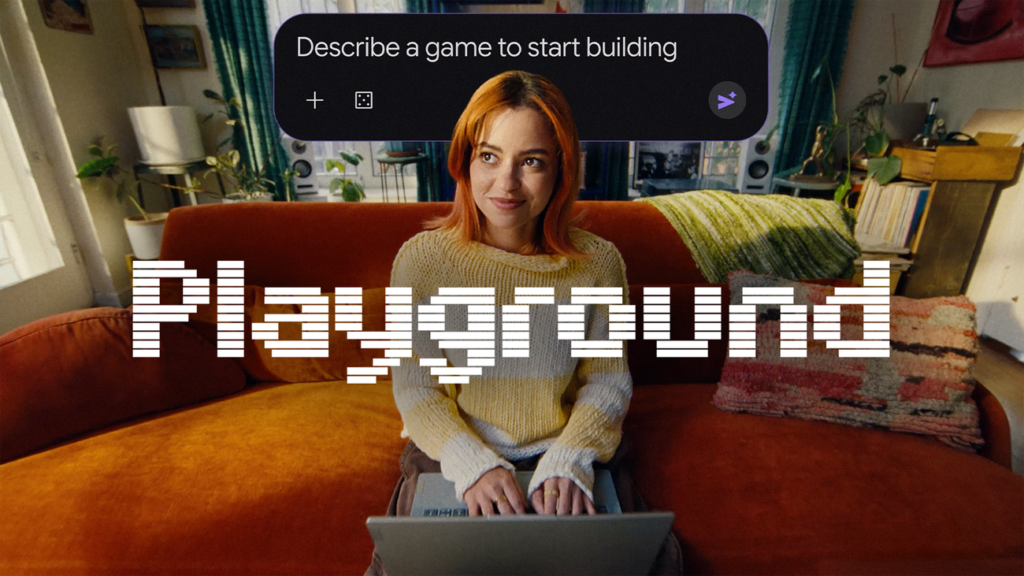
Google launched Playground on October 7, 2026, as an experimental platform for creating, playing and sharing browser games through conversational prompts. Creators can revise rules, physics, characters and environments. Games can remain private, travel through shared links or appear in the Explore gallery. Multiplayer is supported in selected genres.
Our view: Playground’s most promising territory is small games with a specific audience and a tight loop of play, feedback and revision. Its prospects look weaker when judged by how much scenery, story or complexity a single prompt can produce.
Reporting note: This is analysis of Google’s and Unity’s announcements and the published Playground documentation, checked October 8, 2026. We have not created or played a Playground game for this article. The scenarios and evaluation criteria below are our own proposals, not test results.
Launch artwork: Google, via its announcement. The featured image is promotional artwork.
What you can use today
Access begins with U.S. adults aged 18 and over. Google’s Help Center says catalog play is free; creation has a free tier with limited weekly tokens and a phased waitlist. Google One AI plans offer immediate creation access and higher limits. Eligibility and available allowance still matter.
Unity Spark is upcoming. Google says the integration is in testing, with a closed beta coming soon; Unity’s partnership announcement places the expanded experience later in 2026. Its promised capabilities include more advanced mechanics, higher-fidelity 3D and the Unity runtime.
Those dates deserve care. A Playground launch does not make the Spark roadmap available to every creator today. Nor should someone outside the United States buy an AI subscription on the assumption that it establishes Playground access.
For the broader feature and subscription breakdown, see our Google Playground guide. Here, the more interesting issue is what creators could do with this kind of tool once the initial surprise wears off.
Small games can be complete games
“Beyond demos” is easy to confuse with “bigger.” Add a sprawling map, an inventory, a campaign and a crafting system, and the project looks more ambitious. Each addition also creates more ways for the rules to contradict one another.
A sixty-second game can be finished. It can teach its controls, establish a goal, create tension, resolve the round and make restarting irresistible. A much larger generated world can fail at all five.
Consider a hypothetical game made for a group of friends: a short race through an obstacle course built around their running jokes. Its audience might be twelve people. If those twelve compete, complain about one unfair corner and ask for another round, it has already done a real game’s job. It does not need to become a commercial release to justify existing.
This is the opportunity I find most compelling. People have ideas tailored to occasions, communities and private obsessions that would never justify months of development. A game for a birthday. A weekly puzzle for a small newsletter. A playful simulation that lets a club test an argument. Lower creation costs could make those ideas practical.
The result still needs care. A quiz needs correct answers. A race needs readable obstacles. A joke needs enough substance to survive the punchline. But the appropriate standard is whether the intended players have a worthwhile experience.
The tenth edit tells you more than the first prompt
A first generation shows what a system can assemble. Revision shows whether a creator can direct it.
Imagine a simple platformer. You ask for a slightly higher jump. That change should help players reach a ledge. It should preserve the score, restart behavior and collision rules you already liked. If it also rewrites the level, changes the enemy speed and breaks touch controls, the creator has gained a new repair job.
This is why control over changes matters so much. The useful unit of progress is an improvement that preserves the rest of the game. More output can make a project harder to understand.
There are encouraging details in Google’s documentation: edits remain private until republished, the existing release stays playable, and creators can download a ZIP of HTML, JavaScript, CSS and generated assets. Those are documented capabilities; we have not tested their reliability.
Separating a live version from work in progress gives a creator room to experiment. Source export creates the possibility of inspecting or continuing the project elsewhere. The remaining questions concern what that exported project needs to run, how understandable the code is and how easily another developer can maintain it.
For a serious creator, those questions could matter more than the first screenshot. A good prototype should become easier to reason about as you refine it. If each revision turns it into a fresh mystery, the apparent speed advantage may disappear.
Multiplayer makes the rules answer to two people
Multiplayer raises the standard because players must agree on what happened. Google’s Help Center describes turn-based and real-time support as an early preview, selected before generation, and says global platform leaderboards are unavailable for multiplayer games.
Suppose two players try to collect the same object. Who gets it? Suppose one disconnects during a turn. Does the other player wait indefinitely, win automatically or get a way to resume? Suppose one phone pauses the browser tab. Does everyone still see the same timer?
These are ordinary situations. A cheerful demonstration with two cooperative players can avoid them all. A group of competitive friends will eventually find them.
My expectation is that games with discrete turns and visible state will offer a more forgiving starting point than action games whose fairness depends on split-second timing. That is an engineering assessment, not a finding from Playground testing. You can pause over a disputed move on a board. You cannot pause away a disagreement about whether a projectile hit.
For creators, a multiplayer prompt should therefore include what happens when play goes wrong. For Google, the quality of shared state, recovery and fair outcomes will determine how much of the multiplayer promise survives normal use.
The cost that matters is reaching a good version
Subscription tiers tell you something about access. They tell you much less about the effort required to finish a worthwhile game.
Google’s Help Center says generation credits are deducted after successful compilation, with failed or timed-out generations refunded. A compiled game can still have confusing controls, unfair scoring or a broken ending. That means technical success and creative success need separate accounting.
Here is an illustrative comparison. One creator needs four revisions to get a puzzle that players understand. Another needs twenty to repair a more elaborate concept, then abandons it. Counting the number of generated games would make the second workflow look more productive. Counting finished, enjoyable games gives a more useful picture.
I would track accepted revisions, time spent repairing regressions and how often a new player finishes without help. These measures connect the tool’s output to the creator’s goal. They also make it easier to decide whether a higher creation allowance will help or merely fund more attempts at a poorly scoped idea.
A practical habit follows: establish the game’s core rules before spending generations on decoration. An extra background has limited value if the restart button carries the previous round’s score into the next attempt.
When games become easy to make, attention gets expensive
Google says its gallery uses player ratings and play activity to surface games, and that published games undergo safety screening alongside user reporting. The launch announcement establishes those mechanisms. Their effectiveness will need to be judged over time.
The likely pressure is straightforward. If more people can create games, players face more choices. Getting somebody to click becomes a different problem from getting somebody to stay.
A gallery full of competent variations on familiar ideas could be pleasant for an afternoon and exhausting by the weekend. Discovery needs to help players find a game that fits their taste, then give creators useful evidence about what people enjoyed.
Short games also need fair interpretation. A two-minute experience that players finish and replay should not automatically look worse than a twenty-minute game they leave halfway through. Raw time spent can obscure whether the game fulfilled its purpose.
This creates an opening for recognizable creators: people with a distinctive sense of humor, a recurring puzzle format or a community that trusts their taste. The advantage could shift toward choosing, revising and presenting ideas well. Prompt fluency alone is unlikely to sustain an audience.
Unity Spark will need to preserve the creator’s work
The announced Unity connection matters because some ideas will outgrow a simple browser prototype. More capable tools could let creators keep developing an idea they already care about.
Unity CEO Matt Bromberg’s explanation of Spark emphasizes refinement, artist-created Asset Store resources and the craft required to produce an enjoyable experience. That is a useful emphasis. Better assets and a more capable runtime expand the range of projects; creators still need to make decisions about pacing, clarity and feel.
The difficult transition is continuity. If someone spends a week refining a Playground game, can they preserve its rules, timing and identity as they move into the expanded experience? How much needs to be rebuilt? Which parts can they inspect directly? The announcements reviewed here do not establish that complete workflow.
For me, that is the Spark test. The integration should let people carry useful work forward. A dramatic visual upgrade that forces them to start again would solve a narrower problem.
There is also a practical rights boundary. Playground’s additional terms say Google does not claim ownership of creators’ games but retains rights in its own supplied features, services and assets. The terms also address third-party intellectual property. Source export should therefore be assessed separately from the permissions needed for a particular use.
What would convince us Playground has moved beyond demos?
A useful evaluation should follow one modest game through several revisions and ordinary play. The table below is our proposed assessment, not a benchmark we have run.
| Test | Evidence worth collecting |
|---|---|
| A stranger’s first round | Can someone start, understand the goal and finish or restart without the creator explaining the prompt? |
| A complete play loop | Do winning, losing, scoring and restarting obey the stated rules every time? |
| Several focused revisions | Do improvements preserve previously working controls, rules and state? |
| Ordinary interruptions | What happens after a tab switch, resize, rapid input or multiplayer disconnect? |
| A reason to return | Do intended players voluntarily replay or ask for another version? |
| Continued development | Can the creator understand the project, preserve a working release and investigate an exported version? |
The persuasive evidence would include rough edges and failed revisions. A flawless clip hides how much repair happened before the recording. Watching a creator recover from an ordinary problem tells us more about the tool’s usefulness.
Playground is worth following because it could make personal, small-scale game creation practical for many more people. Some of those projects may remain five-minute diversions; others may give their creators a reason to learn more and build further. Both outcomes can be valuable.
The standard I would use is modest and demanding: make a small game, give it to the people it was meant for, improve it without losing what worked, and see whether they come back. A game that passes that test has already gone beyond a demo.
The Kingy Brief
Get The Kingy Brief.
AI changes, original tests and one practical thing to try. Fridays at 09:00 Vancouver time.
Free · Double opt-in · Unsubscribe anytime
Signup help and newsletter schedule
Signup form provided by Beehiiv. After submitting, check your inbox for "Confirm your subscription to The Kingy Brief" and open its confirmation link. Check Spam or Promotions if you cannot find it.
Fridays at 09:00 Vancouver time: source-checked AI changes, original tests and one practical thing to try. The weekly restart begins October 9, 2026. We skip a week when there is not enough verified material. Free. Unsubscribe anytime.