Business analysis · Updated October 5, 2026 · Based on public announcements and partner documentation.
Reflection AI has now put a name to the model at the center of its business: Beam. The company announced a selective preview on October 5, with downloadable weights and an Apache 2.0 license planned for later this month. That moves the story beyond a rumored launch, while leaving the public weights release ahead. Reflection’s announcement sets out that sequence.
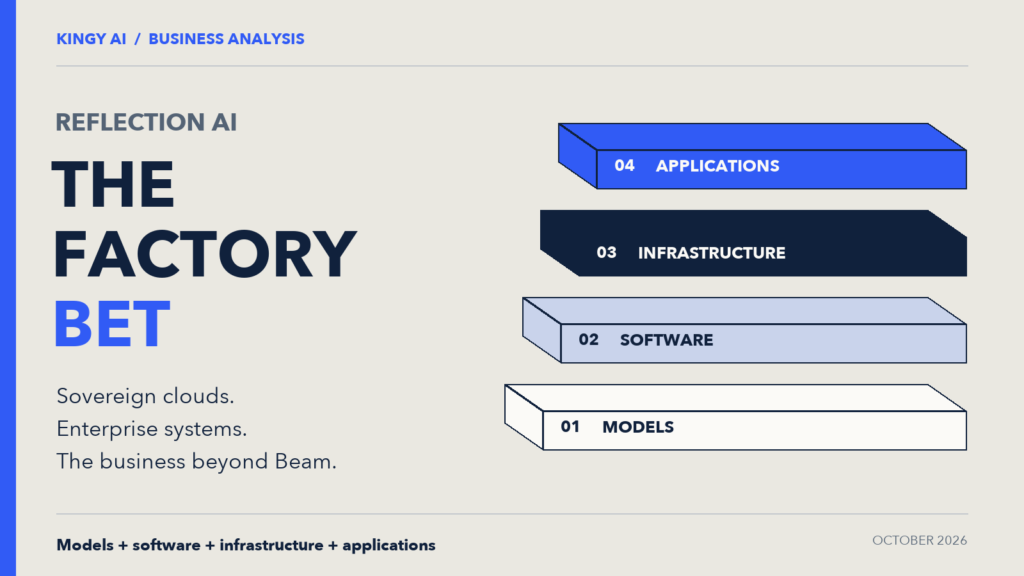
The larger wager is an AI factory: a system combining models, software, computing infrastructure and the applications an organization actually uses. Reflection wants enterprises and governments to operate AI in environments they control, with help assembling and maintaining the pieces.
For a buyer, the consequential questions concern who runs the system, how it handles proprietary data and whether it remains useful when workloads or vendors change. Our separate Reflection Beam technical guide covers specifications, benchmark comparisons, API limits and hardware. This analysis examines the business built around it.
What Reflection means by an AI factory
Reflection’s enterprise offering describes four layers: open-weight models; open-source deployment and customization software; infrastructure; and a team that works with customers to build applications. Its sovereign offering extends the pitch to national infrastructure and domestic AI capability.
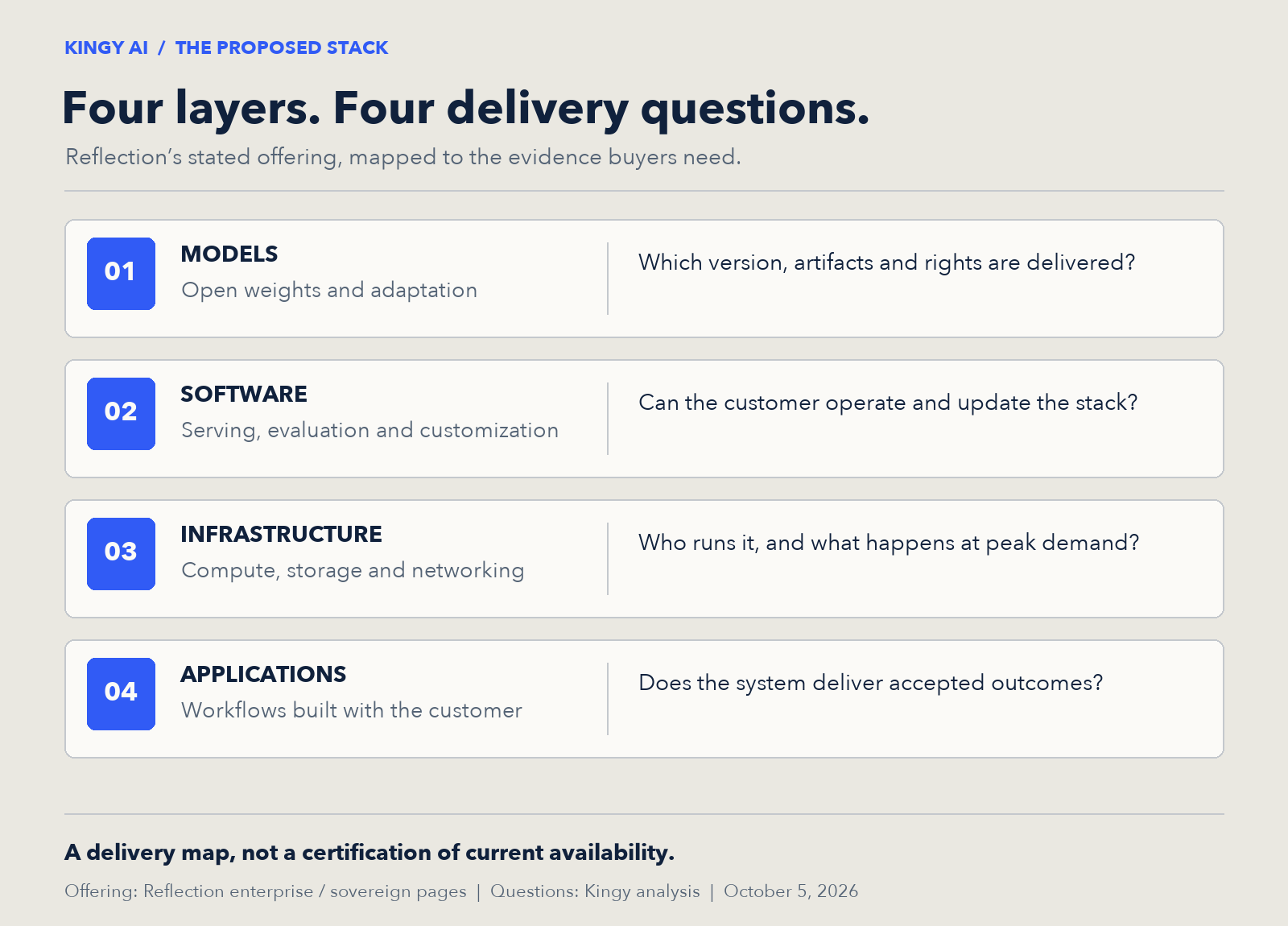
Consider a manufacturer that wants engineers to search maintenance records and draft repair instructions. That is a hypothetical use case. The model supplies language capability. The application retrieves the right documents and checks access. The serving software manages requests. The infrastructure supplies computing capacity. A useful answer depends on all four working together.
Selling that complete system could give Reflection work beyond supplying model calls: integration, customization, deployment and ongoing support. The public pages establish the offering, but do not establish its revenue mix or margins. We should judge the proposed business through the services delivered and the terms attached to them.
The attraction is a single team responsible for bringing the system into operation. The difficult part is making that responsibility clear. A customer still needs to know who fixes a failed connector, who approves a model update and who carries the cost when demand exceeds the planned capacity.
Sovereign AI requires several kinds of control
Reflection argues that open weights give a country durable access to its model and allow local teams to adapt it to national languages and institutions. Its sovereign page also describes working with infrastructure partners on data centers, GPUs, networking and storage. Those are the company’s stated capabilities and objectives. Source: Reflection’s sovereign offering.
Our reading of the pitch is that sovereignty has to be demonstrated at several levels. A data center’s address answers where hardware sits. It does not, by itself, answer who can administer the service, whether an external dependency is required or how a customer leaves the arrangement.
| Kind of control | What a buyer should establish | Why it changes the decision |
|---|---|---|
| Data | Where prompts, documents, logs and backups go; who can access them. | Local inference is only one part of the data path. |
| Model | Rights to retain, run and adapt the delivered weights. | Continued use needs both usable artifacts and clear rights. |
| Operations | Administrator access, update procedures, monitoring and recovery ownership. | Control has to survive a service incident. |
| Economics | Capacity charges, support costs and responsibility for idle or excess capacity. | Visible costs still need a workable operating plan. |
| Exit | Exportable data, application configurations and a tested migration path. | Changing providers should be possible in practice. |
There is a useful tension here. Reflection offers integration to reduce the work customers must do themselves. Customers seeking control also need enough documentation and expertise to operate without indefinite dependence on that integration team. A strong offering would make those two goals compatible.
South Korea is the clearest test of the factory plan
On March 16, 2026, Reflection and Shinsegae Group announced a memorandum of understanding for a Korean sovereign AI cloud. Their joint release describes a 250-megawatt AI factory, intended to serve enterprises and public agencies using Reflection models and NVIDIA GPUs. Source: the joint announcement.
The announced division of work is revealing. Reflection would provide technical expertise, including chips, models and engineering. Shinsegae would handle physical infrastructure, real estate, power, permitting and financing. The partners describe a phased project.
That division shows how much sits outside model research. Securing a building and power supply, installing hardware and operating a dependable service are separate delivery jobs. Progress in one does not automatically settle the others.
The source establishes the agreement and intended scale. It does not establish that 250 MW is operational today. The capacity figure describes a planned facility; it says little about a specific customer’s application performance.
The next useful evidence would be commissioning milestones, capacity available to customers, service terms and measured results from local workloads. Those would show whether the project is becoming an operating platform that Korean organizations can use.
Dell and Genesis give the strategy other routes to market
The Korean proposal is one route. Reflection also has a path into existing enterprise infrastructure. In its May 2026 AI ecosystem announcement, Dell described collaboration to bring Reflection models on premises through Dell AI Factory, integrated with Dell AI Data Platform. Reflection’s current enterprise page says it is validated on Dell AI Factory with NVIDIA.
For Reflection, that route could reduce the burden of selling every hardware and software component itself. For an enterprise already using Dell infrastructure, it may offer a familiar deployment channel. Those are implications of the collaboration, not measured sales or deployment outcomes. The announcements do not supply a Beam-specific customer performance result.
The Genesis Mission Consortium’s member directory also lists Reflection. Reflection says on its enterprise page that it is providing models to the Department of Energy’s Genesis Mission. Membership confirms participation in the ecosystem; it does not establish deployment across every national laboratory, contract value or scientific results.
These channels matter because a model company has to reach organizations with data, budgets and operational requirements. Partner access can help. The evidence that would establish commercial traction is narrower: delivered deployments, repeat use, renewals and documented outcomes.
The compute agreements put scale behind the ambition
On July 14, 2026, Reuters reported that Reflection had signed an agreement worth more than $1 billion for computing capacity from Nebius, including access to NVIDIA chips. It followed a June compute arrangement with SpaceX. Source: Reuters, republished by Investing.com.
These agreements address access to computing resources for developing and running models. They are distinct from the proposed Korean facility and from the infrastructure a particular customer might operate. Combining them into one supposed project cost would misdescribe the announcements.
NVIDIA also named Reflection among the founding members of its Nemotron Coalition in March. The coalition concerns collaboration on open models. It supplies evidence of ecosystem participation, while leaving Beam’s performance and customer demand to be assessed separately.
The strategic consequence is a large obligation to turn computing capacity into useful work. Access to GPUs allows research and service delivery. Sustainable demand requires organizations to keep using the resulting products. We cannot infer profitability, utilization or the cost of serving an enterprise from a contract headline.
Open weights change the bill; utilization determines the result
Reflection’s enterprise page argues that customer-operated open models replace an external per-token margin with infrastructure costs the organization can observe and optimize. That is its economic pitch. Whether the trade pays off depends on how much useful work the system performs for its complete cost.
In a simple operating model, that cost includes hardware or capacity rental, energy, storage, networking, software, support and the people running the service. Failed tasks and human corrections consume resources too. Some of those costs remain when the system is quiet.
Our analysis is that predictable, sustained demand is the strongest setting for testing this proposition. A well-used deployment has more completed work over which to spread its fixed costs. An intermittently used cluster can leave an organization paying for capacity that produces little value. Actual contracts, hardware choices and workload measurements determine the comparison.
A buyer should measure cost per accepted business outcome. For an internal knowledge assistant, that might mean an answer a reviewer approves with valid supporting documents. For a service workflow, it might mean a case resolved accurately without extra handling. Tokens processed are a resource measure; the organization purchases useful work.
Beam’s efficiency claims are relevant to that calculation, but they cannot supply a complete enterprise business case. Our technical guide explains the scope of the compute estimate. The factory comparison needs measured throughput, uptime, utilization, integration effort and support costs as well.
Six questions an enterprise buyer should put in the proposal
A credible proposal should turn the broad promise of control into deliverables that can be checked. These questions follow from the public strategy; they do not assume Reflection has already satisfied them.
- What is available for this deployment? Identify the model version, delivered weights, license, supported software and access status. A preview account is different from a supported local installation.
- Who owns each operating task? Name the teams responsible for connectors, permissions, updates, incident response and recovery. Include the support period and response commitments.
- Where does every copy of the data go? Map inference, retrieval, logs, telemetry, backups and any remote administration. Test the required operating environment rather than relying on its label.
- What happens at expected and peak demand? Measure latency and acceptance on representative work, including long requests, concurrency and failed attempts. Specify capacity and expansion terms.
- What does the full service cost? Compare infrastructure, integration, support and human review over the same period and workload as the alternative. Report cost per accepted outcome.
- Can the customer operate and leave independently? Request documentation, export formats, model substitution procedures and a practical test of the migration path.
What would make the strategy convincing
Reflection has connected a model roadmap to infrastructure agreements and enterprise partnerships. Beam’s October preview gives buyers something more specific to evaluate. The promised weights release is the next immediate milestone because local operation is central to the factory proposition.
After that, the strongest evidence will come from operating systems: Korean infrastructure reaching service, enterprise deployments with clear ownership, and customer workloads that achieve acceptable results at a sustainable cost. A partnership announcement can establish intent. An operating deployment can establish what the customer receives.
Our judgment is that Reflection has a coherent commercial proposition for organizations that want greater control and need help exercising it. Its case will strengthen when those organizations can verify delivery, economics and portability. That is the business test Beam now makes possible.
Sources and reporting scope
Sources checked October 5, 2026. Company and partner announcements establish their stated plans and relationships. The interpretation of control, operating costs and buyer requirements is Kingy analysis. We have not independently audited the Korean project, enterprise deployments or customer economics.
- Reflection: Beam announcement and release sequence.
- Reflection: enterprise offering and listed collaborations.
- Reflection: sovereign AI offering.
- Reflection and Shinsegae: March 16 Korean AI factory memorandum.
- Dell: May 2026 AI ecosystem collaboration.
- Genesis Mission Consortium: member directory.
- Reuters via Investing.com: July 14 Nebius compute agreement.
- NVIDIA: March 16 Nemotron Coalition announcement.
Continue with the model: Reflection Beam: Specs, Benchmarks, API Limits and Our Verdict.
The Kingy Brief
Get future Kingy Brief editions.
Source-checked AI changes, original tests and one practical thing to try.
Free · Choose your subjects · Double opt-in · Unsubscribe anytime
Regular sending is paused; no restart date is set.