Sources checked October 1, 2026. Kingy.ai has not run a matched hands-on test of these two models. Benchmark figures below come from the named evaluators; request costs are our calculations.
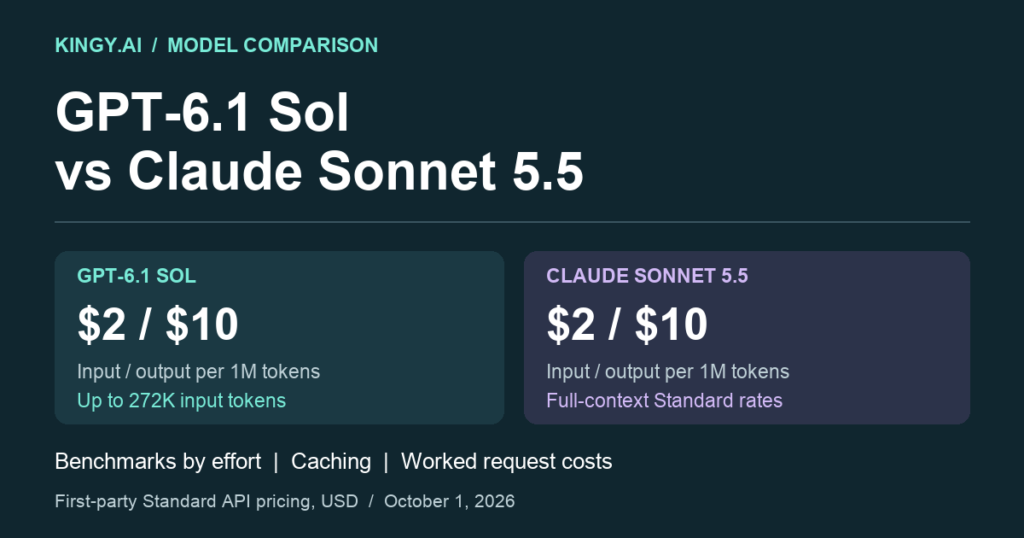
GPT-6.1 Sol and Claude Sonnet 5.5 both start at $2 per million input tokens and $10 per million output tokens. That makes them look interchangeable on a pricing card. Their published results and billing rules give you several reasons to choose differently.
My starting recommendation is GPT-6.1 Sol for repeated coding and agent tasks where you can keep context under its long-input threshold. Claude Sonnet 5.5 deserves a close look for large, uncached document bundles, and for work that benefits from its higher Max-effort benchmark score. The tables below explain why I would test them in that order.
The version matters. Our earlier Claude Sonnet 5.5 vs GPT-6 Sol comparison covers the previous Sol release. This article compares Sonnet with GPT-6.1 Sol, using current documentation and fresh independent results. For the full OpenAI release breakdown, see our GPT-6.1 Sol specifications, benchmarks and task-cost guide.
Where I would start
| Your workload | First model to evaluate | Why |
|---|---|---|
| Repeated coding or tool workflows with a reusable prompt prefix | GPT-6.1 Sol at Medium or High | Stronger independent index results at those settings, lower measured index costs, and cheaper short-context cache reads |
| A large uncached request above 272,000 input tokens | Claude Sonnet 5.5 | Standard token rates continue across its full context window |
| A difficult task where quality matters more than token spending | Both, including higher effort | Sonnet leads the independent index at Max; your acceptance checks must establish whether the extra work helps |
| A product where users wait for a streamed answer | Claude Sonnet 5.5, then a timed comparison | Higher measured token-generation throughput; complete-job latency still needs testing |
These are starting points. A migration earns its place when it improves accepted results, turnaround time or total cost on your own work.
Specifications and controls
Both models accept text and images and produce text. Each provides enough context for substantial source material, but the published context limit is a capacity limit. It does not establish whether every relevant detail will survive a long document analysis.
| API specification | GPT-6.1 Sol | Claude Sonnet 5.5 |
|---|---|---|
| Model ID | gpt-6.1-sol |
claude-sonnet-5-5 |
| Context window | 1,050,000 tokens | 1 million tokens |
| Maximum standard output | 128,000 tokens | 128,000 tokens |
| Native input → output | Text and images → text | Text and images → text |
| Knowledge cutoff | April 30, 2026 | June 2026 |
| Default API reasoning effort | Medium | High |
Sources: OpenAI model documentation and Anthropic model documentation. OpenAI separately caps input at 922,000 tokens. Anthropic also documents a 300,000-token output beta for Message Batches; the table uses the standard output limit.
Sol supports Low, Medium, High, Xhigh and Max. None and Minimal are unsupported. For tool calling, use OpenAI's Responses API; its Chat Completions support for this model excludes tool calling. A model-name replacement alone can therefore break an older integration. The Sol model page spells out those restrictions.
For Sonnet, Anthropic recommends Medium for well-specified agentic coding, with High for harder or longer tasks. Its API default is High. Xhigh and Max should earn their extra consumption in your evaluations. The effort guide also explains that thinking consumes the output budget even when that thinking is not returned to the user.
An effort label is a control within a model. High on Sol and High on Sonnet do not promise equal reasoning tokens, equal compute or equal time.
Independent benchmarks change the answer by effort
Artificial Analysis publishes Intelligence Index v4.3.2 results for both models at multiple effort levels. Here is the October 1 snapshot, using the exact configurations linked in each row.
| Effort | Sol index score | Sonnet index score | Sol cost per index task | Sonnet cost per index task |
|---|---|---|---|---|
| Medium | 48 | 41 | $0.21 | $0.59 |
| High | 50 | 47 | $0.32 | $1.08 |
| Max | 52 | 56 | $0.72 | $7.62 |
Sources: Sol Medium, Sonnet Medium, Sol High, Sonnet High, Sol Max, and Sonnet Max.
The Sonnet entries use Artificial Analysis's Adaptive Reasoning configuration with Default Fallback. These figures describe that complete configuration. A deployment with fallbacks disabled would need its own evaluation.
At Medium and High, Sol has the higher index score and lower index task cost. At Max, Sonnet has the higher score. Its displayed task cost is about 10.6 times Sol's in that particular evaluation mix. This makes Sol a strong candidate for a team trying to meet a quality target within a budget.
The default settings tell another useful story. Sol's API default, Medium, scores 48 at $0.21 per index task. Sonnet's API default, High, scores 47 at $1.08. Those are different effort configurations, so this is a comparison of available defaults, rather than a controlled comparison with equal reasoning budgets.
The index combines ten evaluations spanning agentic work, coding, knowledge and document reasoning. A score of 56 is an index value, not a 56% task success rate. Its cost metric is a weighted calculation using token consumption, provider prices and typical measured cache hits. It includes reasoning, answers and cache operations; it is not a fixed price to finish your next job. See Artificial Analysis's methodology.
For a coding team, the next useful question is whether the model produces a patch you would merge. For a research team, it is whether the deliverable cites the correct evidence and survives fact-checking. The composite index helps choose candidates for those tests.
Speed requires two measurements
In the same snapshot, Artificial Analysis lists Max-effort output generation at 64.0 tokens per second for Sol and 138.8 for Sonnet. Its Sol page and Sonnet page support a clear Sonnet advantage in generation throughput.
A faster token stream can still take longer to finish a task if the model thinks longer, produces more output or takes more tool turns. Record both time to the first useful answer and time to an accepted result. Include retries and the time spent repairing the output. Readers care about when the work is usable.
Keep launch claims separate from a direct comparison
Anthropic's Sonnet 5.5 launch report includes strong coding results, including 70.6% on Terminal-Bench 4.0. Its FrontierCode comparison names GPT-6 Sol, and some other coding charts use GPT-5.6 Sol. Those results do not establish a win over GPT-6.1 Sol.
I would use those provider-reported results to choose tasks for an evaluation, and the current model configurations above to compare this pairing. Anthropic links its system card for the launch evaluation details.
If Opus is also on your shortlist, see our Sol vs Opus 5.5 comparison.
API prices match until caching or long input changes them
All rates below are USD per million tokens, using first-party Standard pricing. Subscription access and partner-cloud pricing are separate.
| Token category | Sol: input ≤272K | Sol: input >272K | Sonnet: full context |
|---|---|---|---|
| Uncached input | $2.00 | $4.00 | $2.00 |
| Cache read | $0.10 | $0.20 | $0.20 |
| Cache write | $2.50 | $5.00 | $2.50 for 5 minutes; $4.00 for 1 hour |
| Billable output | $10.00 | $15.00 | $10.00 |
Sources: OpenAI API pricing and Anthropic API pricing.
Sol's higher rates apply to the full request once input exceeds 272,000 tokens. Sonnet retains its standard rates across the full million-token context. If you routinely send fresh inputs above that threshold, Sonnet has a substantial rate advantage.
Below the threshold, Sol's cache-read rate is half Sonnet's. Above it, the cache-read rates match. Your actual saving depends on which tokens hit the cache and how much billable output the model produces.
Both providers offer a 50% Batch discount on input and output. Sol also lists Flex at half Standard and Fast at twice Standard. Anthropic's current Fast-mode pricing names Opus models, rather than Sonnet 5.5. Keep the processing mode in any cost or latency comparison.
Four calculated request budgets
These examples use identical billable token counts to isolate the rates. They are hypothetical requests, with no tool charges, retries, regional premiums or cache writes. For Sol, an uncached/no-write request can use explicit-only caching without breakpoints. A cache-hit example assumes the prefix was written previously.
| Illustrative request | Sol Standard | Sonnet Standard |
|---|---|---|
| 10K fresh input + 2K billable output | $0.040 | $0.040 |
| 100K cache read + 10K fresh input + 10K billable output | $0.130 | $0.140 |
| 400K fresh input + 20K billable output | $1.900 | $1.000 |
| 900K fresh input + 10K billable output | $3.750 | $1.900 |
For the 400K case, Sol costs $1.60 for input plus $0.30 for output. Sonnet costs $0.80 plus $0.20. That is a calculated rate difference, not evidence that both models would use those token budgets or produce equally good answers.
Use the providers' returned usage counts when comparing the same source text. Tokenizers can differ. Include hidden reasoning in billable output, as OpenAI's reasoning documentation explains. Counting only the answer visible on screen understates the bill.
Repeated prompts need a cache plan
Sol's cheaper cache helps most when you reuse a substantial, unchanged prefix. OpenAI enables implicit caching by default and also supports explicit breakpoints. Sol's minimum cacheable prefix is 1,024 visible tokens, and cached prefixes remain eligible for at least 30 minutes after the most recent write or reuse. Matching content and routing still determine whether a request receives a hit. See OpenAI's prompt-caching guide.
Anthropic supports automatic caching through a top-level cache_control field and explicit block-level breakpoints. Sonnet's minimum cacheable prefix is 512 tokens. Its default lifetime is five minutes, refreshed on reuse, with a paid one-hour option. The lifetime starts when the request starts, so a long streaming response consumes some of that window. See Anthropic's caching guide and Sonnet's model notes.
Consider 20 requests with a shared 100K-token prefix, 2K fresh input and 5K billable output each. Write the prefix once, then assume 19 complete hits. Keep the changing suffix outside the cache-write breakpoint, and start every Sonnet reuse within five minutes of the preceding write or read.
Calculated total: $1.52 for Sol and $1.71 for Sonnet. For either model, processing the whole input uncached, without writes, would cost $5.08. The first cache write costs $0.25 on both; later prefix reads cost $0.01 on Sol and $0.02 on Sonnet per request.
Most of the saving in this example comes from successfully caching the prefix. Sol's extra saving is $0.19 across the 20 requests. A missed cache or a few extra output-heavy turns can matter more than that rate difference. Measure hits before forecasting savings.
API economics and app access answer different questions
OpenAI's current rollout documentation places GPT-6.1 Sol in Work and Codex. The launch rollout includes Plus, Pro, Business, Enterprise and Edu in Codex desktop/CLI and Work web/mobile. Free and Go are excluded at launch; Enterprise and Edu require an administrator to enable it. It is not available in Chat. Standard and Fast are available, with Ultrafast forthcoming.
Anthropic's launch announcement places Sonnet 5.5 in Claude apps and its developer platform. Its model documentation also lists supported cloud platforms. Choose the product and workflow you will actually use: an API rate calculation does not reveal how many tasks a subscription includes.
If you are building around account access, our Sign in with ChatGPT guide covers supported integrations and shared usage. For continuing work from mobile, the Codex Cloud guide covers that workflow. Those product choices can affect convenience without changing which underlying model passes your checks.
Run a small comparison before switching
Take 10 to 20 real tasks from the work you intend to automate. Include routine jobs, difficult jobs and a few cases where the current system has failed. Keep the source material, tool access and acceptance criteria consistent.
For coding, require the fix to reproduce the issue, pass relevant checks and stay within scope. For document work, require source references, correct arithmetic and explicit handling of missing evidence. Have someone review the deliverables without seeing the model name where practical.
Start with Sol Medium and Sonnet Medium for well-specified agentic tasks, then raise effort on the cases that fail. Also test Sonnet High if that is the default your application would use. Give both enough output budget to finish and record the exact configuration, including fallback behavior.
For each configuration, record accepted results, total billable spend, completion time, retries and human repair time. Calculate cost per accepted result as total spending on all attempts divided by the number that pass your checks. Keep repair time visible alongside it.
Choose the lowest-cost configuration that meets your quality and turnaround requirements. Recheck the failed cases before increasing effort across every request.
Trending on Kingy
Keep reading with the stories getting the most attention now.